
If you’ve been watching Saki like me, you may have been impressed with the sheer improbability of many of the characters’ playing styles. If you’ve been playing mahjong along the way too, you may have lamented that you’ll probably never get any of the mega hands that seem to flow like water for Saki characters.
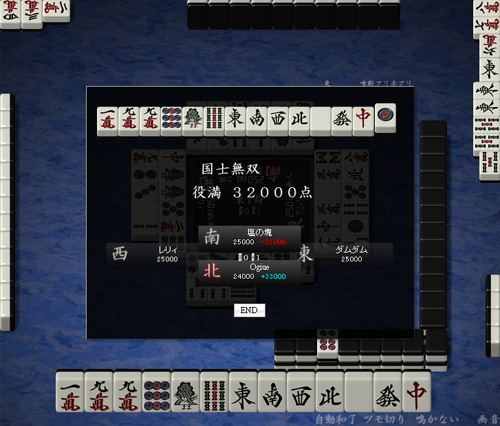
I was like that too, until yesterday when I scored one of the rarest and most difficult-to-achieve hands in the game: Kokushi Musou, also known as 13 Orphans. The hand was so powerful it knocked out one of my opponents in the first round and ended the game instantly. At this point, I almost feel as if I should just stop playing and leave on that very, very high note.
For those of you who know mahjong and are probably much better players than I am, you already know the score. For those who don’t, to properly understand the sheer improbability (there’s that word again!) of a Kokushi Musou hand, I’m going to try to explain it in a way that doesn’t require you to know the rules of mahjong.
Normally in mahjong, you win by having straights and/or three-of-a-kinds as well as a single pair. Most of the hands in mahjong are like this. Kokushi Musou however, cannot be anything but a Kokushi Musou, as the hand actually consists of one pair and then 12 other completely incongruous tiles.
First, what this means is that it is impossible to call on discarded tiles. You may have seen it in Saki or Akagi, where when one player discards a tile another shouts, “Pon!” or “Chi!” or “Kan!” and takes the tile. They are making something, either a three-of-a-kind or a straight or a four-of-a-kind, out of what the opponent had. However, because Kokushi Musou cannot have any straights or three-of-a-kinds, let alone four-of-a-kinds, you cannot call on any tiles without abandoning the attempt to achieve Kokushi Musou. This also means that in order to win, you must draw every necessary tile on your own until your hand is ready to win.
Second, is that while there are other hands which pay just as much as a Kokushi Musou, they usually have a way out, where if the plan to score big fails they can try and fall back on a lower-scoring hand. Kokushi Musou however has no built-in escape routes. If it turns out the tiles you need for Kokushi Musou are 100% unobtainable, then you’re pretty much hosed for the round and you can mount a desperate attack or retreat at best, or you have all the tiles people need to win at worst, which is likely.
Kokushi Musou is called a “Yakuman” hand, essentially an ultimate high-scoring hand. There are also “Counted Yakuman,” where a hand, while not considered one of the Royal Flushes of mahjong, consists of enough high-scoring hands and bonus points to essentially become a Yakuman, not unlike five vehicles combining into a single mighty robot. This Kokushi Musou is my first and only Yakuman ever.
 OGIUE MANIAX
Grats :) Thanks for the explanation.
Great article, as always.
LikeLike
Interesting stuff, and I actually understand a tiny bit more about Mahjong as a result of reading this!
I guess the big question is whether your room filled with water or lightning shot forth from your hands and/or eye as you pulled off this spectacular feat? ;)
LikeLike
I know a little bit about mahjong – enough to say congratulations!
Am I reading it correctly that your opponent in the South tossed the 1 of Coins? How long had you been waiting for that tile?
LikeLike
I wasn’t waiting very long, actually. It came in within a few turns of my declaring riichi.
LikeLike
Because of Akagi I tried mahjong a while ago and got three of each winds only after a couple of plays. I still don’t understand the rules fully and give up on playing, but that looked nice :D
LikeLike
‘grats on the kokushi musou! My first yakuman was dai san gen, which is just classically badass.
LikeLike
I know nothing about mahjong, but I could understand how amazing that hand is. Nice post.
LikeLike
Why’d you even call riichi?
LikeLike
Cause it’s awesome.
LikeLike
So called riichi on a single wait? Unless you were waiting on a pair.
LikeLike
Pingback: Got a Self-imposed Mahjong Goblin Off My Back « OGIUE MANIAX
Pingback: Konya wa Hurricane « OGIUE MANIAX
Pingback: Four Concealed Triples Contain Ten Times As Many Perils « OGIUE MANIAX