Libido Limbo: The Climax of Spotted Flower

For nearly seventeen years, Kio Shimoku’s Spotted Flower has been a uniquely thrilling and terrifying rollercoaster of a manga. The series defies easy categorization: It’s very much a drama featuring otaku, but even more an exploration of varying sexual dynamics and relationship types. While cheating becomes a major plot point in the series, it’s not the fetishized NTR kind, albeit the series does delve into plenty of fetishes in general. What began as a tongue-in-cheek, off-brand Genshiken romantic what-if proceeded to transform over time into an increasingly complex and sprawling web of a relationship chart that ensnared and entangled its characters.

Now, Spotted Flower has ended—or at least the physical magazine in which it was serialized has come to an end. There seem to be some vague rumblings about its future, but there’s no word yet. And I am going to spoil the final (?) two chapters 50 and 51 immediately, because 1) I bet anyone who’s read it over the years is curious, whether morbidly or otherwise, and 2) it acts as an important preface for the rest of what I want to discuss.

The Finale

When last we left off in Chapter 49, everything seemed to come home to roost for its protagonist, the Husband (i.e. Not-Madarame). His Wife (Not-Kasukabe), fully aware of his act of infidelity, gives him an ultimatum: Get hard or get out. It’s also important to note that despite his getting railed by their genderqueer friend Asaka-sensei (Not-Hato) in the past, the Husband remained flaccid during that act, which is one of the reasons the Wife has even given him a chance to redeem himself. 

Chapter 50 focuses entirely on a conversation between the Husband and the Wife. She recalls in the present the events that first truly brought them together: a discussion over drinks where she brought up the time he was confessed to by a bunch of the girls (just like in Genshiken Nidaime). She admitted to feeling relieved that he didn’t choose anyone, and from there convinced him to get a hotel room. In the present, the Husband expresses his frustration that he honestly wants badly to get an erection, but it just doesn’t seem to be happening. The Wife, rather than getting fed up, tells him they have plenty of time, and goes to sit down. 

However, when she goes to sit down, the moonlight hits her hair in such a way that it reminds him of her younger self (back when she dyed her hair), and something sparks inside the Husband. He even goes as far as having her roll up a fake cigarette, and this image of the past she’s inadvertently presenting gets him to talk about just how much he used to masturbate to her, and that he started since the very first day they met. While the Wife is not a fan of how very detailed the Husband is about describing his past fantasies, the results can’t be denied, and she notices that he’s downright throbbing down there. 

Chapter 51 then winds up being 33 pages of explicit scene of the two going at it hot and heavy, interspersed with scenes of the rest of the old club discussing whether or not they were basically a “sex club” in practice (probably not, but it’s difficult to discuss over the moans of the other two), and then the boys all getting together to play fighting games. I would very much like to share even a single page from this chapter, as the images of sex juxtaposed with dudes having some (actually) innocent nerd fun is quite striking, but I would end up having my Patreon age-restricted. 

Thoughts (and Many of Them)

The Husband has rediscovered his libido and deep lust for his Wife. What began as a pseudo spin-off about a horny pregnant woman trying to get her man hard became a story about feelings of male inadequacy, only to loop back to the original premise. All’s well that ends well, right?

And yet, the journey to get here was so tumultuous that some readers (according to online comments) jumped ship partway through. It became too difficult to continue reading Spotted Flower, as the darkness and betrayal began to ruin Genshiken for them in the process, despite it being “non-canon.” Madarame and Kasukabe was a popular fan pairing that didn’t pan out in Genshiken (Madarame ends up with Sue), at least among Genshiken diehards, and it was like their consolation prize was a poison pill. The fact that Kio kept introducing more character analogues only served to create a sense of doubt about the intentions of the story: What if this is the actual Genshiken canon, and we were all played for fools?

I also believe that there’s another factor compounding all this: We increasingly live in a time when feelings about NTR/cuckolding/cheating in general have become more extreme. I personally don’t prefer it as a genre, nor do I think it should be outlawed or anything, but what I have also seen is that a complicated mix of emotions related to fetishes, fear of emasculation, and moral panic has left us in a state where things like “girl dates one guy over the other” is incorrectly described as “cucking.” While I highly doubt that most of the people obsessed with these labels were reading a manga as obscure as Spotted Flower, and the series literally came out over 15 years ago in a rather different period culturally, it is certainly a manga that doesn’t consider vanilla monogamy to be a sacred cow. 

But as it turns out, Spotted Flower isn’t just a series that inflicts pain, either in a malicious or sadomasochistic NTR sort of way. Instead, it is a disorganized world of adults who all have their own types of relationships where some are monogamous, others sleep around, and others are engaged in some form of polyamory or another. And here’s another messy outcome, where the Husband disastrously cheats on his spouse out of a sense of inadequacy, only to end up rediscovering his lust for her amid social pressure from friends and acquaintances. The Wife, meanwhile, has to actually forgive him and give him this chance in the first place. We see not a defense of cheating or an encouragement of it, but ultimately a marriage that has been rocky. I won’t necessarily say it’s “realistic,” but it’s the kind of relationship you rarely see in manga. 

(And if you want that kind of hurt, read Kio’s Gonensei instead.)

That all said, I understand that most series that bring up cheating—and have it actually happen—don’t finish on a happy note. One can even argue that both Genshiken and Spotted Flower “copped out” by giving Madarame and his doppelganger a relationship at the end, but I don’t see it that way.

Not every plot thread is fully resolved, but I’m satisfied by where they leave off. The Wife’s Ex-Boyfriend (Not-Kohsaka) still seems to have some unrequited feelings for the Editor. Yet, it almost seems like what he was really missing in his life (and what he was trying to find with all his philandering) was that friendship and camaraderie from the old days, given that he was the one who kicked off the fighting game session. Most of the other couples seem happy where they are.

As for Ogino-sensei (Not-Ogiue) and her two spouses, a supplemental chapter released online continues teasing at the possibility of a real threesome—this time by having Ogino suggest that if both her and her Assistant fiancee (Not-Sue) have kids with her Editor fiancee (Not-Sasahara), the two girls can share a connection by having their children be related. Sure, why not.

Closing Comments

A part of me can’t believe that I started writing about Spotted Flower almost two decades ago, and we’re only finally seeing it ride off into the sunset. Sure, a lot of that is due to the very slow release schedule, but so much has happened in my life since that first chapter came out. I literally moved to Europe and back, had multiple jobs, got married, and went through a hopefully once-in-a-lifetime pandemic (during which Kio himself started posting on social media). In a way, I’m more attuned to the maturity of the series than ever before, even if I can’t relate to the specific circumstances of the characters. 

It’s been a wild ride, everyone. Hope to see you for the next nerd life milestones.

Large Friends, Bigger Comrades: Tojima Tanzaburo Wants to Be a Kamen Rider

When the anime for Tojima Tanzaburo Wants to Be a Kamen Rider was announced, I didn’t realize it was based on a manga by one of my favorite authors, Shibata Yokusaru. Previously known for works like the martial arts battle series Air Master!! and the bizarrely wonderful shogi title 81 Diver, Shibata is a master of mixing absurd comedy with excitement and tension. So even though I’m not a particularly big tokusatsu head, I had every reason to check out this show. 

The story: Ever since childhood, Tojima Tanzaburo has carried a burning passion for the original Kamen Rider, and he’s dedicated his entire life to becoming as strong as its titular hero. But while he’s built up his strength and martial prowess to an almost superhuman degree, Tojima is profoundly saddened by the fact that he can never use it to fight Shocker—the villainous organization from the TV series. However, when a string of robberies occur by thieves dressed like Shocker’s minions, this might finally be his chance to make his dream home true. Only, he’s not alone, and it turns out there are other Kamen Rider super fans who have decided to emulate their favorite heroes.

One of the beautiful things about Tojima Wants to Be a Kamen Rider is the juxtaposition between fandom as a catalyst for achieving greatness and fandom as a delusion that weighs people down like an anchor. Tojima really is “training to beat Goku,” so to speak, and the result is a guy who manifested the highly choreographed and predictable fighting style of Hongo Takeshi into reality. All he does is throw the same punch over and over, but he is the embodiment of the classic Bruce Lee line, “I fear not the man who has practiced 10,000 kicks once, but I fear the man who has practiced one kick 10,000 times.” 

However, he also encounters Kamen Rider fans who have actually trained in real martial arts, and the difference in technical skill becomes a point of friendly yet intense competition. In other words, Sometimes being the biggest dork is the greatest superpower, and sometimes it just isn’t. The characters are essentially doing the most deadly serious LARP ever—one they’re convinced is as real as their own flesh and blood. Over the course of the series, this belief spreads out to more and more characters, developing in unexpected ways.

There’s one curious thing that immediately stands out with this anime adaptation: The characters and artwork are generally good, and that is totally not what Shibata’s art normally looks like. He has a very off-kilter sense of perspective and human proportions to the point of looking beyond amateurish, and the anime makes a firm decision to mostly hew away from that. I could understand the desire to make this change, but I did worry that it would lose some of the heta-uma magic that I so adore in Shibata’s manga. The solution is that the Shibata style comes out in certain moments, such as in characters’ exaggerated expressions or for the sake of comedy. It’s a decent compromise.

One last note: Tojima Tanzaburo Wants to Be a Kamen Rider makes a brief reference to Air Master. If we get more anime, I’m hoping to see 81 Diver get some love too.

Orangey Orange, Grapity Purple: Drawn to Dawn Concert Review

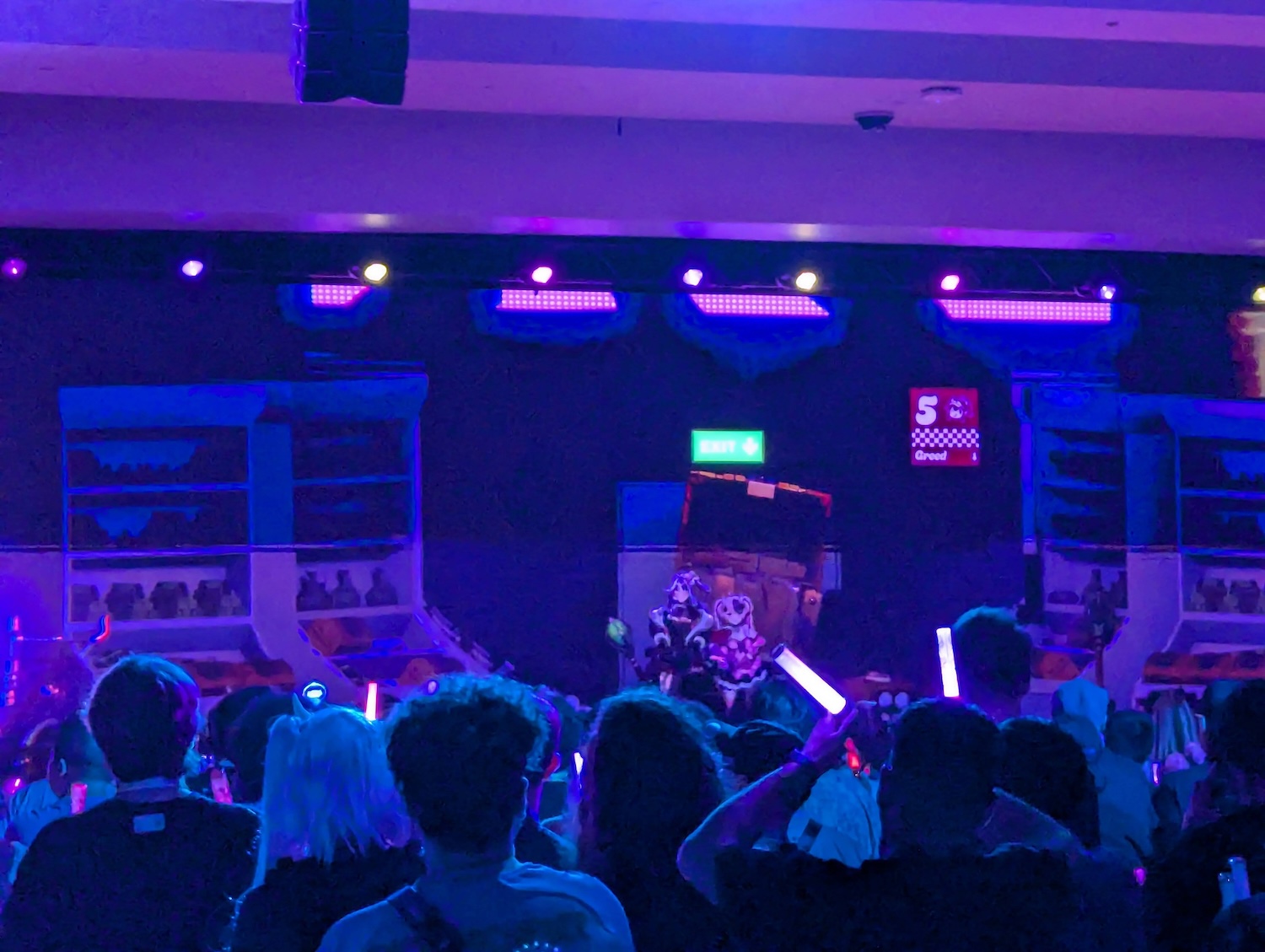
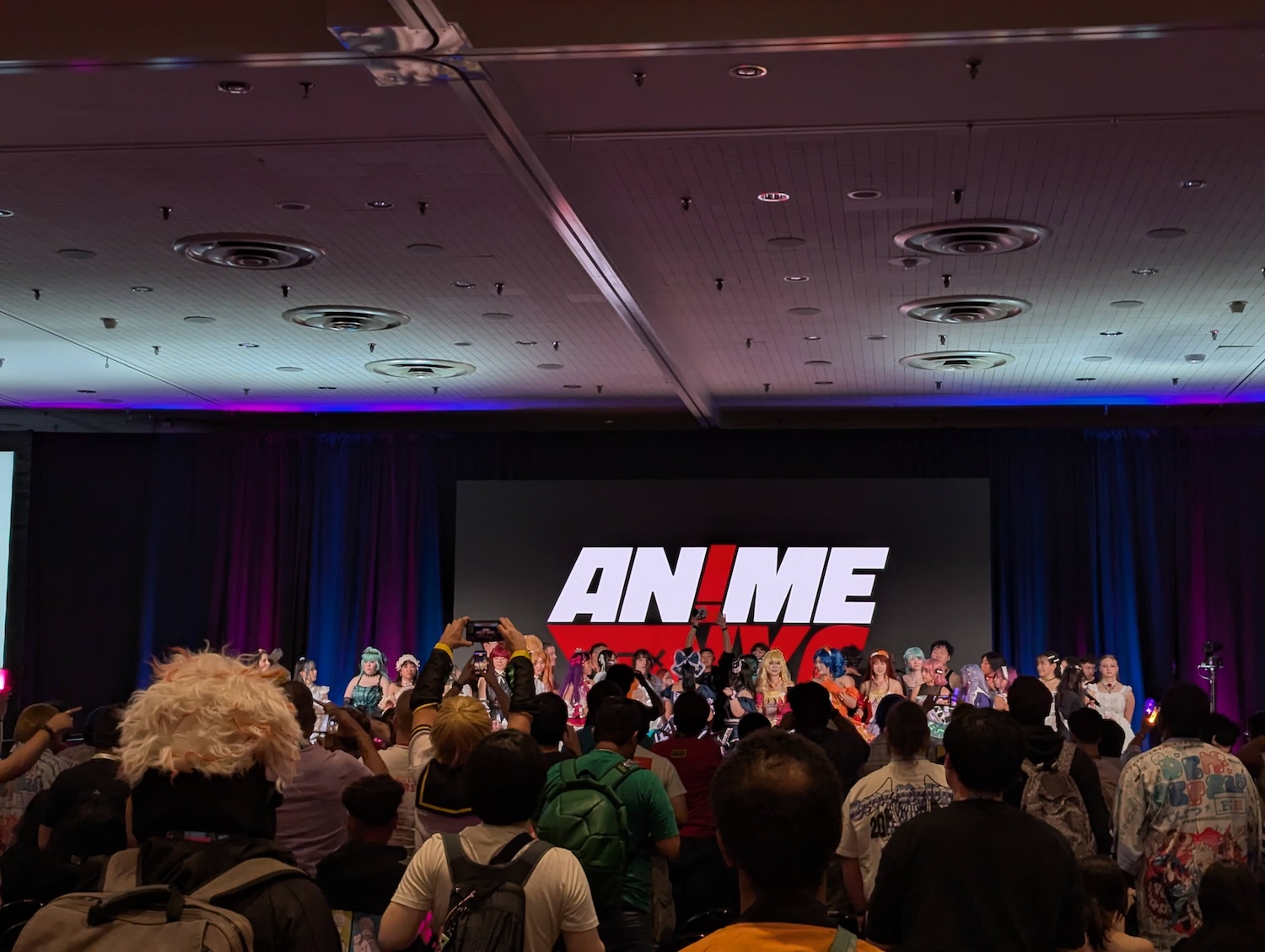
“Solo live.” “Duo live.” Whatever you call it, Drawn to Dawn was something special. An in-person VTuber concert at the Wiltern in Los Angeles held on March 27 and 28, the event featured two of the founding members of hololive English: the spirited phoenix diva Takanashi Kiara and the low-key eldritch priestess Ninomae Ina’nis. While both have years of experience performing in front of a live audience, they also have never had the spotlight dedicated to just them. They join their gen mate Calliope Mori in being among the few EN talents to star in concerts of this kind.

And in the months leading up to the event, I kept waffling between excitement and buyer’s remorse.

While I greatly admire and support both Kiara and Ina, I’m also nowhere near being the most diehard fan of either. Was I denying a bigger KFP or Takodachi the opportunity of their life? Was I spending my money wisely, given the cost of tickets and overall travel expenses? Was I really going all the way to LA just to do this? The doubts lingered, but one thing I told myself was that if ever there was a time to show my appreciation for these Myth girls, this was it.

I’ve seen my fair share of VTuber concerts, and multiple talents typically means alternating between the performers from song to song. To my surprise, however, they instead each had their own dedicated sections before crossing over for a big finale. Kiara started for Day 1 (and thus appeared in the free preview online), while Ina opened on Day 2. The approach differed significantly from the generation-focused concerts (e.g. NePoLaBo’s and holoFantasy’s) by emphasizing them as individuals more than their identity as a group, which ended up very effectively showcasing their differences, allowing each to shine in their own unique ways and at their own paces.

Takanashi Kiara

As the owner of one of the largest discographies on the English side, Kiara has always made clear that a concert like this had been one of her dreams. However, it has been an uphill battle for her, having started in hololive at the height of the COVID-19 pandemic, and having spent the great majority of her tenure living outside of Japan. As later generations have debuted with even more stage experience than her, it felt like her star might not shine quite as brightly among the multitude. Despite these challenges, she persevered and honed her craft, and her resulting performance truly felt like she was pouring all of that passion and determination onto the stage. I have never seen Kiara move better or sound better than she did for Drawn to Dawn. 

Kiara has always had the most “pop star” energy of her generation, and her setlist embodied that. Every single one of her 20 numbers had its own unique choreography, with only a few slow enough to even arguably be considered “restful.” She even included more complex formations with back-up dancers, who themselves had newly revealed designs that took them from shadow silhouettes to full-fledged characters. And in a first for hololive, the dancers actually have two unique designs instead of just one.

Not to be outdone by her own back-up, Kiara debuted a new 3D outfit herself. It was exactly what she was wearing on the official promotional art for the concert, and also happened to be one of the best VTuber outfits I’d ever seen, both from Kiara and in general—and that’s factoring in the fact that I adore her other outfits too. (I may have a dirndl bias, though.)

It was also quite remarkable to hear her bring her current singing ability and some of the flair she uses in “Do U” and “Mirage” (one of my favorites), to her older songs, such as “Hinotori” and “Fever Night” (another favorite). And when she slowed down the tempo for “Blue and Gold,” a song dedicated to her former genmates Gawr Gura and Amelia Watson, the weight of the history they (and we) share felt palpable. 

During one of her MCs, Kiara read a letter she wrote to her past self. She recalled the time she performed in front of an audience of just one person (who wasn’t even there for her), and wanted to congratulate the younger “Kiara” on not giving up. She also brought up the development of her music style—which she cheekily called “K-pop” (short for Kiara-pop)—and the way she has shifted from a more cheerful J-idol sound to a more mature K-pop presentation. She was honest in stating that she personally prefers the former, but understood that the latter was getting her more notice, and that mix of passion, pragmatism, and bluntness is what I think draws fans to Kiara. 

I have to wonder if the rise of “Kiara-pop” simply comes from her fan base being younger than her now (whereas it would have been older than her in the past), and whether Kiara will find a way to unite the two sides of her music into something greater.

Ninomae Ina’nis

In many ways, Ina is the opposite of Kiara. With her more subdued personality, she’s known for things like her professional-level art skills, her comfy chatting style, and her love of puns. To Ina, music and stage performances have not been life-long pursuits, but rather something she has come to learn and appreciate as part of hololive. The size of her discography is only a fraction of Kiara’s, but Ina’s artistic sense comes through every time in her choice of music style and the aesthetics of each music video, and she brought that same creative unity to Drawn to Dawn.

Whereas Kiara’s staging drew most of the attention to herself and the dancers, Ina’s was almost like a series of paintings in motion. Each of her original song performances was unified by a single thematic color that reflected the contents of the song, and often its implications in both the official lore of Ninomae Ina’nis and the identity she has created with her fans. As she sang and moved about the stage, it was as if she was integrating herself into each art piece.

Ina also revealed her own new 3D outfit matching the official promotional art, which resembles something like occult priest robes but with some extra pizzazz. It was sharp and elegant, but there was an additional surprise: the robes could be removed to reveal a more casual long-sleeve and short skirt ensemble. Social media was abuzz with the comments about how her lack of high heels and somewhat larger thighs gave a different (yet welcome) impression to Ina’s appearance. Incidentally, Kiara’s thighs also seem to have been made larger, and attractiveness aside, I can’t help but wonder if this is some kind of trend. (Then again, even the original and official character designs of hololive members often don’t end up perfectly matching their VTuber models in proportions, be they 2D or 3D.)

While Ina doesn’t have a ton of range to her voice, she used it well across all her songs, especially when taking into account that all her originals are quite different from one another. “Violet” is quiet and gentle, “Meconopsis” has a heartrending and forlorn quality that I particularly love, “ “Tako Takover” is silly and hypnotic, and so on. Because she doesn’t have nearly as many songs as Kiara, she filled out some of her setlist with covers of other hololive members’.

As Ina explained in an MC section, she had no experience singing and dancing in this way prior to hololive. However, that has made her journey to Drawn to Dawn special in its own way. Rather than it being the culmination of a continuously striving performer, Ina’s path is one of new discovery and the realization of another facet of herself. Together with Kiara, they exemplify two types of idol journeys, and this juxtaposition strengthened both women’s respective approaches.

Miscellaneous

There were a few technical issues that occurred during the event. The line on Day 2 took so long that some people did not even get the chance to see the first few songs. I managed to get in on time, but only because I went around asking employees about the early entry line, and that was only because a friend reminded me that there was supposed to be early entry in the first place. Apparently some of the Wiltern workers didn’t realize that, and put everyone on the same massive line, which wrapped around the venue. 

This isn’t the first hololive concert that had issues of this kind, and I think it might come down to unfamiliarity with attendees who want to carry their entire fan collection with them. Each venue exists on its own, so we have to repeat history over and over. Day 2 was better in the sense that they just delayed the start. 

I also realized something myself. I’m actually not a huge fan of penlight stuff, especially when it’s supposed to be a detailed and coordinated choreography. When I have to make a conscious effort to do it, I end up having a harder time concentrating on the actual performers, who are my main focus. There was more than one occasion at Drawn to Dawn where I found myself fumbling to do the “right” thing and missed a dance move or accidentally zoned out. I appreciate penlight formations and all that, but I end up distracting myself. At the most, I just want to vibe along with it at my own pace. 

Speaking of penlights, one bizarre thing happened to me (and apparently a few others) during “Blue and Gold.” As per Kiara’s instructions, we were supposed to set our Penlights to Myth colors during the final chorus, and I had mine set to Gura blue and Ame yellow. Venue security actually came up to me during the song and asked me to turn off the yellow, mistaking it for an Ultra Orange glowstick. This is despite multiple Ultra Oranges being deployed by other people during the concert with seemingly no consequence. I was a little annoyed to have the moment tarnished by this interaction, but I understand that security was just trying to do its job and didn’t understand the difference—hell, I only recently learned about it in greater detail.

Final Thoughts

While I was initially unsure about whether attending Drawn to Dawn was the right decision, I don’t regret it one bit now that I’m on the other side. I enjoyed the hell out of it, and was happy to be part of something so unique. I ended up making a lasting memory and growing my appreciation for both Kiara and Ina.

At the end of each day, both girls asked the audience to quiet down so that they could shout out with their voices unmic’d. Despite some audio mishaps and audience confusion, getting to hear the fact that two of them were really and truly present with us in that concert hall is a treat I’ll cherish forever.

I Think I Finally Understand the Omegaverse

I remember being caught off guard the first time I heard about the Omegaverse, and I still feel that way. There’s what? And they get huh? And it comes from…Supernatural fanfic based on the actors?! I’s still not really my cup of tea, but I operate on a policy of “let people enjoy what they enjoy.” Still, I’ve had to wonder why exactly has it garnered such a sizable, prominent, and devoted fandom. At least, why this instead of something else?

As I was pondering that question, though, I realized something: It is both kink and world building in one. 

Plenty of erotic stories revolve around specific sexual dynamics, as well as the idea that a character’s personality (based on a canon source or otherwise) dictates how they behave in more intimate and explicit situations. Shipping is often about expanding this thought exercise to two or more characters.

But the Omegaverse takes things a couple steps further. The concept of “alphas” and “omegas” doesn’t just dictate their roles in bed but also their biological makeup, their history, and by extension the way characters move through their society. The extrapolation of sexual behavior based on personality becomes all-encompassing.

To put it differently, it’s kind of like creating a story where it’s assumed that pizza delivery people are going to get some “extra tip” by default, and the consequences of such a world. 

At least, that’s what I’ve gotten out of the idea? Perhaps I’m barking up the wrong tree.

Loose Connections: Soul of Chogokin Shinkalion E5 Hayabusa

I have a hard time believing that Shinkalion is over a decade old. It feels like just yesterday that I first saw a live suit actor performing as a train robot at an event as a precursor to the anime. But last year, the Soul of Chogokin toyline released its version of the Shinkalion E5 Hayabusa to commemorate the franchise’s 10th anniversary, so there’s indeed proof. And now I have this physical manifestation of train marketing for myself.

Only 10 years to get a Soul of Chogokin rendition is remarkably fast for any mecha series; some have needed 40 or 50, if not more. While Shinkansen Henkei Robo Shinkalion isn’t the most amazing anime ever, it’s fun and tries to bring together viewers young and old. Also, the design is pretty cool overall, and I’m glad they tackled a relatively modern mecha. That said, one of my criticisms of Shinkalion has always been that nearly all the robots across multiple series transform in much the same way and look largely similar, so it can get a bit repetitive. Just one SoC is enough, I believe.

The figure comes in shinkansen mode as two separate trains, which are then bent and contorted to become the upper and lower halves of the Shinkalion’s body. The end product makes quite a striking impression, though I need to mention that transforming it is both a figurative and somewhat) literal pain.

Upon looking at the instructions, one thing stands out: the amount of warnings about notches, pegs, and slots that can easily break off or get worn down if you’re not careful. There are also many areas that have to join together in just the right way, or else things just start falling off or risk snapping. And because the design of the Shinkalion is so spindly, there are pointy edges everywhere, and I could feel them stabbing into my thighs when I was trying to get two pieces to connect. Now that I have it as a complete robot, I probably won’t ever change it back to train mode.

I don’t own and have never touched the higher-quality figures from the original Shinkalion toyline, so I can’t make a firsthand comparison, but based on the videos I’ve watched, the SoC figure sacrifices a good deal of the playability in terms of transforming it back and forth in favor of getting closer to how the E5 Hayabusa looks in the anime. For example, the double-layered pauldrons recreate how the shoulders come together in the show’s transformation sequence, but this also means the arms have to be attached to the body in a more finicky way. Even posing it can be tricky, as pushing too hard in one direction or another can easily make a limb fall off. A delicate touch seems necessary.

However, I can’t deny that the end result looks both really sleek in a way that should be familiar to Shinkalion fans. It’s just an aesthetically pleasing robot, at least from the front. The rear view shows a lot less detail, but that’s just part of the mecha itself from its source material. I find that goofy and charming in its own way. 

I also enjoy how the lower half is mostly just one hefty piece filled with diecast metal, especially in the hip joints, as it makes for a stable and poseable figure overall. The large pieces that attach to the legs help give the figure a more pleasing silhouette.

I do have one other small criticism, which is that the instruction manual is unusually sparse. All of its space is dedicated to teaching how to transform the Shinkalion, whereas other SoC figures’ booklets will have things like a history of the original show, early drafts of the mecha design, older toys, etc. While Shinkalion is a relatively young franchise, there should still be some kind of material worth including. I’m left to wonder if this has anything to do with either the length of the instructions provided, or perhaps some kind of copyright issue.

When I look at the SoC Shinkalion E5 Hayabusa, one thing I think about is the fact that there were kids who grew up with Shinkalion, who came to it because of a love of trains or even learned to love trains because of Shinkalion. Perhaps this figure is a test of their maturity 10 years down the road—can they handle this figure now that they’re teenagers and adults? Well, provided that they have the money to buy it, of course. This thing is still a premium figure at the end of the day, and we might need another few years for those kids to have the disposable income to make a purchase like this. 

Seeing the Influence of Tsuge Yoshiharu and Nejishiki

I first learned about the influential manga artist Tsuge Yoshiharu thanks to that seminal book on Japanese comics, Manga! Manga! by Fred Schodt. In his goal of showing how diverse manga can be, Fred includes images of Tsuge’s most famous work, Nejishiki, also known as “Screw Style.” Now, thanks to Drawn & Quarterly, I’ve gotten the chance to read it in English, as well as other works by Tsuge. 

I had originally written this review with plans to eventually publish it when the time felt right, but then news came that Tsuge had died at the age of 88 on March 3. So here it is.

Tsuge’s work is hard to describe. It’s never straightforward, and each story seems to exist in the space where rationality ends and passion begins. His characters aren’t “characters” in the traditional sense, but rather agents of deep-seated desires. They’re dark and succumb to their (often sexual) vices, and feel like people who are meant to be relatable, though far from admirable. Originally published in Garo, Nejishiki has become practically the go-to example of experimental comics-making in Japan. It’s not surprising to see why Tsuge’s comics would make an impact back in the 1960s and 70s. 

What is perhaps surprising is that they can still shock today. In a sense, the changing morals and ethics of society over the past few decades make the questionable decisions all the more eyebrow-raising, as well as thought-provoking. Even putting aside the sex, violence, and sexual violence (none of which are portrayed with excessive detail, yet feel more visceral), the seeming density is haunting and reminds me more of something like the ambient moments in Serial Experiments Lain or Evangelion.

Reading Nejishiki also puts another creator in a new light for me: Panpanya. It’s clear now that the author of Invitation from a Crab and Guyabano Holiday draws from Tsuge in a big way, whether directly or otherwise. The simplistic character design juxtaposed with the detailed backgrounds, the surreal and seemingly non-sequitur stories—the big differences are just that Panpanya’s “avatar” is cuter (one might say kawaii) and that the narratives are relatively clearer. 

There’s a long essay by Ryan Holmberg in the back that I’ve been slowly working through. In it, he gives the friendship and working relationship between Tsuge and Mizuki Shigeru (author of Kitaro) a lot of attention, describing how the two mutually benefited from each other. Tsuge worked as an assistant to Mizuki, used some of Mizuki’s other assistants for his own work, and exchanged ideas. What I think is fascinating about this connection is that Tsuge is basically the patron saint of unorthodox manga, whereas Mizuki has been a household name for over half a century. While the comparison I’m about to make isn’t quite the same, it reminds me of how the two directors of the Sailor Moon anime ended up on two unique paths, one highly experimental (Ikuhara) and the other conventional yet still profound (Sato). 

Drawn & Quarterly also published a picture diary by Tsuge’s wife, Fujiwara Maki, which details their life together with their young son. In contrast to the image of her husband as this legendary figure of Japanese comics, Fujiwara’s portrayal often paints him in a less glowing light, especially when it came to his abusive misogyny towards her. Fujiwara, who passed away in 1999, was an avant-garde actor herself before having to abandon that career to be a housewife. Tsuge himself even said that Fujiwara meeting him was probably ultimately to her detriment.

Still, Nejishiki is worth at least knowing, but even beyond the historical significance, it holds up in its own way. Tsuge’s manga result in art that can be challenging to approach, and the act of grappling with it can be its own reward. 

I Actually Met the Author of Genshiken! Kio Shimoku Live Drawing Report

A close-up of a drawing of a woman's face from the nose up. It is the wife from Spotted Flower. She's wearing bunny ears.

This past February, Kio Shimoku did a live drawing event with fellow Rakuen: Le Paradis manga artist Minoda Kaidou as part of a series called “Oekaki no Jikan Desu,” or “It’s Time for Doodling.”

And by amazingly fortuitous coincidence, I happened to be in Japan at the time, and I couldn’t let this chance slip by. So I actually got to see Kio Shimoku in person for the first time!!

The Venue

Tonarimachi Coffee is a short walk from Nakanobu Station, and is located in a shopping district, down a short staircase. A number of attendees had already lined up when I got there, and unsurprisingly the audience was mostly older men. The seating area included trays to put your personal items. The “camera” used to capture the drawings for viewing was just a smartphone jury-rigged into a projector. Classic American music played on the speakers before the event started as well as during the break in between, such as “Stand by Me,” “Be the One,” “My Sharona,” “Jailhouse Rock,” and “Oh Carol.”

A coffee shop counter, with coffee cups on shelves in the back.

Event and Guest Details

Photos and video weren’t allowed in the event, so I took notes as the guests drew and talked to each other. Due to a combination of not having the best listening skills and them talking a lot of inside baseball, I didn’t catch everything, so if anyone happened to watch (in person or via the stream) and has more to add, I welcome clarifying comments.

The event was MC’d by a “navigator” (their term), Iida Takashi, who was a gray-haired gentleman in a nice suit and spoke with a fairly authoritative air. I later found out he was the editor of Rakuen: Le Paradis, with a long career working for the manga publisher Hakusensha. His experience includes working for magazines such as Young Animal and Hana to Yume, and he currently does freelance editing after retiring in 2020. 

Kio was a slender guy with gray hair. He had on a sweater, a scarf, and slim pants, as well as flip-top glasses. Later, they mentioned that the weather was fluctuating a lot that day, so it was hard to dress for. 

Minoda Kaidou’s Turn

Both Minoda and Kio drew bunny girls, which seemed to be both the theme of the event and something that other manga artists have done for Tonarimachi Cafe. I didn’t know this going in, but they announced that they were going to give every attendee a copy of the drawings at the end! Iida asked if regular copy paper was okay, to which Kio replied that it’s fine, and he’s had experience doing doujinshi on cheap photocopy paper (copybon).

Minoda was up first, with Iida and Kio providing additional commentary. They used a 2H pencil for the initial, which was so light that it didn’t quite show up on camera. Kio pointed out that a lighter pencil is easier to erase, but Minoda said it’s just what they’re used to. As they continued to draw, Kio got distracted by the fishnet stockings of Minoda’s bunny girl. 

(Iida briefly referenced the author of Houkago Play, Kurosaki Rendou, who was also published in Rakuen. I couldn’t catch it all, but Kurosaki does draw a lot of bunny girls, so maybe that’s why.) 

The topic of pens came up, and Minoda said that round pens are easier to use. Kio followed up by saying that digital art can’t capture the special feel of the G-pen, which is fun and has unique quirks. The digital G-pen setting has no feedback the way analog does. However, digital is great for filling blacks and applying screentones. Minoda and Kio also hold a G-pen differently from each other. Minoda said they probably do it wrong, but Kio basically said different strokes for different folks.

Kio said his right wrist was hurting, and that the wrist bone on the pinky side has issues. He mentioned that it was taped or bandaged, but I didn’t see the actual tape. Genshiken was drawn entirely analog, and Kio basically did it all himself. In fact, he was at a gathering at Kodansha, where Iida pointed out that Kio is one of the few creators who don’t use assistants.

Most younger artists apparently draw digitally now. Kio thinks it’s possibly because of COVID.

The drawing was going fairly quickly up to a certain point, when the pace slowed down because Minoda started meticulously drawing the fishnet stockings details. They really like drawing the S-curve of a woman’s waist and hips. Minoda likes to use a Tentel brush pen with refillable ink for doing blacks.

Gundam and GQuuuuuuX came up briefly. Kio may have also drawn a Gundam doujinshi at some point.

Kio said that artists often struggle with how much ink to put in their pen. While Genshiken linework was drawn analog, coloring was digital. Back then, he didn’t know how to use layers in Photoshop. Someone then brought up the fact that Sadamoto Yoshiyuki, when working on the Evangelion manga, would apparently mke drawings and then discard them over and over.

The topic then shifted to Rakuen Issue 50 (the final print volume), and Iida said the art for Spotted Flower looks amazing, especially when it comes to all the different “connections” being shown. I didn’t understand this at the time, but now that I’ve read it, I can see what he means. (More on that in a future post.) Kio talked about how Spotted Flower started with only a few characters, but the cast kept growing. 

During this, Minoda was adding little dots to the intersections of the fishnets. With the finishing touches done, everyone got to see their drawing up close. We then got a 10-minute break before the next session started with Kio’s turn.

An empty space showing a projection screen and two tall, round tables with tall stools near them.

Kio Shimoku’s Turn

At the start, Kio was asked what some of his preferred drawing tools are. His answer: Air-in erasers and Prockey pens. One thing I noticed is that Kio extends his fingers and grips the pen high when drawing.

He also asked who he should draw as a bunny girl, to which Minoda replies “the wife” from Spotted Flower because they love that character. 

During this session, Minoda accidentally got a bit of water on their own drawing because Iida was advising to erase the pencil and Minoda accidentally bumped a cup of water. 

Kio said he wished he could take a screenshot, but that this was analog. When asked about their own process, Minoda does their manuscripts digitally. However, they do drawings analog but backgrounds digital. 

Kio got to inking really quickly compared to Minoda, taking only 11 minutes. His head kept accidentally showing up on camera and blocking the drawing, until he was informed by staff. Kio showing he’s not afraid to draw hands at odd angles.

Other bits of information: Minoda finds taking a blank page and filling it with black very satisfying. Iida’s manga god is Toriyama. 

Iida and Minoda were very impressed by Kio’s drawing. The wife has sexy curves and wide hips. He used different copic markers with different grays to add shading. Minoda also found Kio’s thin gray lines to be amazing. 

Kio struggled some with erasing the pencil: the perils of working with paper. Iida then talked about using screen tones in the 90s, and about non-photo pencil—a kind of blue pencil that doesn’t show up when copying and printing. Iida also pointed out that grays are easier with digital. [Personal query: Is it because they automatically can become tones when printed?]

When asked how he feels about drawing analog these days, Kio replied that while he does all digital for his work these days, he has drawn analog for signboards. He uses Copic on those.

Seeing both Minoda and Kaidou draw, Iida was reminded of those shows on NHK where they show the old vs. new way of doing something. Minoda mentioned that being so up-close to Kio was a learning experience. Iida meanwhile was impressed by the details on the hands in the drawing.

Late into the drawing, Kio commented that it kept getting more erotic. He also added the little dots to the fishnets. Minoda brought up the angle of the eyebrows on their own bunny girl, possibly because they wanted to fix them. Other revisions they would make if they could do it again would be to have more of the legs and less of the bunny ears. Kio responded that he can’t draw legs well aside from the thighs. After some finishing touches (including some white out), his drawing was done. One really cool thing was that Kio actually used a hand mirror to look for errors, like a low-tech version of the “canvas flip” command in Photoshop or Clip Studio Paint.

At the end, they took questions from the audience.

Q&A

What is the fate of the artists of Rakuen?

Iida: Can’t say anything yet. Wait.

I’ve never seen a bunny girl before. How do you draw the chest, upper body details? 

Minoda: I do what I want to see.

Kio: But there are photos you can reference. 

What software do you use? 

Both: Clip Studio Paint. Kio uses version 4 from when it used to be Comic Studio.

(There seemed to be a question about one of their manga, which is set in Hokkaido.)

Minoda: Seeing people wear not much even in the cold of Hokkaido shocked them.

Will you draw a sequel to your Hokkaido work?

Minoda: Yes. Wait for it.

Kio, did you feel your drawings change from doing adult work? 

Kio: Not really, but it made me really impressed by everyone else who does 18+ material.

Minoda and Kio then made some closing statements:

Minoda: It was fun getting to draw for everyone. 

Kio: Thank you. Could feel myself trembling as I drew.

Closing

A hand holding a drawing of a bunny girl. The girl has a stoic look, medium-length hair, bangs, hands behind body, and medium breasts. It is signed "Minoda Kaidou."
A hand holding a drawing of the wife from Spotted Flower in a bunny girl outfit, done with an upward perspective. She has a hand one one hip and a smirk on her face. Her hips are also very wide. The drawing is signed "Kio Shimoku."

After all the attendees and I got our copies of their drawings, I decided that this was probably a once-in-a-lifetime opportunity for me, and I actually went up to Kio Shimoku to talk to him. I told him I was a big fan ever since Genshiken and thanked him for all his work.

As I walked back to the train station that evening, I picked up some discount sushi. As I ate it, I marveled at how lucky I was to have had that experience. If ever there was a moment to be grateful to be a Maniac for Ogiue, this was it. 

A photo of both bunny girl drawings showing that they are on the same large piece of paper.

You Are Fool!: Ogiue Maniax Status Update for April 2026

April means the spring anime season is upon us once more, and this year’s lineup has some of the heaviest hitters in recent memory. If it wasn’t enough to have the highly anticipated Witch Hat Atelier, we even have Akane-Banashi and a slew of other shows with tons of potential. While many of these are indeed manga adaptations, a lot of them have some sturdy legs underneath them, and I wouldn’t be surprised to see something like Daemons of the Shadow Realm (from the creator of Fullmetal Alchemist), Scenes from Awajima, or even I Made Friends with the 2nd Prettiest Girl in My Class get some real traction.

I do find it funny that Rooster Fighter is out in the same season as the Fist of the North Star remake.

Thank you to the following Patreon members, and may spring be a time of renewal for you and all other weebs:

General:

Ko Ransom

Diogo Prado

Alex

Dsy

Sue Hopkins fans:

Serxeid

Hato Kenjirou fans:

Elizabeth

Yajima Mirei fans:

Machi-Kurada

Blog Highlights from March

My thoughts on 7th fes from hololive!

A tribute to the voice one of my favorite characters of all time.

I visited an amazing store in Japan that I probably wouldn’t think was real if I hadn’t gone there myself.

Kio Shimoku

March wasn’t a big month for tweets, but there are some interesting ones in there.

Closing

I know this blog isn‘t as Kio and Genshiken-tacular as it was at the very beginning, but I plan on having more than one related post this month. After all, the digital edition of Rakuen Volume 50 is out, and with it likely the last physical serialization of Spotted Flower. And I’m saying this now to make me actually write these dang things!

Kio Shimoku Twitter Highlights March 2026

This month: Some movie review tweets, and an Afternoon manga exhibition!

Kio watched Cosmic Princess Kaguya in theaters. It was actually his first time seeing it, since he doesn’t have Netflix. It was super yuri-tacular.

Kio is excited for the anime adaptation of J ↔︎ M, whose original manga shows a ton of potential.

The past month’s chapter of The Five Star Stories is apparently so full of information that it’s ridiculous. Also the character Concord makes an “erotic expression.”

The Japanese White-eye birds were flying around the kawazu-zakura tries, which sucked up the bees from the flowers.

Kio managed to get the third limited-edition manga that came with the third Girls und Panzer: Motto Love Love Sakusen Desu!! Movie.

Kio saw the anime movie L’etoile de Paris en fleur, and found it to be a rich and plentiful film that was 10 times better than the trailers.

Kio also saw the movie Golden Kamuy: Attack on Abishiri Prison. The otter nabe at the beginning looks exquisite.

There’s gonna be an Afternoon magazine 40th anniversary exhibit in Japan in July!

A whole bunch of original comics pages from Genshiken!

Have Some Kaela-Aid

Kaela Kovalskia crossed over with her water jug mascot, Gachan, and made to look like the Kool-Aid Man. Instead of saying "Oh yeah!" she's saying "Dahlah!"

This was inspired by Kaela’s original 3D Debut, so I thought it appropriate to post after her 3D Redebut.