Ogiue Maniax Wins Bronze at the Anime Blog Awards

Ogiue Maniax wins 3rd place for the Bloggers’ Choice Rookie of the Year at the Anime Blog Awards. Congratulations to Borderline Hikikomori and Animanachronism for winning Gold and Silver, as well as all the other winners.

I’d like to thank Shingo of Heisei Democracy and Shiro of Toward Our Memories for giving me the opportunity to make guests posts on their blogs many months prior to starting my own. I’d also like to thank One Great Turtle of Anime wa Bakuhatsu Da! for blogging alongside me the whole way.

I’d also like to thank everyone who nominated and voted for me, and in fact everyone who reads Ogiue Maniax. There’s plenty of new blogs out there and I’m honored that you consider me among the best.

And of course I’d like to thank this blog’s namesake for being Ogiue and for letting me be a Maniac for her.

I started Ogiue Maniax back in November and it’s really been fun. This blog has challenged me to think harder about the anime and manga I enjoy, the industry which runs it, and the community in which I participate, and I’m all too grateful for it. This blog has introduced me to new friends and created opportunities above and beyond what I have deserved.

I hope that along with everyone in the community and beyond that we can every day reach a greater understanding of anime and manga through not only intelligent discourse but simply passion for the things we love.

Which in my case is Ogiue.

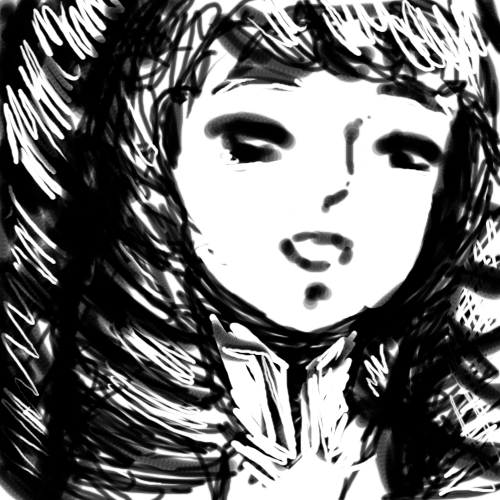
Early Preview of a Personal Project

It’s an idea I’ve put on hold for about 5 years, and it’s about high time I worked on it.

Edit: Ninja Update

Pastel Explosion: 70s Shoujo Anime Backgrounds

Having watched just the first episode of the classic anime Ace o Nerae!, my love affair with 70s-era classic shoujo has been rekindled. Not that it really died down in the first place.

However, this isn’t really about the content of the story but rather just the visuals, and not even in regards to the characters. Shoujo anime of that era, including Ace o Nerae!, have incredibly gorgeous backgrounds and just artwork in general, though they suffer quite a bit in the animation department. I think it’s a fair trade-off though, as the action and fluidity of animation or lack thereof are minor losses when we get shots this incredible.


Repeating the flower pattern seen in her night gown into the plaid background unifies the entire image.


This image almost borders on abstraction, but not in the confusing way. I love this style.


Particularly strong use of color here, as the building and trees blend together.


And I can’t say enough about this background. It looks like it was created with water colors, and it works far better than any approach I’ve seen for indicating melodramatic shock.

Shows like Zetsubou-sensei kind of have a similar effect as far as modern shows go, and Nana and Honey and Clover for example also have excellent cinematography, but they simply lack the rough yet gentle edge of classic shoujo.

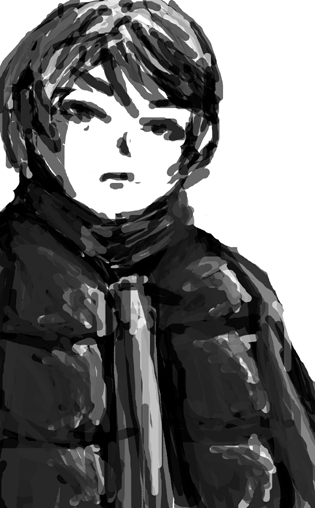
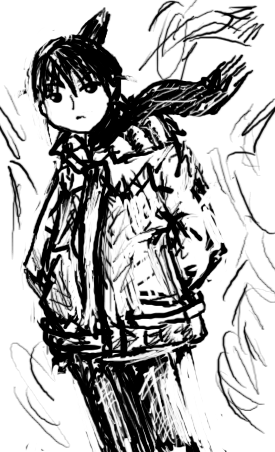
Mildly Ornery Girl in Snow

Lately it seems most of my drawings designed to help me relax have involved girls in winter coats. I wonder if a certain Fred can relate.

Drawn with a mouse because why not.

Drawing to relieve the stress of life

The continuing adventures of Tablet Ogi

Tablet Get

I bought an Intuos3 9 x 12 Wacom Tablet. I think it’s actually bigger than my laptop’s monitor.

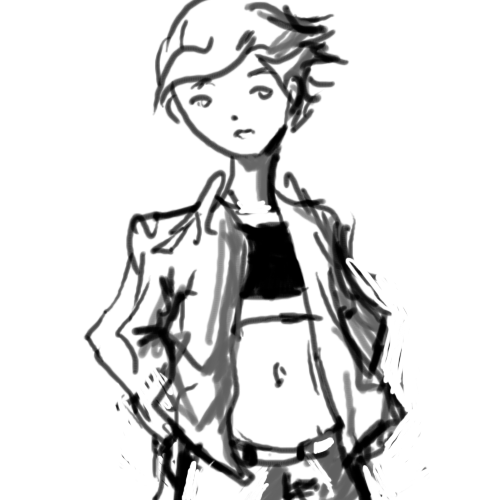
So to celebrate my new tablet…

…I’m going to need some practice

Getting at the Origin of Manga vs American Comics

I was having a conversation with OGT about what is it in the standard American comics-style that makes people either attracted to it or not.  We talked about how the characters in American comics tend to look much more posed, like a figure occupying space, while in manga, the characters are much more a part of the image.

I’m aware that there are plenty of exceptions on either side and many of them are outstanding such as Wil Eisner, Art Spiegelman, and Ryoichi Ikegami.  I’m also aware that manga derives its appearance from Tezuka who loved American cartoons and French films.  Still, I believe that these strong respective art histories play a significant role in just how these styles evolved.  While Wil Eisner commanded the flow of each page masterfully, he still placed great emphasis on how the figures occupied the space making sure to show exactly where each person is positioned.  Riyoko Ikeda, whose Rose of Versailles manga is itself set in France, shows the environment but focuses primarily on the emotions of each page.

That’s all well and good, but then I began to wonder about why this is the case, and I realized that the reason why these styles are so different is as simple as tracing the history of Eastern and Western Art.

I know that these days the barrier has lessened thanks to the internet and other forms of constant international communication, and I know that use of terms such as Eastern and Oriental may have an air of cultural bigotry, but let’s face it: Art between America and Japan have been interacting with each other heavily only for about the past 200 years or so, and of course comics even less than that, and for the longest time these two cultures WERE more or less independent of each other.   This is where the discussion stands.

Non-abstract human representation in the West derives its history from Ancient Greece and Rome, and the desire to portray the physical body perfectly, on to the Renaissance and beyond.  A careful study of anatomy, the invention of things such as the golden ratio, and the notion that empty space is a waste of space are all a part of the history of Western art.  The toned muscular bodies of super heroes can also be seen as the latest version of the pursuit of ideal physical beauty.  Meanwhile Eastern art, from China, Japan, and other locations, particularly that which represents the human figure, has never placed nearly as much emphasis on portraying the body realistically.  When Europe and Japan began interacting with each other on an artistic scale, one thing Europe took away from Japan was their strong use of negative space.  Not drawing, not painting in an area turned out to be able to have equal if not greater impact than what was the standard method of filling the canvas as much as possible.  Combine this with use of line widths to denote depth, as well as heavy use of flat colors, and I think it begins to become apparent just why and how these histories have influenced the art of comics in Japan and America.

Mangaka or MANGAKA? Artist or ARTIST?

I’ve recently been reading a book called Adult Manga which came out in 2000, which deals with various aspect of the world of manga during the 90s, including the otaku community and issues on censorship during that time.

One chapter is titled “Manga Editors and Unusable Artists,” and it talks about the increasingly creative roles that editors were taking during the 90s. On the topic of “unusable artists,” the chapter recounts various editors lamenting the situation that artists were in at the time. One mentioned that with manga becoming so commonplace, they had to take risks picking artists who were willing to be more experimental, but often times it seemed the artists didn’t have the enthusiasm to try something new. Another editor talks about how the current generation of manga artists aren’t really manga artists. He compares the previous generation of mangaka, and how they consisted of people who lived in and addressed issues of their time, with mangaka of today, who often seem completely disconnected from reality. In other words, they were just people who grew up just reading manga (a topic I discussed in a previous post). This same editor basically says that too many of the artists only know how to draw cute girls. The book then goes on to mention one particular artist who seemed so far removed from the public that he had to ask his editor for relevant story topics.

I found this to be extremely relevant to my own situation, as I am both an artist and an otaku, and I know how easy it is to fall into the trap of just wanting to draw cute girls and just ignoring the real world and sticking with anime and manga. For me, it is a struggle to appeal to others and to express myself, as often times the art in which I am most invested is not the most aesthetically pleasing, at least in terms of moe qualities and the like. Reading the chapter on unusable artists has refocused my attention, and I realize that I must at least take the occasional look into the real world before I can progress artistically. I also need to improve my ability to draw cute girls as well, but the former must come before the latter if I dare to try and make a difference with my art.

That said, I’m still an otaku and I’ll still be making incredibly dorkish posts just like this.