Understanding the Girls of K-On!, Instantly!

Now this is an interesting shot from episode 6 of K-On!

All four characters are in the same place, and just from this one still you can get a basic idea of their personalities. On the flipside, if you already know the characters then you can definitely see that this is instantly accurate.

In general, K-On! pays a good amount of attention to these sort of things, and I think it’s characteristic of Kyoto Animation in general. Some wonder why others are so fond of Kyoto Animation’s various works, from Haruhi to Lucky Star to various Key adaptations, and the answer is care. These are not just moe blob shows with no real content, they’re visually rich with a good sense of timing and comedy (or tragedy as the case may be). K-On! is no exception.

Capturing the “Spirit” of a Work

When I first saw the trailers for the new Star Trek movie, a movie designed to be a continuity reboot of sorts with a young Kirk and young Spock, I was worried. On the movie theater’s screen was a whole lot of action and explosions and intense moments all while the trailer implies what a big coming-of-age story the whole thing will be. I felt that while it could still be a sgood movie, there was a risk that it would not be faithful to the spirit of Star Trek. Having seen the movie, I can say that I was thankfully wrong about it. It’s still full of action and is basically a coming-of-age story, but the core of Star Trek felt intact.

Now, this might be hard to believe based on everything I said in the above paragraph, but I am really not that much of a Star Trek fan. I may have caught a few episodes on tv here or there, particularly The Next Generation, sat through parts of the Star Trek original series marathons that would crop up on tv now and then, watched Duane Johnson Rock Bottom Seven of Nine, and know what the hell a Jem’Hadar is, but it’s not something that has consumed my attention like say, Gundam has. I am not speaking from the perspective of a diehard Star Trek fanatic. That said, the core of Star Trek, I feel, lies in its “How far could we go, if only we got along?” message. To extend it further, I feel that Star Trek is an “intelligent” series, not in the sense that you need to be smart to watch it, but that the focus is mainly on the exchange of ideas, be it between friends of the same race or enemies from different planets, and it’s something I think the new Star Trek film accomplished successfully.

I said something similar about Dragonball Evolution about the need for an adapatation to really capture the “spirit” of its source material, something that, for example, I felt the recent Iron Man film also was able to do. However, what I found in speaking about my concerns regarding Star Trek and any other movie where I feel that an adaptation of an existing work may not be adapting “properly,” is that I had a hard time describing what I consider the “spirit” of a work to be, what an adaptation must successfully bring over from the source material to make it truly an adaptation. After some thinking, the answer I’ve arrived at is something like this.

I believe that the necessary ingredient for an an adaptation is respect for the source material. Incidentally, it’s also something which I consider to be essential to the study of anime as well. It’s not about liking or disliking a work, or perhaps even the production quality, but the people doing adaptations must be able to see what at the core of these works made them special, what made them successful, what is it that gives these works their uniqueness, and using that as a foundation to build upon. It’s okay if you want to make it look less “cheesy” or update some outmoded concepts, but don’t completely throw out what made this idea good or effective in the first place.

The Geek Logical Fallacy

Not to be confused with Geek Social Fallacies.

The Geek Logical Fallacy is basically when a person (generally a geek) says, “I have an opinion. I’m an intelligent person who uses logic and reasoning. Therefore, my opinion is objectively correct because it’s backed by my superior logic and reasoning abilities.”

Like many flaws in arguments or understanding, the Geek Logical Fallacy is derived from positive sources. Intelligence is great and so is the confidence to acknowledge one’s own intelligence. Logic and reasoning? Both important facets of life and especially debate. However, there are many situations where these good qualities can all fall apart and lead to the Geek Logical Fallacy. Here are the big ones.

1) When Emotions are Involved

Whether it’s because the topic involves emotions, e.g. love or religion, or because the person is somehow emotionally involved with the topic at hand, the result can often be a mess when one tries to use their heightened logic abilities to tackle a subject that involves more than simply the rational mind. At best, the person misreads a situation or argument. At worst, the person confuses their own feelings for logic and reasoning, and simply assumes that through this odd Emotional Scientific Method they have arrived at the only right answer.

2) When the Arguer Cannot See Beyond Their Own Experiences

This is the situation where it becomes hard for the Fallacious Logic Geek to fathom and acknowledge opinions other than his own, even if they too have been derived through the power of intelligence and reasoning. This often stems from being unable to see beyond their own experiences in life or to realize that people may have lived a life different from them or even worse, that their limited experience and circumstances in life has somehow imbued upon them a unique, i.e. more correct perspective upon the world. Working on their own past experience, and again believing themselves to be logical beings of reason, they remove the possibility of anyone thinking otherwise.

I’m sure you’ve seen this in action before, and there’s even a very good chance someone else has mentioned this before under a different name. It’s probably even a mixture of existing logical fallacies though I haven’t looked at which ones they are specifically.

The obvious advice of course is “DON’T DO THIS,” but it might not be so easy to correct if you feel you have this tendency. So what to do about it?

I feel like the main ways to prevent the Geek Logical Fallacy are somewhat simple. First, you must be able to empathize with others. Second, is that you have to realize that intelligence and logic do not run the whole world and thus there are situations where they do not quite work out, or at least not alone.

The Thing Which Makes You Think, “Ah Yes, This is an American Comic”

In the comments section for kransom’s translation of Takekuma Kentaro’s lecture on Miyazaki, a lot of talk is brought up regarding styles and trends according to where the artist is from or where the artist draws their inspiration from. Specifically, the comments center around Miyazaki’s style being similar to that of European artists. Commenter JBR states, “Nausicaa is very similar, in many ways, to the European avant-guard [sic] comics of the 1970’s/80’s, which also emphasize densely-constructed panels and attention to background detail.”

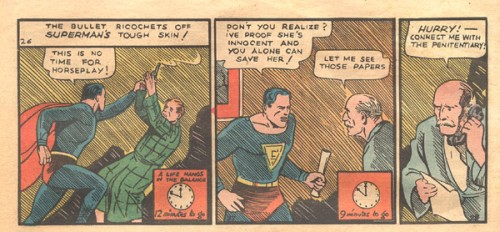
So if the emphasis on European comics is on these “densely-constructed panels and attention to background detail” (something that rings true even for comics that aren’t avantgarde), and the priorities for Japanese story comics is in having the panels be “easy to read” with respect to how panels flow into each other and other aspects, I had to ask myself, “What is the primary feature of American comics, specifically comic books, that makes it stand out?” What, in other words, is the aspect that artists and fans can draw from to make a comic feel very American?

Thinking it over, I’d have to say that I believe that traditionally, the primary feature of American comics is the desire to convey a complete amount of information in a single panel, to really inform the reader that, yes, this is going on right now exactly as you see it. Characters’ poses and actions in relation to text and background all work together to provide a sort of storytelling clarity that some might even regard as overly busy. You know where that foot is going. You know exactly what the characters are doing. You know what is going on in a given scene, as if every panel were an incident in and of itself. Some might say this is the problem with American comics, but I think that wanting to present information in your comic in complete chunks has its merits, in the way radio dramas of yesterday and cd dramas of today do. Of course, I say “traditional” because as comics artists from all over the world interact with each other these differences start to recede, but I think you can still see them in today’s comics.

I’m well aware that there are comics that do not do this, and that even in the comics that do there are plenty of panels which are more for conveying a mood or some other function. I’m also aware that all the visual examples are from superhero comics, and that there’s an entire indie comics scene out there, and famous artists such as Dave Sim, Robert Crumb, Chris Ware, Art Spiegelman, and even Brian Lee O’Malley who do not abide to this “rule” if you can call it one. However, I do feel that this is the aspect of American comics which people remember the most, whether they’re long-time fans or new readers, these panels designed to exist on their own if they have to, but also function as part of a whole.

The False Positive Pitfall in Discussion of Anime and Manga

“Intertextuality” is the idea that there is a conceptual space where ideas brought forth by books, movies, texts, etc. interact with each other. One way to think about it is the old addage that the “truth lies somewhere in between.” This is the space where differing (or similar!) opinions confront each other. Don’t think about it too literally, but with the internet available, it’s become a lot easier to have this sort of thing happen beyond the scholarly journals and academic settings where this sort of thing usually occurs.

As anyone who has read Ogiue Maniax probably knows, I quite enjoy finding and seeing any connections which may connect one aspect of anime to another, be it from show to show, or from staff to real world events or whatever, and it’s something that’s consumed my time and the direction in which my hobby has gone. I think I’m pretty good at it, and apparently others do too.

However, there’s a drawback to having an open mind which actively seeks out connections among the material you’ve ingested mentally. Sometimes what happens is you see connections that do not exist, but because of the success you or others have had in taking this approach to a topic, it becomes difficult to break free of this trap. In other words, sometimes we tend to overthink things. This is what I call the “False Positive Pitfall,” and it’s something I feel anyone academically-minded towards anime and manga (or any other topic for that matter) has to watch out for. Failure to acknowledge this effect can result in a number of problems, from undermining your writing to being seen as unnecessarily elitist to simply leading you down the wrong path until all you see is false positives and you become a case where you’re an anime reviewer everyone makes fun of because you have no idea what the hell you’re talking about anymore.

Now, I’m not immune to this at all, and there’s multiple instances of statements made out of false positives that are on this blog. But people aren’t perfect, and even if you’re constantly on the lookout for them, some are bound to slip through, especially as your knowledge of anime and manga expands. Again, it’s more that I want people to be wary of the False Positive so that we can foster better discussion that is both relevant and respectful to the topics we engage.

The False Decline

The new anime season’s gotten off to an excellent start. From Basquash!, a rare international collaboration basketball-robot-themed anime created by Kawamori Shouji (Macross, Aquarion), and Thomas Romain (Oban Star Racers), to celebrations of anime’s history with shows such as Shin Mazinger and Before Green Gables, I’m finding this batch of Japan cartoons to be really fun and varied and imaginitive, just like last season’s. And the season before that, too. And so on.

As always, there are naysayers who will point out how once again the new shows are proof that anime has been on a decline and that it needs to capture the glory days of when anime was good. However, you might notice that the people who talk about anime’s golden days of quality are not all talking about the same period of anime, and begin to realize that anime has never hit some horrible slump no matter how much some would want you to believe.

Budget allotments may rise and fall, the economy may see dark times and periods of prosperity, and old staff may die or retire while new blood replaces them, but I feel like there are constants, such as the desire to succeed and the desire to express an idea, that make it so that there is always something to hope for with anime.

It’s one thing to be saddened that the types of shows you like are no longer being made. I for one sometimes wish that we would get more bad 80s OVAs and good 70s-style ultra-melodramatic shoujo, but I understand that this is just a preference, and I can appreciate every new anime that comes out and know that as a collective whole the anime industry does not want to fail. Yes, there are shows that are not good at all, and others that cater to niche audiences, but even within those shows and genres that are criticized as being vapid or devoid of content, progress is still being made. It might be the case that the popular shows are overshadowing the better ones, but this doesn’t stop the good shows from being good, and it certainly doesn’t mean popular show can’t be good either.

Criticism is necessary, as is discourse, as is the ability to express one’s opinions on shows and how the industry is doing. However, anime does not need doom and gloom, nor does it ever actually invite such a mindset when you look at it as a whole.

The Pros and Cons of Technology and its Effects on Society: Magic Geox

The Magic Geox comic series is often underappreciated and overlooked. This is especially the case with issue 12 of the series. This issue, titled Magic Geox and…the School of Magic, manages to blend subtle societal commentary with deep, complex characters in a unique setting combining magic and technology with a dash of superheroics. It also reveals much about our hero Magic Geox’s character flaws, and does so with grace on the level of Kino’s Journey.

The story begins on a world called Planet Magix III where a group of young wizard apprentices are tasked with creating shoes that are all but devoid of odor, a practical exercise fitting for a final exam from one of the most prominent magic planets in the galaxy. The young wizards-to-be, in their attempt to find a solid solution to their problem, inadvertently unleash an ancient and terrible pair of demonic shoes with a pungent aroma so foul that they are actually able to control other smelly footwear through the power of their combined stench. Ultimately, it is up to Magic Geox to descend from space and use his advanced technology to put an end to the evil shoes.

It is in this issue that we begin to truly see the level of hatred Magic Geox has for odiferous shoes. Though he hides it well with a smile, and a look of confidence, the sublime artwork really conveys the obsession inherent in Magic Geox.

A lot can be said about the symbolism strewn throughout the story, but three main points come to mind.

1) The young magicians are eager to solve their problem without thinking through the consequences, and their mistake balloons and goes out of control to the point that not even the adults in their community can handle it. This speaks to a growing paranoia in our society that children are growing up faster than their parents and guardians can keep up with, and even those with the power to control matter itself cannot entirely understand the minds of children.

2) Magic Geox is himself a technological being who arrives on a backwater “magical world” in order to save it from the perils caused by its own people. In this sense, Magic Geox is not unlike a Christ figure. Though he uses technology, he chooses to have the word “Magic” in his name, as if to say that his abilities, man-made as they may be, can still cause miracles. It does not appear to be hubris or conceit however, but rather true faith in his cause.

3) The demon shoes themselves possess sharp teeth placed in such a way that if one were to actually wear them as shoes, the pain would be immense despite at first seeming to be very comfortable. When one realizes that the “stink trails” that emit from these shoes are just creatively disguised smog clouds, it is clear that these shoes are a metaphor for pollution caused by industrialization, an interesting contrast to the promotion of technology inherent in Magic Geox’s presence. Much like Hayao Miyazaki’s Nausicaa and Princess Mononoke, this comic wants to show both sides to a situation.

Overall, Magic Geox and…the School of Magic is an ambitious work. Its main flaw may be that it is so densely packed with content in every page and panel that it becomes a difficult read. However, this is also what makes it worth revisiting time and time again.

The Differences in Realism in Video Games

For as long as video games have existed, there’s been a graphical arms race. The Intellivision claims its superiority over the Atari 2600 due to its much more accurate-looking versions of Basketball and Football. The Sega Genesis has 16 whole bits, twice as many as the NES, a number whose significance in marketing was always accompanied by images to show much better Genesis games looked. With the rise of 3-d graphics, particularly with the era where the original Playstation was king, there’s been a push towards manufactured realism. While it’s not like the pursuit of realism didn’t exist previously (Mortal Kombat’s digitized graphics looked amazing at first), it was with 3-d graphics that the foundation was laid due to the simple if faulty logic that a three-dimensional game is more like our three-dimensional world.

As we look at today’s graphics, we know that the pursuit of realism is still going strong, with improved lighting, increasing numbers of polygons per model, and just tons of work and money being put into getting a scene in a video game to look like a photo. While I’m not a fan of this push towards realism as I believe it to be somewhat of a dead end, what I am interested in is how America and Japan differ in their depictions of “realism” in video games, or at least what the perceived difference is. The reason why I say America and Japan of course is that these two countries are really considered to be the places where mainstream video games happen.

Let’s take a look at male characters in games. In essence, characters in “realistic” games made in America are stereotyped as a bunch of square-jawed tough guys who have to drink beer and shoot enemies with automatic weapon fire as a display of their manliness. The male characters of Japan are criticized as being overly effeminate, sometimes to the point that people wonder whether or not it was necessary to make them guys in the first place, and even the more muscular and masculine guys in Japanese games tend to have a bit of beauty to them. Neither category is actually true and you can find a million exceptions, but these are where the stereotypes stand. And as I looked at these generalizations, they seemed oddly familiar, as if I’d seen this argument happen before, and it also occurred between Japan and America. And then I remembered: Comics vs Manga.

The same complaints that are leveled at the male characters of Japanese and American games are given to the characters of comics, from complaints about superheroes being too musclebound to bishounen being too much bi and not enough shounen. And so I have to wonder, how much do comics play a role in the depiction of realism in games for either culture?

By now, we know that the realism from games isn’t meant to actually be “like reality,” but rather a sort of hyper-realism where things we consider to be part of the actual world like muscles and sweat are emphasized and exaggerated. The difference then comes from what is perceived to be important to realism, and when it comes to non-abstract comics, I believe these elements are also very present and perhaps even more prominent. Of course, I can’t completely ignore the idea that both comics and video games are simply influenced by the reality of society. Most likely, it’s not a unidirectional relationship and at this point, especially as video games enter the mainstream more and more, and they will affect the aesthetics of video games and the environment around us in even more profound ways.

“She’s So Developed!”

There’s something about a lot of anime and manga that I think lends them much of the praise and criticism they receive from people, fans or otherwise. I wouldn’t call it a unique or exclusive property of anime, but it’s something that I believe recurs more often when compared to other mediums. What I am talking about is the ability for a character to both be sexualized and objectified by its audience while still being able to move the audience with a well-developed personality.

Sheryl Nome. Arika Yumemiya. Kawashima Ami. Practically the entire female cast of Gundam 00. Every girl in Godannar. All these and more are designed on some level to explicitly titillate, but I would not call any of their characters excessively shallow or designed purely with fanservice in mind. Nor would I say that pure fanservice characters do not exist at all, but I feel like more often than not in anime and manga, blatant, in-your-face sexual attractiveness does not come at the expense of strong characterization or at the very least attempts at strong characterization. Much of the eroge and visual novel industry is built on this premise.

I do not see this happening as often in other mediums. Of course sex appeal still exists in them, but very rarely do they try to turn both dials up to max, rarely do they say, “Hey we want to basically tell the audience outright to fantasize indecently about this character while still showing the strength of their personality.” Hayden Panettiere (Claire Bennet) on Heroes is clearly meant to invoke a reaction from male viewers with her attractiveness, official assignment as “cheerleader,” her clothes, and pretty much everything about her, but there’s some attempt at keeping the character Claire’s “fanservice” somewhat implicit. The DC Comics character Power Girl, known for her super strength and her enormous chest, seems to go through constant subtle shifts in characterization as writers and artists seem unsure how to balance the development of her character with a design clearly meant to get guys’ mojos going. Fans of DC Comics run into a similar problem. In other cases, a character who is obviously sexually attractive while possessing good characterization will have their sexuality incorporated into their personality and character.

Meanwhile, many anime fans embrace this double threat. Others do not of course, and I think this causes some of the conflict as to whether or not a character is “good” or not. Does being explicitly sexual in design and presentation work with characterization, or against it? Or do they perhaps run parallel to each other? Wherever you fall, if you meet someone who thinks otherwise, there’s a chance that, because your approach to characters is so different, arguments will arise. This is probably where arguments about moe find most of their ammo, no matter which side fans are on.

As a final note, keep in mind I used female examples because that’s what gets me. Feel free to replace all examples with male equivalents if that’s your thing.

“Negative Portayal” of Men

When it comes to women in entertainment such as movies, books, and of course anime, it will sometimes be said that a work contains a “negative portrayal” of women. The finger of accusation can be pointed at many things, from having women who are too demure and helpless to women who are all too sexually promiscuous (or not promiscuous enough in some cases, a reaction against the idolization if virginity) to women who some would say are just “men with tits.” The specifics and whether or not something truly is a negative portrayal doesn’t matter here so much as the fact that the concept exists.

But what about the other side? What about “negative portrayal” of men? Personally, it’s something I never hear about. Sure, there’s “Shinji is a whiny baby,” or “Keitarou is completely lacking in any real personality,” but rarely do I see “This yaoi is offensive to men,” or “This is not how a man should be portrayed.” Keeping in mind that I’m talking about multiple cultures though primarily the one I live in (America), is this simply a product of a male-dominated society, that no matter the portrayal of a guy it never really leads back to how he stands up to men in the real world? Even my own thinking makes it difficult for me to really bring up any examples, while it would be much easier to do so on topics of race or class. Could it be that when it comes to gender, only one side has some goal to reach with their portrayal in media while the other perhaps already crossed that finishing line millennia ago? Or are there actually negative portrayals of men in entertainment and that finding them is even more difficult due to the way in which we were brought up?