I Can Clearly Hear It, the Galaxy’s Song: Macross Frontier 1-13

If one were to describe a Macross series, there would be many recurring concepts: war, transforming fighter jets, idol singers, love triangles, culture. However, if one were to describe the feelings conveyed by each series, theywould be hard-pressed to find too many similarities. The original Super Dimensional Fortress Macross feels different from Macross Plus, which in turn has little in common with Macross 7 or Macross Zero thematically. They all exist in the same universe, but they could not be further from each other without turning into Gaogaigar and Betterman.

So it can be mighty confusing when I say that Macross Frontier, or at least the first half of it, feels like Macross.

Macross Frontier is the 25th anniversary celebration of Studio Nue’s Macross, and with it comes a return to the original in terms of pacing, characterization, and the specific balance of love and war and the way they intertwine. Nowhere is this more evident than in  the main love triangle of Macross Frontier.

The “love triangle” has been a constant part of Macross since day one with Hikaru, Misa, and Minmay. Still, I have always found the original love triangle to be the best because it truly seemed like a battle for the heart, a battle whose landscape is transformed radically by war and the circumstances surrounding it. Macross Plus is less about developing love and more about resolving an existing one, Macross Zero’s is wrapped in its own lore, and Macross 7’s you can hardly call a love triangle when it involves a guy who likes a girl, a girl who kind of likes both, and a guy who doesn’t care. In every case, the romantic tension is lacking, a tension which I believe factors significantly into the success of the original.

Macross Frontier’s three main characters, Saotome Alto, Sheryl Nome, and Ranka Lee, recapture that tension. Saotome Alto is an amateur fighter pilot and former theatrical actor. Sheryl Nome, the “Galactic Fairy,” is by far the biggest music idol of the day. Ranka Lee is a young girl working at a Chinese restaurant who aspires to be a pop idol. Mankind’s encounter with the Vajra, a violent alien race so powerful it can easily avoid an Itano Circus, brings Alto, Sheryl, and Ranka together and ties their destinies together.

It all sounds very familiar, but I am in no way saying that Macross Frontier is treading old ground, or that it’s some sort of lazy throwback to time immaterial (the 1980s). Already from my small and deliberately basic description, there are some things which are new and refreshing, particularly in this current age of anime. Unlike previous series, the main characters are all involved in performance in very different ways. There’s also the fact that we have not one but two idols with many years of experience of difference between them, with Sheryl being both Ranka’s surrogate mother (Ranka herself losing her parents at an early age), and her conflicted rival for the affections of Alto. Just like in the original Macross, I cannot bring myself to hate either girl or Alto, and also like in the original, I cannot seem to decide who I want to side with at the moment. I like this feeling. It’s one I’ve enjoyed before, and yet it feels so new.

Macross has always used its continuity as merely a backdrop, unlike say, Robotech, which thrives on it. However, whereas the latest incarnation of Robotech is marred by this devotion to continuity, Macross Frontier’s many, many nods to the past, a live performance of My Boyfriend is a Pilot and a car radio playing Planet Dance being just two examples, fit right in without overwhelming the viewer with backstory. History lessons are welcomed, but are not absolutely necessary, so what you end up having is a series which is progress not for the sake of progress but for making something worth watching and worth remembering.

The suspense is so great I may deculture my pants.

Wahaha: Hidamari Sketch

With Hidamari Sketch x365 currently airing, I finally decided to watch through all of the original series.

Stupid me, I should have done this sooner.

Hidamari Sketch is the sort of show that is the most supremely difficult to convince others to watch if they aren’t already well-versed in shows of its kind. I’m referring to that dastardly “slice of life” genre of anime, the genre that can make or break someone’s opinion of anime.

It’s the story of four girls attending an art high school who live in the nearby Hidamari Apartments. Though they all live alone, you wouldn’t be able to tell from the way they support and love each other. The main cast consists of Yuno (shy and eager to learn), Miyako (energetic and unpredictable), Sae (mature yet easily flustered), and Hiro (soft-spoken but surprisingly willfull). Personally, it is very difficult to decide on a favorite character. All of them are just so wonderfully endearing that when I try to choose one I recall another very memorable scene from another character and then I’m back to square one.

One thing that constantly bothers me about Yuno is that she sounds a lot like Kinomoto Sakura despite not being voiced by Tange Sakura. I definitely know she isn’t, and I can also recognize the fact that she plays Ran in Shugo Chara, but it can be startling to hear such similarities in inflection and expression. I think if Sakura and Yuno met, they would have a wonderful friendship as Sakura would look to Yuno as a beautiful older sister of sorts.

…Back on topic.

Hidamari Sketch was directed by Shinbo Akiyuki, director of Pani Poni Dash and Zetsbou-Sensei among others. The show has the same sort of self-awareness by viewer and creator as Shinbo’s other shows. However, combined with the mellowness of the daily life of Yuno and friends, Hidamari Sketch becomes more like lucid dreaming, and it’s the kind of dream that while at first you’d prefer not to get up from, you are thankful that you did awaken as it lets you greet another day.

Slice of life is Hidamari Sketch.  It’s funny, witty, pleasant, and emotional, but not once do any of those adjectives overpower the other. It’s a show that, no matter your circumstance, you can use it to unwind. Watch as little or as much as you want, by the end you have no choice but to smile.

Armored Trooper Votoms: Part 2

Armored Trooper Votoms is the story of Chirico Cuvie, a soldier and Armored Tooper (giant robot) pilot who was betrayed by his own military and forced on the run. Previously, Chirico found himself in Uoodo, a city where might makes right and people are very likely not to wake up the next morning. In episodes 14-27 of Armored Trooper Votoms, the AWOL soldier Chirico Cuvie trades the disorder and chaos of Uoodo for the focused destruction in the jungles of Kummen, a country at odds with Melkia. Chirico, a man who lives to fight, finds himself in his natural habitat amidst a civil war.

The aptly titled second part of Votoms, the “Kummen Jungle Wars,” sees Chirico acting as a mercenary for the Kummen government, fighting against a rebellious prince who seeks to prevent his nation from abandoning its traditions and modernizing. As the war progresses, it becomes clear that neither side is “good” or “evil” as is often the case with clashes of ideology as well as real robot anime. New characters are introduced on both sides, some familiar and welcome faces appear, Chirico still uses a Scope Dog, and the Perfect Soldier project which forced Chirico on the run is further along than it’s ever been before. …Or is it?

The fighting in Kummen is different from Uoodo, where it was usually cops vs thugs vs Chirico. Instead, Chirico in his mercenary role frequently acts as part of a mechanized platoon, following orders and occasionally giving them. The enemy, being much weaker than them, relies on guerilla tactics and hiding in plain sight in order to confuse the government’s soldiers and weaken resolve. The battles are intense and gritty without much posturing, lives are easily lost, and Chirico continues to wage war in what is basically the Votoms equivalent of a Zaku, a Leo, or a KLF: a rust bucket without many special features other than the strength and skill of the pilot within it.

The only real fault of Votoms is the way it handles romance, as it does so in a very Tomino-esque hammer-over-the-head manner. The origins of romance in the story of Votoms can make it hard to swallow, but don’t let it distract you.

Though the Kummen Jungle Wars arc ties into the greater plotline of Votoms, it can be considered its own self-contained story of a country at war with itself, where tradition and progress are forced against one another to determine the future of the nation. Watching just these 13 episodes alone can be satisfying enough, and if you’re unable to watch the Uoodo arc, the show was courteous enough to throw in a recap episode. At the end of Kummen, while a lot of questions are answered, far more are brought up, and there’s another 26 episodes to go.

Buy Strike Witches: You Can Call this a GONZO Editorial

GONZO’s new tv series Strike Witches has begun airing, and GONZO, as it did with Blassreiter and Druaga, is putting the show online with a good translation for the enjoyment of English-speaking anime fans. It’s an mp4 file, approximately 200mb, with hard-encoded subtitles. It’s even free of Digital Rights Management shenanigans, which is a big plus in my book.

Unfortunately, what I’ve heard is that someone has put the episode on bittorrent.

I will acknowledge that it’s iffy to put money into a series you haven’t watched yet, but GONZO is trying hard to reach out to us in the English-speaking anime fandom, and to piss away their good will just makes us look terrible.

If you don’t like Strike Witches, or are afraid of watching yet another GONZO series, then feel free to ignore it. I’m not expecting people to buy something they don’t have any interest in, but if you think you’re going to enjoy it, I ask that you at least try it out.

One thing to keep in mind is that you have 14 days to download each episode so you can’t really wait until the series finishes. That said, this also means you can perform a 3-episode test. I’d also normally say that you could possibly wait for the DVDs if you want to support them with your wallet, but there’s a high probability that Strike Witches DVDs will never see the light of day.

You can purchase episodes of Strike Witches via Bost TV for approximately $3.00 US. Keep in mind you have to spend a minimum of $10 in order to buy the points necessary, which is kind of annoying, but that has less to do with GONZO itself and everything to do with Bost.

Episode 1 Review
Strike Witches
is the story of a squad of young and powerful soldiers augmented with technologically advanced armored weaponry in order to combat the alien menace known as Neuroi. Its protagonist is Yoshika, a girl with a strong dislike of war whose father died during the conflict. However, a chance meeting with an old friend of her father’s puts Yoshika in a position she never expected.

All in all, Strike Witches is very cute, awfully fanservicey, and  well-animated. The main appeal is that its important characters are basically Mecha Musume. It’s a simple show that is clearly targeted towards otaku, so don’t expect it to be any more than what it tries to be.

Doing this Brooklyn Translation Makes it Difficult to Concentrate: Yu-Gi-Oh! The Abridged Series (in Japanese)

Little Kuriboh’s Yu-Gi-Oh: The Abridged Series, where one man acts out the roles of (almost) every character with surprising skill and summarizes the absurdity of the English version of Yu-Gi-Oh Duel Monsters,  has become quite an internet phenomenon. You are probably aware of this, but one thing that you may not be aware of is that it has reached back to its original source, as one Japanese fan has subtitled Little Kuriboh’s work and put it online. You can also see it on Nico Nico Douga under the names 遊戯王要約シリーズ or 4分でわかる遊戯王アニメ.

What is fascinating about this first of all is that we get to observe the other side of the fansub mirror. Normally, even the Japanese subtitles for English shows that we see are professionally done.

What’s even more interesting is observing how the translator makes various attempts to localize the translation just enough for the Japanese speakers. Characters’ names are in Japanese, but the subtitles point out that “Jonouchi” is speaking with a “Brooklyn Accent.” Characters’ unique speech is kept intact, as Pegasus, according to the subtitles, still speaks in random Engrish and says “de~~~su” a whole lot. “Super Special Awesome” is just “Super Special.”

And of course, one of the big challenes is puns and wordplay, and the guy does surprisingly well. One of my favorite examples is his translation of the famous line from the “evil” Kaiba, “You don’t stand a GHOST of a chance,” said by characters who are ghosts or at least resemble them. Translated literally it doesn’t make much sense.

The translation the subtitler went for is “勝利のチャンスは「霊」だ” (Shouri no chansu wa rei da). It literally means “The chance of you winning is “a ghost.”

Here’s the fun part: the word used for ghost is pronounced “rei.” There’s another kanji with a pronunciation of rei, 零, which means “zero.”

In other words, “The chance of you winning is zero.”

So bravo, Japanese Yugioh Abridged subtitler. Your wordplay kung fu is mighty indeed, and I bow to you.

Let Sleeping Dogs Lie: The End of Inuyasha

I’m not a fan of Inuyasha, so I really haven’t kept up with it this whole time. I do recall buying a single issue from a store back when manga was still being sold like monthly comic books, and I did watch Inuyasha at my college’s anime club. When the heads of the anime club decided to stop showing Inuyasha, I wondered why. One of the last episodes we watched had Inuyasha and Sesshoumaru working together to defeat a common enemy while using their respective blades as intended (Inuyasha for destruction, Sesshoumaru for healing), so I thought that it was finally getting somewhere good and would conclude soon after.

Ha.

Many jokes have been made concerning the “never-ending” nature of Inuyasha, but finally we can stop cracking wise about it and switch to humor based on the fact that as of this week, Inuyasha finishes with 558 chapters.

Inuyasha ends with a final battle with the demon Naraku, after which Kagome makes a decision to choose what’s right over her heart’s desire. The battle itself is pretty nice and conclusive, but it’s the kind of final battle you know that Takahashi could have pulled out at any moment and it would have still made sense. Sesshoumaru wielding his Nendou Bakusai Ken Bakusaiga with its endless destructive capabilities, it could have been a cheese wedge forged by destiny instead.

Inuyasha thankfully concludes with an ending and all that, as opposed to the abrupt stop that occurred with its anime counterpart. It’s not the best ending I’ve seen, but I doubt it’ll displease too many people or get accused of being a cop-out/Gainax Ending/any other conclusion-themed perjorative.

Really, Inuyasha will ultimately not be remembered for its plot, so having an actual ending doesn’t hurt or help too much, though I think it leans towards the latter. I’m not a fan of Inuyasha like I said, but I think its fans will continue to have adventures with Inuyasha and friends for a long time.

Inuyasha is finished, but it’s still endless.

In conclusion, I just want to point out that I was the first person to say that Inuyasha is “Dragon Ball Z for girls.” If anyone says otherwise, they’re wrong.

In Control: Understanding Akira

Whenever I think of Akira, the first thing that comes to mind is my sophomore year of high school. There was an anime festival going on in the city, and I was waiting in line to watch Galaxy Express 999 at a small theater. Behind me on the line was a guy, probably somewhere between 16 and 24, discussing anime, talking about how he found Akira to be incredible and the “best movie ever.” This man’s life was changed by Akira. Later that evening, my life would be changed by Galaxy Express 999. Still, I had seen Akira before, and I wondered just what was it that blew this guy’s mind.

Today, years later, I rewatched Akira, and I finally understand it. More importantly, I understand that Akira is actually not that difficult to understand.

Akira takes place 21 years after the end of World War III in the city of Neo-Tokyo, a city with strong police presence, assigned curfews, and the youthful delinquents who constantly ignore that authority. The story focuses on Kaneda, the confident leader of a biker gang (bousouzoku, literally berserkers), and his timid childhood friend Tetsuo, also a member of his gang. Beyond this, describing the plot of Akira is difficult in that ultimately a cohesive story progression where characters get what they deserve and plot threads tie together is not the aim of Akira.

Neo-Tokyo is an advanced city, portrayed as having large, high-tech skyscrapers looming overhead and bright neon colors all around, but it is through this portrayal that Neo-Tokyo is revealed to be a city liable to fall apart any moment. People in Neo-Tokyo live for the moment, unsure of the future. Neo-Tokyo is a city out of control.

“Control” is the theme of Akira. Wanting it, gaining it, and losing it, one leads to the the next. Tetsuo has always been looked after by Kaneda since they were children, which causes Tetsuo to become resentful towards his own inability and gives him the desire to want to surpass Kaneda. Another character, a scientist with good intentions, strives to control a primal force beyond human comprehension. The politicians believe they control everything, but their pointless bickering and lack of understanding as to what is happening in the real world show that the only things they control are their own wallets. It is the illusion of control that ultimately results in one losing it.

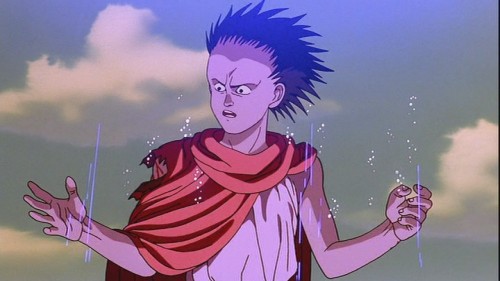
Akira is very famous for its visual style and excellent animation. Everything, from explosions to vehicles to environments (as mentioned above) are rendered beautifully with fluid movement, and it is in this hyper-realism that the fragility of the world in which they live becomes most noticeable. The world of Akira is almost so tangible that it may crumble if touched.

Most of the people who I have met who have a fondness for Akira saw it in their teeange years, like the guy waiting behind me on line. It is in our teenage years that our minds and bodies develop most rapidly, and we begin to think that we control of our lives, or perhaps that our lives are out of control. Tetsuo and Kaneda themselves are teeangers. In a sense, Akira is a visualization of the conflict of being a teenager, where the more you learn about the world, the more frightening it can become. Given the theme of Akira, I realize that while it was not a mind-blowing experience for me individually, it is no surprise that it has been one for so many people.

Despite all that I wrote, I still believe Akira is easy to understand. If you’re struggling with trying to make sense of the narrative, it may just be that you’re trying too hard to control it.

OEL Manga, what is up with it

A few years back Tokyopop started advertising and promoting its own line of “Original English Language” or OEL Manga, and no one I know reads them. I’ve checked out a few here and there, but I feel something holding me back when I see a title in the stores. On the few occasions where I have picked one up to read, well, sometimes I’m pleasantly surprised and other times I’m not.

I liked Bizenghast overall, but the fluctuation in quality from page to page was very distracting. A well-done drawing would lead into a rush job into another nicely detailed drawing, and it seems like the product of someone with not enough time to really hone each panel.

Dramacon is another one I decided to take a look at, simply because Anime Jump and others had lauded it for being one of the better titles. I found myself unable to finish it, as it felt less like a heart-felt examination of the convention scene and the drama in it and more like wish-fulfillment on a level below Comic Party. What’s a mysterious love interest with a scarred face doing in a story where the focus seems to be Normal Anime Fans Doing Their Normal Anime Things? Maybe I’ll come back to it at some point, but it was like the pieces of the puzzle did not fit together properly.

I’m probably giving them a harder time than I should, but at the same time I’m really not, as it was Tokyopop’s desire to showcase these talents on a level on par with work from Japan. If there’s any OEL titles of merit that I’m overlooking, I’d like to know about them.

Your Doujin Work Sucks

Hiroyuki, author and creator of Doujin Work, is not exactly a common name among anime fans. In some cases, I’d suspect that mentioning it would get more people thinking about To Heart than anything else. No, Hiryoyuki is probably better known around the internet for his comic involving a bespectacled teenager with a troubled past trying to get it on with a feline familiar. In other words, “A Cat is Fine Too.”

So here we have a man firmly rooted in the doujinshi “industry” making a comic about creating doujinshi. The story centers around a girl named Osana Najimi and her quest to create doujinshi. However, unlike Kazuki of Comic Party, who draws because he finds it incredibly fun, or Ogiue of Genshiken, who draws because she can’t help it, Najimi dives into the world of doujinshi for one reason and one reason only: profit. Her friends Justice and Tsuyuri are able to sell well at doujinshi events, so with a little practice the money-loving Najimi feels that she too can rake it in.

The only problem is that she sucks at drawing. Najimi has no natural talent, and effort does not seem to reward her much either. The work she creates sells mainly for the so-bad-it’s-good factor.

Hiroyuki’s style, born out of drawing doujinshi, makes much sense for a comic revolving around doujinshi. Overall, the manga (which is presented in 4-panel-style) is well-drawn and entertaining. The same cannot be said of the anime.

The anime adaptation of Doujin Work suffers from poor animation, though much of it is forgiven when taking into account the (presumably) low budget and fairly simple designs of the characters. There were also rumors floating around 2ch and the internet in general that working on the animation with Hiroyuki was a bit of a nightmare, and not in the good way. Even if this is just a rumor, the result is still a show that could have looked better and been better.

But that’s what makes it so interesting.

Here you have someone drawing a comic about a person who tries to get into the world of doujinshi with lackluster results. This comic is then adapted into an anime…with lackluster results. In a sense, the mediocre showing of the Doujin Work anime adaptation is the best possible outcome for it.

“Oh, but that wasn’t intended by the creator!” you might be saying. Well, not everything intended by the creator defines a work. Kind of like when an anime becomes a cult classic in spite of its quality and not because of it.

PS: I know the anime adaptation has a section which shows the voice actors of the anime trying to make and sell doujinshi, but for some reason no one ever bothered to include those parts in the available episodes. A sad loss.

Fireball: Disney did WHAT now?

Fireball is a 3-D animation airing in Japan, produced in part by Disney.

Yes, that Disney.

Each episode is less than two minutes long, and it seems to be a concerted effort by Disney to make newer in-roads into Japan’s animation-watching audience. I say newer because Japan IS actually fond of Mickey Mouse and friends, not to mention the fact that Tezuka idolized Walt Disney.

The use of 3D Animation is interesting, as it’s something that Japanese animation hasn’t really been great at, so in a sense it’s using Disney’s power to its advantage, though I don’t actually know to what degree they actually help.

The main character, Drossel, appears to be at least partially designed to appeal to otaku, with her long twintails and slender robotic figure and large “eyes,” so I also get the feeling that they are trying to tap into this audience as well.

I suspect this has something to do with seeing the success of Powerpuff Girls Z in Japan.