More Shows Should Be Like Heartcatch Precure

While I’ve made it fairly clear before that I think very highly of Heartcatch Precure, I realize that I have yet to actually made a post about why I think the show is so good. Today, I will correct that.

From the vibrant and colorful character designs and setting to the energy of the series to the quality of the dialogue, Heartcatch Precure has a lot going for it. But what I think is most remarkable about it is how surprisingly mature the show can be while also still being very much for children.

Since the first Pretty Cure, the central protagonists have always operated on a theme of opposites. One is smart, the other is strong. One is talented in the arts, the other is talented in sports. As the series grew to encompass larger casts, the idea of having the characters be distinctly unique in this manner grew as well, but it’s with Heartcatch Precure that characterization has hit its highest point in the franchise.

When I watched the first episode, the first thing that really caught my attention (aside from the lively animation of the opening) was the interaction between the main characters, Hanasaki Tsubomi (“Cure Blossom”) and Kurumi Erika (“Cure Marine”). Tsubomi is a transfer student, eager to defy her previous reputation as a wallflower. What she doesn’t expect however is for the seat next to her to be occupied by Erika, a fashionable girl who sometimes has trouble with the idea of “personal space.” Erika is well-meaning and is looking to make a new friend, but her aggressive, extroverted personality is too much for the introverted Tsubomi, creating a tension between the two which is only later resolved when they learn more about each other and their own fears and doubts. Tsubomi learns to be a little more confident and out-going from Erika, and Erika is in turn influenced by Tsubomi’s patience and kindness.

In case it wasn’t obvious that Heartcatch Precure is a kids’ show, the Monster of the Week format makes it very clear. Not only is there a Character of the Week that appears and needs helping out, but they are usually transformed into the Monster of the Week as well. The gimmick is that in their monstrous form, the character expresses his or her deepest negative emotions, such as the fears and doubts in their lives. Kids’ shows really don’t operate on subtlety, and the very fact that the show just tells you exactly what is wrong with the character is the very opposite of subtle, but when I take into account the fears themselves I can’t help but be impressed at the level of maturity. Anger at being told that your dream is impossible, frustration at having to grow up too quickly because of a death or illness in the family, depression at letting others down when they need you most, the series does not shy away from presenting some very serious topics. Heck, the very fact that one of the show’s main focuses is the way these negative emotions can exist in a very real way inside all people is in itself surprisingly adult.

When I look at Heartcatch Precure, I see a heart and soul behind the series. Yes, it is still a part of a merciless merchandising machine of a franchise. However,  I can see in the show that the creators desired to make a show for children that tells them, “Someone out there understands your frustration,” and helps them grow in the process. It’s something I can really get behind.

The Society for the Study of Ogiue Dialogue

Today, I want to try something out with anyone who reads this post and has read the official English-translated Genshiken manga from Del Rey. It’s a simple question whose answer from a great many I would like to see.

What do you think of the way Ogiue talks in the English version of the manga?

I don’t want to reveal the entirety of my intentions quite yet (though they may be somewhat obvious), but do know that I plan on doing a follow-up post once I have gathered responses.

Wait, Where Am I?

The other day a startling realization hit me.

While I’m still watching anime as I always do, my intake of older and classic anime has been on the wane as of late. When I look at the shows I’m currently watching, Heartcatch Precure, Durarara!, Giant Killing, among others, they’re largely new-fangled series. This solution is as simple as watching older series, but my concern lies more in the possibility that I was getting caught in the seasonal trap without realizing it, that I was starting to get new-series tunnel vision. While I think it’s important to watch what’s new, I don’t want my perspective too shaped by simply what is there “now.”

I also realized easy it is for anyone to get caught in the seasonal trap if you’re an internet-based anime fan. Its ease of access is like a warm embrace and it’s all too simple to just let it happen.

Though actually, I have been getting my “classic content” through manga. I’m on an early shoujo kick, picking up volumes of Attack No.1, reading Swan, getting all of Rose of Versailles, but seemingly at the expense of reading newer titles. It’s like with anime I’ve planted myself with the present, and with manga I’m entrenched in the past. It’s not quite what I’d call a “routine,” but before I knew it these had become my fandom habits.

I’m perfectly aware that there’s nothing really “wrong” with the way I’m doing things, but it’s still something I’d like to change before I get too comfortable with it. After all,  “Running water never grows stale.”

I’d Kill Kill Kill Kill Kill For That Ability

Heiwajima Shizuo of Durarara! is a man of many traits. He’s a berserker. He’s a man who wants to be a pacifist but can’t seem to get it down. There’s one quality in particular that I want to focus on however, and that is how unusually perceptive Shizuo can be.

All of us to some extent set up walls and barriers in our lives. Sometimes they’re to keep people out, other times we reinforce them and build upon them and even decorate them to the extent that we expect others to see us as these walls. But Shizuo’s personality is such that he sees the “truth” more readily, as if his senses are more animal than human. Wall-building is not a trait he’s familiar with, so he ignores it entirely. He’s naturally attuned to human nature, even if he isn’t aware of it.

Shizuo’s perceptiveness reminded me of  another show I’d been watching alongside DRRR! last season, Kimi ni Todoke. In it are two characters who could best be described as “simple-minded,” but it’s that simple-mindedness that allows them to sense deception or the absence of true honesty, much like Shizuo.

The first is Chizuru, the tomboyish friend of the main character Sawako.

The second is Pin, the loud-mouthed, belligerent teacher.

In both cases, you can see how much finely-tuned their instincts are to seeing past the elaborately constructed walls of human life when they interact with the character Kurumi. Kurumi is seen as beautiful and sweet, but her looks hide a manipulative personality. When Kurumi tries to turn on the charm with both Chizu and Pin, they can’t help but feel that something is amiss, even if they can’t pinpoint it. They can see the walls for what they are.

Personally speaking, I really wish I had a trait like this. Or maybe I do, and I don’t realize it. Or maybe I don’t, and I’m just kidding myself.

I Have the Answer. What’s the Solution?

Do we really know why anything is popular?

Whenever an anime or manga is super popular, be it with “casual” fans or super hardcore 4channers or die-hard bloggers or anywhere in between, someone eventually decides to ask, “Why is this popular?” The question can be interpreted positively, encouraging people to express why they like that work so much. It can also be interpreted negatively, giving way to sweeping generalizations that categorize a work’s fans in a particularly unattractive light.

As a quick demonstration: Why is Baka to Test to Shoukanjuu so popular?

We can posit why Gundam isn’t popular “here,” or why Captain Tsubasa is popular “there,” but after a while I just have to wonder how often we’re putting the cart before the horse, completely blinded by hindsight and trying to draw conclusions from something most people might have trouble expressing in the first place, even if you asked every Naruto fan why they like Naruto so much. And in a way, when we accumulate more knowledge and experience in anime, we paradoxically move both closer and further away from the truth.

Not saying I don’t enjoy the speculation, nor am I telling people to stop, but popularity (or lack thereof) can be such a difficult entity to grasp and manipulate that I’m sure we’re all wrong more often than not.

Also, I know this doesn’t just apply to anime or manga or even fiction. Asking why stuff is successfully popular is applicable to just about any topic where  group enjoys or uses something.

No, really, why is  Baka Test so popular? I liked it well enough because of the way it embraced the otaku/moe/anime humor and really ran it to some logical extremes, but why is it considered the #1 light novel series of 2009?

So Then Maybe Sesshoumaru is Darkseid?

Warning: Inuyasha Spoilers

Despite the fact that Inuyasha: The Final Chapter ended recently, I have not seen very many people talking about it. I know that can’t possibly be the trend across anime fandom as a whole, though. It’s Inuyasha after all, the show so popular it all but defined Adult Swim anime alongside Cowboy Bebop.

I already know about the ending from having read the manga, but remembering just how long and encompassing Inuyasha is, and how much detail that is ideal for a fan-made Wikipedia about the subject exists, I took a look over at the Inuyasha Wiki, reading up on what swords Sesshoumaru uses, what the heck people’s attacks are, as well as the character who deservedly has one of the longest and most complicated entries on the Wiki, Naraku.

As I read Naraku’s entry, his description started to remind me of another famous villain. He’s powered by negativity. His power is seemingly infinite. He increases his power and transforms thoughout the series. He has a vast army of demons under his control which he can absorb in order to regenerate and heal (which the heroes manage to turn against him). At the very end, in a desperate situation, he switches to a strategy of pure revenge and destruction, abandoning his tendency towards elaborate scheming.

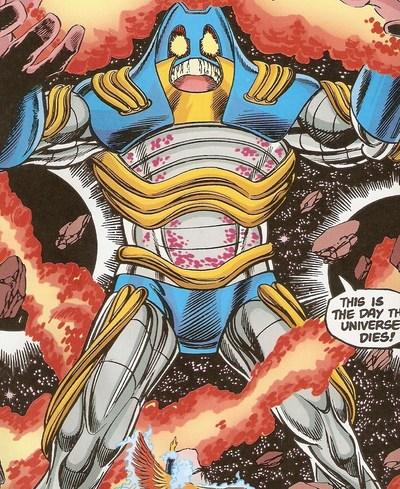
Naraku is like the manga equivalent of DC Comics’ Anti-Monitor.

The End of the Otaku Diaries, the Beginning of More?

In their concluding post of the Otaku Diaries, Hisui and Narutaki of the Reverse Thieves reflect back on their experiment: the ups, the downs, what could have been done differently, what they learned, and what they’d hope to learn in the future should they take up the task again. I hope to see them take a swing at it at least one more time, but that’s up to them.

One of the really remarkable things about the Otaku Diaries was that it was a concerted effort by the Reverse Thieves to learn about their fellow fans, and to do so by collecting information in a structured manner. With anime blogging (or hell, writing blogging in general), it’s very easy to play fast and loose with facts and data, and to write based primarily on feel (I am guilty of doing both), so it gives me a degree of joy to see bloggers who actually want to discover more about their peers instead of pigeon-holing them in stereotypes or talking in too-broad strokes. The project wasn’t perfect, as they’d themselved admit, but it opened up new possibilities.

Obviously I’m not telling people they can only write about anime and fandom once they’ve gathered enough information on the subject, but I’d like to see others encouraged to try similar endeavors, to really reach out and try to learn about your comrades-in-arms. I could stand to do more of that myself.

On a final note, I think they’re onto something with the idea of interviewing people over Skype instead of simply writing surveys. Provided they can make the conversation easy-going (and I know they can), it would allow a lot more otaku to open up, and would also make the conversation more free-flowing.

Worth Thousands Upon Thousands of Words


This picture is here for a reason.

The Aniblog Tourney has me looking at a whole lot more blogs than I normally do, and as I check out one after the other, I’ve noticed a recurring blogging style that many sites follow, and I would like to figure out where it came from.


I also have no recollection where this image is from.

The style is defined by its frequent back-and-forth switches between between text and anime-related images. Sometimes it involves screenshots, but more often the pictures are high-resolution fanart with some kind of humorous caption underneath.  At their most extreme, images and text will alternate at a frequency of one image per paragraph.


Like so.

Now it’s easy to point fingers at “episodic blogs,” but that’s a little different from what I’m talking about, as a glut of screenshots is practically par for the course for an episode review. Also, many times they’re placed at the beginning, with a summary and then opinions following. This 1:1 paragraph to text ratio seems far more common with editorial-style anime blogs.

So I’d like to know, where did this style come from? Using the Aniblog Tourney itself, I checked out the highest-seeded blogs in the tournament to see if it was their far-reaching influence which provided younger bloggers with a stylistic framework, but in all of the cases the connection would be tenuous at best.

I might be thinking about this too hard. Maybe the desire to alternate paragraphs with images at a constant rate goes beyond simply anime blogging to the fact that there exists a space between every paragraph, literary voids which beckon to gain prominence by having art emerge from them. Or maybe it’s that people take screenshots and download fanart in batches first, and then look for ways to apply all of the images to an existing post. I’ve felt that desire myself, as it becomes hard to decide which images to cut from a post, a decision almost as difficult as having to cut out extraneous paragraphs that kill the flow of a post.

Speaking of which, the reason why I don’t really throw in a large amount of images into my posts is because an excess of images has the potential to be detrimental to the writing itself, interrupting the flow of a post as much as a superfluous paragraph, if not moreso. Not to say that it’s impossible to write well with constantly alternating paragraphs and images, but you risk cutting off your writing at the knees just as it’s starting to go into a full sprint.

So if you’re a fan of the aforementioned style of blog-posting, tell me, where did you find your inspiration, if any at all? If you really enjoy those types of posts, what in particular do you like about them?

Maybe Scanlators Just Gotta Scanlate

Lately I’ve been following a most insightful user on Twitter called otaku dog. A Japanese person running an otaku goods import service, otaku_dog has made his presence known on the internet through his desire to engage with the English-speaking anime fandom. While I have not tried out his “Otaku Personal Import Agency,” I have had a chance to have a few discussions with him via Twitter.

It was in one conversation that he talked about how he is not only a fan of anime and manga, but also American comics, particularly Neil Gaiman’s Sandman. He spoke of his desire to read more of it, but that the translation never finished and that in general translation projects of American comics tend to die down and never revive.

“American comics translating projects often do not continues to last….(;- -)”

I do not know if he meant official translations or fan ones. Regardless, it made me think about the scanlation and fansubbing community, and how for all of the negatives in those communities, from the egotism to the translations wrought with errors to the personality clashes and drama and millions of other problems fan translators can have and often do, things still get translated. It might be the most popular series which get the most attention, but we see translation groups occasionally gravitate towards  fairly obscure series, even if the motive is to garner attention and praise. This is a huge contrast to otaku dog’s description of the reverse and in a way it’s quite impressive.

One possible factor for this wide disparity might be the fact that Japanese comics generally have significantly less text than their American counterparts, particularly with someone like Neil Gaiman penning the work. This is related to the differences in storytelling through panels that emerged between the two countries, and even those from the Golden Age that were produced purely for the enjoyment of children and not today’s older audience tended to be densely packed with text, making translating American comics possibly more time-consuming.

The difference in text density between Japanese and American comics also makes me think about that old stereotypical moment from throughout the decades, where a parent takes a child’s comic book away because it isn’t “really reading,” and that pictures in books are a sign that it’s juvenile. If only those parents knew about the brevity of dialogue in manga…

(By the way, I’m well aware that the title of this post can be a bit misleading.)

Dairy Influences: A Personal Look At “The Far Side”

In his latest comic, the author of Gunshow Comic pays tribute to cartoonist Gary Larson (while also making a reference to his own series, The Anime Club, which I talked about previously). The Larson style was instantly recognizable to me, as I am actually a long-time fan of his classic one-panel newspaper comic The Far Side. Seeing this parody of the man’s work, it makes me want to reflect on the influence that his surreal humor had on me and my development in art and life.

Long before I could even really call myself an “anime fan,” I was a fan of The Far Side, calling it “my favorite comic” for years, and to this day I consider it to be the very best one-panel-style strip in history. For those unfamiliar with it, The Far Side was typically a single-panel (though it would sometimes split itself into two or more), and would be a mix of suburban stereotypes and off-kilter humor that took normal situations and twisted them just enough so that the mild absurdity would be magnified ten-fold. The comic also often featured humor based on biology, a direct consequence of Gary Larson himself being a biologist as well as a cartoonist, and while it had no real recurring “characters,” it did have a number of iconic designs and stylistic flairs. Bespectacled pudgy boys and their bee’s nest hairstyle mothers, animals standing and talking like people (particularly cows), and a tendency to have bulging eyes be an attention grabber were all common sights The Far Side. In a way, it was like a precursor to the Perry Bible Fellowship.

I would provide an example image, but Gary Larson has personally wrote letters asking everyone to not post his comics online, and while not 100% perfect it has worked surprisingly well. And so, even though I know that explaining a joke inevitably ruins it (as author Stephen King demonstrated in his foreword to The Far Side Gallery 2), I’m going to try so that you can understand Gary Larson’s style of humor.

The comic is situated in the backseat of a car, behind the driver. The driver is staring into his side-view mirror, and as is the case with all side-view mirrors, there is text to inform the driver that “objects in mirror are closer than they appear.” The object in the mirror, meanwhile, is an eyeball taking up the entire surface of the mirror. In other words, the object reflected is your eye staring into the comic’s panel (Again I apologize for my humor assassination).

So what did The Far Side do to me? When I first discovered it either fourth or fifth grade, I already loved to draw, but Gary Larson’s comic made me love art even more. It gave me a role model in art to look up to, and it gave me a direction to take in my drawing. I started actively trying to make things that would be seen as “crazy.” I created my own Far Side-style comic, called My Biz and also Crash and Bash Land, about horrible rides in an imaginary amusement park whose themes were violence and abuse of its customers. Both were as good as you’d expect a 10 year old’s attempts at Far Side knockoffs would be. Even after I discovered anime and became a “fan,” I held in my heart two dreams, to draw a full-fledged story comic like my favorite manga, and to create a humor comic that would appear in newspapers.

Today, though I no longer aspire to draw my own absurdist newspaper strip, I can see that Gary Larson had an enormous influence on my sense of humor, and for that I am ever so grateful, though my peers who have seen my brand of comedy in action may be inclined to disagree. You can even see The Far Side‘s effects on at least some of the drawings I have posted to Ogiue Maniax. And though I can’t tell you for certain, I think The Far Side probably even influenced my writing style through its combination of simplicity and eccentricity where even those who weren’t enthusiasts of biology could find a laugh or two.