The Thing Which Makes You Think, “Ah Yes, This is an American Comic”

In the comments section for kransom’s translation of Takekuma Kentaro’s lecture on Miyazaki, a lot of talk is brought up regarding styles and trends according to where the artist is from or where the artist draws their inspiration from. Specifically, the comments center around Miyazaki’s style being similar to that of European artists. Commenter JBR states, “Nausicaa is very similar, in many ways, to the European avant-guard [sic] comics of the 1970’s/80’s, which also emphasize densely-constructed panels and attention to background detail.”

So if the emphasis on European comics is on these “densely-constructed panels and attention to background detail” (something that rings true even for comics that aren’t avantgarde), and the priorities for Japanese story comics is in having the panels be “easy to read” with respect to how panels flow into each other and other aspects, I had to ask myself, “What is the primary feature of American comics, specifically comic books, that makes it stand out?” What, in other words, is the aspect that artists and fans can draw from to make a comic feel very American?

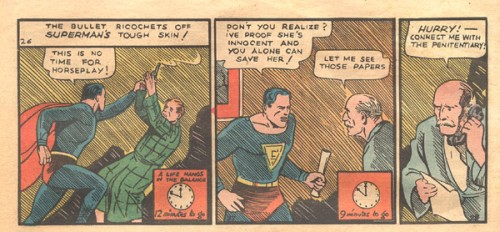
Thinking it over, I’d have to say that I believe that traditionally, the primary feature of American comics is the desire to convey a complete amount of information in a single panel, to really inform the reader that, yes, this is going on right now exactly as you see it. Characters’ poses and actions in relation to text and background all work together to provide a sort of storytelling clarity that some might even regard as overly busy. You know where that foot is going. You know exactly what the characters are doing. You know what is going on in a given scene, as if every panel were an incident in and of itself. Some might say this is the problem with American comics, but I think that wanting to present information in your comic in complete chunks has its merits, in the way radio dramas of yesterday and cd dramas of today do. Of course, I say “traditional” because as comics artists from all over the world interact with each other these differences start to recede, but I think you can still see them in today’s comics.

I’m well aware that there are comics that do not do this, and that even in the comics that do there are plenty of panels which are more for conveying a mood or some other function. I’m also aware that all the visual examples are from superhero comics, and that there’s an entire indie comics scene out there, and famous artists such as Dave Sim, Robert Crumb, Chris Ware, Art Spiegelman, and even Brian Lee O’Malley who do not abide to this “rule” if you can call it one. However, I do feel that this is the aspect of American comics which people remember the most, whether they’re long-time fans or new readers, these panels designed to exist on their own if they have to, but also function as part of a whole.

Lady Boobsalot and the Gluteus Gladius

With American comics and animation you’ve got Vampirella, Lady Death, Heavy Metal, and Witchblade.

With Japanese manga and anime you’ve got Ikkitousen, Queen’s Blade, Grenadier, …and Witchblade.

All of these titles and more center around buxom ladies kicking ass and taking names but always being just on the other side of emasculating so that we as guys can picture them in our fantasies, if that’s the sort of thing we’re into.

I can throw around all sorts of descriptive terms, like fanservice, cheesecake, girls in metal bikinis, girl power, but is there a specific name for this genre?

If not, I propose a few.

“Swordcake”

“Tit Fighter”

“Action Cleavage Boobs Fest”

Or perhaps, as one friend suggested, “Softcore.”

The Differences in Realism in Video Games

For as long as video games have existed, there’s been a graphical arms race. The Intellivision claims its superiority over the Atari 2600 due to its much more accurate-looking versions of Basketball and Football. The Sega Genesis has 16 whole bits, twice as many as the NES, a number whose significance in marketing was always accompanied by images to show much better Genesis games looked. With the rise of 3-d graphics, particularly with the era where the original Playstation was king, there’s been a push towards manufactured realism. While it’s not like the pursuit of realism didn’t exist previously (Mortal Kombat’s digitized graphics looked amazing at first), it was with 3-d graphics that the foundation was laid due to the simple if faulty logic that a three-dimensional game is more like our three-dimensional world.

As we look at today’s graphics, we know that the pursuit of realism is still going strong, with improved lighting, increasing numbers of polygons per model, and just tons of work and money being put into getting a scene in a video game to look like a photo. While I’m not a fan of this push towards realism as I believe it to be somewhat of a dead end, what I am interested in is how America and Japan differ in their depictions of “realism” in video games, or at least what the perceived difference is. The reason why I say America and Japan of course is that these two countries are really considered to be the places where mainstream video games happen.

Let’s take a look at male characters in games. In essence, characters in “realistic” games made in America are stereotyped as a bunch of square-jawed tough guys who have to drink beer and shoot enemies with automatic weapon fire as a display of their manliness. The male characters of Japan are criticized as being overly effeminate, sometimes to the point that people wonder whether or not it was necessary to make them guys in the first place, and even the more muscular and masculine guys in Japanese games tend to have a bit of beauty to them. Neither category is actually true and you can find a million exceptions, but these are where the stereotypes stand. And as I looked at these generalizations, they seemed oddly familiar, as if I’d seen this argument happen before, and it also occurred between Japan and America. And then I remembered: Comics vs Manga.

The same complaints that are leveled at the male characters of Japanese and American games are given to the characters of comics, from complaints about superheroes being too musclebound to bishounen being too much bi and not enough shounen. And so I have to wonder, how much do comics play a role in the depiction of realism in games for either culture?

By now, we know that the realism from games isn’t meant to actually be “like reality,” but rather a sort of hyper-realism where things we consider to be part of the actual world like muscles and sweat are emphasized and exaggerated. The difference then comes from what is perceived to be important to realism, and when it comes to non-abstract comics, I believe these elements are also very present and perhaps even more prominent. Of course, I can’t completely ignore the idea that both comics and video games are simply influenced by the reality of society. Most likely, it’s not a unidirectional relationship and at this point, especially as video games enter the mainstream more and more, and they will affect the aesthetics of video games and the environment around us in even more profound ways.

Clark Kenshiro