When I was in art school, I often heard a recurring sentiment from my fellow students: “If people can understand even 10% of the message my piece conveys, I would be happy.” Though we differed in style, talent, skill, and experience, there was a mutual desire to have we put into our work to make it to those viewing it. So when I began reading the fine arts–themed manga Blue Period, and the main character starts to cry after his friends “get” his drawing of Shibuya at dawn, it brought me back to those younger days. It also told me that this manga really understands the struggle that artists have with themselves and their work.
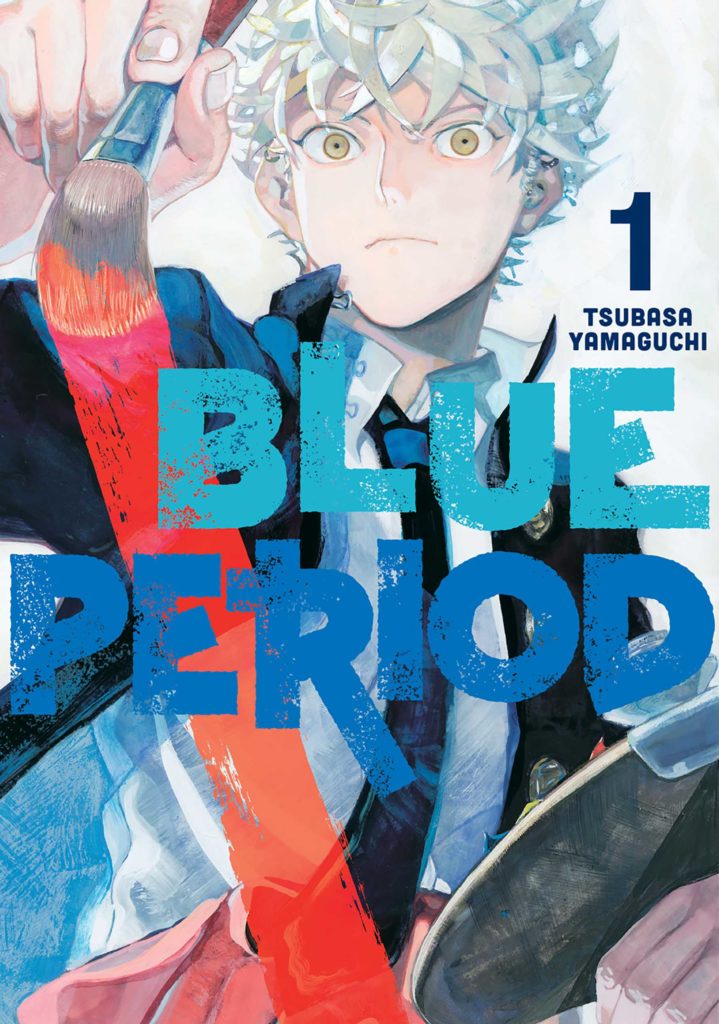
Blue Period is the story of Yaguchi Yatora, a contradictory “academically successful delinquent” whose social and school careers are both solid. However, Yatora is prone to being the person others want him to be, and he lacks personal motivation. When a chance encounter with an older female classmate’s large-canvas artwork fills him with inspiration to try making something himself, it leads Yatora to start down the path of applying to art school despite his parents’ wishes. As a total beginner with certain expectations placed upon him by friends and family, the walls he must surmount are tremendous.
It’s rare for manga and anime about artists to actually be about art; most of the time, it’s really just a motif to convey drama and/or comedy. This is a fine approach, and some of my favorite series fall under this umbrella—Hidamari Sketch and Honey and Clover stand out. But like Blank Canvas, Blue Period takes a more serious approach, delving deep into the “art” of art, so to speak. From theory and experimentation to the emotional roller coaster that comes from thinking you’re hot stuff one day and hot garbage the next, I can speak from personal experience that what’s portrayed is all too real.
While Blue Period does approach the subject of art very seriously, this doesn’t mean it’s a dry and boring instruction manual. The characters and their stories are some of the best parts of the series, and I find myself drawn to most of them. Yatora himself is quite rare in terms of protagonist types because being a successful yet directionless individual is not the kind of conflict you see too often, and the rest of the cast feels like three-dimensional individuals living their lives, whether they appear a lot or a little. Whether it’s Yuka’s gender-nonconformity riling their parents up, Kuwana being pressured by the artistic pedigree of her family, or even Yotasuke’s reasons for being an artist clashing with Yatora’s, their world and their emotions feel real.
Blue Period is the kind of series I enjoy most: one where character interactions are robust and powerful. In that sense, it reminds me of Kio Shimoku’s work in certain ways. Notably, Blue Period is actually serialized in Monthly Afternoon (home to Genshiken and Hashikko Ensemble), which makes me think the similar vibes are less a coincidence and more a general editorial emphasis.
I’ve both watched the anime and read the manga, and while they largely tell the same story, they each have a particular feeling that makes them not quite 1:1. The anime has the advantage of portraying things in color instead of black and white, which makes the artwork feel more like how you’re “supposed” to see it. The pacing is also such that the human drama is emphasized. The manga has one obvious edge in that it goes past the anime, but even putting that aside, there’s more to it. The manga lingers more on the art and its characters’ internal worlds more, and the rougher artwork has an appeal all its own. In short, the anime feels like it emphasizes the interpersonal more, whereas the manga is more about the internal.
One theme that comes up in Blue Period is the way that making art can be very revealing about oneself, and willingly exposing your deepest self to the world can be intimidating. Seeing Yatora and the others so hard at work reminds me about my own journey and process, namely that I wasn’t half as dedicated as these characters are. Blue Period may be making me confront my own inadequacies and regrets, and I can’t help but feel that itch to start making art again, if only to address those unresolved emotions.


 OGIUE MANIAX