

Warning: Full Spoilers
When I first started watching the 22/7 anime TV series, what stood out to me was how generally serious it was—not only compared to other idol anime, but also what I knew of it from one of its official Youtube channels. Instead of the off-kilter hijinks of a bunch of virtual youtubers, the anime follows a formula of introducing the backstories for each character in order to show how they became who they were. While all of them have some element of drama or tragedy, with the recurring theme being that they weren’t all born with the personality and attitude they have now (especially when onstage), all of them are well within the boundaries of what one would expect out of idols, especially fictional ones.
By the finale, however, the one big exception to those confines is the main heroine, Takigawa Miu. I don’t know if I’d call her my favorite character of the series, but she ends up being the most memorable part of the 22/7 anime.
The first couple of episodes revolve heavily around Miu, who’s shy and unconfident to the point that it loses her a much-needed part-time job, and who has some sort of trauma when it comes to playing piano. At first, she’s extremely reluctant to join 22/7 and become an idol, but over the course of the series, she opens up and becomes more comfortable with her fellow members. We learn about the other girls as well, and then we reach episode 11, which focuses on the childhood of Nicole, the one among them who gave Miu the hardest time early on. What we see in that flashback is that the two knew each other in elementary school, and that a single event would tie the two together.
Unlike her current self, Nicole was very shy and quiet, often being bullied by other students. When it came time to put on a school play, Nicole’s name was volunteered by her tormentors to play the evil queen, and they play a prank on her in an attempt to embarrass her during the performance. Miu, who’s also in the play, runs onstage and tackles one of Nicole’s bullies.

At this point, I think most idol anime, which tend to be kinder and gentler, would make that tackle one of the big moments. It would cut away and all the characters would gasp. 22/7 takes it a step further, and shows Miu actually wailing on the girl with closed hands—albeit, not as punches or anything, but more like the flailing hammer blows you’d expect from a little kid. Not only does this differentiate 22/7 from so many of its peers, but highlights a certain depth of character to Miu. She’s not just the girl who lost confidence and found it—she’s someone who has a strong sense of fairness, and is willing to throw hands to make her feelings known about that.
That was the past, and it doesn’t entirely gel with the image we have of her in the present. However, as the series nears its climax, the mysterious “wall” that was giving them instructions all along reveals that it is actually an AI that had been manipulating the girls for its own purposes and no longer needs them. As the 22/7 girls strongly plead to let them join back together instead of disbanding, the AI refuses to budge. When hope is all but lost, Miu steps up to make her intentions known…by hitting the wall with an armchair.
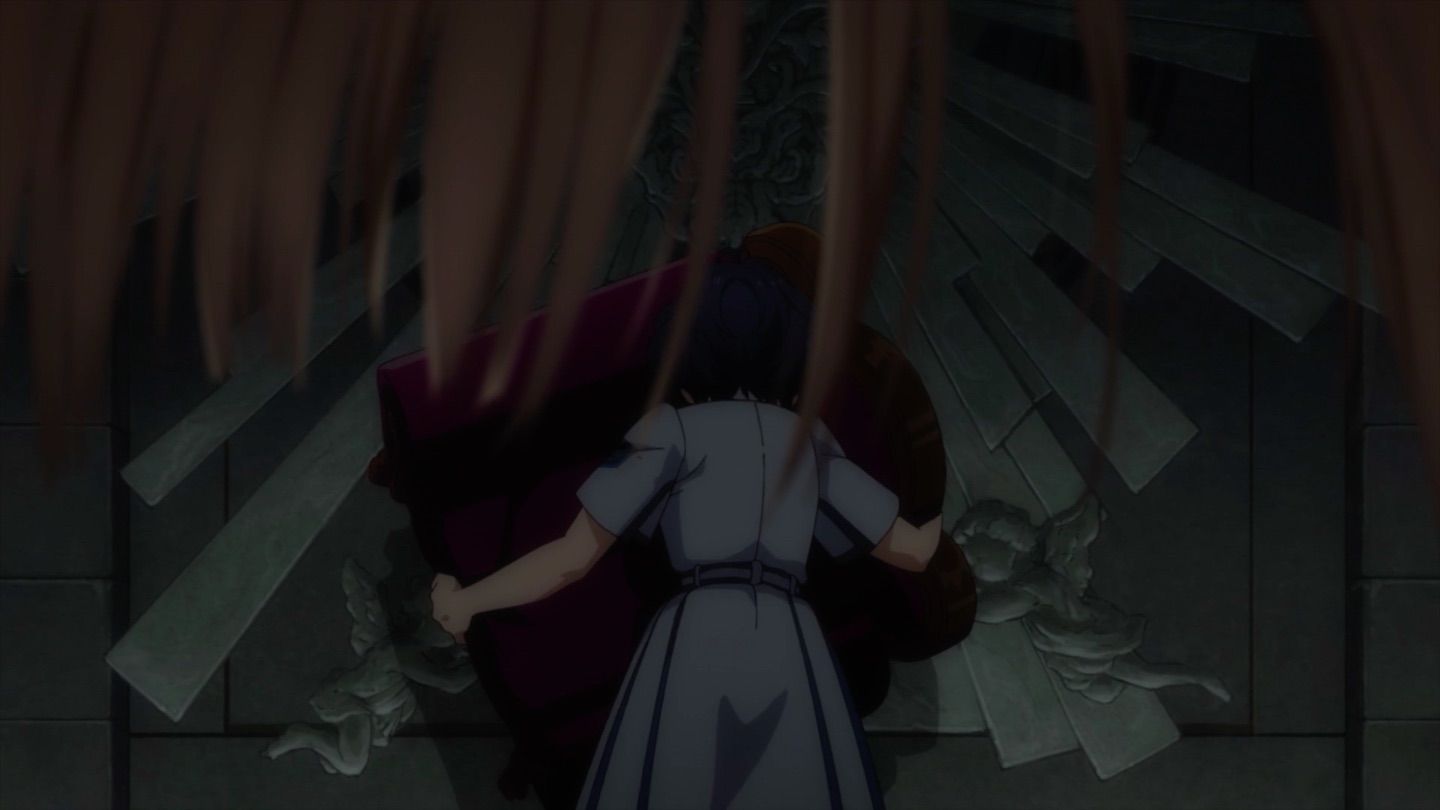
What really impresses upon me in this scene and the one Snow White performance in the flashback is that Miu’s actions aren’t portrayed as “wacky” or “cool.” They’re expressions of frustration and indignation over perceived malicious acts, and they come from someone who lashes out despite her lack of confidence because of what she believes in. It’s a far cry from a pillow fight or some slapstick antics, and it’s what establishes the 22/7 anime as a little more than just some forgettable idol fair.
 OGIUE MANIAX