
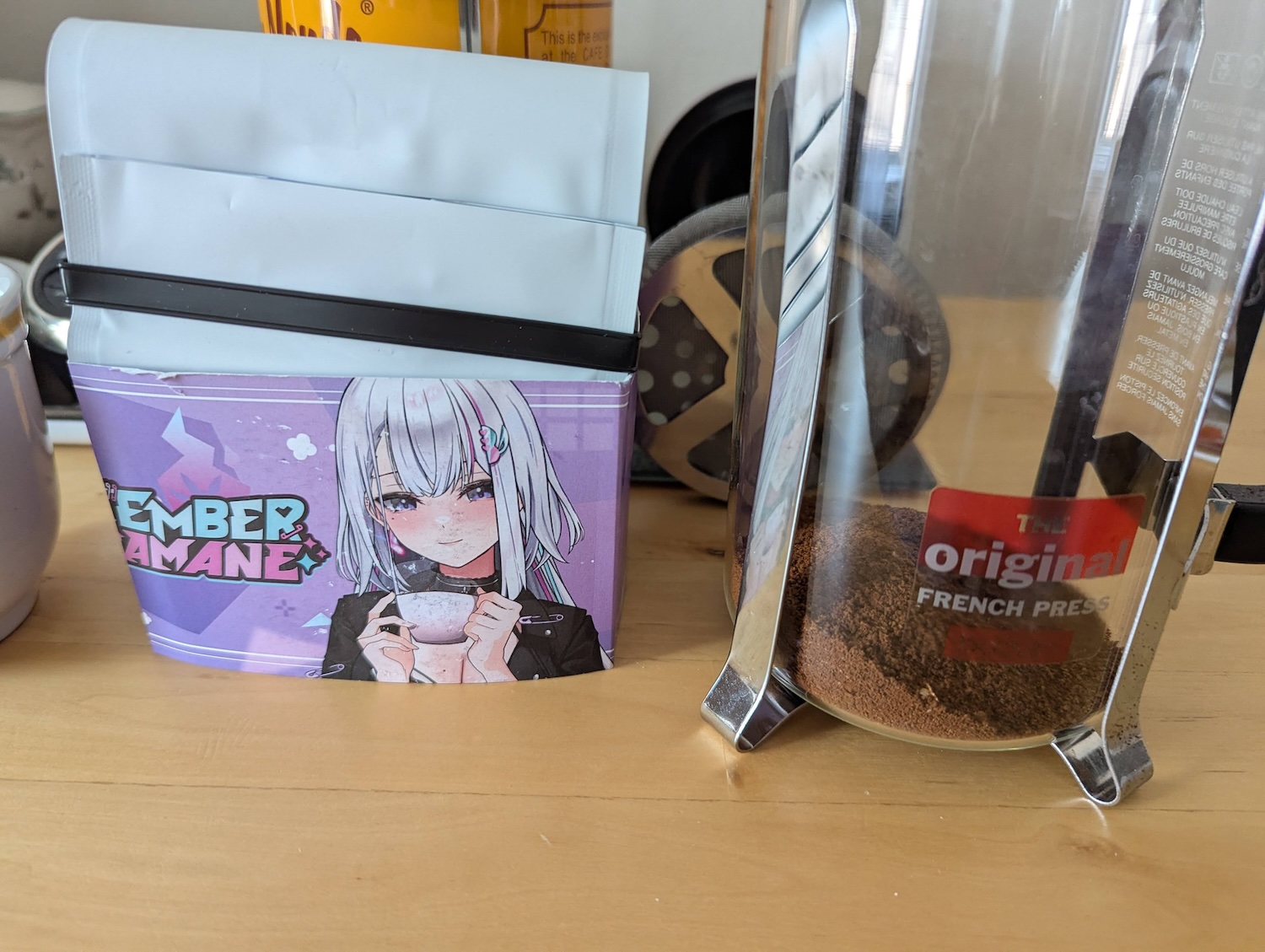
One of the most oft-recurring jokes about the VTuber company Phase Connect is that it’s actually a coffee store with a VTubing skin draped over it. It defies common sense as a business strategy, yet somehow they stay afloat. What kind of fool would buy coffee beans just because there’s an anime girl slapped on the front?
Me. I’m that fool.
And apparently, I’m not alone. At Anime NYC in 2024, all the coffee was sold out by the time I got to their convention booth. The following year I was more fortunate, and I managed to get a bag of the Ember Amane custom roast. I wanted to get the Dizzy Dokuro beans as well, but failed to take into account that her Dizzy Dizzy Coffee jingle would be so effective at getting people to buy hers in particular. Lesson learned.
It helps that I happen to have gained a greater interest in coffee in 2025. Thanks to a gift from a friend, I was encouraged to start trying to make coffee at home, and it’s put me on this little journey. Phase Connect coffee dovetails neatly into this new minor hobby. Also, I decided to buy specifically at Anime NYC for a reason: I didn’t want to see what the tariffs would do to an online order (and because it’s psychologically easier for me to excuse a weird purchase like this when I’m on the show floor).
As for the Ember coffee, the official store describes it as follows:
Fiery and fun loving, the Ember inspired coffee has some very warm red notes. The coffee bean chosen to match Ember comes from Papua New Guinea. This coffee has nice stone fruit flavours and a fiery spirit with a slight floral note to match Ember’s feminine charm.
In making it, I used the following equipment.
- A Kingrinder P2 hand grinder
- An electric kettle
- A Bodum French press
- A Bialetti moka pot
I utilized James Hoffmann’s French press method and a simplified version of his moka pot method. The first differs a bit from the more standard approach by using a finer grind and a couple extra steps, and the second is unlike typical moka pot recommendations in that it uses almost-boiling water and a lower flame. I went with a ratio of 30g of beans to 500g of water for the French Press, and then 30g of beans to 270g of water for the moka pot.
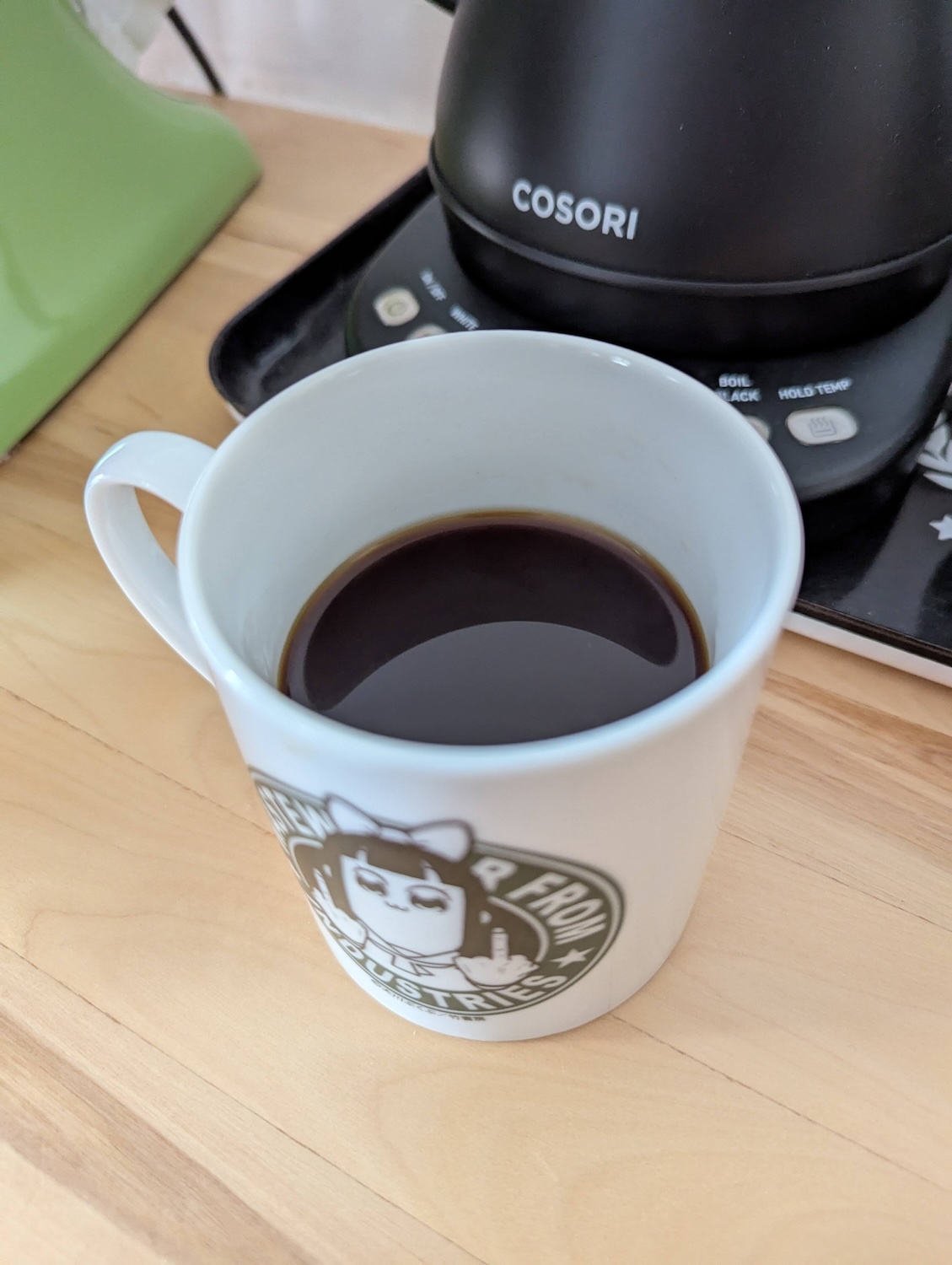
The resulting coffees were relatively light and mild. I first tried it black, and It had an initial strong acidity, but that sourness faded quickly and transitioned into a smooth and pleasant finish. Perhaps due to my untrained palate, I couldn’t quite taste all the things the description mentioned when drinking it black.
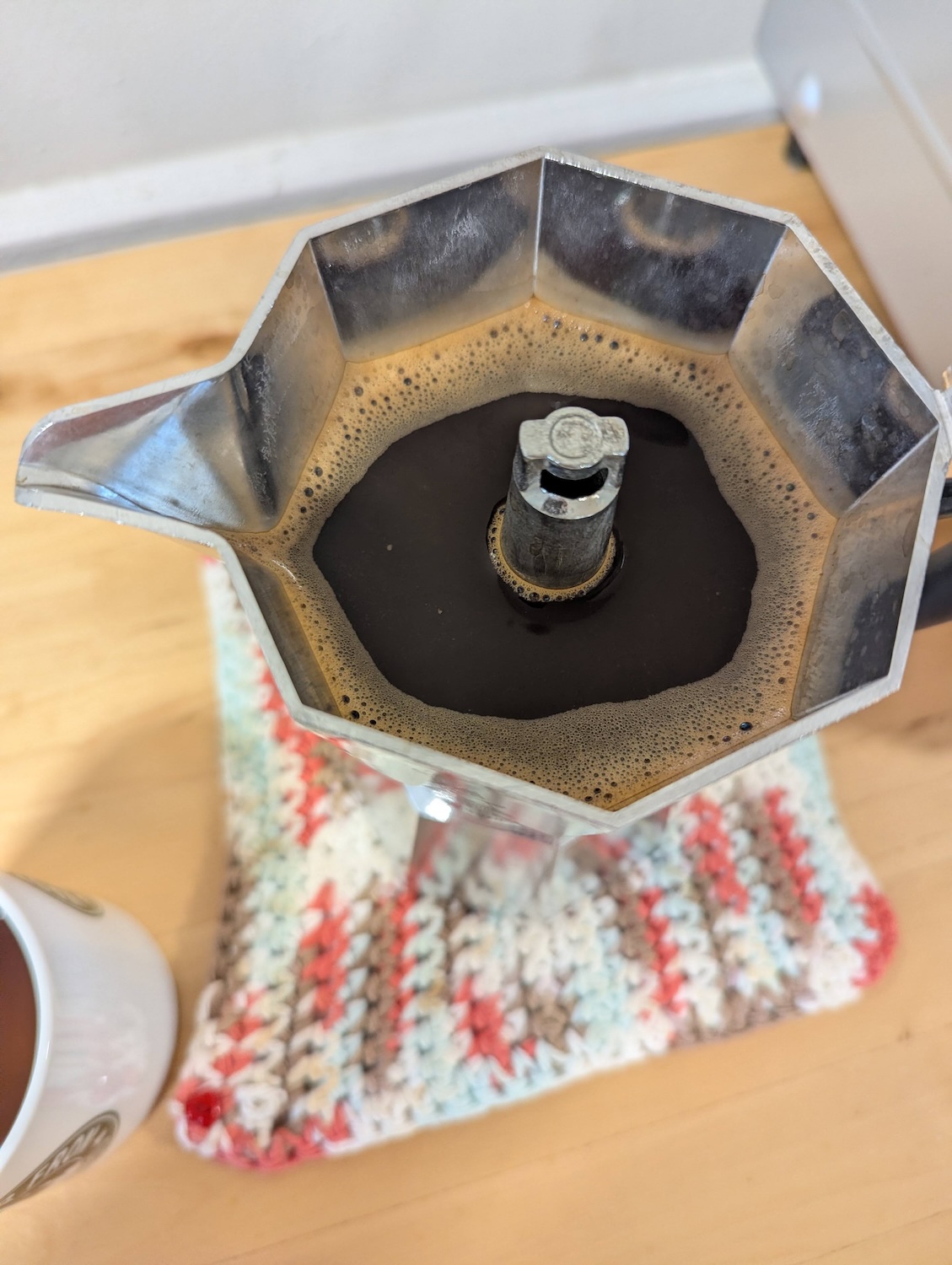
But then I decided to brew some more and tried the coffee with other ingredients, like oat milk, butter and salt, and skim cow’s milk. While the first two tasted all right (and resulted in a relatively less harsh drink overall), it was the cow’s milk that made a big difference. That “stone fruit” flavor in the official description, previously hard to detect, really came through. While I didn’t try it with 2% or whole, I assume it would be even better. This applies to both the French press and the moka pot.

Was it worth the cost? Well, if you’re trying it just for the beans, you can get something about as good without the waifu tax that transforms 225g of beans for a $40 USD purchase at a convention (or $35 USD plus shipping, etc. when ordering online). However, the resulting coffee is not bad or disappointing by any means, and you are just getting a better quality product than buying some Dunkin’ or Starbucks. Even my amateur-ass self could make some tasty cups of joe with these beans, and I think the Ember Amane blend is quite good for people who might typically be averse to coffee, provided you use dairy milk of some kind.
I don’t think I’ll end up trying the entire Phase Connect coffee line, but I just ordered the Dizzy and Clio blends (along with the Phase Invaders Wish album). We’ll see how they turn out.
 OGIUE MANIAX
Pingback: De-Frosting: Ogiue Maniax Status Update for February 2026 | OGIUE MANIAX