Parafusion Starmie and Memories of Early Pokémon Gen 2 Theorycrafting

I’ve been thinking about Pokémon a whole bunch lately, particularly about the online community and how much time has passed. The competitive players I considered my friends are so far in the past that the next generation after them is considered the “old school.” I met many of them during Generation 1, and one of the most fascinating times was in the transition to Generation 2, particularly with regard to theorycrafting.

The importance and limitations of theorycrafting is something all players have to deal with in any competitive environment, but back when information was scarce and we only had questionably translated materials from the Japanese release, it really felt like something different. As with every generation change, players on sites like Azure Heights tried to figure out what would be strong in Gold and Silver. One answer that came up was Starmie.

On paper, it made sense. Starmie was among the top picks in Red, Blue, and Yellow. It was fast. It hit hard. Its movepool was also among the best. Not only did it learn powerful moves that benefited from its Water/Psychic typing (Psychic, Surf, Hydro Pump), but it could also cover every type combination in the game with Ice Beam and Thunderbolt (or Blizzard, which was ~90% accurate in Gen 1), and it learned amazing defensive/support moves in the paralyzing Thunder Wave and the health-restoring Recover. Being Psychic type was also a huge boon in a generation where they had no actual weaknesses.

Gen 2 introduced egg moves: techniques that Pokémon could only learn via breeding. This could potentially be transformative, and one move stood out in Starmie’s list: Confuse Ray. Being both paralyzed (25% chance to not move at all combined with a 75% speed reduction) and confused (50% chance to hit yourself and not execute a move) was among the most annoying things to deal with in Gen 1. To have parafusion on a single Pokémon seemed like a nightmare scenario, and so Starmie was predicted to be a serious meta threat. 

Time proved things out differently, however. While parafusion could still be annoying, the changes made to the battle system went far beyond players’ early theorycrafting. The dividing of the Special stat into two (Special Attack and Special Defense) meant that moves like Amnesia and Psychic were not quite as effective. The introduction of the Dark and Steel type, and to a lesser extent the improvements made to Bug, all took away the Psychic types’ major advantage. Curse turned out to be an incredibly strong move, especially when paired with an incredibly bulky choice like Snorlax—even when stuck in place while paralyzed and confused, they could weather the storm and Rest off the damage. Heal Bell, a move that removed all the status effects inflicted on your own team, trivialized attacks like Thunder Wave. And this is the generation Mean Look and Perish Song was introduced, creating the Perish Trap strategy that could lock opponents in and force them into no-win scenarios.

Back then, the false hype of parafusion Starmie taught me something important: People will theorize based on their previous experiences because that’s what they have to rely on, and that strength is relative. Strategies don’t exist in a vacuum, and things that were considered universally strong sometimes falter in a different environment. (And sometimes, things are actively nerfed.) This is far from the only instance of theory not matching practice in Pokémon or even beyond, but it’s one I remember with a strong tinge of nostalgia.

La+ Darknesss Birthday 2025 and the Proximity of Fandom

Laplus Darknesss from hololive posing on stage. She's a short girl with long white hair and large purple horns in a dark dress.

Today is hololive VTuber La+ Darknesss’s birthday, and that has me thinking about her relationship with her fans. In a world that both passively and actively encourages talent and fans alike to fall into obsession, she rarely lets others dictate what directions to go.

I like watching new VTubers debut. Variety is the spice of life, and you never know who’s going to be a pleasant surprise. But I’ve also noticed something when looking at reactions to these reveals: There’s a certain kind of viewer who seems very eager to throw their full support behind someone or something. With just an initial introduction (or even less) to work off of, this type of fan behaves like they’re looking desperately for a conduit for their passion

This can be just another way of engaging with online personalities, albeit one that differs from my more hesitant “wait and see” approach. A forlorn heart might yearn to be recognized and have its intense feelings reciprocated, so having some kind of outlet can be healthy. The fact that this can turn into genuine feelings of attraction and affection can still be okay if there is recognition and understanding of the limits of this relationship. 

Where it starts to get iffy is when someone either projects all their values and fantasies into a figure and fails to at least admit that this is projection, or when the eagerness to find a fandom turns into bitterness. That’s the point at which being parasocial becomes harmful, and I worry about both sides in these scenarios.

Some will play into this dynamic, but La+ has a bit of an unusual relationship with her viewers. She is herself an idol fan, and she has expressed empathy for those who have been hurt by an idol revealing that they have a significant other. She’s also a self-professed doutan kyouhi: a competitive fan who does not want to interact with others who share the same particular fandom. She knows what it’s like to be obsessed with someone…but she doesn’t actively seek to be that object for other people. 

The way the holoX commander prefers to hold her fans at arm’s length has actually at times garnered her haters. They wish she was something she’s not trying to be, and the fact that she doesn’t conform to their desires bothers them. She’ll make connections outside of hololive in big collabs with people regardless of gender or genre. She’ll gush over Mai Shiranui from the Fatal Fury franchise, channeling the energy of fighting game fans who grew up in the 1990s and 2000s despite not being of that era. She’ll ask to be insulted by her colleagues in hololive with mature voices. She’ll even come up with an official name for her fans (Plusmates), but never actually use it. And when others talk about what La+ is like behind the scenes, they’ll mention how hard she works for herself, her peers, and her fans. That’s something I really appreciate about her: She does her own thing and appears to have a good time in the process. 

La+ Darknesss prefers to act as a fellow fan who has the privilege of doing idol-like activities, such as singing and dancing on stage. In this way, seems to look at the fans who might potentially become her most obsessive and parasocial supporters, and says, “I get where you’re coming from, but I can’t be that for you. I can entertain you, though.” That’s just fine by me.

Paying It Forward, Correcting the Past: Final Thoughts on Cobra Kai

Cobra Kai finished earlier this year after six seasons, and it has me remembering when I started the Karate Kid spin-off. Back then, it really surprised and impressed me with how much it avoided being a regressive nostalgia fest and tried to put out new ideas, and all while having the old characters look over a new generation of karate students. But like with so many popular things, a bad ending can really sour a series as a whole, so I was still a bit cautious. There’s a reason I’ve never really written about Game of Thrones.

Thankfully, despite the later seasons dragging in places and sometimes forcing drama in certain places like there was an obligation to do so, Cobra Kai finishes strong both emotionally and thematically. It also understands something very fundamental: A show based on The Karate Kid needs to begin and end with karate.

Everything I wrote in my previous review still holds up. Cobra Kai stresses the importance of finding balance, but that there is no one-size-fits-all approach. Sometimes, the aggressive approach of Cobra Kai is exactly what a person needs, but following it to the extremes can cause more harm than good—something Johnny Lawrence (the main character of the series and original bad boy of the franchise) knows all too well. Miyagi-Do, the style and life philosophy of the “Karate Kid” himself, Daniel LaRusso, is more defensive and less likely to lead someone down a dark path, but it might not have the sheer force to break through to the hearts of those who aren’t receptive to it.

There are numerous moments in the show that stress this point, but I think one of the most powerful comes when the character Tory Nichols is facing Sam (daughter of Daniel) to see who will represent Miyagi-Do in the women’s division of the world karate tournament, the Sekai Taikai. Tory’s mother has just passed away, and the girl is distraught and emotionally unstable during the match. The LaRussos see this fact and try to stop Tory, but Johnny understands that Tory needs to let out her emotions through this fight. While Daniel’s heart is in the right place, it’s Johnny who better understands what Tory is going through, and the former’s failure to recognize that causes Tory to abandon Miyagi-Do.

Eventually, pretty much all the characters get their happy endings, which might feel a bit hokey, but the nature of each one really speaks to the unique qualities of each individual. With the setting of a tournament to determine the world’s greatest karate dojo, each person must achieve their balance. 

Robby Keene (Johnny’s once-estranged son) has had a rough past with negligent parents and getting roped into the wrong crowd, and Miyagi-Do has helped him temper his anger. When his opponent in the semifinals, Axel Kovačević, purposely breaks his leg, however, Robbie is forced to forfeit. Yet, while he wishes he could have won in front of the world, he also knows in his heart that he had what it took to do so, even if a dirty trick stopped him.

Sam LaRusso decides to quit in the semifinals and give Tory a bye to the finals, it’s because she realizes that she never got into karate to prove that she was the best or the greatest. It’s helped her find good friends, a great boyfriend (despite some Teen Karate Drama), and even mend fences with her rival in Tory. Karate opened the world to her, and she ends up going to college in Okinawa (the birthplace of karate).

Tory Nichols, however, is not like Robby or Sam. She has a chip on her shoulder, guilt over causing so many problems, and a burning desire to beat the crap out of Zara: the arrogant, man-stealing, social media darling waiting for her in the finals. Zara knows how to get into Tory’s head, but an “I love you” and a kiss from Robby brings her back to take 1st place. What Tory needed was to realize that she had people on her side no matter what. When she and Robby also get offers for karate sponsorships, she gains the stability she’s always been searching for. 

Miguel Diaz, Johnny’s first student and in many ways the heart and soul of the Cobra Kai series, finds balance in bringing together all the experience he’s gained from not just karate but bonding with everyone. He’s no longer the weak, bullied kid he once was. At the same time, all the challenges he’s faced and the lessons he’s learned from both Cobra Kai and Miyagi-Do unite in him to win the finals against Axel.

As for Axel, he might have been responsible for Robby’s injury, but he ultimately refuses to let the toxicity of his own sensei control him. Despite having strong romantic feelings for Sam (who is Miguel’s girlfriend), as well as being told that his life is worthless without victory, he chooses to be the better man and fight honorably. He helps highlight another key aspect of Cobra Kai: The purpose of teachers and mentors is to pass on the good lessons and understand what should remain in the past. And this isn’t just subtext—it’s stated outright.

Nowhere is this idea more ironically poignant than the original big, bad villain of The Karate Kid: John Kreese. He is responsible for so much of the misery brought forth by the Cobra Kai dojo. The Cobra Kai series delves into his past as a traumatized Vietnam veteran who tried to instill in his students the mantra of “strike hard, strike fast, no mercy” as a way to make them invincible, and it isn’t until the very end that he realizes how much damage he’s caused in the process. 

I find the moment of Kreese’s inner revelation interesting, because it doesn’t seem to click until he sees the real master of the Cobra Kai style (an elderly Korean man) using his weaker students as fodder to train the stronger. Even Kreese wanted only to drive weakness out of his students, and not to sacrifice them on the altar of strength. When he remembers his own commander in the Vietnam War (and the one who originally taught him Tang Soo Do) allowing his subordinates to fight to the death as POWs instead of acting as a leader, Kreese decides to end the cycle of abuse, albeit decades after he already traumatized Johnny, LaRusso, and many others. However, he can’t stop being the man he’s been, so his ultimate act of closure is to stop his former friend and literal comrade-in-arms Terry Silver from kidnapping Johnny’s family by fighting Silver and blowing up his yacht. (Whee.)

It all comes to a head when Johnny has to face another teacher, the Iron Dragons’ Sensei Wolf, to determine the overall winning team of the Sekai Taikai. Wolf is younger, stronger, faster, and more skilled, making Johnny the complete underdog, and he’s overwhelmed by fear during the match. But Daniel, knowing Johnny all too well, goes against his normally gentle demeanor and tells him that fear does not exist in Cobra Kai and to “stop being a pussy.” When it comes down to the last point, Johnny sees himself in the same position he was in when he lost to Daniel back in 1984. This time, however, Johnny takes a defensive stance. He looks like he’s about to perform Daniel’s move, the Crane Kick, but instead sweeps the leg and uses the advantage he gains from that to finish Wolf and win it all. 

Daniel came to realize that the crass and aggressive philosophy of Cobra Kai was what he needed to successfully communicate with a panicked Johnny, but he used it to communicate a lesson Mr. Miyagi taught him: You can lose the match, but you must not lose to fear. Johnny, in turn, used the patient defense of Miyagi-Do but adapted it to his own style, changing the context of the iconic “sweep the leg” line that is one of the most lasting pieces of pop culture from The Karate Kid.

Overall, through the ups and downs, Cobra Kai sticks the landing magnificently. It understands that it has old fans watching, but also a new audience who don’t know anything about Karate Kid. It stresses that the young can learn from the old, and that the old can learn from the young. 

As a final note, I think one thing that really gets across the positive vibes of the series is the sheer number of cameos from the old movies. They seem to be there to give props to as many people who were involved with The Karate Kid, no matter how big or small their roles were. It’s a celebration in the best way: One that knows that when the party ends, there’s still more to do to make life better.

Nevertheless, Science Endures—Orb: On the Movements of the Earth

Orb: On the Movements of the Earth is either the best-timed anime release of all time or the worst. To begin airing in a time when scientific thought and discoveries of the past 150 years are under attack—by reactionary forces claiming to be speaking on behalf of God, no less—hits with stinging precision. But I’m very glad we have this show, which has a very good chance of being the best anime of 2025.

Adapted from a manga by the same name, Orb takes place in mid-20th-century Europe, and begins with a boy named Rafal, who has spent his life trying to present himself as the perfect child in pursuit of an easy life. However, he has a minor interest in astronomy, and when he learns the heretical idea that the Earth revolves around the sun, it sets him on a path in conflict with the Church and his own peace and comfort, and changes the lives of others who also similarly discover that the pursuit of truth isn’t easy when the authorities in your world want to keep you blissfully ignorant.

Throughout the show, one thing that stands out to me is how the characters are products of their time in terms of how they both follow and defy the predominant conventions around them. For example, while you have characters who are proponents of heliocentrism, they are often also deeply religious and believe that they are celebrating and worshipping God by doing so. They are shaped by both personal qualities and cultural forces, whether it’s a zealous inquisitor named Nowak who thinks his bloody work helps protect his family, a scholarly monk named Badeni who thinks scientific discovery is important but that literacy should be restricted to the elite, or a young girl named Jolenta who loves to learn but is faced with pervasive and entrenched sexism of her environment.

I hope as many people as possible watch Orb because while its ideas aren’t exactly new, they are especially important to remember and take to heart right now and likely in the coming decades. I would recommend that you go into this show knowing next to nothing, but if you don’t mind spoilers, I’m going to list some additional thoughts I had after finishing the series.

Before that, I need to mention the fantastic theme song, which has become a massive hit in Japan. If nothing else convinces you to watch this show, maybe the opening will.

SPOILER SECTION

I want to first start at the end, and think about the fact that the attempt by Rafal and all the others before the finale was ostensibly for naught, as they failed to get their book on heliocentrism published. However, by having the last protagonist be Albert Brudewski, showing him initially dismissing the idea heliocentrism but still believing in math, and explaining in the epilogue that this was a real-live person who would later become Copernicus’s teacher, the series emphasizes something important. Orb is basically historical fiction about what if there were earlier people who had made Copernicus’s discovery but were forgotten because their work was destroyed, but it also shows how the simple act of observing the stars with a curious mind can bring back ideas thought lost to time. Science has the power to persist because its findings can eventually be rediscovered. This even shows up when Badeni looks at the orb necklace hanging on two nails and inadvertently realizes that the planets have elliptical orbits—in the real world, it would be Johannes Kepler who theorized it over 100 years later. 

The destruction of human knowledge is not fictional. Famous real-world examples of this include the destruction of the Library of Alexandria as well as the Imperial Library of Constantinople, and even today, we are seeing the loss of both knowledge and lives that has been the result of the current Trump administration and its sledgehammer gutting of science and health initiatives. The tragedy we are seeing will ripple forward, but there is hope that we can come back from this someday.

In thinking again about how the characters are shaped by their circumstances, one thing I really love about Orb is how the transmission of science across time is done through very imperfect individuals, instead of giving us brilliant intellectuals altruistically motivated to progress human thought. Badeni and his selfish scholarship is one thing, but there’s also Draka, whose profit-obsessed mind is what allows her to pursue unconventional avenues of thought and push things ahead where others might falter. Oczy is in no way an intellectual, but his tremendous eyesight and humble personality both help push things ahead, especially when he makes Badeni realize the potential there is in a simple book written for the (presumably dumb) layman. 

Even figures who aren’t the protagonists or adjacent to them impact the course of events in fascinating ways. Count Piast pushes away a doubt he had about geocentrism for most of his life in the fear that it would render pointless his life’s work (and that of his mentor), but he ultimately acquiesces because he realizes being wrong is just as important to finding the truth as being right. A young inquisitor in training who thinks little about what his work truly entails later becomes the priest in the church where Albert makes his confession, and that priest’s questioning of Church orthodoxy is the result of seeing his colleague help Jolenta escape at the cost of being burned at the stake.

What a work, man. I hope it gets as much recognition as possible.

A Look at the April Mayhem of VTubing

The past two months or so might be the most significant period in VTuber history since 2020 and the pandemic. During this time, we saw major changes in every corner of the scene.

  • Gawr Gura of hololive graduated
  • Murasaki Shion of hololive graduated
  • Nanashi Mumei of hololive graduated
  • hololive affiliate Amelia Watson made a guest appearance at Takanashi Kiara’s concert
  • hololive affiliate Sakamata Chloe made a guest appearance at Shion’s graduation 
  • Amagai Ruka debuted with her new group, Weather Planet
  • Nimi Nightmare revealed her full, non-chibi model
  • Regis Altare of Holostars returned after a long hiatus
  • Sinder was publicly called out by multiple peers for manipulating one of her artists and betraying her VTuber friends 
  • Fulgur Ovid of Nijisanji graduated
  • Ike Eveland of Nijisanji graduated abruptly, with all his content removed 
  • Matara Kan is no longer a part of VShojo
  • Michi Mochievee of VShojo celebrated her first anniversary with a 3D concert, alongside K9Kuro
  • Multiple members of V&U graduated
  • Roca Rourin of Idol Corp returned to social media after being hospitalized for months
  • Phase Connect debuted three new Phase Invaders: Clio Aite, Mari Mari, and Eepy Sleepy
  • The disastrous new tariff policies have made buying merch (including celebratory merch for graduations) devastatingly expensive for American fans

VTubers are leaving companies, reviving in new (yet oddly familiar) forms, making cameos in their old companies, and even sometimes getting dragged by their peers. So much has happened that it can be difficult to wrap one’s head around it all. The timing of it all might be coincidence or just the result of the Japanese fiscal year starting in April, but having it all hit at once magnifies the emotional impact. And this is without considering all the different big concerts or the departures and returns that occurred earlier this year!

Gawr Gura’s “Ash Again” came out basically on the same day as Michi and Kuro’s “Deja Vu.” Gura’s is an expression of the turmoil she felt while being in one of the top companies as one of the world’s most popular VTubers. Michi and Kuro’s seems to refer to their mutual pasts as part of another major VTuber company. The talk of pain and renewal from two or three different-yet-related perspectives feel as if they are engaged in a conversation, even if it isn’t intended that way. 

Shion and Mumei graduated within 48 hours of each other, and both went out singing songs named after themselves. Shion’s is new and the kind of sweet but tearful tune expected of graduations, while Mumei’s is older but is still a moving song that talks about fading into and out of memory. 

Gura and Mumei both had mini concerts instead of full ones, owing in part to the challenges faced by the hololive members who don’t live in Japan and therefore don’t have easy access to the company’s 3D studio.

With Matara Kan and the newest Phase Invaders, we see the exit of a member of a company that emphasizes independence, as well as the folding in of previously indie VTubers who largely hold onto their identity and don’t have to tiptoe around who they were before. The indie vs corporate line gets further blurred. 

Amidst all this, seeing Ame and Chloe, even if only for a moment, was like a breath of fresh air. It also made clear what affiliate status can accomplish in hololive, as there was some uncertainty what it meant versus as a normal graduation. While some fans and talents might prefer a clean break, others might appreciate the possibilities that come with staying connected to hololive. 

Meanwhile, Ruka and Nimi each showed off a model that was designed by an artist that has worked for hololive. The designs are different in many ways, not least of which are changes to the eyes and the subtle personality differences that are implied by those differences.

And while I’ve always wondered, given VTubing’s similarities to wrestling, what a VTuber heel would be like, I guess I’ve gotten my answer via the Sinder drama. Only, I wanted it more in the form of kayfabe and less in the form of backstage politicking.

Altogether, this feels like a reminder that VTubing is still a very young field of interest, realistically less than 10 years old. The most enduring people and groups might be gone tomorrow, and it might be better for fans to accept this possibility even if it hurts. But while it’s often said that fans should express their support for their faves because you never know when they might be gone, I think it’s important to show at least some moderation in terms of not letting an obsession turn into bitterness if things don’t happen the way you want. One should ideally emerge from this situation empowered by their time spent watching and cheering for talents, though I understand that’s not always possible, especially if the circumstances are extremely messy.

I have no idea what the future holds, but it might be good to step back and take a breath before moving ahead.

A Mecha Classic More Timeless than Ever: Blue Comet SPT Layzner

When I first saw the opening of Blue Comet SPT Layzner, I was blown away. The music, the animation, the dramatic flair, the giant robots—it all worked together to make me want to see the show for real someday.

This was my introduction to Layzner, and it would be a long time before I was able to watch the series. Now that I have, I’ve come away feeling that this Cold War relic is not only an excellent work despite major setbacks, but actually more relevant than ever, for better or worse. 

Before actually watching it, I continued to encounter Layzner in different forms. In the first TV series of my beloved Genshiken, there’s an episode preview narration where the characters are talking about anime that got their runs cut short. The character Madarame (i.e. the nerdiest of the nerds) posits the curious notion that it’s not so much that great shows often get canceled but that getting canceled is the very sign of a great show. One of the series he mentions is the thinly veiled title Dizner, which taught me that Layzner was an anime that got kneecapped. 

Was this abrupt end a case of a show burning bright and then fizzling out? Or maybe the merch simply didn’t sell; that happens all the time. But the truth is more bizarre, and tells the story of a series cursed by circumstances beyond its control—a faulty kerosene heater made by the primary sponsor of Layzner, Sanyo Electronics, meant funding ended up being pulled

Later, I would command the characters of Layzner through my import copy of Super Robot Wars GC, but because my Japanese was not all that great at the time, my understanding of the story was limited, as was my awareness of how exactly it was rushed. (Having Shin Getter Robo and Mazinkaiser show up doesn’t exactly reflect the story of Layzner with great accuracy either.)

But now, in 2025, I can say I have watched all 38 episodes of Blue Comet SPT Layzner, plus the three OVAs made to give the series some semblance of a real conclusion. But before I get to the end, I need to talk about the beginning and all the potential this anime held and indeed lived up to, until things went sideways.

Watching Layzner

In the future year of 1996, the Cold War between the US and USSR has expanded into the stars. During a visit to a space station by a youth culture club, a mysterious figure appears. His name is Eiji Asuka, and he has come to warn the Earth of an impending invasion by his home planet, Grados. Eiji is half Earthling, and he does not want his father’s world destroyed by war. The advanced giant robots known as SPTs are far superior to anything humankind has created, but luckily, Eiji has an SPT of his own: the powerful Layzner. However, his abhorrence towards killing weighs heavily on him when he might have to turn his weapons on the very people from his home planet. This is made doubly troublesome because the A.I. of Layzner seems to hold a dangerous secret that makes it much less merciful than Eiji himself.

Layzner drew me in instantly with its compelling story, its characters’ political and philosophical conflicts, and its overall animation and style—80s “real robot” anime at its finest. Every episode brims with drama and intensity, and the action is consistently exciting. Central to it all is Eiji himself, who definitely has a place in the Mecha Angst Hall of Fame. Unlike the stoic Chirico Cuvie from director Takahashi Ryousuke’s Armored Trooper VOTOMS, Eiji is deeply passionate about his love for both Grados and Earth, and the determination he must hold while his heart aches makes for one of the finest (and indeed angstiest) protagonists ever. His compassion also helps win over some of the more skeptical Earthlings, who go from mistrusting him to being some of his closest allies. One of those humans, a 14-year-old girl named Anna Stephanie, acts as the narrator for the series. 

The Mid-Series Tonal Shift

Like with so many anime that are set to run for an entire year, the “halfway” point for Layzner comes with a massive shift and changing of the status quo. Whereas the first 26 episodes are about Eiji trying to reach the Earth in the hopes of preventing or at least slowing down war, the second part sees the plot jump forward a few years to a time when the Earth is dealing with a brutally regime that is trying to stamp out all nearly aspects of human culture, including books and art. Given our current political climate—where right-wing leaders who are largely fascists, racists, and grifters who are trying to force their backwards view of humanity onto the world and bilk us for all we’re worth—I found myself taking a bit of psychological damage. Seeing the main New York Public Library being set on fire hits a little too close to home, and it makes me all too aware of the fact that I might have viewed this series differently if I had watched it even 10 years earlier.  

Eiji himself changes during this time, abandoning some of his more pacifist tendencies in favor of outright opposition against the powers that be. He also goes from that angsty young man with a thinner build to a brooding and brawny freedom fighter. While he isn’t Fist of the North Star Kenshiro levels of being a barrel-chested Greek god, the difference is noticeable. 

However, the biggest transformation goes to Anna Stephanie, who grows into a strong 17-year-old girl and has basically learned what it means to fight in the face of oppression from her time with Eiji. Anna might be a sticking point for viewers, as her younger self seems designed to appeal to lolicon fans, and they set up a burgeoning romance towards the end of the first 26 episodes that’s made more blatant after the timeskip (including an ending theme talking about love and longing). While Eiji is supposed to be 16 (later 19), his design is such that he looks much more mature than Anna, and I have to wonder if the timeskip designs are meant to make the pairing more generally palatable. 

The Early Finish

It’s fairly clear around when the sponsorship got pulled because the show begins to make giant leaps forward in time with only the briefest explanations as to what has changed. The final episode answers next to nothing, functioning like a canceled manga’s non-conclusion. The third and final OVA episode basically replaces Episode 38 and gives a greater sense of closure to Layzner as a whole, but still has to suffer from the fact that the series was originally forced to rush through its story by the end. That said, it’s truly fascinating to see what a work of fiction prioritizes when it suddenly doesn’t have enough time left, and Layzner chooses to up the political and emotional drama of its characters. 


If there’s a significant flaw of the series that is not wholly related to having its year-long run cut short, it’s that Lazyner sometimes doesn’t seem to know what to do with certain characters. For example, the initial image of Eiji’s sister comes from the ending sequence, where it implies that she is some kind of gentle soul draped in a white dress. However, when we finally meet her in the series, she is a focused warrior intent on revenge. Then, after the timeskip, she becomes more like a messianic religious leader whose pacifism gives hope to the people. Another character whose purpose seems to change over time is Le Cain, the talented and powerful son of the Gradosian commander who is leading the assault on Earth. Introduced later in the series, he swings from arrogant and brutal antagonist to honorable rival to naive noble desperate for his father’s approval, with some romantic sparks between him and Eiji’s sister. I get the sense that Le Cain ended up being a popular character, and that the show tried to lean into this.

Final Thoughts 

Hobbled by aspects outside of the production’s control, Blue Comet SPT Layzner is nevertheless an all-time great that tragically could have been even better if it was allowed to tell its full story. It has the characters, the story, and the thematic messages to be a timeless classic, and unfortunately for us, it is perhaps more relevant than ever before. I’m very glad I watched Layzner after all these years. While it might have taken forever, the timing might have been perfect: In the world we live in now, Lazyner makes me feel more invigorated to stand up for human dignity.

I Finally Watched Seven Samurai

Recently, I watched Akira Kurosawa’s Seven Samurai for the first time. I’ve long been aware of Kurosawa’s reputation as one of the greatest filmmakers of all time, and that Seven Samurai is often seen as his magnum opus, but only in the past few years have I actually begun to engage with his work.

Having now seen the film, I feel it deserves every bit of praise it has ever received. Its storytelling, cinematography, acting, and themes all hold up extremely well. The word “timeless” is thrown around often, but little to nothing about Seven Samurai feels dated in its presentation, and that helped me to understand why this was such a pivotal work in the history of film. Given that this is one of the most discussed movies of all time, there’s not much (if anything) I can add to the conversation. Nevertheless, I still want to say something.

Seven Samurai is set in feudal Japan, where a poor farming village is the victim of bandits. Left with next to nothing, a group of villagers go into the city to try to hire a samurai to protect them from the next impending raid. However, most samurai are either too expensive to hire, and most of the ones who would be okay with merely receiving food as payment aren’t exactly the best. But when they see one samurai go to great lengths to rescue a girl being held hostage, they know he’s the one. After some desperate pleading, this veteran agrees to help, but he must first gather six other capable allies if they have any chance of repelling the bandits. 

Reading about Seven Samurai, I’ve come to learn that it is not just any film about bringing the band together—it is the film. While there are precedents in other forms of media (notably the Chinese classic Water Margin and its whopping 108 heroes), it is the grandfather of this ever-popular genre in cinema, and shines strongly against its descendants after all these years. The utterly unique personalities of all seven warriors, and the ebb and flow of harmony and discord created by their interactions amidst the mission at hand is just amazing. That influence can be felt in the fact that its characters and their archetypes are still referenced in media to this day, like the stoic (yet deceptively kind) figure dedicated solely to his swordsmanship, the young noble who wishes to be one of the down-and-dirty heroes so unlike his upbringing, and the brash and bearded rebel who eschews all the etiquette and formality of the elite.

The only thing that makes the film feel of an entirely different time is its portrayal of women, which reminds me more of Golden Age Hollywood with its dramatic closeups of fluttering eyelashes and the like, as well as the relatively reductive roles of the female actresses.

If anyone is daunted by the age of Seven Samurai or its 3 ½ hour run time, don’t be. It doesn’t require its viewer to be a dedicated student of cinema or to have a particular fondness for the classics. Kurosawa’s most famous film remains compelling, exciting, and filled with important messages about how things are achieved through mutual aid and cooperation.

“This is the nature of war. By protecting others, you save yourself. If you only think of yourself, you’ll only destroy yourself.”

The Dawn of the Sports Boys: Captain Tsubasa

Tsubasa, the spiky-haired hero of Captain Tsubasa, delivering a powerful midair kick to a soccer ball that looks more like he's launching a laser beam from his foot.

As an anime and manga fan, I enjoy checking out the big fan favorites of yesteryear. It helps broaden my perspective on these artforms, and gives me an opportunity to form my own opinions on a work and not rely solely on the views of others. And who knows—maybe I’ll get a new favorite. In this spirit, I recently familiarized myself with a manga that is not only beloved worldwide for its portrayal of soccer but also the father of the modern shounen “team sports boys” format. Before Blue Lock, Yowamushi Pedal, Haikyu!, Prince of Tennis, and Slam Dunk, there was 1981’s Captain Tsubasa by Takahashi Yoichi.

Regarding reading older major titles, Shounen Jump has been a consistent resource of works for me to tap, such as Saint Seiya and Hunter x Hunter. But while these titles are huge in their own right, Captain Tsubasa’s influence is really something special.

In Japan, Captain Tsubasa helped propel the popularity of soccer nationwide, even being published in a time when “World Cup” wasn’t even a commonly known phrase. Abroad, it gained popularity anywhere soccer was. On my most recent trip to Japan, I watched an episode of Why Did You Come to Japan?, a well-known program that interviews foreigners who are in Japan. This particular episode followed a German fan who made a pilgrimage just out of love for the series, during which he got to visit the real inspiration for the school in the series, among other things. There’s also a famous story about the occupation of Iraq by the US military, where water trucks were covered with images from Captain Tsubasa to show that they were friendly vehicles.

Creating love for soccer at home and garnering praise internationally for its portrayal of the sport are parts of the legacy of Captain Tsubasa. But it was also important in another area that has become a prominent part of anime and manga culture: doujinshi. In my review of the giant robot anime God Mars (also from 1981), I described it as one two series fundamental to the establishment of the fujoshi fandom as we know it today—the other was Captain Tsubasa. Having read the entirety of the first manga series, I now feel that I understand exactly why this story of young soccer athletes achieved the hat trick of domestic influence, international acceptance, and subculture proliferation.

Let’s talk about the actual story: Captain Tsubasa kicks off with a hell of an introduction to its main character, Ozora Tsubasa. As a small child, Tsubasa is literally saved from a truck by a soccer ball (avoiding the isekai protagonist fate, in the modern parlance), and his life is forever changed. The boy falls in love with the sport, treating the ball like an extension of his body. And as Tsubasa grows from impetuous kid to adult with soccer in his heart (though I only read up to the point where he finishes middle school), he influences every other player he meets, be they friendly or adversarial or both.

Those looking at Captain Tsubasa, especially from a modern perspective, might be surprised by its aesthetic, expecting a title known for its various fandoms to either have characters who look impossibly cool or incredibly beautiful. Instead, Takahashi’s designs feature ridiculously long and stilt-like legs, squashed craniums, and bird-like eye placement that makes it seem as if the characters can see in two different directions at once. How could this possibly be the series that helped spark soccer fandom and spawned shounen sports BL shipping? Yet, despite the odd look of the characters themselves, two things become clear even from the very beginning. 

First, the manga is fantastic at depicting action and tension. When portraying things like passing, dribbling, and goal attempts, the art is very clear and easy to follow while still creating excitement. When the athletes use their ridiculous signature moves (that aren’t meant to be supernatural but still play fast and loose with the laws of physics), there’s a satisfying sense of weight and emotion. The paneling frequently takes advantage of the double page spread to portray very wide shots, especially when points are being scored. It almost feels as if Takahashi made some kind of pact that made him a genius at depicting characters in action in exchange for being bad at drawing them standing still. 

A bunch of manga characters who are elementary school boys in soccer uniforms. Most of the kids look to be realistically young, but the one in front is weirdly lanky and muscular.
Kojiro as a gigantic grade schooler

They’re also all weirdly mature-looking. Some 10-year-olds look like they’re 16, while some 14-year-olds look like they’re 30—something we see in later titles like Prince of Tennis.

Second, many of the tropes of the shounen sports boys genre—namely having a wide-ranging cast of passionate guys engaging in intense forms of camaraderie and rivalry—are on full display here. Wakabayashi Genzo the goalkeeper starts off as Tsubasa’s first antagonist while later developing a nagging ankle injury that stymies him at dramatic moments. Misaki Taro is a student from out of town who becomes Tsubasa’s most reliable partner on offense, but who can only play for their school for a year before his family has to move away. Ace striker Hyuga Kojiro sees Tsubasa as the man he must take down, and his violent, win-at-all-costs mentality comes from a heartfelt desire to support his family. Wakashimazu Ken is a reliable goalkeeper for Kojiro who utilizes his karate background to defy what should be possible in soccer. Matsuyama Hikaru emphasizes teamwork above all else as the captain of his team. Misogi Jun is a handsome and noble all-around genius who would be the greatest youth player in Japan if not for his congenital heart disease that limits his playtime. And there are other characters.

If you were to ask who is Tsubasa’s greatest rival/partner, there really is no clear answer, making the series ripe for explorations of the imagination of various kinds. All the ingredients are there, whether one is reading for the competitive soccer or the bromances, and it’s doubly powerful when you realize how these very characters fueled their archetypal descendents in the following decades. 

It’s also worth noting that all the female characters are the kinds of managers and sideline supporters typical of sports boys series, except that this was an era when they were clearly intended to be romantic partners down the line instead of mainly audience-perspective characters. For example, Tsubasa’s main love interest, Nakazawa Sanae, starts off as a tomboyish ouendan-style cheer squad leader but becomes more “feminine” over time. I actually got a little miffed that the story couldn’t even keep that fun aspect of Sanae’s character. It’s no wonder why the female fans gravitated towards guy-guy pairings, regardless of their inclinations towards BL in the first place.

Two spiky-haired teenage manga boys (who look unusually tall and mature) trying to kick a ball at the same time in midair, which makes them look like they're clashing as martial artists.

But when Captain Tsubasa is at full strength, the excitement jumps off the page. The matches start off as exaggerated depictions of actual soccer before transforming into something that looks more like a battle manga at times. Many scenes feature opposing players clashing in mid-air like they’re Fist of the North Star characters who happen to have a soccer ball between them, and while it does start to feel ridiculous, I can’t deny the infectious energy. Though its tropes are old hat in the realm of sports boys at this point, the series holds up very well. There’s so much manly passion in this manga that it’s no wonder it formed so many different fandoms and even played a part in making soccer a national sport in Japan. 

Personally speaking, the ball is not my friend, but maybe Captain Tsubasa is now.

Juggling Tubes: Ogiue Maniax Status Update for May 2025

April was a hell of a month for VTuber fans. Between the departures from various major companies, a few surprise returns, and even a boatload of legitimate drama on the indie side, it felt like a nonstop rollercoaster. It has been (and perhaps will continue to be) such a frenzy of a time that I devoted more posts to the topic of VTubers than I usually would—a combination of things I had been wanting to write about, plus other things becoming more time-sensitive. Additionally, I want to write something encapsulating the tumult, because I think it deserves to be gathered together and contextualized.

The result is that many of the posts I had been working on that are more directly related to anime and manga have been pushed back. Hopefully, I can get some out for May.

Thank you to this month’s Patreon supporters!

General:

Ko Ransom

Diogo Prado

Alex

Dsy

Sue Hopkins fans:

Serxeid

Hato Kenjirou fans:

Elizabeth

Yajima Mirei fans:

Machi-Kurada

Blog Highlights from April

My feelings about Gawr Gura’s last project with hololive.

Amid these tumultuous weeks, ENReco is starting up again real soon. Here’s something I found fun from Chapter 1.

My review of 2024’s notably less violent Precure.

Kio Shimoku

Tweets and a bit of art!

Closing

Last month, I mentioned thinking about allowing tips directly through WordPress. I don’t really see Ogiue Maniax as my primary source of income, so I’m not desperate for more ways to make money, but it might be a way for readers to show support without having to use Patreon. I do technically have a ko-fi gathering dust as well, but maybe folks would prefer less hoops to jump through.

Kio Shimoku Twitter Highlights April 2025

April was a relatively light month of tweets for the Genshiken artist.

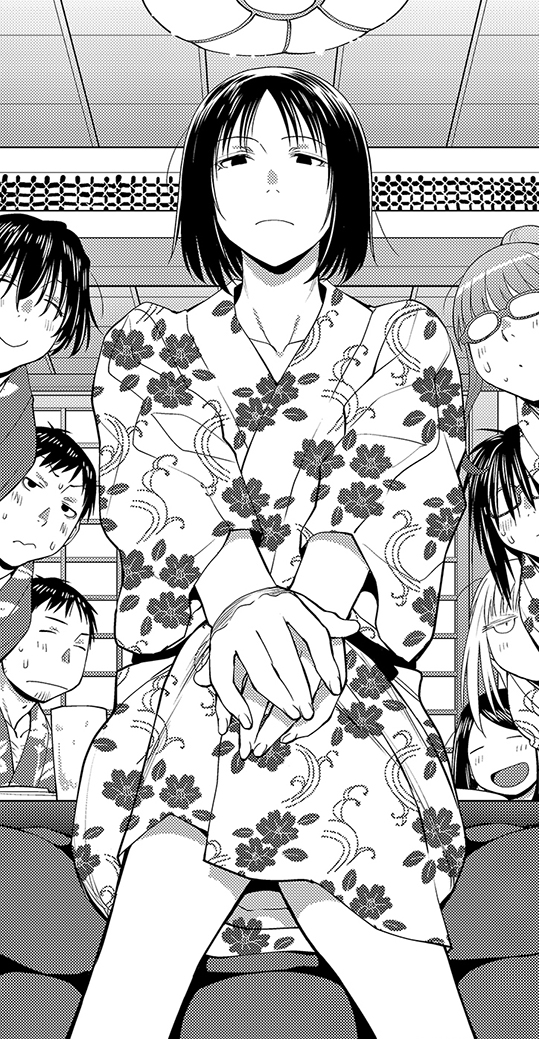
Kio spent all of April Fool’s driving, so he couldn’t see any of the jokes. Someone suggests he still has time to fly to the US and experience the day there, and Kio responds that he’d only end up seeing American April Fool’s gags as a result. Another person mentions that he heard Genshiken 3 was coming out, to which Kio replies, “Yay!”

Kio drew fanart of Sis-tan (the mascot of the arcade Okayama Fantasista) for her 10th anniversary. SIsta-tan tells Kio that he’s helped make her anniversary more splendid, and asks Kio what games he’s played at arcades. 

Kio responds that there were certain games—namely Neo-Geo ones—that he would only ever watch at the arcades because he wasn’t brave enough to play against other people. He did get to play them at a friend’s house, though. When it came to games he actually played, he liked vertical-scrolling shooters like Gunbird and RayForce.

Sis-tan replies in turn that it was still great that Kio had an environment where he could play Neo-Geo, especially one where no one as skilled as Kohsaka in Genshiken would show up. And while Okayama Fantasista doesn’t have a whole lot of vertical shooters, it would still be great if he came to play the ones that are there.

Kio got help to finish his work schedule for April, but it looks like some of his other work will spill into May. A person replies that Gundam GQuuuuuuX model kits come out in May, but Kio doesn’t think he’ll be able to buy them, so he’s giving up now. He really wants them all, though.

On May 10, Kio will be at the Rakuen: Le Paradis gallery in Tokyo giving a talk with Tsuruta Kenji. It’s a part of an entire month of talk shows.

Kio is happy to finally have some time to watch the first episode of Gundam GQuuuuuuX. He’s jealous of those who can watch the first episode without having seen the theatrical release, The Beginning, which he did.

Kio thought nothing would really surprise him in the first episode of GQuuuuuuX just because he saw The Beginning in theaters, but the ending theme made him a lot more emotional than he expected. [The ED is by hololive’s Hoshimachi Suisei!]

He was already seeing fanart of the show’s characters before the first episode even aired, so watching the ending video had him in tears. The personalities contrast between the two main girls is right up his alley, and his imagination is running wild as a result.

Someone responds that he also expects to see old men dancing to the opening. Kio recalls grinning so hard he could die at “Naatu Naatu” from RRR, and wonders if the old men dancing to “Plazma” could beat that. 

Despite a busy schedule, Kio went to the Hirano Kouta Super Expo gallery, featuring the work of the Hellsing author. He thought it was fantastic, from the way it showcased the power and insanity of the work, to the choice of manuscript pages to feature, to the way it showed off what makes all the characters great.

He wanted to listen to the audio guide by the Hellsing characters Luke and Jan, but he didn’t realize that he needed to connect to it through his smartphone, so he ran out to get some cheap earbuds.

Kio wears bifocals, but he likes to look at his work with the naked eye. However, when he does, he risks getting headaches and has to take Bufferin (a brand of aspirin).

Kio is happy that after a day of intently painting erotic naked skin in grayscale, he then gets to watch trailers for the new Ghost in the Shell and Steel Ball Run anime.

Kio checked out a special for How Do You Like Wednesday?, The Conquest of 21 European Countries in Our 21st Year.