Factoring Time into the Visual Aesthetics of Anime

Having spent yesterday and today hesitating on whether or not to buy the special edition Cardcaptor Sakura movies, I decided to sit down and watch some episodes of Cardcaptor Sakura, to see if it would swing my decision one way or the other. As of now, it’s still undecided, but just like every other time I’ve decided to re-watch Cardcaptor Sakura, I was reminded of how good the show looks. Years from now, the show will still look good. And this got me to thinking about the way time relates to an anime’s visuals.

In animation, there is a race to see the visual quality of animation improve over time. Though it’s not as drastic or hotly contested as the race that video games have gone through, it’s not uncommon to hear from people that a show looks outdated. This is a dangerous way of thinking, as it assumes that the shows you like today will be considered inferior in ten, twenty years. One might say then, that “timelessness” is the ideal to pursue, but at the same time I don’t think “timelessness” of visuals is necessarily a good thing. Much like how making anime for an international audience can take away some of the uniquely Japanese aspects of anime, I think a similar problem can occur when the creators of a show try to isolate it from its own time. At the same time, this isn’t an excuse for a show to look bad or have poor art direction and using either “timelessness” or “representative of its time” as an excuse.

Different shows seem to approach this issue of time and its relation to the animation quality. In Cardcaptor Sakura, it’s the well-thought-out “camera” angles, transitions, and just the way the show flows naturally from scene to scene and action to action that makes it stand the oft-mentioned “test of time.” Koutetsushin Jeeg and Re:Cutie Honey, both updates of 70s Nagai Go works, merge the visual cues of 70s anime with a modern sense of perspective and consistency towards animation. Casshern SINS, a current show, takes an interesting approach. Its main character is said to be immortal, and to show this the design of Casshern references anime throughout the decades. Casshern himself is a 70s anime character, while his hair and musculature are similar to 80s characters, his figure and facial features are reminiscent of 90s bishounen, and the overall aesthetic of the show is very modern. Anne of Green Gables, a 1979 anime series directed by Grave of the Fireflies director Takahata Isao (with Miyazaki on staff as well), is an adaptation of an already well-known novel, and though there wasn’t a lot of resources in animation at that time, they worked with what they had to make the show very engaging.

“Working with what you have” may not always produce the best or most well-remembered shows, but I think it’s an important step in making a show whose visuals will be well-remembered years down the line when what was once cutting-edge will become as old-hat as wearing a skinned sabretooth tiger. One thing that Cardcaptor Sakura, Koutetsushin Jeeg, Re:Cutie Honey, Casshern SINS, and Anne of Green Gables have in common is that you can see the sheer amount of effort put into these shows. Judging “effort” is tricky business, and might even be scoffed at as impossible or even arbitrary, but when there’s this much effort involved I think you can’t help but notice. And when people, year after year notice this, that’s when a show’s visuals can be called “timeless.”

Though if you don’t aim for “timeless” art direction, that still doesn’t mean your show cannot be great.
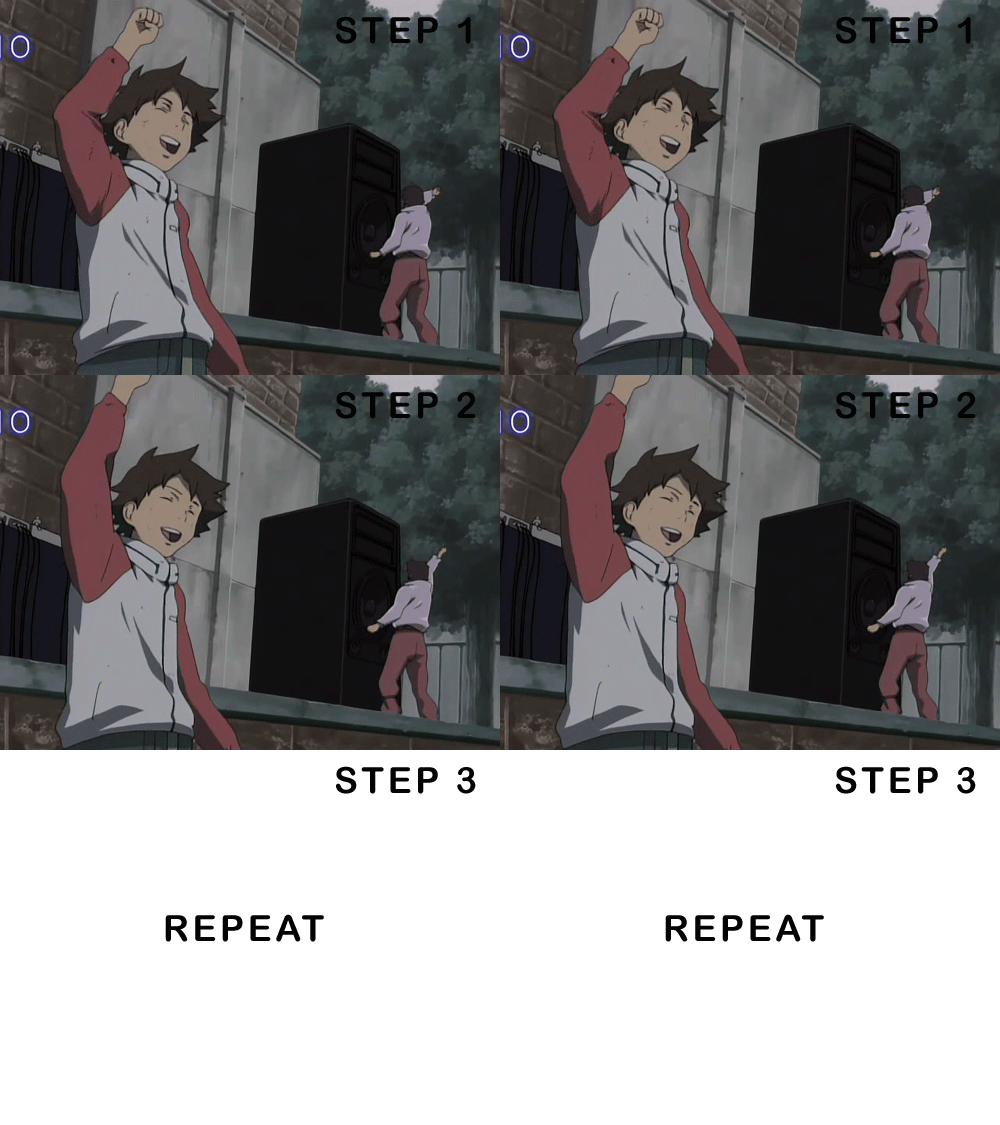
Eureka Seven Teaches You How to Guido Fist Pump

(an explanation)

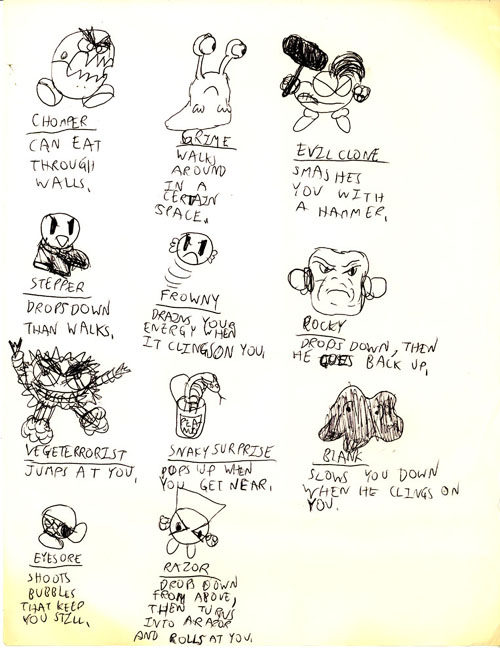
Personal History of Drawing

Something I put together because a friend did it a while back.

1995

2001

2002

2003

2004

2005

2006

2007

2008

The Moe Heroine and the Yamato Nadeshiko

A “Yamato Nadeshiko” is defined as the traditional ideal Japanese woman. These qualities include being loyal to their husband, putting family first, modesty, and being skilled in domestic matters. Belldandy from Ah! My Goddess is a prominent example in anime and manga of a Yamato Nadeshiko, and the fact that Ah! My Goddess has continued to run for many years indicates that this type of character is relatively popular today.

Of course, the spotlight in recent years has been on moe characters, and while some character traits reinforce the idea of the Yamato Nadeshiko, others defy them. Key’s heroine of heroines Tsukimiya Ayu has loyalty as one of her important traits, but is also a clumsy tomboy whose cooking ability is on par with Homer Simpson pouring cereal. Tsundere characters such as Hiiragi Kagami are strong, capable, and put family and friends first, but are independent-minded and are anything but submissive. Aisaka Taiga from Toradora! meanwhile is a clumsy tsundere.

I don’t think the intentional increase of moe traits in characters is, at the very least on a basic level, “progressive feminism,” but I think it’s worth taking a look at how these characters relate to a concept with a long history in the society from which their fictional media are produced. In American fiction, particularly television and movies, there are certain stereotypes for female characters, particularly when it comes to romantic interests. The Girl Next Door can be considered a reaction to the Bombshell (or vice versa). Any time there’s a shy girl who turns out to be highly sexual, it’s actually just a simplified form of “what you see isn’t always what you get.” Though they are now recurring, even stereotypical concepts in fiction, their basis is in the trends of what most people want in their entertainment, at least as it pertains to female characters.

Granted, otaku are not “most people” in Japan or any other country in which they (or should I say we) reside. And when non-typical people look at something typical, I think there’s often a desire for something “different,” though perhaps not drastically so. But the line between “different enough” and “too different” is a very personal thing, and I think it’s the area in which disagreements regarding the validity of moe characters arises.

Oh Man I Hope No One Notices It Shrunk in the Wash

THIS IS COMMON JAPANESE KNOWLEDGE: Lucky Star Original Visuals and Animation

Lucky Star, last year’s anime phenomenon which transformed a small, quiet town into an otaku tourist attraction, returns with a ~40 minute OVA titled Lucky Star Original Visuals and Animation. Fans of Lucky Star, I probably don’t have to tell you to watch this, and non-fans of Lucky Star I’m not sure if I could convince you to watch it, but this OVA is different from the rest.

Lucky Star’s often incorrectly characterized as being otaku in-jokes and little else, and while this OVA is filled with references to anything and everything anime-related it isn’t limited by them. It’s Lucky Star to be certain, but I’d almost describe it as Shinbo-esque. There’s multiple stories contained within this single long episode. They vary in levels of absurdity, some bordering on the surreal, others more down-to-earth, and others pushing the viewer/creator boundary further as one expects Lucky Star would, but with a consistently high level of quality and creativity throughout.

See the world of Lucky Star through the eyes of a lazy dog!

See Kagami in her debut role as Tsunderella!

See Tsukasa…eat meat!

Unlike Zetsubou Sensei, where characters gradually became singularities of their own character designs, pushing the limits of being defined by one’s own basic traits, Lucky Star’s characters remain full of heart and just on the other side of parody, Shiraishi Minoru exception aside. As for Konata, she is by far the main attraction of the Lucky Star OVA with her positive attitude showing what an otaku can be if only he or she had the confidence to be an otaku in public, but the vast majority of the characters make a return. It’s also great hearing Kujira talk to herself constantly throughout the entire episode.

The success of Lucky Star is very evident in this OVA, as it’s clear that a lot of money and effort was put into it, even though you might not expect Lucky Star to need it. It’s really a step above, even by Kyoto Animation standards.

In closing, I hope Misao’s voice actor gets more roles in the future, and that’s not simply because Mizuhara Kaoru sounds incredibly similar to Mizuhashi Kaori.

I Know All the Anime!

Yesterday while hanging out with friends in a game shop, I overheard someone who was probably 17 or 18 at the oldest say, “I know all the anime!” Then he mentioned Code Geass, and I didn’t really hear the rest.

I don’t know if he was putting on airs or actually believed he knew “all the anime,” but it made me remember an earlier time in my anime fandom, back when I was already familiar with internet forums but they still felt pretty new to me. There was a thread, I don’t remember what it was about, where I decided to list as many of the shows that I watched that I could remember. Eventually the list was large enough that I felt satisfied to post it, thinking it was a job well done. “I’ll show these guys just how much anime I’ve seen,” was probably my intention at the time. I distinctly remember listing Gundam Wing as “Gundam W,” and this was before W began airing on Cartoon Network. Just the idea that I could start listing shows and act like I had done more than scratch the surface of anime makes me realize how naive I was at the time.

Years later I signed up for a myanimelist.net account (check the second post on this blog), and tasking myself with jotting down all of the shows I’ve watched, I felt overwhelmed. Even with this very convenient website which remembers things for me, I lost the will to just record every show I watched.

So I don’t know who that kid is, but I hope he knows that if he truly wants to know “all the anime” that he has a long journey ahead of him.

Making Good Use of My Time

I Love Character Lineart

There’s the front view and the back view, and then some 3/4 views. Accompanying these shots will usually be facial expressions, different poses, possibly different outfits. Whenever I buy an artbook I look for character lineart and design images, prioritizing them over even full posters. They’re one of the main reasons I bought issues of Newtype and Newtype USA. The odd thing is, I’m not sure exactly why I like them so much.

It could be that I like seeing the creator-side of any sort of production or work. Hell, I’m not afraid to admit that years ago I bought the first volume of Megatokyo just because I was curious what Fred Gallagher had to say about his own stuff. I’m always eager to read interviews by creators, and it’s also the reason I go to their panels at conventions. I try to pick their brains and ask questions to get a better understanding of their process and themselves.

These images are the basis from which everything is animated. They serve as guides for animators to go back to whenever they’re unsure of how a character should look or feel. Character design images are the bridge between still and moving image.

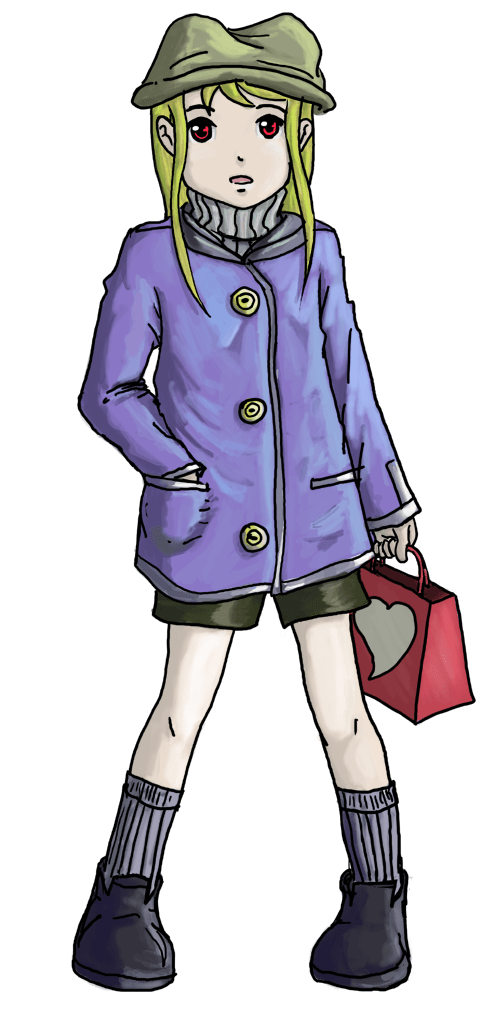
Bag + Coat