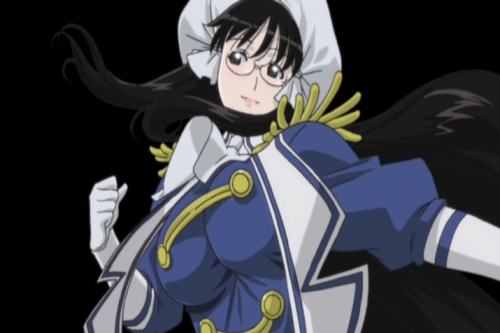
The Tsun to Dere Ratio

For better or worse, tsundere are an increasingly common character type in anime, and as stated by the illustrious Shiraishi Minoru, they generally come in two flavors: traditional tsundere who are tsun and slowly become dere, and modern tsundere who switch between tsun and dere frequently. As one might expect from referring to the latter as “modern,” that type of tsundere is more common these days.

This isn’t about discussing which one is better or worse though. What I wonder about is why there has been this shift in the first place. I don’t think it’s as simple as otaku wanting instant gratification or that their attention spans are getting smaller, though those things could actually be happening. Could it be in its own way a fight to make more female characters with an aggressive side to them, or an attempt to soften aggressive characters? Maybe the answer lies somewhere in the middle, as any fan of tsundere will tell you that the appeal comes from the combination of the two sides, though I think they will disagree on specifics.

In thinking about the appeal that the tsundere has for viewers of anime, the notion of risk/reward comes to mind. With a modern tsundere, it is very obvious when a character is acting “dere.” The first instance of the switch from tsun to dere happens very early to establish it as part of their character. For a more traditional tsundere, the switch happens much later. The traditional tsundere also tends to be less abusive towards their love interests than the modern variety. Do you get strong love after much effort, or do you get a strange, convoluted love regularly such that you’re not sure if the girl is interested at all?

In looking at traditional vs modern tsundere, their specific appeal is actually pretty different. A traditional tsundere can be won over by a guy through sheer effort. Even if she doesn’t like him at first, the guy tries so hard to be the man for her that she is moved by his genuine interest in her. It appeals to the nerd in the sense that what they lack in good looks or charisma they can make up for in passion. A modern tsundere however is more like a girl who is secretly shy, a girl who is afraid to admit that she like a guy. This is more for the guy who believes that maybe, just maybe there is a girl out there who likes him but neither side is brave enough to initiate conversation.

Effort vs Potential.

Time vs Space.

Genshiken Region 2 DVD Box Covers

I ordered the one on the right, which is the OVA collection.

However, seeing as how the two sets match each other so well, I’m really tempted to buy season 1 even though I already have it in Region 1 Form.

I also have the last two DVDs of Genshiken 2 coming as well. I’m kind of sad though that the box covers for Genshiken 2 are significantly different from these aesthetically. Still, they fulfill the ever-important task of “having Ogiue on the cover.”

EDIT: For reference, here are my Genshiken 2 dvd boxes.

That damn Yoshida

During the New Year months ago, Eureka Seven character designer Yoshida Kenichi posted an Eureka-themed New Year’s Card on his personal site.

I looked at it back in January, not thinking much of it, only noticing that Eureka looked kind of young in it.

Recently, I revisited the image and realized that I’ve seen this Eureka somewhere else…

The Eureka Seven Movie.

So it seems Yoshida dropped a hint on us months in advance and no one, myself included, realized it.

That bastard.

The Fujoshi Files 5: Ohno Kanako

Ohno Kanako

Name: Ohno, Kanako (大野加奈子)
Alias:
Kannazuki Yohko (神無月曜湖)
Relationship Status:
Dating
Origin: Genshiken: The Society for the Study of Modern Visual Culture

Information:
Ohno Kanako is a member of the Society for the Study of Modern Visual Culture aka Genshiken at the prestigious Shiiou University, and is quite possibly the first willing female member to join the club since its inception. Ohno spent much of her childhood living in America and thus has a firm grasp of the English language, something shared by fellow female member Kasukabe Saki. While Ohno had previously visited both the Anime Society and the Manga Society at Shiiou University, she ultimately decides to stay with Genshiken due to their understanding nature. Although very nervous at first, Ohno slowly gains confidence in herself, eventually becoming a surrogate fujoshi older sister of sorts to Ogiue Chika and ultimately becoming the fourth Chairman of Genshiken after Sasahara Kanji steps down.

Ohno has very unique taste among fujoshi, one that resulted in her being ridiculed by many friends: A passion for middle-aged and retirement-age men  that is matched only by Ohno’s love for cosplay. Ohno participates in cosplay events so often that she has to maintain a schedule. Her cosplay is so successful that she has become the main attraction of Genshiken’s booth at school festival. It is for these reasons that Ohno forms a friendship with Genshiken member Tanaka Souichirou, an avid costume designer, but it is their care and understanding for each that leads them to start dating.

Fujoshi Level:
Ohno is mainly known for her love of older men and her cosplay. However, all of that pales in comparison to the fact that Ohno will actively attempt to transform her friends into fujoshi and reinforce ones who already have taken the step. Though only implied, it is clear that Ohno introduced yaoi to her young friend Susanna Hopkins at a rather early age, creating a dangerously powerful female otaku in the process. It is this active corruption of the youth of America that earns Ohno Kanako a remarkable place among fujoshi.

Dio Brando is an English Vampire Who Grafted His Head on his Arch Enemy’s Body

He is not Muslim or representative of Islam, as some would claim, and it’s not something that’s difficult to figure out if only people would do research into Dio’s character.

For those who don’t know Dio’s backstory, and are only familiar with him through his famous catch phrases “WRYYYYY” and “THE WORLD” and don’t even know that Dio even sometimes says “WRYAAAAA,” here’s a brief synopsis. Dio was a young boy adopted by the wealthy Joestar family, and began a love/hate (mostly hate) relationship with the son of the household, Jonathan Joestar. In their adult lives, with Dio pretending his hardest to be on good terms with Jonathan, Dio discovers an ancient power which turns him into a powerful vampire. After suffering defeat at the hands of Jonathan and what appears to be his demise, Dio reappears many years later to antagonize Jonathan’s great-grandson Kujo Jotaro, now armed with the body of Jonathan Joestar himself and a powerful time-stopping “Stand” or spiritual apparition called “The World.”

Dio believes himself to be the greatest thing since sliced people, and is incredibly arrogant and full of himself. He in no way represents anything having to do with Islam, and in fact based on Dio’s character the only reason he’d be reading the Qu’ran would be to mock religions. He would say something along the lines of, “These fools worship a God they cannot see, when I already walk the Earth!”

…Which is a whole different problem, but it has nothing to do with Islam being a religion for super villains.

The first step is sometimes the hardest: Starting a new series

It’s happened to me quite a few times, and I’m sure that it’s happened to a lot of people too.

Why is it that sometimes starting a new show can be so difficult? There’s nothing holding it back, there are no prejudices against it, many times I have the show in my possession specifically so I can watch them. And yet, I will start episode 1, then pause it a few minutes in, then walk away or ignore it, and then close it and say “I’ll save it for later.”

It happened with Yamato (which I’m still not finished with) and most recently it happened with Round Vernian Vifam. After much struggle, I finally got through the first episode of Vifam, and am poised to keep watching, but it’s amazing how resistant I can be to new things even when I want new things.

By the way, expect some Vifam reviews in the future.

Part of the Culture: Identifying Oneself Relative to an Industry

There is a way to play multiple games on a Nintendo DS on just a single card. Many people have utilized such a device, and I hold no ill will towards them for doing so. None at all. However, when asked why I don’t use one, my immediate response is that “it hurts the industry.” Now, if you were to pressed me for more details, my response would be that I am afraid that if I have this magical multi-game device that it will remove from me my will to actually buy the games. After all, the complete game is right there readily available for me. I’m afraid that even good games will end up not being bought. Of course, I had to relate this to my status as an anime fan, and the fact that there ARE some shows I liked which I haven’t bought (though I intend to at some point).

The important question here, though, isn’t about whether or not I or anyone should be buying games individually. The question I want to ask instead is, at what point did I place myself in the position that I am relative to the anime and gaming fandoms? At what point did I stop becoming simply a consumer (or not) who looked out mainly for myself, and screw the companies if they can’t stop me from getting what I want for free?

Perhaps the answer to this lies in another, older question: What makes someone a fan? I’ve criticized anime fans in the past for lacking a desire to pursue anime’s history. My stance has always been that it doesn’t matter how much anime you’ve watched or are capable of watching as long as you have the desire to pursue it. If you watched a show and you like it, try to find the shows that inspired the staff. Or if you read a manga and like it, try to read other manga by the same author. That sort of thing. Looking at my words, I realize that this is simply desire for more people to be fans of anime history and not just anime. So I’ll try to find a new answer.

What makes someone a fan?

If a person is emotionally invested in something, then they are a fan. It’s an answer that is perhaps too simplistic, but I think it’s a good starting point. Going back to myself as an example, I think it’s because I’m a fan that I feel concerned for these industries. If the US anime industry were to collapse tomorrow, I have little doubt that I would still be able to find what I need, but that isn’t the point. Wanting to see anime and manga succeed and continue to succeed, be it in America or Japan, I feel strangely connected to the industry.

And this is no surprise, as I’ve shown that I do have an emotional investment in anime. I mean, I have been writing this blog.

Baccano Uguuuu~

The typical joke leveled at Kanon and other similar shows is that the characters’ appeal can be summarized by calling them “damaged goods.”

I find myself watching Baccano! (and the extra episodes which have started coming out recently) waiting for the moments which show just how off-kilter or mentally deranged some of the characters are. And every time they bring in a new and even more damaged character it just makes me want to watch more. Ladd Russo and his twisted code of ethics (if you can call only wanting to kill people who don’t want to die a “code of ethics”), Graham Specter’s endless rambles, if there’s a manly equivalent to the “damaged goods” type of moe this must be it.

Misuzu tripping on the ground and Rail Tracer covered from head to toe in blood?

Totally related.

The Strength of Manga in Clearly Describing Deeper Concepts

Sometimes I’ll see people say that western comics beat out manga because when they actually are written to be sophisticated they do so in a much more mature and literary fashion. Granted, Miyazaki’s Nausicaa is richly dense in this respect but he’s the exception that sort of proves the rule as he’s greatly influenced by European comics.

However, I think that the greater strength of manga in general is that it manages to marry strong ideas and deeper philosophy with a very clear, conventional story-telling style often meant for young readers. While Naruto is indeed a children’s comic, no one should be ashamed of reading it while they’re above the age of 10 as it carries (and sometimes loses) interesting themes of redemption and friendship. You don’t have to dig deep to find out that Naruto is trying to fight 12 years of neglect and depression throughout his own series, or to know that Oscar from Rose of Versailles has to struggle with the conflict that arises from her trying to understand her own gender. This is not a bad thing.

I already have an exception, as I think this may be why Avatar: The Last Airbender is so appealing to its fans (which includes myself) as well. While it still feels very western, it is similar to manga in the sense that there are many themes running throughout the show but they are not obscured and require multiple viewings to get most of them.

Sure, they’re not Grant Morrison or Alan Moore, but they don’t need to be.

To Be, or Not to Be Cool and Spicy: Shugo Chara, episode 27 and on

Hinamori Amu is now in the 6th grade (her sister Ami just starting kindergarten), and she has to face the new school year while dealing with the departure of two of her closest friends, Nadeshiko the queen and Kuukai the jack. Hinamori Amu receives her 4th guardian egg, while we find out that Utau has a second Shugo Chara, an angel named Eru.

Get it? A devil named iru and an Angel named Eru. DebIRU, EnjERU.

Ha ha. Ha.

Ha.

Much like Miyazawa in Kare Kano, Amu’s cool and spicy persona has begun to break down, and it turns out that the other kids are noticing. Amu, who was used to thinking of her outer person as her “character” hiding her true self, is now unsure of what part actually is the real her, or hontou no jibun as the 1st Ending theme is called.

I feel for you, cool and spicy one, though the very fact that you question both the coolness and level of spice shows signs of actual maturity.

I’ve spoken at length multiple times about how highly I regard Shugo Chara, and it looks like for this second part of the anime they’ve decided to ramp up the plot immediately. Episode 27 immediately throws down the gauntlet with a few surprising twists, and while it’s probably quickly resolved by episode 28 (as these things tend to go), they’ve made sure that 27 and on won’t be quite the same as the previous episodes.

Oh, and no new opening (yet). We get a new ending theme, though.