No one told me about the other side of Kurenai.

People have been telling me that Kurenai is an amazing show, and prior to watching the first two episodes I fully intended on checking it out based on the visual style alone.

However, most of the comments I’ve seen in regards to Kurenai have focuses on the young 7-year-old Murasaki and her realistic and charming innocence. I thought it would be a fairly slice of life show.

No one told me that those moments of innocence are there to contrast with the ugliness of the rest of the main character Kurenai’s world. It’s a world of corrupt and emotionally crippled adults who are forced to play a game of life without knowing all of the rules. The show’s mood carries a sense of stark pathos in the same vein as the tales of the rogue surgeon Black Jack.

So yes, people were right, Kurenai is an amazing show. I just wish I had a better sense of what truly makes Kurenai good beforehand.

Or maybe I don’t. It’s fun to be surprised, after all.

What is the skill level of a professional tennis player in Prince of Tennis?

After much thought, I believe this would be an accurate depiction of a Tennis pro in the world of Prince of Tennis.

Japanese and American Cartoons Are Totally Different

What happens when a popular manga becomes a late night anime?

“If it’s late at night then it’s geared towards otaku” is an argument that gets tossed around fairly often, even by myself.

But then there are examples of anime adapted from popular manga that end up showing at midnight or later. Nana, the most popular shoujo manga around, had an anime adaptation with an 11:30pm time slot. Glass Mask, one of the most popular shoujo manga of all time, aired at 2:00am with its 2005 remake. In the case of Glass Mask, the fact that it is not hip and modern (though the manga is still running!) may have contributed to this late-night airing but I still do find it unusual.

Assuming that late-night really DOES equal otaku, is it possible for a manga with general popularity to be turned into an otaku-targeted anime?
However, if we were to assume that late-night DOES NOT necessarily mean the show is meant for otaku, just how difficult is it to get a decent time slot on the Japanese air waves?

Finally, are there any examples of otaku-oriented manga becoming popular anime?

Living Light 2.0: The Angels of Rebuild of Evangelion

I have always considered the Angels of Evangelion to be at the pinnacle of monster design in anime and the giant robot genre. More than the Mecha Beasts of Dr. Hell, the Mechasauruses of Emperor Gore, the Dolems of Mu and so many others, the Angels inspire fear and discontent with their unorthodox, downright eerie designs that make you question the facts of their existence. With the Rebuild of Evangelion, it turns out that the Intelligent Designer decided to get another PhD, as we are now treated to highly improved revisions of the Angels we know and love.

Whereas the Angel’s core in the TV Series was akin to a glimmering gem, this vital organ has been re-imagined as a fleshy, amorphous, organic substance that has been tempered and forged into an object that resembles solidified blood. The bodies of the Angels themselves have been given similar treatment. When alive, they resemble sculptures molded by a divine hand, but upon death their natures as living beings are revealed as they collapse into a pile of undefinable viscera.

The relatively static Shamshel, the second Angel that Shinji must face and the namesake of my online alias, is given new life. Shamshel’s relative immobility is contrasted by the undulation of its many ribs, evidence of a Perfect Design where the living and un-living blend together. Its partially translucent torso also reveals an unknown liquid bubbling inside, giving further evidence of it being alive.

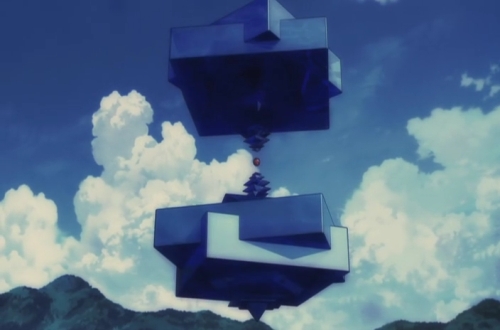
The most drastic change comes from Ramiel. I was a fan of the simple diamond design of its TV incarnation, but Ramiel has been re-imagined into a being who also toes the line between the organic and the artificial but in an entirely different way. Ramiel is not limited by how we perceive space, and as it transforms into various geometric structures it does so with a surprising amount of life and personality.

One unusual thing about the Angels in Rebuild of Evangelion is that their numbering system has been bumped up by one. Whereas Sachiel was once the 3rd Angel, it is now the 4th and so on. The movie also hints at the fact that there will be fewer Angels than in the TV series, so we’ll be seeing a few of the lesser ones getting the cut.

Zeruel and Bardiel are shoe-ins, but sorry Matarael, no one likes you.

Dai Gurren Dango Dai Kazoku: Kyoto Animation’s Clannad

Oh, Furukawa

More than any other company in the world, Key associated with the concept of moe. It is responsible for revolutionizing the visual novel with its heavy emphasis on tragedy and empathy. The heroines of Key games are deeply flawed (some might say too flawed), and to care for them is to feel the pain of your own existence. Their fantasies come with a price.

Kanon and Air, two of Key’s most famous works, were adapted into animated series by Kyoto Animation with great success. They remained faithful to their original source material while adapting them to fit the needs of the television series format. In 2008 they took on the third of the “Seasons” tetralogy (each major Key game takes place in a different season of the year), Clannad.

Clannad is the story of Okazaki Tomoya, a young man in his senior year of high school, whose aspirations in life have been rapidly fading away ever since he had a falling out with his father a few years ago. A chance meeting with Furukawa Nagisa, a shy, soft-spoken high school girl with a love of anthropomorphic snacks, and her desire to re-establish the defunct Drama Club puts Tomoya on the path to rediscovering what it’s like to have hopes and dreams.

The gentle Furukawa Nagisa, the starfish-obsessed Ibuki Fuuko, the introverted genius Ichinose Kotomi, the athletic and aggressive Fujibayashi Kyou, and the dangerously powerful Sakagami Tomoyo comprise the main heroines of Clannad with significant story time devoted to all of them. Behind them is an even larger cast of secondary and minor characters, chief among them being Sunohara Youhei (Tomoya’s best friend), Fujibayashi Ryou (Kyou’s twin sister), and Nagisa’s parents. However, don’t take my brief descriptors as evidence of the characters being shallow or underdeveloped. They are all given time and room to express the many facets of their characters, even the minor ones.

Delving into the characters’ pasts can at times become overly reliant on exposition, and though I am a fan of exposition in general I’ve found the best moments in the show come from when Clannad does not present you with all of the facts. The most notable example that comes to mind is a moment where Youhei, in an angry outburst, hints at the reasons why he and Tomoya became best friends. No more explanation is necessary to understand Youhei’s character at that point in the story.

Clannad is Key improved through years of experience. It doesn’t break any genre conventions, as it is still, at its heart, an anime based on a relationship-heavy visual novel, and it has its cast of cute, moe female characters, but it and the people at Kyoto Animation did try some new things to set it apart from the other Key adaptations.

Clannad, while still very much a conventional Key-style moe drama, does do a few things different from its predecessors. Aside from a few exceptions, there is less emphasis on the supernatural. Also, Kyoto Animation structured it differently compared to Kanon and Air. While there is a strong focus on each of the main heroines and the series can be divided into chapters, the girls do not suddenly stop mattering when their story arcs finish. Nagisa’s story is the most notable, as it is developed throughout the series, from episode 1 on. It clearly puts her in the position of the Clannad heroine, though based on any remote amount of information or even the events of the first episode this should not be a surprise or a spoiler to anyone.

The character designs in Clannad are much like the ones used in Kanon and Air, and they are the most prominent aspect associated with Key, even more than their penchant for supernatural tragedy. There are no surprises in this regard, though the school uniforms are much better designed compared to the ones worn in the previous two major Key works, and the spring-time setting of Clannad results in a more subtle atmosphere for backgrounds and overall artwork. The series also has a surprising amount of animation for a show so heavily based on words, but at this point it’s par for the course with Kyoto Animation.

Clannad is not entirely based in sorrow and anguish, and in many respects it is lighter on the tragedy than the previous Key series. It has more than its fair share of comedic moments, most notably with Fuuko, and it blends the lighter and heavier sides of its story with a sort of deftness that’s not easy to achieve. More than likely, this is the result of both Key and Kyoto Animation gaining experience working with these types of narratives.

If you’re not a fan of the Key-style moe, then Clannad is probably no exception. Clannad is the flavor of Key distilled and refined, and those who treasure its taste will be pleased.

An anime by any other name…

Today I thought about what is one of my favorite instances of the Pokemon anime: the sequel to Mewtwo Strikes Back. I don’t mean the second movie, I mean the special released in America as “Mewtwo Returns.” However, when I talk about it, I usually refer to it by the English name given in its Japanese release, “Mewtwo Lives.” Further still, the actual Japanese title is “Mewtwo! Ware wa Koko ni Ari” or literally “Mewtwo! I Am Here.”

That’s three titles for the same work. This happens pretty often with Pokemon too, such as in the aforementioned second movie (Lugia Bakutan, Revelation-Lugia, and The Power of One) and in the case of To Terra/Toward the Terra/Terra E, though that’s a somewhat unusual case. Usually I follow a hierarchy of English Name Given By Japanese followed by Japanese Name and possibly the American-given name if it makes it easier to understand. In that respect, I still say “Erementar Gerade” instead of the more sensible “Elemental Gelade.”

It can get kind of confusing though, and I wonder at what points exactly should I conform to convention for the sake of others. Do I from now on refer to Mousou Shoujo Otakukei as “Fujoshi Rumi?” I know that when writing reviews or academic papers, the American release title takes priority over everything else, which makes perfect sense, though I find myself somewhat resistant to using it.

Though I am thinking of referring to “Muteki Choujin Zambot 3” as “The Invincible Zambot 3” rather than the literal translation of “Invincible Superman Zambot 3.” I know it’s based on the Italian title of “L’Invincible Zambot 3,” but I think it has a nice ring to it and isn’t as awkward as using “Superman” in the title. This also goes for “The Unchallengeable Daitarn 3.”

“The Invincible Zambot 3.”

We’ll see.

PS: Zambot 3 really isn’t invincible at all.

Zetsubou Sensei Makes Ogiue Reference

In Zoku Sayonara Zetsubou Sensei, the titular Zetsubou Sensei is in despair over various “strays” being chased out.

Let’s take a closer look.

And based on the fact that Zetsubou Sensei has made references to Genshiken in the past, I can only say that this is definitely the case.

You’ve won this round, Kanokon

It’s the kind of show which won’t last long in the memories of anime viewers, the kind of show that will have come and gone. Certainly not the kind of show that would result in a long post from me explaining how it relates to other anime.

And yet, Nozomu’s little stunt, where she consciously tries to achieve the “toast-in-mouth-late-for-school” look is endearing. The last time I saw such conscious pandering with this very specific method was episode 26 of a certain show.

I don’t think it’s at all a mistake that this girl with the seemingly emotionless voice would be trying to imitate the most famous emotionless girl of all.

Pastel Explosion: 70s Shoujo Anime Backgrounds

Having watched just the first episode of the classic anime Ace o Nerae!, my love affair with 70s-era classic shoujo has been rekindled. Not that it really died down in the first place.

However, this isn’t really about the content of the story but rather just the visuals, and not even in regards to the characters. Shoujo anime of that era, including Ace o Nerae!, have incredibly gorgeous backgrounds and just artwork in general, though they suffer quite a bit in the animation department. I think it’s a fair trade-off though, as the action and fluidity of animation or lack thereof are minor losses when we get shots this incredible.


Repeating the flower pattern seen in her night gown into the plaid background unifies the entire image.


This image almost borders on abstraction, but not in the confusing way. I love this style.


Particularly strong use of color here, as the building and trees blend together.


And I can’t say enough about this background. It looks like it was created with water colors, and it works far better than any approach I’ve seen for indicating melodramatic shock.

Shows like Zetsubou-sensei kind of have a similar effect as far as modern shows go, and Nana and Honey and Clover for example also have excellent cinematography, but they simply lack the rough yet gentle edge of classic shoujo.