Nandoga Nare: Let’s Get Ready for Otakon 2010

Otakon is this weekend, and I am psyched. Not only that, but if you didn’t know before, I’m doing two panels this year. You’ll find both of them on the Otakon Schedule, but just to make sure, I’ll highlight them below.

Riichi: Japanese Mahjong, Anime, and You
Time: Friday, July 30 at 9:30am
Location: Panel 4
(Hilton Key 11-12)

If you’ve watched such popular anime as Akagi and Saki, you’ve been witness to the ancient game of mahjong– and you had no clue what the players were doing. Maybe you’ve even tried the game and found the complicated rules too intimidating. We did too! But we managed, and today we’re here to show you that it can be done. Let us enlighten you on the basics of Japanese style, or “riichi” mahjong, its appearances in anime and the entire genre of manga devoted to it, and how to play this fascinating game!

Portrait of a Fujoshi: The Psychology of Ogiue Chika
Time: Friday, July 30 at 11:00pm
Location: Panel 4 (
Hilton Key 11-12)

Throughout the series “Genshiken,” the character of Ogiue Chika goes on a journey of development, tackling topics such as self-image, childhood trauma, and the many perils of being an otaku-in-denial. Come, if you want to really delve into the mind of Genshiken’s most psychologically complex character with a panel brought to you by the experts on angry fujoshi characters, Ogiue Maniax and Viga the Otagal!

Now I understand that the first panel is very early and the second panel is very late, but I think you’ll get a kick out of both, particularly if you are a fan of both Ogiue and mahjong (I’m sure there’s a lot of you out there).

I’ll also be running around with the above image around my neck. It’s a special badge for this year that I’ve put quite a bit of thought into. You might even be wondering, “Are those a random assortment of tiles below Ogiue to reference the mahjong side of things?” But they’re not.

The hand is a Hon Itsu, or Half Flush, signifying Ogiue’s self-image of “impurity.” It also contains bamboo tiles, as the Ogi in Ogiue means “reed,” with the added benefit of the 7 of bamboo resembling Ogiue’s paintbrush hairstyle. They’re all odd numbers because Ogiue herself is odd, and the east and north tiles are in reference to the fact that Ogiue is from “Tohoku,” the northeast region of Japan. Finally, the hand is also a Chii Toitsu, or Seven Pairs, because Ogiue is a fujoshi who likes to come up with pairings.

See you in Baltimore!

Sho Nuff Himself Would Be Scared

When I think of western anime fanart, the first thing that pops into my mind is something I call the “Deviantart style.” Characters are usually drawn fairly realistically, their bodies becoming canvases for a psuedo-airbrushed look, every shadow and every highlight blended so softly that characters can probably be best described as “glowing.”


Artist: Yanimator

Artist: Ramy


Artist: REIQ (NSFW)

Now I am fully aware that Deviantart is home to an incredible variety of artists, and that even among the anime-style artists this is not anywhere close to the sole artistic style present. Nor am I even saying that this style is bad. However, as far as I can tell, this glowing style tends to be the most popular and ubiquitous, especially at anime conventions.

So my questions are: Why is this style so popular, and how did people learn it?

When I look at the most popular manga artists, none of them actually color their images in this manner, not Kishimoto (Naruto) nor Kubo (Bleach), and especially not Oda (One Piece). Branching out, I can only think of a handful of artists who get anywhere close to that Deviantart style, and most of them cut their teeth in the world of adult doujinshi, such as Satou (High School of the Dead), so their styles end up being closer to visual novel CG than anything else.


Artist: Satou Shouji (aka Inazuma)

One major difference is that the aforementioned Shounen Jump artists all color using real tools, and when I think about it, the Deviantart style seems born out of an almost purely digital environment, where textures can be finely tuned to almost microscopic levels, and stroke lines can be edited down with the utmost precision. It is, perhaps, a style resulting from the ability to hit ctrl-z in Photoshop and Illustrator. Of course, I’m not saying that it’s an impossible thing to overcome, but that perhaps artists who have experience with traditional media may be better at transcending limitations and making that style their own.

When it comes to anime artwork among western fans, I feel like there is an obsession with “realism.” In OEL manga for instance, a great amount of attention is put on screentones for smooth shading and for perspective in building backgrounds. With fan artists, perhaps this manifests itself into a hyper-realism where vibrant gradients rule the land. Not to pick on him again or anything, but it feels like the “five-tone shading” concept taken to the extreme, where the number of tones approaches infinity and the whole thing turns into a calculus metaphor. In a way, it reminds me of superhero comics, where musculature is emphasized greatly because they similarly harken to reality through exaggeration.

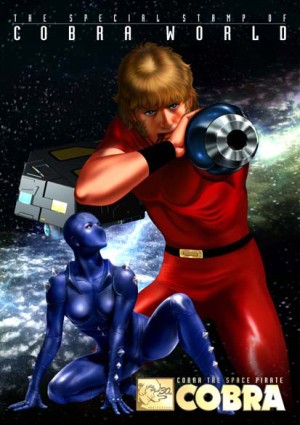
The closest artist I can think of which combines all of these elements is probably Terasawa (Space Adventure Cobra), but I get the impression that not very many artists on Deviantart take their inspiration from Terasawa.

Artist: Terasawa Buichi

But this is all speculation on my part. What do you think of the Deviantart style? Like it? Hate it? Do you use it? If so, what are you influences?

I just want to figure out how it came to be.

Remember the Good Times

Random Robot Doodles

The Soul of Doujinshi: Why I Like the Comic Party Anime

As more and more dating sims and visual novels have gotten adapted into anime, the question of what makes a good adaptation frequently comes up. When I’m asked this, the title I most often mention is Comic Party.

I’m going to get into specific story details to express the strengths of Comic Party, so I’m going to be spoiling a good deal. Also, I have never played the original game, so while I am aware that a number of differences between the source and the adaptation exist, I do not know to what extent, aside from the very fact that the main characters seem to have been de-aged from college to high school.

Based on the dating sim by To Heart creators Leaf/Aqua Plus, the first Comic Party anime is not that different from a number of similar titles. A single guy finds himself surrounded by a variety of girls, including one childhood friend, one bespectacled jokester, one quiet girl, and so on, only this time the guy is a fledgling doujin creator and the girls are fellow doujin artists, cosplayers, and otaku. But what sets apart Comic Party from other dating sim adaptations is its approach to that single guy, that protagonist around whom the story revolves.

Kazuki, amateur artist, is introduced to the world of doujinshi by his enthusiastic otaku friend, Taichi. Although a rocky start, Kazuki ends up being inspired by a number of other doujin artists and eventually creates his very first doujinshi. A square-jawed violent tale of gangs and guns called “Not Hundred,” Kazuki’s isn’t exactly a crowd pleaser, but still manages to sell a few.

The joy of having his own artistic work purchased and read by others gives Kazuki a new determination. For his second attempt, he would do some serious research, learning what people wanted in doujinshi and how he could best incorporate all of it into a single work. Full color, twice the size (and price) of his first doujinshi, and featuring a big-breasted giant robot pilot as its main character, Kazuki was confident that his follow-up would be a smash hit, but failed to realize that in his attempt to make a big seller, his work lost its soul in a way that was recognizable to anyone who picked it up.

Feeling dejected, Kazuki abandons the world of doujinshi. However, with the help of the friends he made along the way, Kazuki is able to regain inspiration and draw again. Though his third work is rougher than the last two, even being made by xeroxing copies at the local convenience store, it is clear that his enthusiasm and spirit are stronger than ever. Kazuki learns what it means to be an artist of doujinshi.

Kazuki’s character is remarkable, particularly when you compare him to other dating sim heroes, where most protagonists of these adaptations are primarily viewer surrogates who act as guardian angels of sorts to help solve the problems of the girls around them. While this exists to some extent in Kazuki, what’s more important is that Kazuki has a significant character arc. He finds a goal, grows, falters, and recovers, and comes out of it a better person. I know that dating sim anime are not exactly where people look for anything more than wish fulfillment, but I was glad to have gotten an actual story and a much more active main character. This is also exactly the reason why I dislike Comic Party Revolution, as the anime went from being a tale of artists to just a nudge and a wink to the existing fans and an excuse to see all of the characters together.

Comic Party was also the first anime which introduced me to the concept of doujinshi (incidentally, also the concept of moe). It told me that doujinshi were comics created by fans for fans to celebrate the joy and love that comes with being a creator who sees himself not above his readers but as a peer. It wasn’t about money, it was about loving anime. And while I know that there are many doujin artists out there who do manage to work for profit, that doesn’t tarnish the ideal Comic Party presents.

Showcase Your Manga Abilities: Manga as/in Essay

This is a call-out to all of you artists, writers, and scholars who believe in the power of manga to convey ideas, and want to spread this belief to others.

The Modern East Asia Research Centre at Leiden University is sponsoring a new series of competitions for the next five years, with the goal of exploring the creative and expressive power of manga.

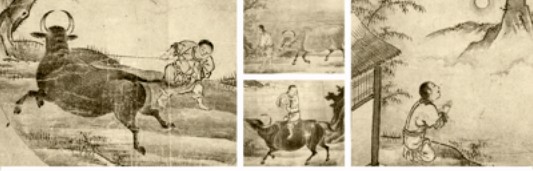
The first project up is  “Manga as/in Essay,” wherein contributors will create graphic essays about the theme of “ox herding” as a metaphor for the path towards Enlightenment in Zen Buddhism. It’s a heady and perhaps difficult topic, but that’s part of the fun, and I think it’ll be quite  interesting to see what happens when the imaginations and ideas of thousands(?) of contributors are focused upon a single specific idea such as this.

For the most part, contributors are free to interpret the topic however they choose. One page or 50 pages, verbose or silent, all manners of writing and drawing styles are welcome.

Of course, this is a competition, and there will be prizes for the winners: 1000 Euros for 1st place, and 500 Euros apiece for 2nd and 3rd place. On top of that, the winners will be published in an academic journal. According to the promotional material, the criteria for winning is as follows:

-originality of expression
-power of expression
-style of expression
-quality of imagery
-overall effectiveness

So keep them in mind as you create your projects.

I’m going to link you the project page one more time because there is a lot of stuff to read about it and I don’t want anyone jumping into it only to realize they made some serious error. It also explains what exactly the “ox herding” thing is if you’re completely unfamiliar with it like I am.

The deadline is October 31st, 2010, so get cracking!

The Hidamari Sketches

While looking through my recently-acquired volumes of Hidamari Sketch, I found myself enjoying the comic well enough, but gravitating more towards the interstitial drawings that populate the pages in between the 4-panel comics.

“Wow,” I thought to myself upon first noticing them, “These drawings are really nice and and have excellent line quality to them. I kind of wish the whole comic was drawn this way.”

But then I wondered about how that would actually affect Hidamari Sketch. Part of why I like a looser, heavier brush style is that it gives off a good sense of vibrancy and energy; it’s really visceral in a way but also can be extremely elegant. However, all of that has to do with the drawing itself and connecting to the artist, as opposed to the art style being a way to connect with the characters. Given that Hidamari Sketch is a pleasant slice-of-life story, soothing like a spoonful of honey, drawing that much attention to the hand behind the art might not be the best thing for it.

I can still hope though.

Yelling Till It’s Blu in the Face

HD video is currently the next step in increasing the visual quality of moving images, and it is certainly more detailed than anything in the past, but it just makes me think about how in terms of visual clarity, video is forever doomed to lag behind still images and photographs.

Here is a fiction re-enactment of the interaction between video and photography.

Video: I’m bigger and sharper and better than ever! Maybe I’ll finally win!
Photography: Well that’s great! By the way, have you seen my new ultra mega resolution that lets me get in 100 times as much detail?
Video: DAMN YOUUUUUUUU

Or something to that effect.

Of course video is more realistic in its own way, but through time we’ve seen that increasing desire for more realism in it, but just by the fact that for every step in visual clarity that video takes, photography and the like are able to be at least twice or three times better just by virtue of being static images.

This might make for a good shounen manga, actually. Personally I can’t wait for the heroic team-up to vanquish a common enemy.

And by common enemy, I mean REALITY ITSELF.

Doodle Doodle Dee

Different Aims, Different Misses: “Traveler,” Manga, and OEL Manga

Back when I was buying issues of Monthly Afternoon to get my Genshiken fix, the magazines would occasionally come with packaged mini-manga. Each small book has one or two self-contained stories and it seemed like a pretty good extra. It wasn’t until kransom’s post about the Afternoon Four Seasons Award that I realized that these manga were exactly that: winning entries from the competitions.

Though anyone is allowed to enter, amateurs can still manage to win, as was the case with Winter 2005 when then-rookie manga artist Imai Tetsuya won the Winter 2005 Grand Prize for his entry, entitled Traveler.

Portable Four Seasons Winter 2005. Traveler is the one on top.

Looking at Traveler, it most definitely deserved to win. The basic premise is that a boy wakes up one day to find that he’s four months in the future and that apparently in those four months he’s turned into a complete jerk who left his band and broke up with his girlfriend. The story is less about returning back to the proper time and more about dealing with responsibility even when it shouldn’t have anything to do with you. It’s pretty intriguing, and everyone loves to say, “Fuzakenna!

Imai makes mistakes. Some of the characters and plot development seemed tacked on and unnecessary. But what I find really interesting about this is that the faults of Traveler feel different from the mistakes that tend to happen in OEL manga.

When we look at criticism of OEL manga and the whole movement behind it, one of the factors is how much it just doesn’t “look” like manga. Artists try their best to live up to the series they love, but something typically feels off. In the past I’ve talked about some of the reasons why I think this happens, and Narutaki over at the Reverse Thieves pointed out the abuse of screentone in a lot of OEL titles. But I think there’s a more inherent cultural difference, one that’s not really a matter of talent or experience.

The art in Traveler hits bouts of inconsistency, particularly with the characters, as they sometimes suddenly look like they have no bones underneath their skin and muscles. I think you can see this in the image from earlier. Faces go out of proportion, too. A lot of western artists probably even have a better grasp of anatomy and motion than Imai, but the way in which the artwork turns out inconsistent is different from the way it happens in most OEL titles.

The story’s faults are also different from the issues that occur in OEL manga. In Traveler, some characters and plot threads sometimes seem unnecessary or perhaps given too much time, a problem when it’s just a 32-page one-shot, which are problems which occur in OEL titles too, but the plot issues with Traveler seem very much like the kind of mistakes that would happen in manga. There’s a sense that Imai and other manga-aspiring artists in Japan, when compared to their counterparts across the ocean, are simply aiming for separate goals; whether they reach them or not is another matter entirely.

I think the lesson here might be that when you judge two things, comparing the very best of one to the very worst of another doesn’t really get you anywhere. It’s far more interesting and fruitful to look at the middle ground; avoid the absolute greats for a little bit so you can see what most people are doing. There, you’ll find a good snapshot of the state of manga, or whatever it is you’re looking at.

I also know that “across the ocean” leaves out countries and products like Korean manhwa. I’ll leave that for another day though.