Umino Chika Spikes Water at Production IG, Kimi ni Todoke the Result

I strongly suspect that Honey and Clover creator Umino Chika, while on her way to deliver character designs for Eden of the East, decided to “spice up” the lives of the members of Production IG. How else can I explain how good Kimi ni Todoke has been?

Not to take anything away from the original creator of Kimi ni Todoke, Shiina Karuho, seeing as it’s her strong story and nice character designs that they’re working with, and certainly Production IG has always been known for its high standards of animation quality, but KnT is a beast unlike any other unleashed by the Igg (that’s how the cool people pronounce it, you know). Rather than using their expertise to make a more fleshed out and realistic-looking show, as one might expect from the studio that brought us Ghost in the Shell: SAC, what Production IG has managed to achieve is a show that truly looks shoujo in a way most anime have not, including perfectly good works such as Cardcaptor Sakura and Itazura na Kiss.

There’s a very strong understanding by the staff on this show as to when to utilize the more visually two-dimensional and emotional elements and when to incorporate a three-dimensional sense of spacing among the characters, and it, and the result is that it achieves that pastel and wispy shoujo manga feel while still making sense as an animation. In a way it reminds me of 70s-style shoujo, only with less emphasis on the melodramatic, and more technical skill on the part of the animators.

And even if you don’t care about all of that stuff I just said, note that Kimi ni Todoke is still very good, and does a good job of murdering cliches with an 80 lb. battle axe, which I will assure you is the perfect metaphor for this show. Good shoujo, from Igg to you.

Relating to NES Sprites

Whenever I say there’s something special about video game graphics during the NES/Master System era, some will believe that it’s simply due to nostalgia, while others will agree with me, but won’t be able to explain why. Sometimes those who agree with me will even chalk it up to nostalgia themselves. I however believe that there are concrete reasons as to why the level of graphics that the 8-bit systems achieved for home consoles holds such significance, and I’d like to discuss one of them here. I’m going to be using mainly NES graphics and not Master System ones, because 1) the NES was more popular and 2) the Master System actually had better graphics overall, and we want to look at the less-good.


From left to right: Berzerk, Robot from Berzerk, Circus


From left to right: Mario, Megaman, Karnov

What is the significant feature that the characters below all have in common that the characters above do not, aside from obvious graphical quality improvements?

Answer: They have faces.

This makes it easier to identify with them as characters, and gives them a sense of personality. In the NES era, the graphics were strong enough on the popular consoles to portray characters’ faces and to give them facial expressions, even if it’s the same expression all the time. This is important because we as humans tend to see ourselves in our surroundings. Scott McCloud talks about this a good deal in Understanding Comics, but it really is something fundamental. Two dots and and a line becomes a face. A semi-circle shape can be a smile or a frown depending on which way it’s facing. It allows players to identify with the characters.

While this does not take into account those games which feature primarily vehicles or objects inanimate objects, my focus is not so much on them, as I believe they have a somewhat similar appeal, only focused on their fantastical realism rather than their human quality.

Even those characters who practically had no eyes, noses, or mouths still benefited from the 8-bit graphical quality, as it allowed the games to clearly delineate an area of the body as the head.


From left to right: Simon Belmont, Bill Rizer, Ryu Hayabusa

This was especially useful in portraying characters with more human proportions as opposed to the big-headed cartoonish sprites from before, as it allowed the characters to seem realistic on the NES while again still giving them some sense of personality.

That is not to say that faces on sprites were a wholly unique experience to the 8-bit era. The NES and the Master System were not the first consoles to regularly portray characters with faces, with that honor probably going to the Colecovision in 1982. However, the difference here is a matter of timing, as 1983 was also the year of the North American Video Game Crash, and so in the minds of most people, graphics went from Atari to Nintendo, and if you look at the graphics of that era, they more often than not could barely differentiate a head from a neck, with one notable exception being Pitfall for the Atari 2600. Hey, it’s not all art and discovery.

The 8-Bit NES era was when graphics were good enough so that almost anyone who made a game for the console could give a sprite a face (and in essence, a personality), and thanks to good timing also was when video games were again popular enough to be a common feature in households. Graphics were certainly not the only factor in endearing the NES (and to a lesser extent the Master System) to young gamers, but as humans are visual creatures, graphics played a significant role in implanting the memories of these games into their minds.

Bleach Fight Scene

Slap a Teenager: Maturation of the Creative Process

I’ve been doing quite a bit of drawing lately, and it’s gotten me thinking about the whole creative process, and the influence of one’s own age.

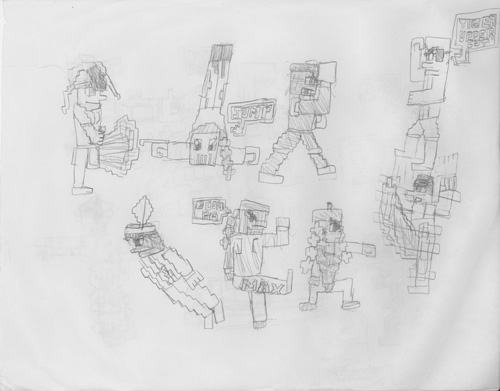
Recently, an old friend of mine found material for a video game we were creating back in elementary school. It had everything kids (or rather, we specifically) wanted in video games: tons of levels, tons of bosses, tons of neat gadgets and enemies. It was a game we’d spend time on nearly every day during lunch, thinking up new ideas for it. Honestly, looking at the stuff we came up with, I’m a little jealous of what we created back then. These were the unfettered mindsets of a pair of 10 year olds, where anything was possible as long as it made video game sense, and back then video game sense wasn’t very sensible.

Then one day something happened: we started to become teenagers. Now, when we looked back at our materials, everything seemed so kiddy. We thought, if our game was to go anywhere, we’d have to update it to make sure it didn’t look like the game was only for kids! Keep in mind we were like 13 or 14, and of course the hilarity of kids trying to make a game not for kids practically writes itself. This was the age of people accusing Nintendo of not appealing to the older demographics enough, and when Rare decided to revamp Jet Force Gemini and slap a few extra years onto its characters. So we made the characters cooler and tougher. We tried to give the bosses more realistic proportions, closer to Dragon Ball Z than Dragons of Blue Land. It wasn’t exactly 90s extreme, but it was something close to it.

Eventually high school came and we worked on it less and less until it dropped off entirely until more recently when we began to uncover our old materials. Now of course, looking at the things we came up with early on, and then how we tried to change it as we got older, I sort of want to slap my teenage self for accidentally trying to ruin a good thing. Not that I think my ideas as a teenager were all that bad either, but in this one case that teenage mentality was trouble.

I truly think that what we were thinking up at the lunch table back then could still appeal to kids today, though we’d have to apply a more cohesive design philosophy to everything. The goal would shift from trying to replace the products of our childish maginations with something more “mature,” to trying to refining or childhood imaginations and keeping it from exploding out the sides.

Then I hear people say, “Why do you watch an anime that’s meant for KIDS?” and the answer is obvious.

Apparently I Wanted Street Fighter for the NES When I Was a Kid

Another Legend is Born

Googly Shades

This is the Nerdiest Thing I Have Ever Drawn

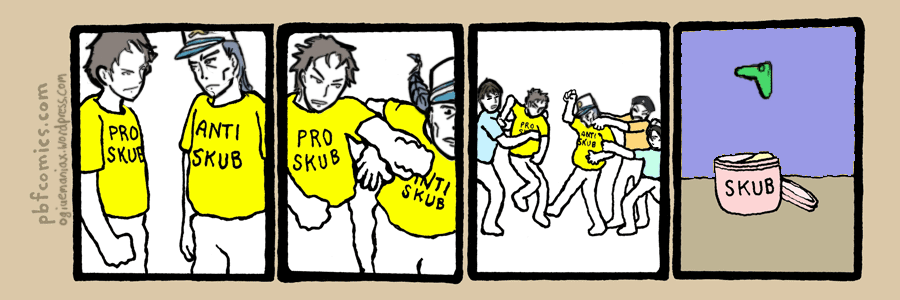
Pro-Skub/Anti-Skub 7

Hot Blood