Manga Criticism Translation: “At First, I Wanted to be a Manga-ka”: Analyzing the Nausicaa Manga by Kumi Kaoru, pt 2

Blogger/Translator’s Note: This is the long-past-due followup to the translation posted by kransom over at his blog, welcome datacomp.

As stated by kransom, the translation is based on a lecture by freelance writer Kaoru Kumi and included in a book he has written about Miyazaki. More information can be found in the introduction of part 1. For the sake of consistency and other things, all names in the essay are first name first, unlike my usual style.

Incidentally, just as we have translated his writings from Japanese into English, Kumi has translated an English book into Japanese, “Astro Boy and Anime Come to the Americas” by Fredd Ladd and Harvey Deneroff. More information about the Japanese translation can be found here, and you can purchase the original version from Amazon.

So without further ado, Part 2.

___________________________________________________________

Actually, the Nausicaa manga also frequently uses these techniques to create a sense of smoothness between panels, the difference with Yotsuba&! being that the sequence from Nausicaa relies on speech, while the one in Yotsuba&! relies on sound in order to keep the flow continuous. In short, this sequence utilizes a spoken word to smooth the sensory incongruity between the two panels.

Volume 7 p.83

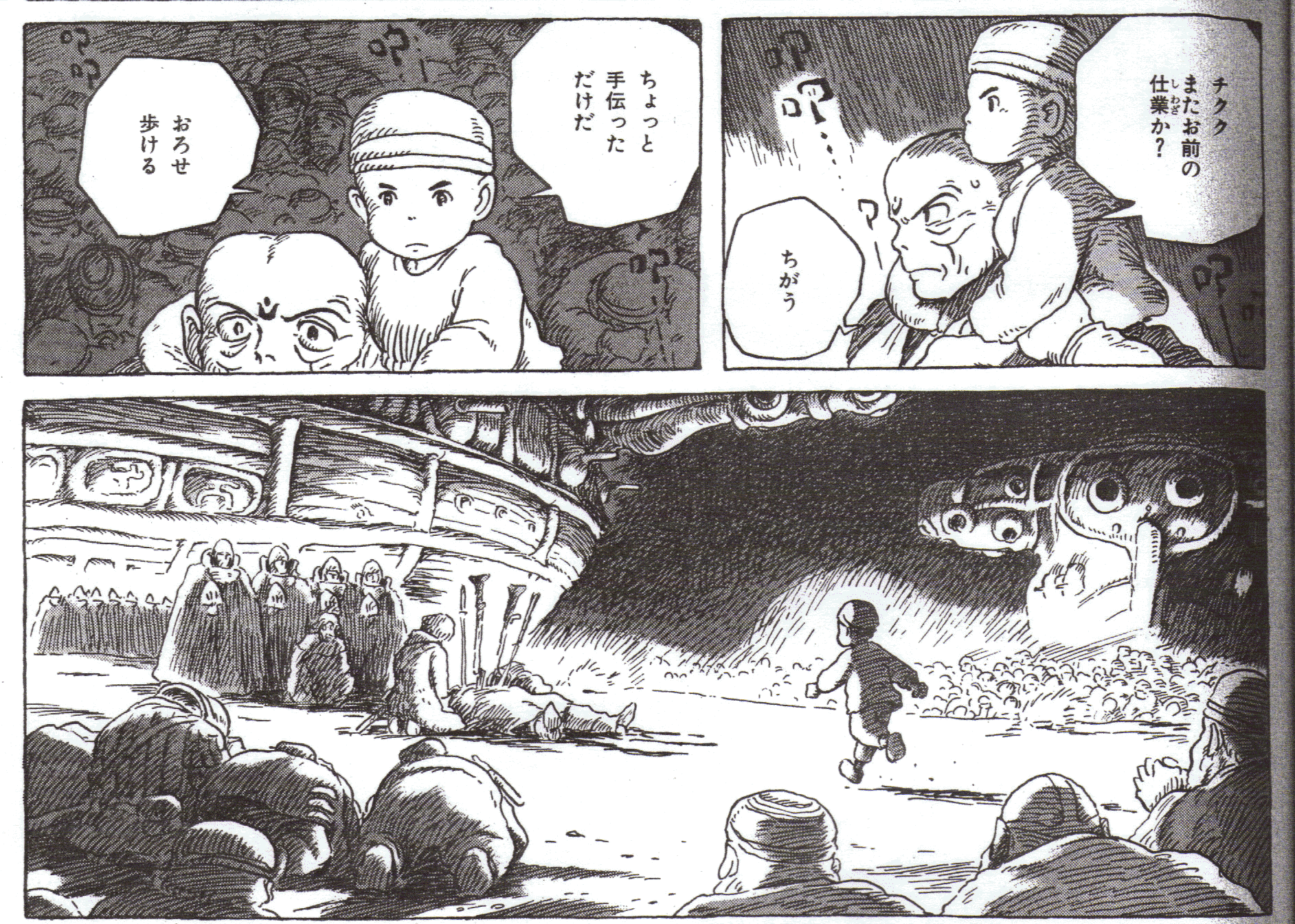
This is the impressive scene where Master Yupa steps in to stop the conflict between the citizens of Dorok and the remnants of the Tolmekian Army at the cost of his own life. Panel 1 and 2 show the boy witnessing the death of Yupa while being carried on monk’s back, while Panel 3 shows him rushing over to Yupa. Here, the cut between Panel 2 and Panel 3 is B’. With a B’ cut however, there should fundamentally be a continuation of the overall action, as is the case with the prior example of Shirley, which is covered by the action where the young maid quickly makes a cup of tea for her master. However, in this example, with panel 2 you have the boy sitting on the man’s shoulders without moving, and then with panel 3 he’s running. Technically, his overall action has been interrupted between these two panels.

However, you can see a line of dialogue in panel 2 where the boy says, “Put me down. I can walk.” Thanks to this line, the overall action is continued. Let’s try covering up the line, if you like (Here, the lecturer puts is hand over the projector to cover the words “Put me down. I can walk.”). Even with this, there’s nothing hindering the transition between Panels 2 and 3, but now don’t you sense something amiss? It’s like a baby stroller being pushed along and then suddenly hitting a bump in the road. But when you add in the line, “Put me down. I can walk,” (moves hand away) now it becomes smooth. The overall action of “rushing over to Yupa” continues in panels 2 and 3. In other words, B’ is established here. I think it subtly proves that Miyazaki cares a lot about having his readers enjoy Nausicaa and has a good sense of what will improve that enjoyment.

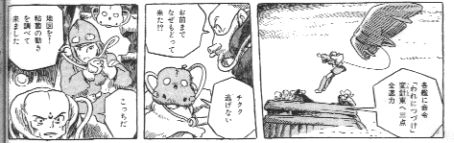
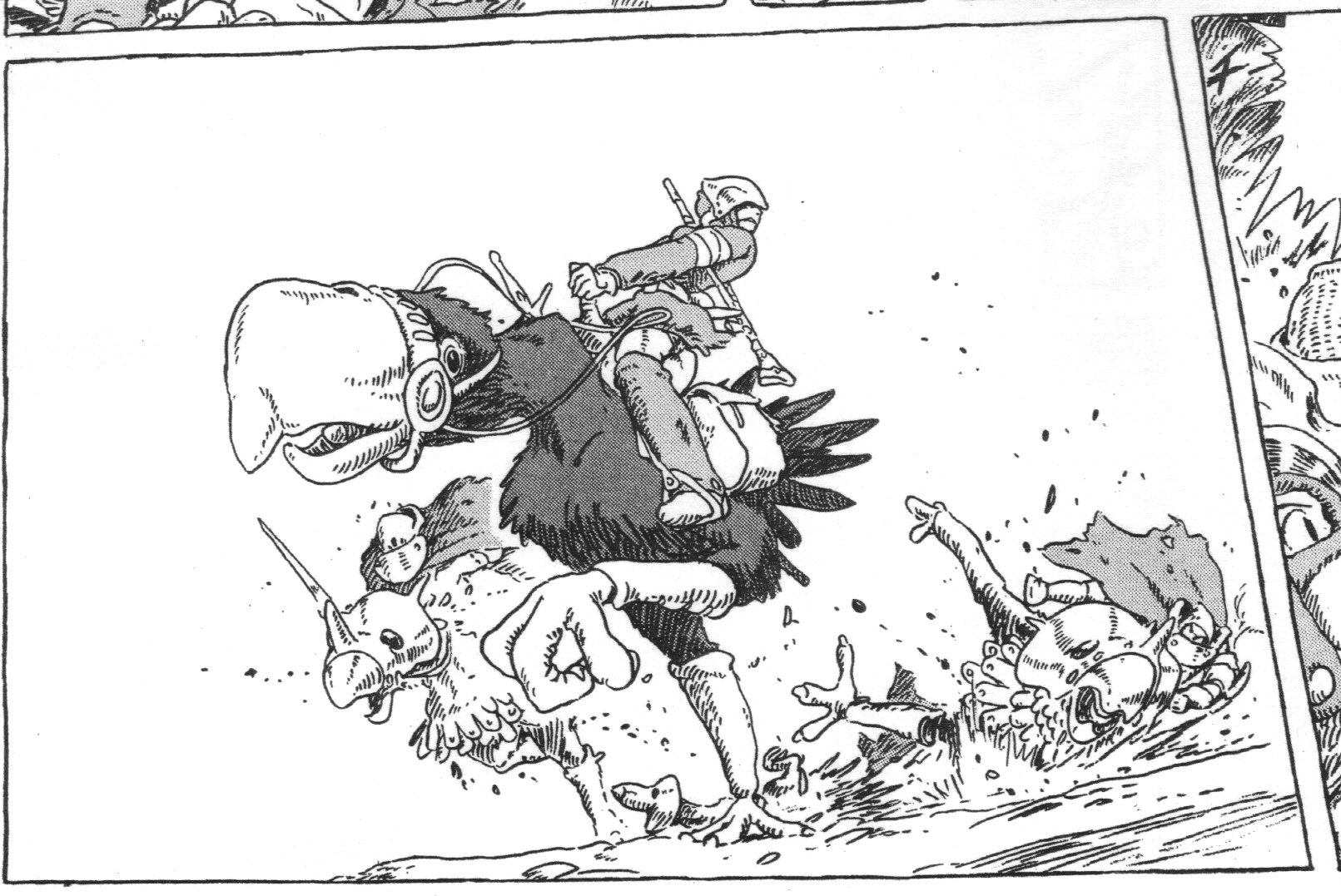
Nausicaa also has a clever use of Pattern B”. Let’s see the beginning of the old edition of New Treasure Island once more. If you compare the two, you will find that the two use the same Pattern B”. Here, Nausicaa and Chikuku are returning to a Dorok airship via air. In New Treasure Island the vehicle runs along hastily, while in this scene from Nausicaa, Nausicaa, Chikuku, and the monk are in a rush. That’s right, they both fall into Pattern B”.

Volume 5 p.62

“You’ve come back, too!?” “Chikuku won’t run away!” “A map! I’ve traced the movement of the mold.” “This way!” [CL1] These three panels look perfectly continuous since their dialogue goes on, in spite of the discontinuity in physical action in these panels. It’s the same technique as the one in the three-legged race I referred to earlier.[1]

Speaking of Pattern B”, I know there is another example in Nausicaa.


Volume 5 p. 87

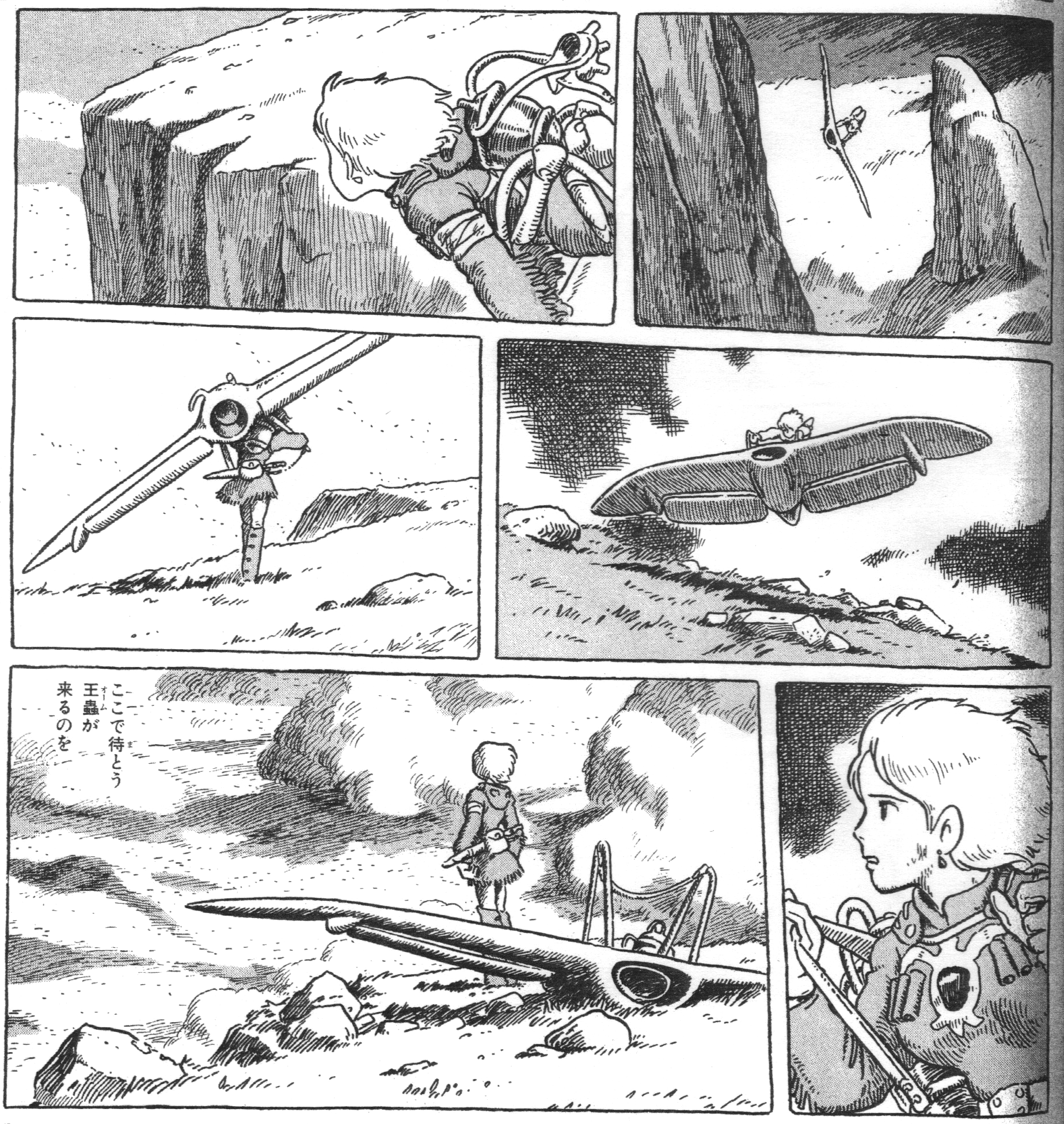
The world of humans is on the verge of destruction, and with Teto in tow Nausicaa goes on a solitary flight. She lands on high ground and decides to wait for the army of Ohmu, who know the key to the situation at hand. The action in these six panels is not continuous, and so one might determine these panels to be an A” sequence[2]. And yet, you can follow these panels smoothly, as if you were watching a movie, in spite of the lack of speech or sound to give you a sense of continuity. Actually, while these panels do not follow Nausicaa’s actions continuously, including how she lands on the ground and how she shoulders her kite, you can still follow those actions smoothly because the overall action of ‘her swooping down from the sky and landing near some high ground and then walking towards it’ remains continuous, or is uninterrupted. And so you sense that they are still continuous. This is Pattern B”.

Let’s look at another example of B”.

Emma Volume 5 (Mori Kaoru/Enterbrain) p.76-77

This is Emma. I’m impressed with this author, who takes a total of four pages just to draw Emma changing into her maid uniform. However, when you look at it, the omissions in the actions that happen from panel to panel are assuredly there. If the sequence were to be drawn in its entirety, a mere four pages would not have sufficed. When you read it, however, it looks perfectly continuous. The overall action of “changing from plain clothes into maid clothes” is done consistently, and the small actions which are not drawn instead take place in your head and complement the action. This is a typical example of Pattern B”[3].

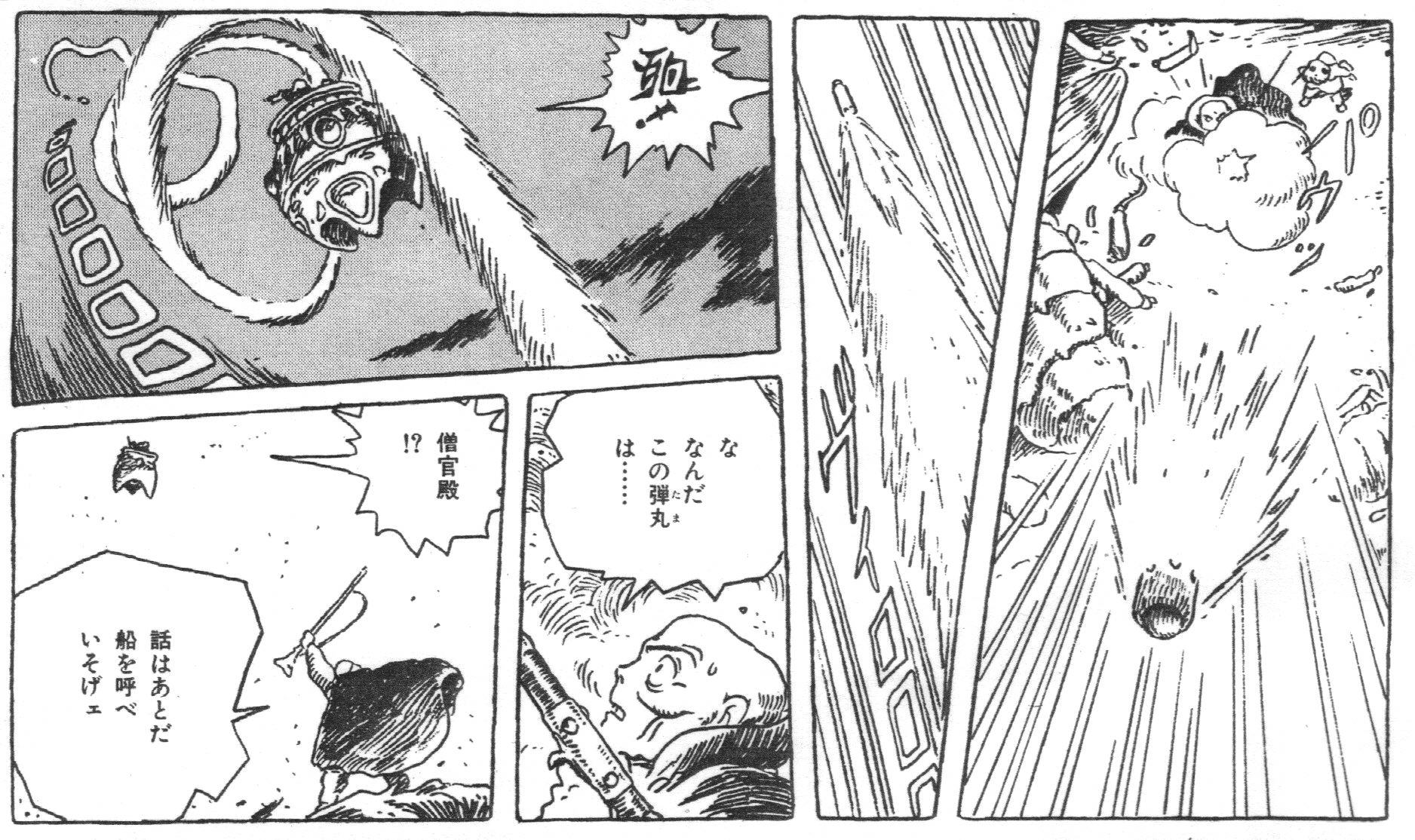
By the way, recall that earlier I explained how the Pattern B you see in movies theoretically cannot be replicated in manga, and that in order to do so you would need some way of falsely approximating the process. Actually, it is not impossible. Here, the monk points his gun at the sky and fires. Then, the subordinates up in the sky make their presence known.
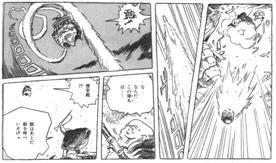
Volume 4 p.124

The sequence from Panel 2 to Panel 3 is key here. If you were to put this into a movie, in panel 2 the bullet would appear to be flying OUT of the screen, and then a cut would happen. Then, in panel 3 you would suddenly see the bullet flying, or, to put it differently, you would see the bullet flying IN when the officers in the sky riding the flying turtle are startled by it. That’s the exemplary editing it would need if it were put into cinema. Simply put, this is a Pattern B sequence. Pattern B may be theoretically not replicable in manga, but take a good look at Panel 3. The trajectory of the bullet is shown by the smoke trail. “Wha… What kind of bullet was that?!” [CL2] exclaims the astonished monk. Indeed, it’s a little more like a rocket. Thanks to this however, you can now tell with just one look that Panel 3 is an IN shot. Wow, this is definitely like a B sequence from a movie!

Incidentally, this kind of smoke is associated with the “action lines” which you might remember from Zipang, where it is used in aerial battles. Contrasting with the physically impossible and fanciful assemblage of lines, the smoke in Nausicaa has a physical existence. It does not feel insubstantial, but rather actually quite real and natural. If we analyze the transitions in those five panels, they are A’ B’ D’ A’; in other words, they are all single-dash (‘) sequences and not double-dash (”) ones.

Miyazaki’s composition of these panels is so awfully sophisticated that I’m terrified, but the examples I’ve drawn upon so far have been from when Miyazaki’s manga had been serialized for a while and he was establishing his own form of manga syntax, and not at the point when he first began serialization, back when his refinement was still lacking. Take a look here at the first page from Volume 1.

Volume 1 p. 9

I touched on it just before, but the second image here is unusual for Nausicaa in that the rectangular panel does not have a border. Actually, when it was published in Animage originally, the title logo for Nausicaa of the Valley of the Wind was inserted here. When it was being collected together for the tankobon, Nausicaa flying with the glider was drawn in, and so the edit from panel 1 to panel 2[4] is not B” so much as it is B”-. It’s the same as the beginning of the revised edition of “New Treasure Island.”

Now what’s a good way to explain the transition from Panel 2 to the giant skull in Panel 3? In a movie it would be a B. You’d think then that it would be a B’ sequence, but when you compare it to the way the bullet was handled in the panel I mentioned earlier, I must say it looks less sophisticated than a typical B’ scene.

And then, doesn’t the edit from Panel 3 to Panel 4 feel abrupt? First, some of her actions seem omitted. 1) The glider lands -> 2) Nausicaa pulls the gun from the glider -> 3) Nausicaa carries it on her shoulder -> 4) Nausicaa faces the Sea of Corruption and walks (Here, the lecturer demonstrates the way in which Nausicaa walks). That is how Nausicaa is supposed to act in this sequence, but three out of four of her actions have been removed. Moreover, while in Panel 3 she was gliding very close to the skull, in Panel 4 the scene is set at ground level, and so they cannot be A, B, or D. So, is it supposed to be C? No, because Pattern C is a scene change, which usually does not have the continuous presence of the same subject.

So then, what exactly is the sequence in these panels? If I had to explain it, I might venture to say that it’s like the old version of “New Treasure Island.” That is to say, it can be categorized as B”. However, there we have the consistent action of a moving vehicle. In this page of Nausicaa, the glider vehicle’s action is interrupted. Perhaps, if Panel 4 illustrated the glider flying towards the Sea of Corruption, it would be a smoother sequence, although Nausicaa would crash right into the tree trunks! (laughter) …even if it would be a smoother sequence.

Here’s the same scene from the movie version. Here, it is incredibly smooth.

1

2, 2’, 2’’

3, 3’

4

5

6

Nausicaa sweeps over the giant skull (1) -> Nausicaa prepares to land very close to the Sea of Corruption (2)~(2)” -> Nausicaa makes a soft landing below onto the sandy surface (3)~(3)’ -> Nausicaa pulls the gun from the glider (4) -> Nausicaa hangs it over her shoulder (5) -> Nausicaa walks towards the Sea of Corruption (6). They are edited in quite a normal fashion. But when you see this and then look at the same scene from the manga, you find that the sequence from the manga has less elegance to it in comparison. It suggests that Miyazaki was unsure of how to transfer and convert movie syntax onto paper when he began drawing the first chapter[6]. Also, the first chapter was 18 pages. With only so many pages, the complicated sequences where Nausicaa appears, wanders through the Sea of Corruption, reunites with Yupa, and then flies to the Valley of the Wind—a sequence which in the movie takes 15 minutes—has to be drawn, then the panel sequences would inevitably feel crammed and rushed.

If you were to again look over this first serialized chapter, you’d wonder why, despite the fact that the drawings are made to be dense, does the comic look so stark-white? Really, why? After thinking about it, I realized the answer: there are no screen tones being used. Do you understand? I brought some with me today. Can those sitting in the back see this? It’s a somewhat thin, net-like sheet. There are dozens of varieties of these, and they’re used by nearly every manga artist, cutting and pasting them onto their manga in order to create effects such as shadows and clothing patterns[7]. But in the first chapter of Nausicaa, all shadows are hand-drawn.

Volume 1, p.19 (with close-up)

With that, it’s pretty white. But actually, in the comic a bit of screen tone does get used.

Volume 1 p.26 (with close-up)

This is a close-up of Yupa’s face. Notice the shaded area. On top of the thin lines drawn here, a layer of screen tone is pasted onto it. This is the last page in the serialized chapter 1.

There are other instances of Miyazaki’s process of trial and error showing up in his drawings.

Volume 1 p.23

Nausicaa here is running with a big smile on her face. This same scene is also in the movie, but in the manga the scene has more of a slow-motion feel to it, and gives the impression of being a slowed-down moment. This is the weakness of B”-. Here, Nausicaa is sticking out of the panel, and is quite possibly Miyazaki’s deliberate attempt to reduce the slow feeling here. This technique, called “off the panel,” is incredibly common in Japanese manga, but this is the only instance[8] of its use in Nausicaa. “How should I draw a manga?” Miyazaki probably asked himself as he was holding a variety of manga magazines in his hand, and tried his hand at making something “off the panel.” Miyazaki had most likely not yet developed his own methodology as of chapter one.

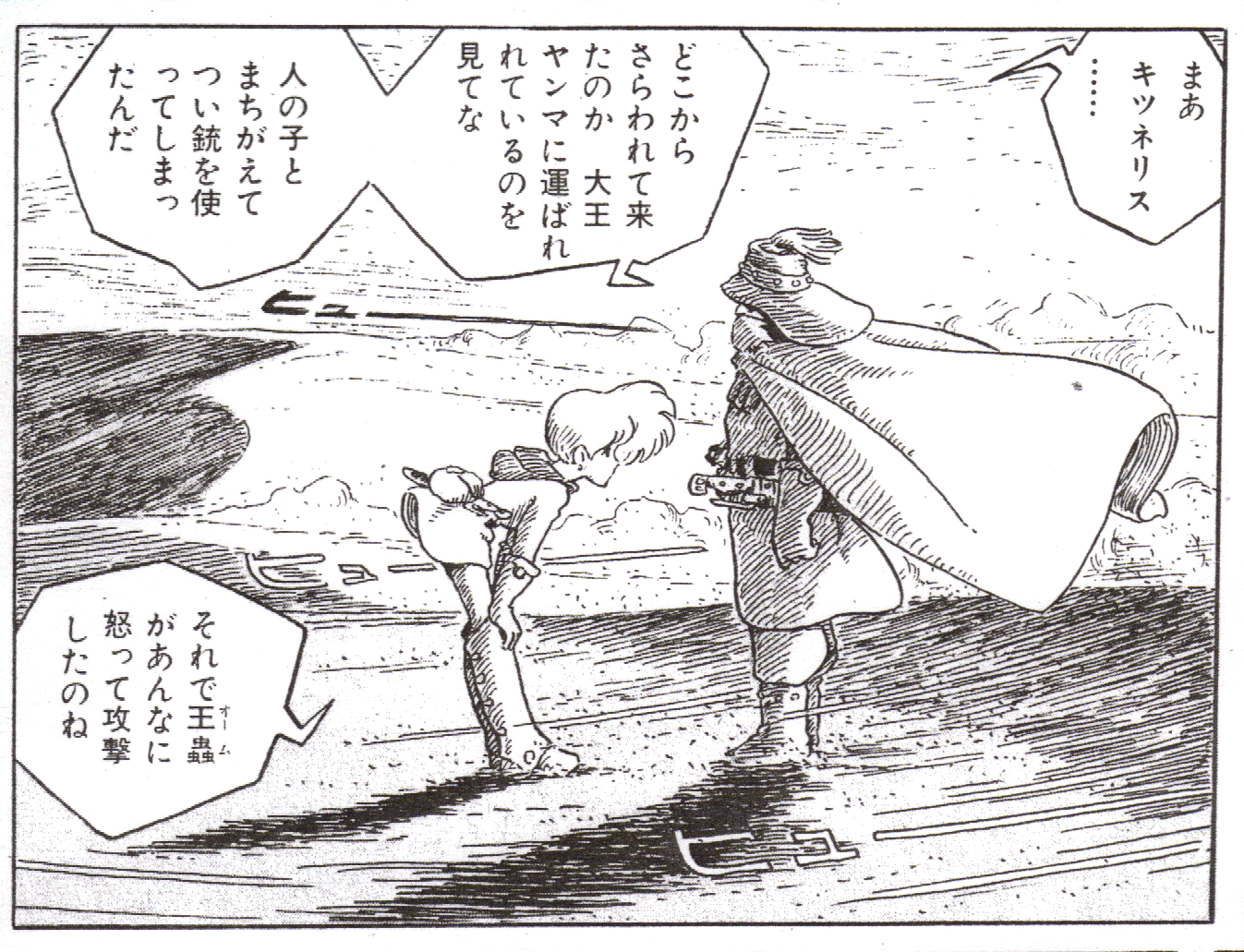
Such is also the case with this panel, where if you look at it after you’ve come to know Nausicaa it seems unpolished.

Volume 1, p.24

First, the use of the “hyuu” sound effect and the streamline seem rather forced. Second, the scene composition gives the impression of unsophistication. For a genius layout man like Miyazaki, the scene is too loose and incomplete. Why is that the case? Well, it’s because too many words, or should I say “speech balloons,” have been crammed into the scene. Later on, Miyazaki would use a multitude of panels to handle such a scene, but I think here Miyazaki decided to depict their conversation only for one panel because Nausicaa and Yupa are holding still. There are many speech bubbles in the panel, so the scene feels relaxed.

And so on and so forth. In chapter 1, examples of Miyazaki’s trial and error are everywhere. “There’s a lot I want to talk about, a lot I want to convey, but I am not trained enough to put what I really want to tell into manga. This is so frustrating!” thought Miyazaki, I suppose. However, the second chapter is much more stable. And listen, ladies and gentlemen, he finished the second chapter not in pen, but in pencil! When the first manuscript for Nausicaa was handed over, the Sherlock Holmes (aka Sherlock Hound) project was given the go-ahead, and so Miyazaki no longer had any time to draw manga. However, Animage persuaded him to continue the series, with Miyazaki finally agreeing to do so, on the condition that he could draw the Nausicaa manga in pencil because it enabled him to finish it more quickly. Nausicaa, as a result, became the first commercial manga ever drawn in pencil.

Volume 1, p.35 (with close-up)

One of the unique characteristics of the manga version of Nausicaa is how the shadows are rendered by drawing a series of thin lines. This is influenced by the French comic artist Moebius[9]. Look at the right image. You can see that these shadow lines are chipped subtly. That’s because it’s drawn in pencil (laughter). For your information, Miyazaki seems to have used a variety of pencil types, including a B and an H.

But then around the second half of the second volume, the comic goes back to being in pen. Now I might have this wrong, but I get the feeling that even after that it occasionally goes back to being in pencil. Here, for example.

Volume 3, p.41 (left) Volume 3, p.42 (right)

For the sake of the Nausicaa movie, the manga’s serialization was put on hiatus. The image on the left is a panel from the final page before Nausicaa was put on hiatus, and the image on the right is from the page right after serialization resumed. In the collected volume (tankobon), they’re printed on the same piece of paper, one on the front and the other on the back, but in reality there was a 13-month gap. Now if we were to magnify the dangling ends of the gas mask…

Do you see? The lines in the image on the right are more chipped. This means it’s a pencil drawing. You might know that in animation key frames are drawn in pencil, and so while making the Nausicaa movie, Miyazaki became more attuned to using pencil. I guess after the manga resumed, he was unable to draw with a pen the way he wanted to, and so after the manga started up again, the first new chapter was done in pencil. But then in the next chapter, the comic goes back to being in pen. Incidentally, when he resumed the Nausicaa manga after having completed the movie Kiki’s Delivery Service, the lines look a little chipped. I think that it was also drawn in pencil. Then, it returned to pen.

Now we’re going back to analyzing what it means to be “cinematic.” Having the background be out of focus is a technique frequently used in live action film, or should I say, photography. Suppose there were many little flowers blossoming and you attempted to use your camera to shoot one of them very closely. However hard you tried, the shot would get crowded by the other flowers. For that reason, you have the camera focus on just the one flower and leave all of the other flowers out of focus (Lecturer projects it on the screen). This is a terrible example though, granted (laughter).

The “out of focus” method is also in Nausicaa.

Volume 2, p.116

This scene is the duel between Yupa and Asbel. It’s an action scene, and yet it’s more akin to stopped motion. In my opinion though, I wouldn’t call it stopped motion so much as the removal of sound.

Look at this scene from the Nausicaa movie (DVD playback). A giant transport vehicle crashes into the Valley of the Wind. By the window is a girl who looks the same age as Nausicaa. The sound disappears in this cut. Movement in this scene hasn’t stopped, and yet doesn’t it seem like time has stopped for an instant? The panel in question, the one with Yupa and Asbel, achieves the same result on paper, although this scene was drawn before Nausicaa was ever turned into a movie. It is said that Takahata, who joined the production of Nausicaa the movie as a studio manager, worked as the sound supervisor as well and removed all the sound in this cut. His sound removal method must have impressed Miyazaki, as Miyazaki applied it to the Nausicaa manga in a more refined way later.
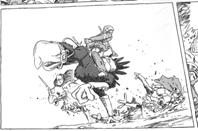
Volume 3, p.139

Here, Nausicaa is fleeing from a Dorok cavalry. Of the guards who are desperately covering Nausicaa with their bodies, one of them gets hit and falls over. It’s quite exciting. At the same time, the lack of a rendered background emphasizes her psychological shock and as a result gives off a sense of stillness, a sense of stopped motion [10].

The overlap technique seen in films is also used. It’s not used that often, but if you take a look here:

Volume 5 p.75

For some reason, the monk has a worried look on his face, and Nausicaa appears behind him flying. Drawing an image like this on paper is a little too bold, but in actuality the image does not feel out of place. In other words, it reminds us just how heavily we have adapted ourselves to the scene dissolves that occur in movies and television.

Speaking of which, this is a manga which faithfully uses rectangular panels. There are, however, exceptions, like here.

Volume 3 p.13

This image brings back some memories from when I was in elementary school, especially the illustrated encyclopedias that would be available in the school library. Boys who are into science or technology like illustrated encyclopedias, and a young Miyazaki would be included among them. (laughter). Now have a look.

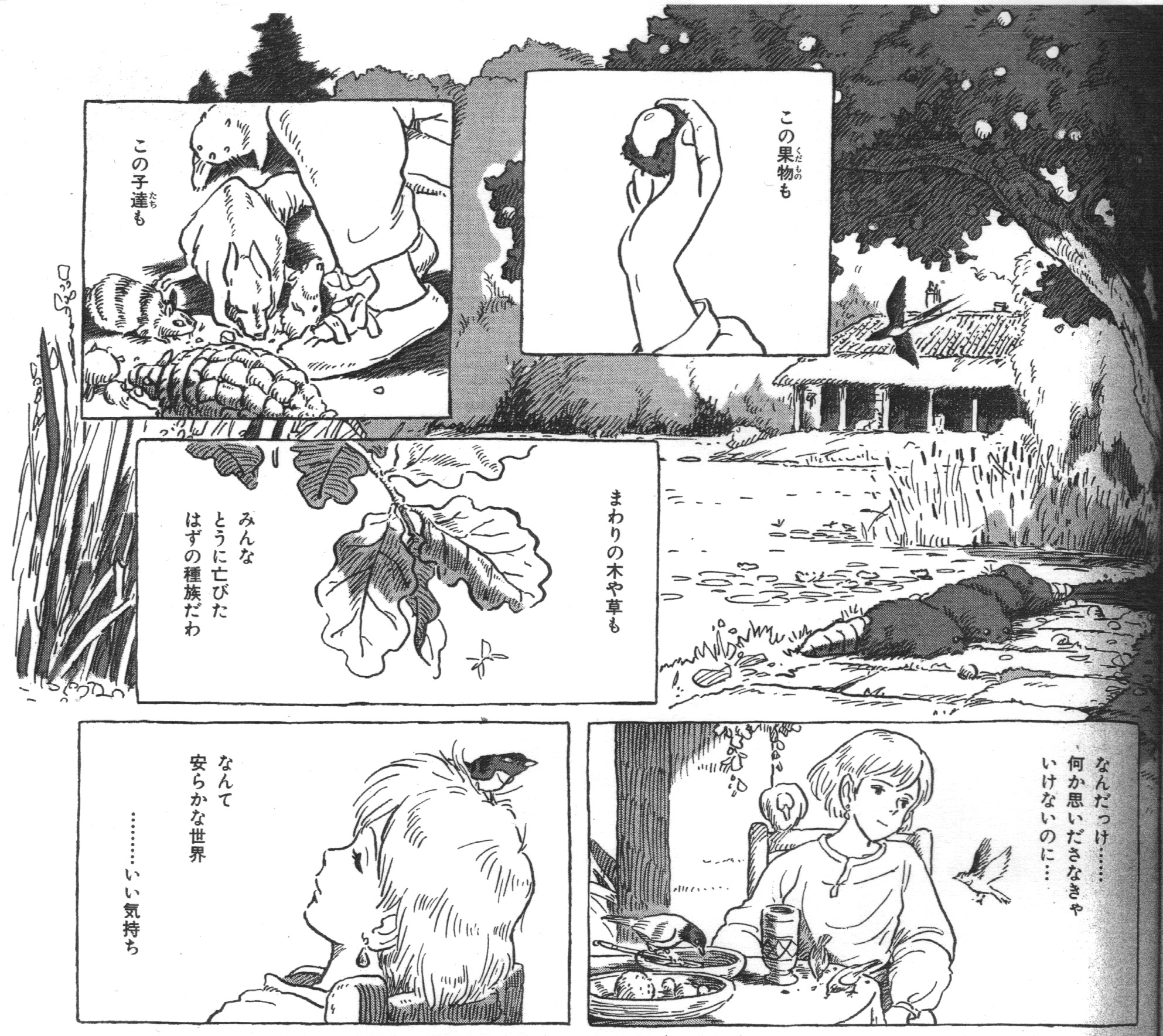
Volume 7 p.105

Oh! Here we have Nausicaa relaxing with a silly look on her face (laughter). She’s forgotten her usual self-denial and self-restraint, feeling quite relaxed and refreshed, with the image of the garden bleeding past the edges of the page as if to reflect the calm in her mind[11]. The author wanted Nausicaa to relax for a short while. After this, she would be sacrificed to a journey filled with despair…

…Which is my own humble analysis of Nausicaa. Seeing this manga, I’m impressed that almost all of the panels are rectangular, something quite unusual for modern manga, while each of those panels is packed with the passion and energy of such an extraordinarily talented creator. This gives off the impression that Miyazaki was holding back. As he was most likely extremely conscious of how the movie’s sequences and transitions would be edited, the activity in the actions from panel to panel, in other words A”, are united with the context of words and dialogue. In short, Nausicaa is the manga which blends cinematic methods exquisitely into classical manga syntax.

Miyazaki learned Disney-style full animation at Toei Animation, and then left the studio where he and his comrades ended up falling in labor union activities. He and Takahata joined the TV cartoon industry, trying to achieve maximum “cinematic” efforts using lower budgets and fewer animated drawings. In his autobiography, veteran animator enthusiastically writes about how Miyazaki had been living his vision.

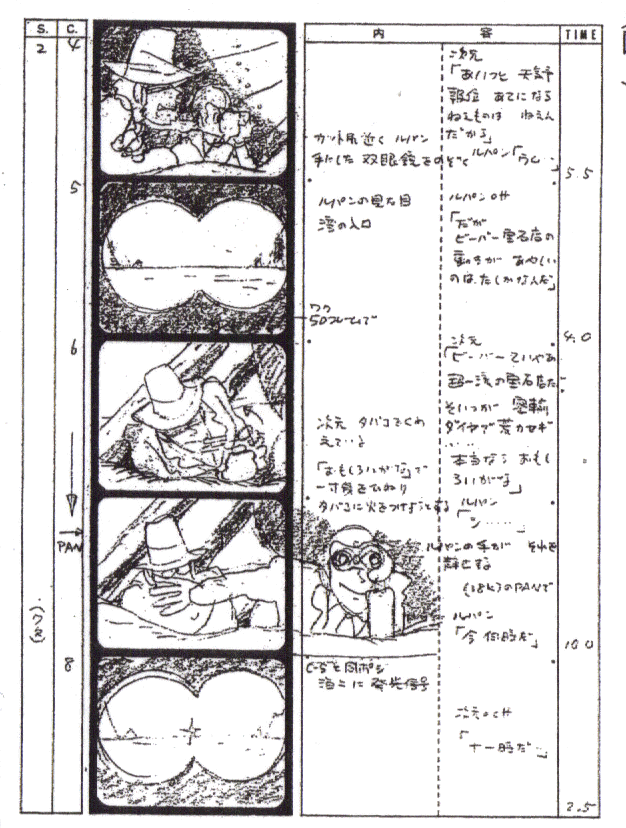
This is Miyazaki’s storyboard from the 1971 Lupin III[12]. Otsuka compares Miyazaki’s storyboard with one done by a different animator. If we look at this other storyboard done by someone we’ll call “Mr. X…”

The Animator Clawing His Way (Sakuga Ase-Mamire),
Revised and Expanded Edition by Yasuo Otsuka,
published by Tokuma Shoten Publishing, p.149

…there’s an A cut. However, with Pattern A, the action must be continuous, which makes drawing the images for it labor-intensive. Miyazaki’s storyboard on the other hand is entirely D edits. If the action isn’t continuous, then the drawings become easier to do, all the while Miyazaki remains perfectly faithful to the principles of film editing.

Looking at the Nausicaa manga more closely, not only can you see that the D’ sequences are well-done, but that there are a lot of A’ sequences (with actual A sequences being impossible). When A sequences appear in TV anime, a character’s actions must be singular, and it must be a simple action—like an arm extending—to shorten the amount of labor put into the drawing. Manga, however, is by nature a series of still images, so with Pattern A’ or even Pattern A”, the readers will conceive the movements in their heads. Showcasing clever uses of this mental mechanism is the air battle scene I showed you earlier. In Panel 8, the gunship is depicted flipping like a springboard diver jumping backwards into water. If you were to actually try to animate it, the process would have been laborious and would have required many frames of animation to be drawn. However, because it is manga, the complementary actions are envisioned mentally by the reader, where less labor is needed than in drawing animation frames, and so it becomes an easier task.

Thus, what you have here are the patient efforts of Japanese animators over dozens of years to make TV cartoon shows as fully cinematic as possible in spite of difficult circumstances in production, as well as the brilliant efforts of Japanese manga artists over dozens of years to achieve cinematic style on-paper in spite of the fact that manga is just composed of still images. One of the most brilliant fruits of their labor is the subtle and bold fusion of the two sides that is Nausicaa of the Valley of the Wind. That is my conclusion. (Applause) What? Why are you all clapping here? (Big laughter, huge applause) I’m grateful! Oh, don’t you think NHK will have to invite me as a guest commentator whenever they have their “Manga Night Talks” show about Tezuka’s New Treasure Island? (laughter).” Not that Tezuka Productions would ever give the OK on it, even though this is the 80th anniversary of Osamu Tezuka’s birth[13] (laughter).

Next week, we’ll continue to discuss Nausicaa. This time we discussed technique in depth, but next time we’ll be analyzing and getting at the core of its story and themes. I hope to see you all in this classroom next week. Class dismissed.

Footnotes:

[1] It goes without saying that the three-legged race I mentioned earlier is A”. However, the two girls’ swing of conversation fills cinematic gaps among the three panels.

[2] Notice how in panels 1~5 there are no speech balloons, sounds, or entire figures. On the other hand, you have Footnote 9, or “Osaka splitting her chopsticks apart,” where sound and figures make it easier to follow the panels smoothly, as if it were cinematic.

[3] In an interview, Mori mentions liking this sort of panel sequence.

[4] For the sake of convenience I called this “panel 2,” despite it having no actual borders.

[5] Actually there’s another solution here. If one were to insert a panel of Nausicaa preparing to land in between panels 3 and 4, it would become B”.

[6] I also referenced Yukihiro Abeno, who said, “Miyazaki is the ultimate and most fortunate amateur manga author.” (Seidosha Publishing, Eureka Special “World of Hayao Miyazaki” Issue)

[7] The first time this was used in a manga was by Miyomaru Nagata. Around 1955 or so.

[8] An omission.

[9] Moebius, born on May 8th, 1938. He is famous for having influenced the styles of Katsuhiro Otomo and Hayao Miyazaki, and apparently Moebius style had an influence on Tezuka’s Hidamari no Ki, the samurai drama featuring Tezuka’s ancestors. As an aside, Moebius named his own daughter “Nausicaa.

[10] In Nausicaa, when an action scene occurs the closing line in the panel becomes diagonal.

[11] I believe this technique of piling fragment-like panels on a larger, non-bordered image was first used in Japan by Shotaro Ishinomori (January 25, 1938 – January 28, 1998).

[12] At first Satoshi Dezaki drew the storyboard for the sequence, but Miyazaki rejected it and drew this afterwards. Though keep in mind that Dezaki was not “Mr. X.” In fact, the second storyboard on this page was drawn by a younger animator whom Otsuka got to draw it years after the production of the first Lupin.

[13] The old New Treasure Island was finally re-released on February, 2009.

Summer Wars Tomorrow in NYC

Regretfully it’s too late to buy tickets now so for those who were unaware of this event in the first place I extend my apologies, but I will be attending the New York International Children Film Festival‘s opening night showing of Hosoda Mamoru’s Summer Wars. I’ve been highly anticipating this movie, especially because the year I attended my first NYICFF was when I saw his previous film, The Girl Who Leapt Through Time.

I am going in blind. I have no knowledge of Summer Wars whatsoever, not even its basic premise, which should tell you a thing or two about how high my expectations are for this movie. Am I setting myself up for disappointment? I highly doubt it, but we’ll see.

Hosoda Mamoru himself will also be there, and it will truly be an honor. The last time I went to a showing where the director was there was for the Otokojuku movie. While I don’t expect Hosoda to be putting on a display of swordsmanship, I really hope the audience is able to deliver some solid questions. I know I’ll be there with my hand raised.

Our Unique Approaches to Anime

It sometimes amazes me just how many ways there are to approach a given creative medium or product. When we look at a piece of art or fiction (or non-fiction!), we bring with us all that we prioritize and seek in works. Even when the focus is on just anime and nothing else, the result is a plethora, possibly even a panoply of differing viewpoints, each with their own inherent sense of validity.

At Otakon 2009, Yamamoto Yutaka, director of Kannagi, mentioned his praise for Studio Ghibli’s Takahata Isao, and how Takahata’s classic TV series Anne of Green Gables is essentially the gold standard of how a long TV series should be. Yamamoto is also known for being an anime critic, though his opinion can be difficult to comprehend. But then you realize that he looks at anime from that director’s perspective, and that his priorities are less on the content or themes or story  of the work and more about how scenes move into one another, how well it all conveys the idea.

Narrowing the focus a bit brings forth the notion of watching anime for the animation, and Anipages is probably the best example I can think of for someone whose focus is mainly on the “moving image” aspect of anime. It affords him a perspective very different from that of most fans and enthusiasts, and nowhere is this more evident than in the fact that he will watch isolated episodes of Naruto because there is particularly good and creative animation in them. One look at his site and it’s clear that he is in no way a “Naruto Fan,” but that divide between people who love the series and those who consider it the worst showcase of anime is a battle in which he is simply not participating. Just like Kaiba, just like Macross: Do You Remember Love?, Naruto can be another vessel for delivering great animation.

That’s not to say of course that things such as characters aren’t or shouldn’t be important. While I don’t have any specific numbers to give, I think the vast majority of the current anime fandom focuses heavily on characters. We like to relate to characters, we talk about shows and characters as if we were violating Wikipedia’s rules of not having profiles that are primarily in-universe synopses. Even with characters there are divides, such as between those who want to see a story unfold from the characters, and those who want to see a story focus on the characters above all else. Wanting to see characters to whom you can relate is wonderfully human, I think.

However, relating to humans can go well beyond the characters themselves, especially when you factor in the people behind those characters. Here, you have fans who will watch shows based on following their favorite voice actors, something I have actually done on occasion myself. At first, it can seem like the most shallow reasoning for a person to watch even shows they personally admit as being terrible simply because their favorite voice actors are in them, but that is mainly if your priorities are on anime as a storytelling device. When you take the idea that anime is also a showcase for the actors in the roles, it starts to become a more exciting prospect. When following voice actors, it becomes about seeing how those actors take on their roles, how they own their characters, how they approach the challenge of not having a great script.

You can also watch anime for the mechanical or character designs. They’re two very different, yet similar categories, which is why I’m grouping them together. Again, like following shows based on seiyuu, the idea of watching something based on how the robots or the girls look can seem incredibly shallow, but that is another area you can follow in order to see how well certain elements are executed. There are plenty of people out there who won’t watch a show because it “looks old,” and while I lament this case, I understand that many people want to experience something that feels like the environment and era in which they’re currently living, the desire for the new over the old. And generally, I’ve found that this is more an issue with getting into a show. I’ve known friends who couldn’t watch a show because they disagreed with the mecha designs, and it has everything to do with that initial barrier. Still, anime is what’s given us all these great mechanical designs, so it’s kind of no wonder that there are people who will focus on such things.

And then for others still, characters and animation and actors and such hardly factor in at all, and the real meat of what they’re looking for is in the overarching themes of a given anime. Characters aren’t human so much as they are vehicles through which to express different concepts. Director Oshii Mamoru of Ghost in the Shell fame has increasingly focused on this idea over the years, and as such his works appeal to those who seek not a world which you can step into in order to experience it firsthand, but ideas you extract from a world and bring into your own reality.

It’s obvious to me, looking at all of these examples, how some heated arguments can start. People approach works from so many different angles that people can be arguing from entirely separate universes, and frustration sets in when the other does not “understand.” On a much broader level though, interest in anime can simply be derived from wanting to laugh, wanting to cry, wanting to smile, wanting to be aroused, and all of the previously mentioned focuses, from technical direction to themes, are in a sense all there to deliver to us the emotions we want.

As for me, I’m actually not entirely sure what my approach is. Perhaps this whole blog has been me trying to find it.

The Divide of Time, Space, and Imagination: A Look At the Concept of Nostalgic Merchandise

A few days ago, when I wrote about the direction giant robot designs have taken over the years, I received a comment pointing out to me the “Master Grade RX-78-2 Gundam 2.0,” which was a new model kit version of the iconic original Gundam, only designed to more closely resemble the mobile suit as it appeared in anime. When compared to previous RX-78-2 model kits, this means less details, different proportions, and a more “cartoonish” look overall.

Interested in how hobbyists took to this version of the classic Gundam, I looked at reviews of the kit. Any time its aesthetics were criticized, it was largely because the model was not as detailed as they liked. Being “anime accurate” was not a positive trait, and they would point out other kits, notably the “One Year War” version with a higher level of grittiness and detail, as a preferred alternative. In response to all this, I made my own comment, which was to point out that these fans appeared to be saying, “I don’t want the RX-78-2 to resemble the robot in the show, I want it to resemble the robot in my imagination!”

Then today, I saw the Toy Fair 2010 GI Joe toys. These action figures were designed based on the 80s version of GI Joe, the 3 inch figures instead of the giant doll-like ones. The only thing is, they are much more detailed and gritty than the 80s toys they were based on! It was also made clear that these toys are there partially for GI Joe collectors, adult men who look back fondly on their childhood toys, and I think it is all the more apparent that, like the One Year War RX-78-2, these GI Joes are trying to fill the gap between the actual toy and the collectors’ memories of what the toys were like as children, memories fueled by the power of childhood imagination. And there, in the attempts to make up for the loss of childhood creativity and thinking with skilled craftsmanship, lies the foundation of the nostalgic toy.

That is not to say of course that adults are incapable of having strong imaginations. Fiction as a whole would be incredibly boring if that were the case. Nor am I lumping everyone in as wanting more “realism” in their toys, as the original commenter I referred to above was all in favor of more toys like the MG RX-78-2 2.0. Instead, the issue is simply that the mind of an adult is simply different from the mind of a child. I am reminded of this fact whenever I look at drawings from my childhood and compare them to what I have done as an adult or even as a teenager.

When I previously touched on the subject of childhood imagination as it applies to animation, I talked about how children tend to ignore significant errors in animation and make up for these deficiencies through their imagination. But now when looking at a similar topic, that of toys and model kits, I realize that it’s not just a matter of childhood imagination “filling in the gaps,” but that childhood imagination, unlike adult imagination, cares little about “structure.”

If you look at the Soul of Chogokin series of toys, you will find everything I’ve been talking about, with its more solid and realistic redesigns of classic mecha targeted towards adult buyers, but if you want to really see what I mean by adults caring about structure, take a look not at the Soul of Chogokin line, but the original-style Chogokin toys, or rather, reviews of them by collectors. You will find that the way the reviewers talk about the features of the toy, about what is good and what is bad, is almost inevitably a very “adult-minded” way of looking at the toy, giving words to topics such as “points of articulation” and what-not. Even when referring to the nostalgia factor this happens, whether the topic is Chogokin, Jumbo Machinders, or Generation 1 Transformers.

It’s common knowledge among collectors, but the first generation of Mobile Suit Gundam toys, resembling the “neat gadgets”-style Chogokin toys that preceded it, were a marketing failure, as the toys did not really match up with what was on the screen. It really wasn’t until the concept of the giant robot “model kit” revolutionized giant robot figures that Gundam merchandise became the monster that it still is today, and people claim that this has to do with the fact that the audience for Gundam was skewing older than giant robot shows had in the past. I may be jumping the gun here, but what it looks like to me is that the older audience of younger and older teens were looking for more structure and accuracy in their toys, and that is what they got. As soon as Gundam hit that older demographic, I believe the Chogokin-style toys were dealt a serious blow, even putting aside the shoddy designs and inaccuracies of the original toyline. I think that the attitudes towards the 2.0 MG RX-78-2 are actually an extension of this over time and international waters.

Actually, more than even Chogokin reviews, if you really, really want to see the difference between child and adult mindsets and creativity, take a look at the webcomic Axe Cop. Promoted as being written by a 5 year old and drawn by his 29 year old brother, the artist admits to the story not being truly written by his significantly younger sibling, but that he asks the young child questions about the setting and events that occur, and then builds a story around it. The adult adds structure to the boundless imagination of the child, structure that is necessary to keep it all together, even if it doesn’t make sense entirely.

The child’s imagination says, “This is what happens.”

The adult’s imagination asks, “Why?”

But when it comes to reality, the child and adult’s responses reverse.

Shinnikuman

I don’t think anyone out there expected this, but there is actually a new volume of the Kinnikuman manga out. Released on the 29th of January, this manga is not Kinnikuman II or variations thereof, but an all-new release of the original series. Kinniku Suguru, not Kinniku Mantarou, is the star of Volume 37.

The time between this release and the previous one? Over 20 years! That’s some Glass Mask-level release schedule! Though to be fair Kinnikuman actually ended its story, and this I assume is just Gravyman.

I haven’t read it myself yet, but it is available for order on sites such as Kinokuniya.

If you’re unfamiliar with Kinnikuman, I recommend you check out my review, which lays out just how much a series like Kinnikuman wouldn’t really fly in today’s shounen environment. Still, I hope Kinnikuman Volume 37 proves me wrong.

I Went to Nintendo World and All I Got Was This Tatsunoko vs Capcom Autographed Poster

On my way to  Nintendo World’s Tatsunoko vs Capcom: Ultimate All-Stars I thought to myself, “Even though I’m getting there an hour after it started, there shouldn’t be too many people! I mean, who really knows about Tatsunoko vs Capcom anyway?” But never again will I underestimate fighting game fans.

Upon reaching the second floor, my friends and I noticed that it was packed. Not only was there a tournament about to commence with the prize on the line being an actual copy of TvC, but there was an autograph line snaking throughout the entire floor, and small groups crowded around each sample kiosk.

You could pretty much tell that almost everyone there was a fighting game fan, and in all likelihood weren’t really sure what “Tatsunoko” was. There’s something about the dress, the demeanor, the energy of the crowd that really made it obvious that they loved 1 on 1 fireball-throwing action and possibly yomi.

Another thing I noticed was that the event actually brought cosplayers. And it wasn’t even like all of them were relevant to the event at hand. While there was a Yatterman cosplayer walking around, I also spotted a Kakashi from Naruto with flack jacket and all, as well as a guy dressed as Kyon from Haruhi. Still, it wasn’t like the event was overwhelmed by anime fans in anime costume, but I was both a little nonplussed yet not surprised at all at this situation. It was an event celebrating anime characters after all.

All this time, I was on the line to get my autograph poster, and after an hour and change, I reached the signing. There, I asked the producers of the game an important question: Is Joe the Condor’s voice actor in TvC the original, Sasaki Isao, i.e. Joe’s original voice actor and famous anime singer responsible for shows such as Space Battleship Yamato, Neo-Human Casshern, Galaxy Express 999, UFO Robo Grendizer, and Getter Robo? They said “yes,” and were surprised that I even knew who Sasaki Isao was. Mission accomplished.

Afterwards I played the game a little, using Gold Lightan and seeing if he felt any different. I wasn’t that good at the game so I couldn’t really tell, but he’s still the Gold Finger Crashing Behemoth we know and love.

And then I ate udon. Mm mm.

2000-2009 Part 2: Looking Forward


Make Way for the New Generations

Introduction

Anime and manga continue to change and develop, becoming at times almost unrecognizable from what they once were in the past. Having first taken a broad (but also detailed) look at the significant parts of the decade of anime and manga from 2000-2009, I think it is only appropriate that we also look ahead. As such, I have written out a number of topics pertaining to where I think anime and manga will go in the coming years. They’re half-predictions, half-observations, and all things that I think people should watch out for.

The First Digital Generation

In the previous part, I discussed how the advent of digital animation is one of the biggest markers of the current decade of anime and that anime is affected by this switch. One vital point to consider is the likelihood of a generational shift. In about 20 years or so we are going to see an entire generation of adults in Japan (and around the world) who have grown up primarily on digital animation. When you consider the level to which nearly all people in and out of the industry still look fondly back towards the anime of their youth (or from the time they discovered anime), the style that has begun to grow out of digital animation is likely going to have a profound impact on where anime goes, especially as that first digital generation grows older and the cel generations die off.

Over time, I think that the peculiarities of digital animation, such as the computer-based shortcuts, will become part of the style itself, but less direct about it than, say, Studio SHAFT’s current output, and not necessarily influenced by Shinbo’s work either. But if there are any, they will be making in-jokes and references about the early, nostalgic days of digital animation and not light boxes and such.


SHAFT’s Bakemonogatari is a hint of where anime may go in 20 years.

For better or worse, as a new range of ideas and techniques emerge, parts of animation technique and philosophy born out of cel-based anime will fade away, perhaps forever. After all, Miyazaki can’t live forever.

Flash Animation

In this decade the US animation industry has embraced Flash Animation as a way to reduce cost, particularly by eliminating the need for animation teams in South Korea and other places to do everything for you, as well as being able to create works domestically without incurring the exorbitant costs required to animate things traditionally in the US. The results have been mixed, as Flash as a program lends itself to “flat” animation.

In light of the anime industry’s history of low budgets, I think that more companies, be they animation studios, broadcasters, or otherwise, will start to look at Flash as a viable method to keep things low-cost and at-home. Now I don’t think it will eliminate today’s more “traditional” animation, especially when it comes to bigger-name, bigger-budget works, but it will be an appealing tool for those middle-of-the-road shows, and shows for kids. We’re already kind of seeing it with something like Shugo Chara Party!, where one of the segments feels very much like a flash animation.

There are two key points here. First, is that I do not think, if Japan starts to use Flash more regularly, that they will utilize the same methods the US does, particularly because US animation is generally characterized by lots of movement and Japanese animation is not. Also, I think that animators will be trying to apply their existing principles to flash, rather than trying to master the “science” of it. Second, this will create another bridge between the industry and the internet, where flash animations come out of 2channel periodically and some achieve terrific success. The main challenge from there will be pushing the limits of flash animation in terms of how successfully the visuals can be used to convey a story, as well as the breadth and depth of the subjects explored.

“How effectively can stories be told in this format?”

Changing Views on Hikikomori and NEETs

The chronic shut-in known as the “hikikomori” is a topic that Japan for the past decade has been in debate over, and as with the “NEETs” and the “Freeters” and so on, the focus has been on the future and fate of Japan, especially when factoring in the shrinking Japanese population and the fear that arises from that scenario. “Why aren’t these people going out and making something of themselves? Why aren’t they growing up?” Essays and news reports and even anime, manga, and light novels have been made of the topic, with Welcome to the NHK providing prominent examples of the last three.

But the reality of the economy is such that not having a good job (or a job at all), living at home, and having your parents’ support will be an increasingly common sight. Some will become hikikomori and try to close themselves off from the world, but there may be a sizable group that is only partially hikikomori, who will not completely lose their ability to interact with others or to engage in meaningful activity, and they will have a cultural and social “pulling” effect on the full-blown hikikomori. In turn, those “full hikikomori” may drag some down with them.


Writings on hikikomori will evolve.

The result may be that Japan’s view on the hikikomori and the NEET, especially in the face of having these groups increase in size, will be a mixture of greater panic and greater relief as they will fret once again that this is potentially very dangerous for Japan, while the internet will provide this larger hikikomori population with the group setting in line with Japanese ideas of “group,” where the interactions between partial hikikomori and full hikikomori will take place.

Thematic Responses to the Economy

The anime industry, much like every other industry, is feeling the sting of the poor economy but also has the sting of disappointment and high expectations from the US and other markets. The result is that production of anime is feeling the squeeze, with reduced budget and staff and less wiggle room for creativity. All in all, anime is being affected on a technical level by the world economy. In a certain sense however, this is only the beginning.

In about three to five years, I predict that we will begin to see both anime and manga which address the idea of global recession itself and incorporate it into the themes and settings in these works, to have it become a concept that is to be explored, whether directly or indirectly. Evangelion and other shows were responses to the recession that befell Japan starting in the early 90s, and I don’t think it would be unusual for an international economic downturn to have a similar effect.

Money will matter on more than a practical level.

Some works will be more explicit about the topic, and probably mention governments and businessmen who played roulette with the world’s economy, or businesses which had too much hubris, while others will be Silent Service-style “what ifs” but for the economy. There will also be shows which are more subtle about these elements or will have them as part of the background.

The New Escapes

Fiction, even realistic fiction, is often an escape, and over the course of anime and manga’s histories we have seen the idea of the “escape” take on many forms. More recently, escape has been manifested through the idea of “moe” and all that it entails. Moe however, like every other genre of anime, cannot last at the forefront forever, and in time new escapes will appear. Some of them may resemble older trends, but they will all ultimately still be ways to not approach reality head-on.

There are two basic forms to “escapism.” The first is a type of introverted escapism, that is, to become increasingly insular. The second is an extroverted escapism, where you want to project outwards, to go beyond yourself. Almost all genres have both to some extent in different ratios. Moe for example is very insular in the sense that it seems to want to keep characters and emotions isolated in time, but is also somewhat extroverted in that these shows are generally trying to portray the strong emotions of other characters and the ideal of being able to see these qualities at the forefront.

In that sense, I think that in the near future the escapism for anime and manga will be increasingly introverted, but will soon give way to a more extroverted form as a response to the desires of more and more fans who want to be released into other worlds. Though I don’t think that anime and manga will be reaching that early period where stories tended to feel very “epic,” I think we will see a lot of stories about worlds with wide scope focused through the lens of personal characterization, and in a way in which the former affects the latter significantly and vice versa.


Many series will try to balance daily life with a greater world.

Increased International Integration in Collaborative Efforts

Like all companies, manga publishers want to increase profit every year, and at some point a decade or three ago, Japan began to realize that one direction they had not gone was to appeal to people outside of their fanbase and readership. The classic example at this point is Shounen Jump, which noticed that it had developed a sizable female audience, and so made the move to start releasing series that are designed for female readers (without driving the boys away, of course). The result is Jump‘s approximately 50% female readership.

But then I recalled something Ed Chavez, currently of Vertical Inc. and formally of Kodansha, has said on multiple occasions: The “problem” with the Japanese manga industry today is that it has no room to grow in the nation itself. For all intents and purposes, the Japanese market has been saturated, as manga selling a million copies is completely normal and the fact that there’s pretty much something for everyone.

The only way to go then is outside of Japan, but the problem facing the industry there is that it’s difficult to pinpoint the manga-reading audience for different cultures and nationalities around the world. The same thing applies to the anime industry, which has been trying to really grow outwards for a while but lost its footing along the way. The tricky part in all this is that anime and manga have to achieve a certain level of distinctness, but still have to be familiar enough that people are comfortable with the material, and this is something that is even more of a challenge to achieve when the people making the work are unfamiliar with the culture they’re trying to attract. Naruto, Bleach, and Dragon Ball Z are pretty much the most popular things out there for boys in the US, and when you think about it they’re not that different from American superheroes.

This is why I predict that over the next decade and beyond, we will be seeing collaborations on animation and comics where the staff producing these works will be much more closely integrated. International collaboration isn’t new to manga and especially not to anime, but the work is usually cleanly divided between the countries involved. So it’ll be less Gurihiru drawing for Marvel’s Power Pack and more Oban Star Racers. This way they have a better chance of hitting that cultural sweet spot, though nothing is guaranteed and there’s going to be some serious misses as a result of trying to mix two cultures together at the base level of production.


French and Japanese Collaboration Oban Star Racers

Incidentally, by necessity translators will have to be more closely involved in the process as well.

Age Demographics in Japan vs Age Demographics Abroad

Anime and manga in the US has had a contradictory reputation for the longest time, being viewed both as “cartoons for children” and “raunchy pornography.” These days however, if we were to look at the fandom we would know the truth: In the US, anime and manga are primarily for teenagers with both childish and adult elements in different proportions, and it’s been this way for a number of years now. One concern I’ve seen from people is that they fear that a lot of these works, particularly in manga, will never get brought over here because they will simply never have an audience. And to an extent they’re right, but I believe that in time the manga audience in the US will slowly mature and eventually reach a point where they want something that is more in-line with how they feel about entertainment, their lives, and the world at large.

The key however will be whether or not Japan realizes that age demographics do not map one-to-one between Japan and the US. Not all “seinen” works will appeal to an older audience, and they will have to somehow find a way to understand just what this slightly more matured manga-seeking audience is looking for, possibly through the greater international collaboration I mentioned earlier.


Seinen may become more “shounen-friendly.”

Josei in Japan went through a similar growing pain in that it tried to be more “adult” in certain ways until creators and editors realized that older women still want the shoujo series trappings of their youth, but with more mature concerns and characterizations. In time, I think Japan and the US will get a better handle on it, but it won’t come without some serious bumps in the road capable of taking a company or three under.

Multimedia Customization

When it comes to streaming anime, you can’t please everyone, and methods of distribution and how to turn those view counts into sales is a mystery which eludes even big sites like Hulu, let alone smaller players like Funimation or Crunchyroll. While streaming anime is a step in the right direction, anime finds itself to some extent in the same bind as scanlations: sometimes people want to actually own a hard copy for themselves. However, the cost of printing DVDs for a series that won’t sell can be prohibitively expensive, meaning even if you really like Saki, unless someone decides to pick up the license to produce a box set you’re not going to have it sitting pretty on your bookshelf.


People outside of Japan will be able to own Saki however they want.

I think that starting in the next few years this is all going to start changing until we reach a point of personal customization in our anime and manga: You will be able to make exactly the purchase you want with exactly the things that you want, on-demand. As an example, let’s say it’s 2015 and you’re watching a streaming video of the latest series New Mobile Fighter G Gundam: Second Generation. Sadly the show has no box set you can buy in stores, but you still really want to own it. What you’ll be able to do is specify just how you want to have it in your possession, and you will get that package. Do you want it on blu-ray or DVD? Do you want to shove all the episodes onto fewer discs, cutting out the extras and possibility some of the quality? Do you want to just download the episodes so you can watch them without relying on internet access? Do you want to also purchase merchandise for Neo-Japan’s “Typhoon Gundam?” You will be able to get what you want, weighing cost versus extras, and in a way that doesn’t just limit you to “Normal,” “Super Deluxe,” and “Bare Bones” packs.

Choice is the future.

New Paths for New Talent to Appear

Shinkai Makoto made a big splash on the anime industry when he released Voices of a Distant Star, a science fiction-themed OVA which he wrote, directed, and animated all by himself on his Macintosh back in 2002. More recently, Aniplex has introduced the world to Cencoroll, by another independent writer/director/animator named Uki Atsuya. The idea of the Anime Renaissance Man is appealing, but it’s something that people cannot expect all the time. Skilled creators can be born independently, but it’s clear from Shinkai’s example that, given proper resources and experience, even a genius has room to improve.

Works like Cencoroll will continue to be rare, but lessons can be learned.

I think anime is heading in a direction where people won’t have to be skilled at every aspect of animation production to be considered a Big Deal. One possibiliy I’ve thought of is “anime festivals” for amateur creators, be they industry-sponsored or independent, with competitions and awards for categories such as storyboarding and writing in addition to full-on animations. More importantly however, these anime festivals could take place entirely online.

The primary advantage of having festivals be online would be low overhead costs, and in this age of streaming video (which will only get more efficient over time) people will be able to see each others’ works and comment on them, possibly through chat rooms or Nico-style scrolling text. This will also encourage people to send in works from abroad, as they would be on an equal footing of sorts with those living in Japan, and would be able to enjoy seeing the results all the same. Of course this is not to say that online animation festivals would replace actual ones, but the ease of setting one up would make it an attractive prospect, and it would give amateurs opportunities to be noticed.

Manga too will start to have online festivals. There is already the International Manga Competition, but these will be a little more like Comic Market on the Internet, and will have a lot less pornography. The same idea applies however, in that people will be able to enter in a variety of categories and not just “Overall Excellent Manga Creator.” It’s not so much specialization as it is realizing again that not everyone talented is multi-talented.

Conclusion

Although I have written all of these ideas of the future of anime and manga, I of course do not pretend to be a soothsayer and cannot guarantee that any of my predictions will come true. I’ve always been better at observing the past than predicting the future, and I know my views on anime and manga are tinged by a certain degree of optimism, so in time we will all see  just what I was able to sense correctly and what was just my wishful thinking.

Still, I think that even if I get everything concrete wrong, every single item I’ve written about is something to consider and analyze further as anime and manga reach into the next decade.The main themes I’ve discussed are the ways in which the industry and the fans will handle the significant changes to the economy that have occurred, shifts in philosophy on the creation of anime itself, and new steps towards customizing and tailoring for audiences. Taken all together along with the advancement of technology in society, and even if I’m wrong I think that my ideas all have more than a few kernels of relevance to them.

So let’s approach 2010 with open arms, not so much to simply accept whatever anime and manga may come, but to give the same consideration of the past that we do the future, and to know that no matter how it might change they are still capable of inspiring.

2000-2009 Part 1: Looking Back


Ogiue Chika, Goddess of the 2000s

Introduction

We are on the cusp of a new decade, and with such a benchmark on the way it’s only natural for people to reflect on the past, to review what has happened to them and everything they care for. Anime and manga fans are no exception. After all, it’s normal for us to assign certain traits to specific periods of anime and manga, whether it’s nostalgically remembering the “time when anime was GOOD” (which depending on your mileage can be pretty much any period) or analyzing the trends and developments in anime from decades prior, and to really be compelled to fight for the medium we love. Anime and manga thrive on emotion and reflection, and we love it for that reason. With all that in mind, I asked myself a question.

“How will this decade be remembered in the eyes of future anime fans and scholars?”

After much thought, I decided on nine ideas in total which I feel are significantly representative of the 2000s.

The Dawn of Digital Animation and the Proliferation of CG

For about as long as there has been an animation “industry” to speak of, cartoons were done on cels, painted and layered by hand, resulting in a cost-intensive and laborious process. When graphic technology progressed far enough that it became possible to animate shows “digitally,” it’s no surprise that the Japanese Animation industry, known for its significantly lower production costs compared to western counterparts, would by the early 2000s embrace this change. As of today, about the only cel animation holdovers that still exist are Sazae-san and Ponyo. Going hand in hand with the switch to digital is the increasing usage of cg and 3D graphics in anime, again generally as a cost-saving measure. Though 3D graphics in anime have been around since the late 80s (see Char’s Counterattack for example), it was the 2000s where it became a common sight.


Athrun Zala from Gundam SEED (left) and Gundam SEED Destiny (right)

The unique properties of the digital format influenced every aspect of animation production and aesthetics. Looking at character design for one example, characters are made to be colored digitally now and their features are drawn in ways which facilitate digital animation. As such, the impact the switch to digital has had on anime cannot be underestimated.

Digital Anime is a little over 10 years old now, which is a lot of time and yet not very much at all, and this decade has seen it go through some serious growing pains. In particular, it’s gone under scrutiny as critics from every level of anime, from the highest industry intellectuals to the fans, have pointed out how much it isn’t cel animation. Personally speaking, the classic example of awkward digital animation for me is Gundam SEED, where characters in zero-gravity environments looked like cut-outs awkwardly motion-tweened against a background, something which improved with SEED Destiny. Over time, animators have become more adept at using these “digital shortcuts” more effectively, and now just as you have people championing the days of cels, you also have people who think that digital animation is inherently superior.

The real answer of course is that each has its own strengths and weaknesses, and that it’s best to understand that, but that’s another talk for another day.

Character Over Story

Though there are still plenty of series which try to tell stories and have greater themes, the overall trend over the past few decades has been an increasing focus on the characters in those stories and to view them on a very personal level. While Evangelion is often marked as one of the major points where character emphasis began to supercede story emphasis, it is after 2000 where story truly begins to fall by the wayside. Taken to the extreme, these shows focus everything on intimate character portrayals with little to no narrative progress, eschewing narrative entirely, effectively creating a time capsule where characters are defined more by their static qualities than their active ones. Putting aside slice of life shows such as Hidamari Sketch and Azumanga Daioh, even series such as Haibane Renmei and Eureka Seven which place great emphasis on the grand scope of the world tend more towards the personal. The Melancholy of Suzumiya Haruhi in particular is a show whose story and events are more backdrops to display the characters and their workings.


Suzumiya Haruhi and the SOS-Dan

Essentially, this decade of anime and manga has been very much about “getting to know the characters” and treating them as “real.” Sometimes you’re a voyeur, peering into their most private moments. Sometimes you’re a close friend who gets to see them as they really are. In every case, it’s as if the goal is to have an anime viewer see a character and say, “I know what you’re really like.”

Moe

I could discuss moe all day long, but that’s not as important here as the fact that it became such a publicized word in anime fandom around the world. Whatever moe “is” or “is not,” in this decade it was clear that fans wanted it and that companies were eager to sell it.

While the word had been used prior to 2000 (such as in the 1999 visual novel Comic Party), it was after 2000 that the concept exploded and transformed into the beast that everyone knows and loves (or loves to hate). Moe became a buzzword, a rallying cry, and a point of contention as people inside and outside of the industry, as well as fans new and old, debated the effects that the popularization and push of “moe” had on the industry, the art form, and the people. The best example of how far the idea has reached would probably be the fact that Pokemon of all things featured a cute, spunky female character named “Moe” who had a crush on Satoshi/Ash.


Moe‘s name is also a pun on her usage of Fire-type Pokemon

At this point, it seems that moe has reached the height of its popularity and will become a genre that can be utilized in part or in whole. I suspect it will still be revisited in the future, but never again will we have this “moe mania,” perceived or otherwise.

“Softened” Character Designs

Chalk it up to “kawaii” or “moe” or “digital animation” or “influence from visual novels” or anything else, but character designs became softer in the period of 2000-2009. What does “softer” mean? It means rounder facial features, it means smoother curves on characters, it means subtle changes to color palettes that give off a sense of warmth, even in shows where you might not consider that appropriate. That’s not to say of course that “soft” character designs never existed in prior decades, but it was never to the same degree, and it did not seep into nearly every level and genre of anime in existence as it has here. It’s not just the Dengeki Daioh shows which went through this transformation.

It would be very easy to show you a picture of some gruff, manly shounen anime from the 80s and then put it next to something more modern and have people go, “Wow! That’s so different!” but there would be too many variables there, such as the inherent styles of the artists. Instead, I’m going to use a more subtle example.

Suzuki Mikura, Mezzo Forte (left), Mezzo Danger Service Agency (right)

Mezzo Forte is from 1998. Mezzo Danger Service Agency is from 2003. Both character designs are by the same person, Umetsu Yasuomi (who also directed both shows), and both of them are supposed to be the same character as well. Now Umetsu was always known as a skilled animator and character designer whose style leaned a little more towards the realistic side of things. And yet, look at what a difference five years make! If someone like Umetsu felt the winds of change to this extent, I think you can see what happened to character designs in anime as a whole.

Otaku in Fiction

Like many things on this list, the idea of otaku appearing in anime and manga isn’t new or unique to this decade, but the 2000s were when the concept exploded. While you had a handful of works in the previous decade, most notably Gainax’s Otaku no Video, the period from 2000-2009 saw such a growth of stories centered around otaku that it’s difficult to keep track of it all. Genshiken, Welcome to the NHK!, Lucky Star, Fujoshi Kanojo, Otaku no Musume-san, Rabuyan, Mousou Shoujo Otakukei, Tonari no 801-chan, Akibakei Kanojo, and of course Densha Otoko are among the many works which have thrown anime and manga fans into the fictional spotlight. Densha Otoko requires special mention, as its supposedly true story was partly responsible for Akihabara receiving much more mainstream media attention than in the past.

Not only are there stories about otaku now, but the “otaku” and the “fujoshi” have themselves become archetypes used in anime and manga. Go back to previous decades and only rarely will you find an otaku character who’s called an “otaku character.” Rarer still will you find them as main characters. The establishment of the otaku and fujoshi as character types in the world of anime, manga, and beyond is arguably a bigger impact than simply having works centered around otaku. Sanzenin Nagi would most assuredly have found a difficult time existing prior to this decade.


Sanzenin Nagi from Hayate the Combat Butler, Otaku Heroine

The arrival of the “otaku hero” is itself indicative of the increasing desire to appeal towards otaku. Just like how many shounen heroes are designed to appeal to kids by being more like them, otaku heroes are created to market towards anime and manga fans, to make it easier for them to relate to the characters and world of the story. At least, that’s the intention. Actual results have varied.

Greater Reverence for the Past in Remakes

Every decade has its remakes of famous and beloved works from the past, but there was something different about the way the 2000s went about it. In order to show just exactly what that difference is, we’re going to take a trip back over 40 years and start at the beginning.

In the 1960s a black and white cartoon called Tetsujin 28 appeared on Japanese television. Taking place in that era (or in “2001” if you follow the Gigantor version), the show followed a boy detective named Kaneda Shoutarou and his remote-controlled giant robot “Tetsujin 28.” He would traipse about the world in his plaid suit and short shorts, righting wrongs and fighting crime, and the show was very popular among kids.

In 1980 someone decided to revive the franchise and Tetsujin 28 underwent “modernization.” Referred to either as New Tetsujin 28 or Emissary of the Sun Tetsujin 28, the new anime sported updated redesigns for both Shoutarou and his trusty metal companion, with Shoutarou ditching his semi-formal wear for an open button-down shirt over a striped t-shirt and Tetsujin 28 slimming down and gaining more “realistic” human proportions. The art was less like its predecessor and more like the other anime coming out at the time.

The series was remade again in 1992 under the title Super Electric Robo Tetsujin 28 FX. Taking place many years into the future, the main character this time around was the son of the Kaneda Shoutarou. Kaneda Masato looked completely like a 90s anime character, sporting wild spiked hair and trading in the old remote control for a remote control gun. The new Tetsujin 28 meanwhile was the biggest departure yet, with its massive armored frame, oversized shoulder pads, and angular features. One look at this show and its designs, and you would be able to determine its time frame almost instantly.

Then in 2004 another Tetsujin 28 was announced. Would the story this time be about Tetsujin 28 fighting terrorists in the 21st century? Would Shoutarou’s be changed into a bishounen? Just how would this Tetsujin 28 update itself? The answer, it turns out, is by revisiting post-war setting of the original anime and manga, putting Kaneda Shoutarou back in his suit and short shorts, and returning the titular robot to its round and cumbersome-looking original design. The main difference was, this time around they could tell an on-going story that wasn’t possible with the episodic nature of the first anime.


Tetsujin 28, 60s (top-left), 80s (top-right), 90s (lower-left), and 00s (lower-right)


Here we see the level of reverence that animated remakes in the 2000s have for their source material. As cool as Sugino Akio’s Black Jack from the OVAs looks, it’s more a Sugino design that it is an adaptation of the Tezuka version. Whether it’s the new Black Jack, the new Towards the Terra, or the new Glass Mask, these remakes over the past ten years have all derived their aesthetics from the originals and tried even in their updated redesigns to capture their visual essence, as opposed to re-envisioning the characters almost entirely to fit in with the current trends of animation. Re: Cutie Honey in particular is a prime example, when comparing its opening to the original’s. Even adaptation of 90s series such as Itazura na Kiss and Slayers Revolution went about trying to capture that 90s anime “feel.”

Overall, this decade has done a much better job at looking back then the decades previous, but that might just be because anime is old enough at this point for that to happen in a proper fashion.

The Kids’ Manga of Yesterday is the Adult Manga of Today

Tying directly into the remake reverence, nostalgia for anime and manga has become a greater factor in the industry than it ever has in the past, and it has everything to do with appealing to the adults of today who were once kids. As with the example of Tetsujin 28, the revivals of today differ from the revivals of yesteryear in that while the previous ones tried to update the series for the kids of that era, more current series tap directly into the adult market who have a longing for the anime and manga of their childhood. Whereas Kinnikuman and Hokuto no Ken ran in Shounen Jump (the current home of One Piece, Naruto, and Bleach), Kinnikuman II (1998) and Souten no Ken (2001) run in adult magazines high on nostalgia.


Hokuto no Ken’s Kenshiro (left), Souten no Ken’s Kasumi Kenshiro (right)

Nowhere is this more evident than in the way the super robot genre has been approached over the past ten years. Arguably starting with 1997’s Gaogaigar and its realization that adults are watching this kids’ show, super robots have tried to tap into the childhood of those 18 and up. One only has to look at Gurren-Lagann, Godannar!!, Koutetsushin Jeeg, New Getter Robo, Shin Mazinger, Aim for the Top 2 and others to see this trend. While not all of these shows go out of their way to alienate new viewers (and shows such as Gaiking: Legend of Daikumaryu try harder to focus on a younger audience), they are still homages to the themes and tropes of decades past, trying to attract yesterday’s fan today.


Accelerated Access to Anime

Looking at the way we watch anime and read manga now, with our streaming videos, official online comics, torrents, rapidshares, and just ease of access to the product, it can be easy to remember that there was a time when getting any anime at all was a diffcult feat, and any show we saw was many years old at that point. But let’s not step back too far, and just consider the fact that there was a time before stores had “anime” or “manga” sections where you could easily buy the latest volume of your favorite series (or not buy, as the case may be).

Speed of information. Speed of communication. Speed has defined this decade as a whole, let alone in the realm of anime and manga, but it’s in the easy access to large amounts of media that anime began to feel like a juggernaut. On the up-and-up, you could buy anime DVDs and manga in mainstream stores and chains, or watch anime about fighting with monsters on Saturday Morning cartoons, or catch Cartoon Network’s Toonami and Adult Swim. On the illegitimate side of things, people began to produce “digisubs,” obviating the need for VHS fansubs and tape-trading. IRC downloads gave way to Direct Connect, which was succeeded by the Bittorrent, which in turn was overtaken in popularity by a new website called YouTube, which ushered in an age of streaming video.


The ease with which we could find anime made the world feel a little smaller

At anime cons, industry representatives have talked about how Bittorrent, while significant, didn’t cut into their revenues nearly as much as streaming video had. Streaming anime was fast, easy to understand (no “What’s a Torrent?”), and of course it was free. That’s why so many companies are trying streaming video right now; they know that this is where people are turning and they want to get something out of it rather than trying to squash it entirely. Even the Japan side is getting more savvy about this, with Bandai Channel getting into the mix and the rise of Nico Nico Douga. Now we actually have shows which are accessible to international audiences at nearly the exact same minute as a broadcast in Japan. And ironically, some people have shown that it’s still not fast enough.

The Ups and Downs of Internationalization

Back in 2000 I saw the second Pokemon movie on opening day, as I had with the first movie. I distinctly remember it being the summer of 2000, seeing as how the English title for the movie was Pokemon 2000 and all. But as I sat in the theater with friends that morning, I looked at the entrances for a moment and then…they came. Children flooded the theater, seeping into every row and every seat that they could like a single Pikachu-loving blob. In a couple of minutes the theater was packed. This was Pokemon. This was where anime had gone.

Then years later I went to see the 5th movie, starring Latios and Latias in theaters. Once again it was opening day, but this time I was the only person in the theater. Looking back, this should have told me everything I needed to know about the life of anime and manga in this decade.


The Pokemon movies from 2000 and 2003

The anime and manga industries of today struggle as their peers and rivals fall victim to a mix of overzealousness, bad decisions, and a market that just isn’t there even though they wanted it to be. But whether there was ever any actual success, or whether it was built purely on kindle and gumdrops from the beginning, the fact that these companies were even around to be eliminated, the fact that someone could actually think an “Anime Network” would succeed, the fact that another person would think, “We have to make our cartoons more like that anime stuff,” the fact that Anime and Manga could even give the impression of “Making It Big” is amazing in itself.

Conclusion

Anime and manga in the period from 2000-2009 has undergone changes in almost every area imaginable, from the way it’s watched to the way it’s created, from storytelling styles and character aesthetics, to perceptions of the past and the future. Whether it’s for the better or worse, I think ultimately history will have a neutral opinion on this era as the good inevitably came with the bad.

While these changes have been quite major, they do not exist in a bubble separate from history, and if you look closely you’ll find strong connections going back to the earliest days of anime and manga that continuously resonate from past to present. And in a way, this decade was not so different from the ones previous to it in the sense that every decade has brought with it changes to how anime is perceived, received, and produced. What’s different this time though, is that everyone around the world can see them more clearly and talk about them with ease, as we are doing right now.

So that’s 2000-2009 and the look back. Get ready for Part 2, where I talk about where I think anime and manga will be going in the coming years.

The Return of the Vertical Vednesday: Licenses and Licensing

There hasn’t been one for a while, but Vertical Inc. and Ed Chavez are back to lay down some information for anyone willing to listen tomorrow, December 2nd.

For those who have never heard of Vertical Vednesdays or haven’t read my previous posts announcing them, Vertical Vednesdays are very casual informational sessions where the marketing director Ed Chavez engages in a conversation with the audience to teach and discuss various aspects of manga, whether it’s trends in Japan, the history of manga genres, or technical details. A lifelong fan and even a former editor at an actual manga publisher in Japan (Kodansha), Ed is a fount of knowledge and I advise anyone who gets the chance to have a listen or at least find a summary of one of the Vednesdays online.

This time around the topic is “Licenses and Licensing,” which might not exactly sound exciting, but Ed promises to get into some of the nitty gritty of what the licensing process actually is, a detail that most manga fans including myself do not have a comprehensive image of.

When: Wed. Dec. 2, 2009
Where: Kinokuniya NYC (6th Ave between 40th and 41st st., Manhattan)

Shugo Chara Party! is a Kids’ Show

You’re probably looking at the title and asking why in the world would Ogiue Maniax be making such an obvious, brain-dead statement. Shugo Chara! was a kids’ show. Shugo Chara!! Doki was a kids’ show. What’s the fuss? Let me clear up something though. While the first two Shugo Chara anime were kids’ shows, Shugo Chara Party! is a KIDS’ SHOW.

The format of Shugo Chara Party! consists of 1/3 live actors introducing the show, 1/3 flash animation starring the Shugo Chara who proceed to engage in hijinks, and 1/3 actual anime episode. This is important to keep in mind.

While shoujo has traditionally been designed to target young girls primarily, there has been for many decades now a desire to implement a degree of storytelling sophistication. This is how the world got works such as Candy Candy and Onii-sama e, and mahou shoujo ends up being no exception. This sophistication is also what manages to draw in additional audiences outside of young girls to magical girls, be it older women, teenage boys, or adult salarymen, and while the manga for Shugo Chara! is running in Nakayoshi, very much a shoujo magazine, it is also written by Peach Pit, manga creators who know a thing or two about appealing to non-female audiences through seemingly feminine stories (Rozen Maiden).

The first Shugo Chara anime is regarded by fans as a very good show (and I would agree), with each sequel being regarded as inferior to the series that came before it. You may have seen back when the second series Doki was airing that people complained about it being significantly worse. They cited the large amounts of filler and lower-quality animation as evidence of the decline, and to some extent that is true, but what the fans of Shugo Chara were truly feeling was actually the sting of them being removed as a relevant demographic. In an old post, I talked about how the characters in Doki tended to talk directly at the audience in a manner reminiscent of Dora the Explorer, and with Party!, it is clearer than ever before that Shugo Chara is being turned into the type of show that kids enjoy at the expense of keeping older viewers and fans of the manga entertained.

Look at Shugo Chara Party! and compare it not so much with shows such as Pretty Cure or even the original Shugo Chara!, but rather Thomas the Tank Engine or Mister Rogers’ Neighborhood. You have live actors talking to you the audience, asking you questions about how you’re feeling. The characters in the animated portions do the same. And while Mr. Rogers can certainly be enjoyable to watch as an adult in its own way, it’s always obvious that 20 year olds are not the target audience here.

In fact, the similarities between Mr. Rogers and Hinamori Amu really come to light when you consider the following famous saying by Fred Rogers.

You’ve made this day a special day
By just your being you
There’s no one in the whole world like you
And I like you just the way you are