Alpha vs. Omega, Awai vs. Koromo

As a manga about cute girls with mahjong superpowers playing in tournaments, Saki constantly adds new characters as opponents for its heroines. We’re getting to the point where the cast is not just large but enormous, which has me wanting to see characters who are not normally associated with each other paired together. I don’t mean that in the yuri sense, but in the mahjong throwdown sense.

The two characters I really want to see square off against each other, possibly in the national individuals tournament, are the lunar-powered Amae Koromo, Miyanaga Saki’s final opponent in the Nagano prefectural team tournament, and the double-riiching Oohoshi Awai from Shiraitodai, who is a teammate of Saki’s sister Teru. The reason why I want to see a mahjong match between them is because their respective abilities appear to function almost opposite to the other’s.

Koromo has two main abilities. The first is that she can consistently win by drawing the last tile in a game, also known as Haitei Raoyue, or “scooping the moon from the bottom of the sea.” When combined with her second ability, which is that she can bog down her opponents’ hands, making them unable to reach tenpai no matter how hard they try, it means a slow, painful death to her adversaries.

Awai also has two abilities. Rather than winning on the very last tile Awai is firstly able to reach tenpai on her opening hands and call a double riichi, and then combo off of it for big points. Along with her second ability, which is to induce awful starting hands in her opponents, it means she’s able to reach victory more quickly while everyone else is scrambling to assemble even a semi-decent hand.

So you have a character who wins by giving herself a large advantage at the start, and who aims to win early, versus a character who stifles opponents’ progress throughout the game and wins by dragging them down. If you look at those power sets, it would appear that Awai has the advantage as she can get to tenpai at the very start, and win well before Koromo gets to the last tile. However, this also means that Awai’s negative influence on her opponents’ starting hands affects Koromo less because she generally aims for Haitei anyway (though neither of them have to use their powers). The impression I get from them is the unstoppable force vs. the immovable object, and it all hinges on whether or not Koromo’s ability to prevent hands from forming affects someone already in tenpai. Other factors that might contribute to how this plays out are that Awai doesn’t win off of her kans but simply uses them to bolster her hand in big ways, as well as what appears to be a limitation of Awai in that she can’t use her powers simultaneously while Koromo can. I suspect that the degree to which one character’s abilities outrank the other’s will have to do with Koromo’s tendency to be influenced by phases of the moon.

I’m aware how ridiculous this all sounds, and at the end of the day Saki abilities don’t actually make sense. However, I do think this confrontation is likely to happen as Saki continues, so I remain hopeful towards seeing it happen in the actual story.

Girls und Panzer is the Best Show of Its Kind

Girls und Panzer is one of the latest in a long line of anime and manga which mix a unique activity or concept with a cast of cute girls, in this case World War II-era tanks. I’ve enjoyed many such shows over the years, but I think Girls und Panzer is actually the strongest anime I’ve seen in this genre because it possesses qualities which give it the capacity to reach an audience beyond the fanbase one would normally expect. More than the spectacle and the juxtaposition of girls and tanks, Girls und Panzer delivers a good story.

In the world of Girls und Panzer, the act of piloting tanks is considered a traditional feminine martial art and widely revered sport, much like archery. Referred to as senshado, or “way of the tank,” in a fashion similar to how bushido is “way of the samurai” and judo “the gentle way,” and tankery in the official subtitles (invoking the similarity in reputation to archery), the main character Nishizumi Miho comes from a prestigious family and school of senshado. Because of an event in her past, Miho has deliberately transferred to a school without any tankery in order to escape it, but has the unfortunate timing of coming in right when the school decides to bring it back. As the only person in the entire school with experience in senshado, Miho gets roped into participating so that they can compete in a national tournament, and along the way rediscovers her passion for the art.

It’s a strange premise to be sure, though not that different from girls playing mahjong in a world where the game is enormously popular (Saki), or one where girls use magic to become half-human/half-airplane (Strike Witches). Also, while Girls und Panzer may not be as firm in establishing extremely distinct personalities and quirks for its characters as those other shows, it also goes beyond simply being a large cast of cute girls by doing three things especially well. First, it establishes a protagonist with a solid sense of purpose and desire in Miho, who becomes the moral, narrative, and strategic anchor for all of the other characters (of which there are many; it’s a cast of dozens). Second, it has well thought-out narrative arcs for its characters which give the story a clear sense of direction. Third, it knows how to create tension and anticipation to keep interest in both the characters and the premise of the show itself.

Compare Girls und Panzer to Saki, for instance. In both stories, the main heroines have the problem that, in spite of their talents in the specialty of their series, neither of them find it particularly enjoyable, and part of both Girls und Panzer and Saki is that they discover what it means to have fun doing either tankery or mahjong. What does it mean to have fun, though? What do they achieve by learning this? For Miyanaga Saki, it’s never really clear. She plays a lot of people who are as strong as she is, and learns that mahjong is fun, but the idea just seems to end there. For Nishizumi Miho, on the other hand, Girls und Panzer shows how moving to a different school, breaking from her family and their established methods of senshado, and discovering the fun of tanks all have a significant impact on her because Miho’s greatest strength as a commander—adaptability—is given room to grow in a way it wouldn’t be able to otherwise. In this way, Miho’s character becomes somewhat of a poster child for the philosophy of  Bruce Lee, particularly the following quote:

“In memory of a once fluid man, crammed and distorted by the classical mess.” 

It was a criticism of traditional martial arts schools for being too caught up in perpetuating restrictive rules which could prevent people from reaching their true potentials. Girls und Panzer as Jeet Kune Do analogy.

Even before all that, though, the very first episode works to establish the idea that Miho is something special, building up that sense of anticipation which pays off when you see her in action. In this regard, Girls und Panzer reminds me a lot of Initial D and how it would hint at its main character Takumi’s skill at racing, so that when he finally gets behind the wheel you’re already invested in him. The show also follows the Initial D school of stopping an episode right in the middle of action and never giving a good point to walk away, which makes it hard to watch just one episode at a time, unless you were delayed for the week, or even months as the case may be, as Girls und Panzer‘s final episodes aired after a long break.
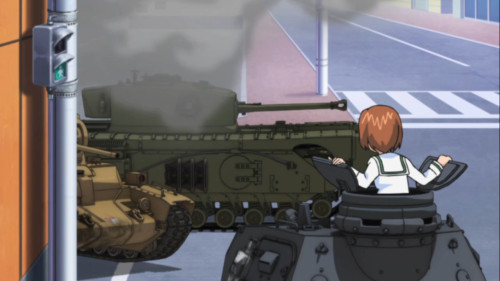
As for the tanks themselves, I am not a tank fanatic or particularly knowledgeable about them, so I can’t comment in that regard, but what I can say is that the series does an excellent job of portraying the tank battles in terms of thrill and excitement. Each of the tanks are shown to have particular strengths and limitations, and seeing the utilization of these qualities in terms of strategy and tactics, especially positioning, invokes the same feel one can get from the battles in Banner of the Stars or even Legend of the Galactic Heroes, where the unorthodox strategist Yang Wenli is in some ways similar to Miho. The actual animation of the tank battles is also very impressive, and is probably the best integration of 3D and 2D animation that I’ve ever seen. Very rarely does the show make its use of 3D appear awkward, which makes it easier to stay focused on what’s happening and not how strange everything looks.

Another thing I want to say is that with a show like Girls und Panzer which glorifies a well-known and still relevant weapon of war, it is easy to criticize it as promoting militarism in a very direct manner. However, I think it isn’t so simple, as the transformation of tanks into a “martial art” resembles the origins of many sports, including judo, which was specifically modified from its combative origins to be a way for self-improvement and healthy competition. It’s possible to criticize all competitive sports for promoting aggressive tendencies in people, but I think  Girls und Panzer has the potential to separate the beauty of machinery from its function of war.

For some, the premise of Girls und Panzer sells itself, but for the skeptical, or those who avoid this type of show like the plague, I would dare say that this is your best bet for finding something you’ll actually want to watch. Either way, it has the potential to become the standard by which all shows of its kind will be judged.

Proof-of-Concept Singapore Mahjong Manga

Note: the page is is read left to right.

Further reading:

For my thoughts (and a summary) of Singapore-style mahjong, go here, as well as here.

The American-style mahjong conceptual narration and comic page (the two are somewhat unrelated).

My initial idea of having manga about all styles of mahjong.

Thoughts on Casual Gaming

I once had a conversation with friends where they expressed bewilderment that people could enjoy casual games. To them, games are about challenges, puzzles, something to figure out in order to overcome or outwit an opponent be they computer-generated or another human being. As a gamer myself it’s something I understand, but I also know how daunting or even draining the “gamer” mindset can be, and I feel the ups and downs of “true gaming” in my experience with online mahjong.

I’ve been playing Japanese-style mahjong for a few years now, and it’s a game I find fascinating for a variety of reasons. In mahjong you have this mixture of skill and luck which creates a dynamic interaction between its players. The game is such that it’s possible to create complex plans and intricate webs of deception to upset your opponents, but the random component means the best-laid plans can go to waste, and adapting to the “unfairness” of the luck elements by knowing when to call it quits becomes part of the strategy. In other words, when playing mahjong your mind has to be sharp and focused, but what happens when you’re not at your best?

This is the problem I run into with mahjong sometimes, and why I feel able to understand the casual game mindset. I love mahjong at this point, but there are times when the day was long and I’m all worn out mentally, and I’m looking for just a way to relieve stress. At times like this, I’ve made the mistake of trying to use online mahjong as a way to relax and I’ve been punished nearly every time. In those instances, I want to treat mahjong like a punching bag, except that in this case the bag punches back. Mahjong is the type of game where trying to win a hand at all costs just makes you vulnerable. In these situations when one’s mental condition isn’t the best, decent opponents can exploit it without even trying because it’s basically the equivalent of running straight at them in the hopes they won’t fire first. Naturally, watching my rank drop as I make this simple mistake over and over again causes more stress instead of less.

It’s not mahjong’s fault, though, that it fails to do what I want it to in those instances, and that’s where casual games come in. They can be your reward for a hard-fought day, as just a way to escape from pressure. The games might be even more random than mahjong, but clicking a lot can basically be the mental equivalent of punching a pillow over and over. This is not to say that casual games can’t have any skill or challenge component (Angry Birds being perhaps the most prominent example, and you can pretty much auto-pilot Tetris), but that it can be tough to feel like life is beating you down and then a video game is too. Sometimes, people might just want to have the comfort of knowing they’ll always win (or at least win eventually), and they might even be willing to put down $5 just for that luxury.

American Mahjong Manga

As a follow-up of sorts to my previous post about American Mahjong, I drew this (read left to right):

First Drawing of Sagimori Arata

In-Flight Mahjong, the Riichi-style Airplane Mahjong

Over the past few years I’ve had the opportunity to fly to other countries, and with flying comes checking out the in-flight entertainment. More often than not these days, in-flight entertainment includes a number of games from Chess to Tetris to even Doom, and sometimes the list even includes mahjong. While much of the time this refers to the tile-matching game, what I’ve found is that on Asian airlines it can actually refer to the real game we know and love. That’s how I found In-Flight Mahjong on Korean Air.

Actually, based on the full description provided, which used the phrase “match the tiles,” I ignored it for a while thinking it was going to be Shanghai, but curiosity got the better of me, for which I’m grateful. Programmed by the guys who make all of the other in-flight games (DHC or something?), the game purposely tries to aim for the anime fan audience by not only following the rules of Japanese-style riichi mahjong, but also boasting what it refers to as “anime-style” characters, which you can see in the videos below (trust me they’re worth it, if only for a healthy laugh).

I’m actually a little sad that I wasn’t able to record the audio (headphones-only after all). Whenever you see a character pop up in those videos with a “PON!” or a “KAN!” as in the first image above, just pretend they’re being exclaimed by people with heavily American-accented Japanese. The voice “acting” is anything but, though I don’t exactly hold my free game programmed to distract me for a few hours in between meals (which included bibimbap by the way) to the standards of Mahjong Fight Club or even Tenhou.

The game offers two modes: “quick game,” and “career,” which is meant to be like a single-player adventure mode (and in fact there is no multiplayer) with a few paragraphs to tell you whether you’re playing in a local parlor or at the end against some significant bigwigs. All of your favorite hands are there, though it refers to some in interesting ways (Chanta and Junchan are “Hon Chanta” and “Chanta” for some reason) The game offers three levels of difficulty, from easy to difficult, and of course I chose difficult out of some bizarre and fragile sense of pride. The computer opponents aren’t tough, but what I did notice is that on the difficult setting they tend to be extremely safe and conservative, and more often than not the rounds would end in a draw.

While this is not too surprising or annoying normally, it unfortunately comes with a peculiar rule in In-Flight Mahjong that rounds, at least in the South half of the game, will repeat if no one wins, even if East wasn’t in Tenpai. What this means is that the same round might last for 10 games in a row, and the only way to break out is to go for a win or hope a non-dealer computer pulls something off. Games that should have taken maybe half an hour total ended up taking about twice that.

Still, it is mahjong and definitely plays like mahjong, so if you happen to be flying to Korea (or wherever, as I assume this specific version appears elsewhere), and you have a desperate mahjong itch, you’ll know how to handle it.

Sagimori Arata and the Pinnacle of Powerful Puns

I love good (bad) puns. I’m also quite fond of mahjong and its representations in manga and anime. So when the two combine in an interesting way, why it’s just a wonderful day for me.

Saki and its spinoff Saki: Episode of Side A (aka Achiga-hen) both feature a lot of characters with weird mahjong powers based on elements of the game, but Achiga especially has this tendency throughout its run to obscure the abilities of its characters. One such case is the character Sagimori Arata.

Here’s the joke: Arata, it turns out, also has a special affinity for the circle or dot tiles, which are known in Japanese as “pinzu.” In addition, Arata’s family owns a bowling alley, she wears a bowling glove, and she even got a bowling-related winning sequence in the anime that didn’t exist in the manga.  Arata, the bowler, is good with pins.

Did you groan? Did you cheer? Both is the right reaction.

Those who’ve talked to me about Saki know that I totally called this. I just wish I said something on here earlier for proof. What I didn’t predict, though, was how complex the bowling analogy is. Essentially, Arata is not like Kuro or Yuu in that her ability dominates her hand, but rather means that she’s really good at tricky, complex waits using pin tiles, things that increase the probability of her winning with pins.

You can even see it in the screenshot from the anime above. Generally, most hands that you see in mahjong have maybe two possible tiles they can win on, sometimes three. Arata’s pin tiles above are 2, 3, 3, 3, 4, 5, 6, which means she has four winning tiles: 1, 2, 4, 7, twice as many possibilities as normal.

As the character FunaQ explains further, the waits Arata usually goes for have some vague relation to splits in bowling, the most famous of which being the oft-mentioned “7-10 split.” I don’t know enough about bowling to say more than that.

So, seeing as Arata is my favorite character in Episode of Side A, the fact that she has become the delivery system for the ultimate case of punnery means she strikes all the right chords for me.

My Conversation with a Singapore Mahjong Expert

Because of mahjong anime, I gained an interest in Japanese mahjong. And because I played so much Japanese mahjong and continued to consume anime and manga based on it, I began to wonder what it would be like if there was a series based on having to play all of the different styles of mahjong which exist around the world. This has led me to do some research and even attempts to play other styles of mahjong, and in fact the first post I made on this blog about other styles of mahjong was about Singapore-style. At the time, the only way I could play it was a single player java program, so no matter what my speculations about strategy and gameplay were the result of a very limited experience.

Since then, I’ve been able to find a website which allows me to play some form of Singapore mahjong against human opponents, and through it I’ve been able to put to the test some of my musings on Singapore mahjong from that post. Looking back, the post turns out to have been decently accurate, but I am of course still very much a beginner at it, so I wanted to find someone with more perspective and experience. That’s how I came across Singapore Sparrows, site dedicated to mahjong in Singapore (primarily the MCR—more on that another time—and Singapore styles), and through it managed to have an interesting and enlightening conversation concerning the similarities and differences between Japanese and Singapore mahjong.

I recommend reading the entire post as well as my follow-up comment, but to summarize I asked the blog owner Edwin a series of questions about strategy in Singapore mahjong, especially because the Singapore style has far fewer hands than Japanese and therefore the hands felt comparatively less fluid. Edwin brought up the fact that not only does Singapore mahjong have things called bonus tiles which can net you points just for drawing them, but it has more bonus tiles than probably any other style of mahjong, and so in his opinion the bonus tiles function in a capacity similar to cheap hands in Japanese-style such as tanyao and iipeikou.

Thinking about the function of bonus tiles, I speculated that rather than fulfilling the role of those smaller value hands, they were more akin to calling riichi: ways to empower worthless hands and give them some teeth and a chance to win. The big difference is that with bonus tiles they are the catalyst to deviate your hand into something simpler, whereas calling riichi always exists as an optional goal, beginning vs. end, but both carry risks unique to each version of the game.

Now, when considering how this would impact a narrative about a game of Singapore mahjong, the flower tiles really are wild cards, and I could see some maverick of a hero taking a risk to get just the right bonus tiles he or she needs, a foolish move normally, but one that the hero recognizes is the only path to victory. Along with all of that animal tile imagery of cats eating mice and chickens eating bugs, panels could be filled with really elaborate nature imagery.

Another fascinating point brought by Edwin was the way in which pinfu (or ping hu) hands in Singapore mahjong really influence the way the game is played. If you play riichi mahjong you may think pinfu hands are important because of how quick and probable they are, but their potency is nothing compared to Singapore pinfu. Not only can it be played open, but it has a special stipulation which makes it either a weak, simple 1 han (tai in Singapore-style lingo) or a monstrous and deadly 4 han hand, controlled by the presence or absence of bonus tiles (no bonus tiles means 4 han). As such, many players will aim for “ping hu,” but because it’s so clearly a good option no matter what, players of Singapore mahjong are also especially wary of its dualistic lamb/lion status. If you have no bonus tiles and a couple of open straights in your hand, people will get mighty suspicious and the player to your left will try to figure out ways to avoid dealing out tiles you need for your straights. It’s a dimension of strategy that is in many ways different from Japanese-style mahjong, and it’s the sort of thing that encourages me to try more styles.

And of course, the variable strength of Singapore pinfu is also a perfect place for some dramatic storytelling. Can’t you imagine a Washizu-esque villain playing his masterful 4 tai ping hu, ready to destroy his opponent, when suddenly he draws a flower bonus tile and all of his beautiful machinations slip through his fingers like sand? Can’t you imagine his agony as the hero willingly deals into the significantly downgraded hand, giving poor Singaporean Washizu a rather pyrrhic victory?

Fun times. Fun, fun times. Incidentally, thanks to mahjong comrade Dave I learned that Mahjong Hime allows you to play both Singapore and Taiwanese styles. Most likely, my next post regarding the hypothetical International Mahjong Manga will be about Taiwanese mahjong.

Don’t Play Tenhou on Firefox

This is just a little public service announcement warning people of a problem with the mahjong client Tenhou when used in Firefox. The problem is that sometimes no matter what tile you select for discard, the game will automatically discard the one you just picked. In other cases, sometimes if you try to call for a tile, the client won’t listen to you. This is a documented issue on Tenhou’s website, and if you can’t read Japanese you’ll at least notice that some sentence pertaining to Firefox is highlighted in bold.

For those who play mahjong, I’m sure you can imagine the frustration of drawing just the tile you need only for the client to not listen and throw away your chances of winning that round, or worse yet, throwing away a tile you know is clearly dangerous and that you yourself would not have discarded in a million years.

I’ve switched to using Chrome when I play on Tenhou and it works out fine, aside from some strange squeezing of the image that can occur when you go from window to full-screen. At the very least, it’s not the game actively disobeying your orders.