I Thought We Liked Mahjong Series!

While Akagi and Saki were probably a lot of people’s introduction to the notion of manga based on the game mahjong, I don’t think I’m alone when I say that my first introduction to “mahjong manga” was from Frederik L. Schodt’s seminal book Manga! Manga! The World of Japanese Comics.

In it, Schodt explores the burgeoning genre and talks about popular titles such as Mahjong Houroki (“Tales of a Wandering Mahjong Player”) and Jigoku Mahjong (“Mahjong Hell”), even citing the author of Mahjong Houroki, Kitano Eimei, as the sort of “father” of mahjong manga, who showed that a comic about dealing tiles could look and feel exciting.
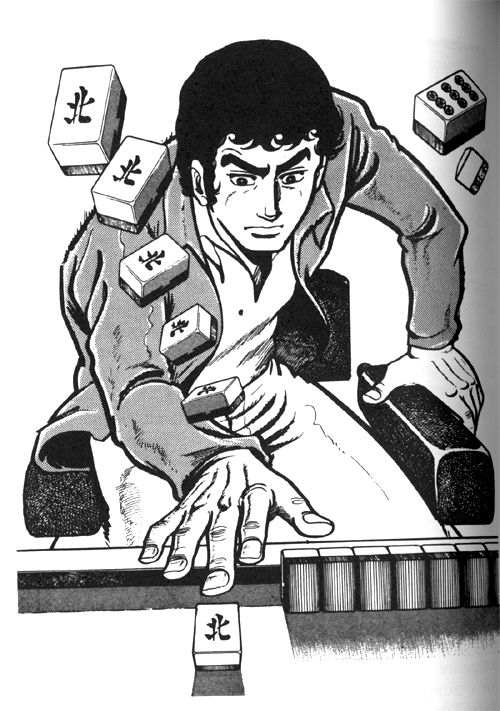
Truth be told, while I was fascinated by the idea of mahjong manga back when I first read Manga! Manga! ten years ago, I am not so different than the people who discovered it through Akagi, as that was the first mahjong series which I actually had the privilege to see. And while I don’t expect mahjong manga to become a runaway success in even the scanlation community, it’s clear that it has its devoted followers.

Here’s the odd thing though: Where are the scans of Mahjong Hourouki? If Akagi and Saki have resulted in people from all over the fandom getting into mahjong even at a periphery level, why hasn’t anyone bothered to look into these significant works which established the genre that so many are enjoying now? And it can’t really be the case where fans of these newer series might not like the older series due to the artwork. After all, we’re talking about Akagi fans here, and I’ve never seen anyone proclaim, “If the characters don’t have ultra pointy faces and noses and everyone looks shocked all the time, then I refuse to read it!” And I see you considering making a comment where you reiterate what I just said. I’m watching you.

Oh, and of course the reason I’m talking about it in the realm of scanlations and such is that no sane company would license a mahjong series in the United States. The closest you’d get to one that could conceivably do well is Saki which is streamed on Crunchyroll, and even that is a bit of a stretch when you consider the not-internet.

The most likely culprit is probably scarcity. It’s no doubt difficult to find these old series in the first place, especially with a niche genre like mahjong. And I’m as guilty of not contributing to the pursuit as any other. This is the first post I’ve made about it, and it’s only because I was re-reading Schodt’s book today. But still, I’m making the call out. We have to find these old works, titles like Mahjong Fuunroku (“Mahjong Crises”) and Gambler no Uta (“The Son of the Gambler”), and bring them to the forefront of consciousness.

Now It’s YOUR Turn to Survive a Deadly Game of Chicken

For those of you who were regaled by my tales of exciting mahjong (as well as the tales of others) but were saddened by the fact that you yourself were not able to participate, fear not! There is a new opportunity for you (yes you!) to participate in a live session of Japanese-style “riichi” mahjong! Well, provided you live in the New York area.

This month’s “US Professional Mahjong League” meeting is Sunday, March 28, 2010 from 3-7pm. Address and further information are here. If you’re going, make sure to RSVP on the forums.

I’ll most likely be there, ready to lose.

Passionate Fiery Mahjong 2 – The Dora Revenge Wave

Just as I had in January, this past weekend I participated in another live session of Japanese-style mahjong, aka “Riichi” or “Reach” mahjong. It’s held by the “United States Professional Mahjong League,” but don’t take that name too seriously. These are not a bunch of hardened grizzled tile veterans who have mastered the game.

Since last time I’d done some more reading on the various types of mahjong out there, from Chinese to Korean to the outright outlandish American style (which features “jokers” of all things), and discovered that, for various reasons, Japanese mahjong is considered much more of a defensive game than the others. Not that this knowledge really helped me too much, but it was a new way of looking at the game. It also makes it clear why Akagi is so crazy: when it comes to his chosen game, a game where “not losing” is generally more important than “winning,” as Sub often puts it, Akagi is an incredibly aggressive player.

Speaking of Sub, he was there too, and we played two hanchan sessions together, i.e. the format which takes longer. I managed to do both well and terribly, winning the first session, where my waits were effective, and then hitting dead last in the second session, where I was largely unable to do anything.

Luck factors aside, and mahjong is certainly full of them, the big thing I realized about myself when it comes to the art of tile-slinging is that I have some issues with mental stamina. After a while, I was just making bad decisions because I couldn’t focus. Not to say I would’ve won had I done that, but I could actually feel my concentration slipping away partway through the second hanchan as I struggled to even think of hands to aim for. It’s something I really have to watch out for; maybe I should bring some fresh fruit to the event to keep my brain sharp and ready.

Or I could keep eating Pringles. Speaking of which, isn’t it amazing that the craving for Pringles feels so different from the craving for normal potato chips? I know I’m amazed.

Of Course They’d Be Yakuza

I’ve been dreaming anime dreams recently, and this one might be one of the best by far.

I was playing mahjong with a bunch of Yakuza guys, looking like they came straight out of a Fukumoto manga. I get a hand, and it’s a really good hand. I could probably get into tenpai in one or two tiles. I think, “Yeah I can definitely win with this.”

Then suddenly the guy on my right gets up. He then comes over, puts a scoop of chocolate ice cream on my plate, and looks at my tiles.

“Hey!” I say to him. But then I see his confident look, and realize that those are the rules. Then I look at my plate and realize that aside from the chocolate I just got, I also have strawberry and vanilla on my plate (as well as some orange sherbert on the side). There I thought, “My Neopolitan Combination is ready. Just you wait!”

So yeah, ice cream mahjong. I think it’ll be big.

I Played Mahjong with Real People and Also Ate Potato Crisps

When it comes to playing mahjong, I am a very recent convert. I’m not good by any stretch of the imagination and I generally make bad decisions, but it’s generally fun and I like the way the game gives you the ability to make constant decisions so that you don’t feel entirely subject to the whims of fate and luck while  still incorporating those very same aspects into the game itself. But as fun as it’s been, I knew I had been missing out on the full experience by playing only against people online and against Char Aznable on my DS.

Then fortune struck. Sub of Subatomic Brainfreeze (aka Dave of Colony Drop), himself a newbie in the wild world of mahjong, notified me that someone was holding a live gathering in the NYC area to play reach mahjong, i.e. the Japanese style of mahjong used in all anime and manga. And so we decided to hit it up, see how we stacked up against these other players who more likely than not had far more experience than we did.

The first thing I noticed was just how tiny the Japanese mahjong tiles are. They are significantly smaller than Chinese tiles, almost to the point of being cute. The second thing I noticed was that playing live is awesome.

Having played against real people with real mahjong tiles at a real mahjong table while eating real Pringles, I have to say that I much prefer it to online mahjong. On a basic level, it’s like playing video games with people next to you on the couch instead of playing against them through X-Box Live. But more than that, I loved the feel of the tiles and the way in which I had to manually pick them up and discard them.

I also loved how there was more to go by than just people’s tiles, like their energy; I’m definitely no Akagi Shigeru, but I think anyone can appreciate that element of the game.

Speaking of Akagi, it turns out that almost everyone there had learned how to play reach mahjong because they saw the anime. Basically, everyone was a nerd and that is definitely an environment to which I’m accustomed. I’m waiting for the people who got into mahjong because of Saki to start arriving.

In the end, I played two games total, one East-only game, and an East-South game that was aborted early due to time constraints, getting second place in the first game and first in the second, scoring a few decent hands and calling, “Pon!” and, “Chi!” with gusto. Knowing my results you might think that I was being modest when I said I wasn’t good, but I really do mean it. I don’t know how to score, I can’t do multi-sided waits, and a lot of it I would chalk up to luck. Next time I play, I’m likely going to end up in last place. But that’s the way mahjong rolls, and it’ll still be fun as hell.

Getting to Know the Characters: An Example

In my look back at the first decade of the 21st century, I talked about the shift towards character and the idea of “getting to know the characters.” While I think I made it pretty clear as to what I meant in the original post, I thought of a good example to explain the idea: the mahjong anime and manga Saki.

Mahjong has been a topic frequently explored in manga for decades now, with even Frederik Schodt’s “Manga! Manga!” pointing out its existence. It’s a favorite topic among salarymen and older audiences, but it wasn’t until the game was paired with moe and a heavy dash of yuri that it began reaching out to the otaku market in the form of Saki.

Anime nerds are playing mahjong in greater numbers now, and it’s not like Hikaru no Go where the manga itself explains the rules to a certain extent; characters in Saki just come in and do their thing and winning magically happens. And yet the otaku still want to play.

The reason that fans of Saki play mahjong, instead of just admiring the girls through fanart and doujinshi (and possibly their own dreams) is that mahjong is the focus of the Saki world, and by playing mahjong a person can feel closer to the characters in the series. I’m sure Miyanaga Saki fans smile every time they get +/-0 in their final scores, while achieving Haitei Raoyue is a wonderful feeling for supporters of Amae Koromo.

Performing an activity that is done by the characters gives a sense of connection, and the characters themselves make you want to connect to them through the power of their cute, moe designs and notions of very close friendship. That is the feeling of being “one” with the characters.

This Gundam Mahjong Game Has a Really Long Title But It’s Still Really Fun

Despite being a huge fan of video games in general, I haven’t bought very many video games as of late, so I think it’s all too fitting that the latest game I’m playing is something that pretty much doesn’t NEED to be a video game but sure enjoys being one. The game I’m referring to is (deep breath) Kidou Gekidan Haro Ichiza Gundam Mahjong + Zeta: Sara ni Dekiruyou ni Nattana! Or in short, Gundam + Zeta Mahjong for the DS. Being Gundam doesn’t really imply any gameplay functions and mahjong certainly doesn’t require any sort of electronics to play, but it’s got all sorts of fun touches that may have you playing it over regular mahjong (or free online mahjong).

Gundam Mahjong is essentially mahjong + super meter. Before the match itself you pick a character, each of whom have their own special abilities, as well as a  “figure” that gives it own unique bonuses.  Char for example has the ability to see an opponent’s winning tiles if they declare “reach,” as well as the ability to deplete every other super meter. Otherwise it’s just normal mahjong. And if you have trouble remembering the rules, there’s a handy built-in guide (though you’d have to know Japanese to use it).

The playable characters are Amuro, Kai, Bright, Sleggar, Char, Lalah, Ramba Ral, Garma, Dozzle, Kycilia, Gihren, Kamille, Emma, Quattro (yes, he’s considered separate from Char), Jerid, Yazan, Scirocco, and Haman. Other characters make cameos, with Frau Bow and Four Murasame being the most prominent. It’s interesting to note which characters in Gundam are considered “characters of action” in the greater consciousness of its fandom.

The selection of Mobile Suit and Mobile Armor figures (it’s implied in the story mode that everyone is a figure-collecting otaku) is much more broad, tapping not only into the two main series but all of the Mobile Suit Variations and side stories from both the One Year War and the Grypps War. You can even use Johnny Ridden’s Mobile Suits. There are certain Mobile Suits that can only be used by specific characters, like Amuro with the original Gundam, Jerid with the Baund Doc, Haman with the Qubeley, and so on. Part of the fun is in deciding which figures to use with which characters that best utilizes their super moves. Char’s Zaku II for example allows Char to gain meter at 3.5x normal speed, which goes well with his meter-killing super. If you’re a real romantic, I suggest pairing Kycilia Zabi with one of Johnny Ridden’s mobile suits.

There’s a free play mode, a story mode, and you can customize the rule set or use a pre-existing one. The game is packed with clever nods big and small to the Gundam franchise, particularly in the way characters talk to each other during the game. When Garma wins, he will comfort his opponents by telling them that it’s not that they were weak, but that he’s simply too strong. Then he’ll recite his winning hand. The best moments are probably when you declare reach, as the music changes accordingly. Nothing says Char’s about to win more than this song.

Even without the Gundam elements though it’s still a solid mahjong engine, and you can even battle people over wireless and wi-fi. About my only complaint is that sometimes the computer opponents are a bunch of cheaters, but that comes hand in hand with any sort of game like this. So, overall impressions are about as obvious as you can get. If you like Gundam and you like mahjong, then check it out, but don’t trip over yourself in trying to obtain it.

Got a Self-imposed Mahjong Goblin Off My Back

What you see here is a “San An Kou,” or “three concealed triples,” a fairly good hand in mahjong that scores some impressive points because it also happens to be a “Toi Toi Ho,” or “all triples.”

It might not seem like anything special, but it is for me, because this is the first time I’ve ever managed to pull it off, and it’s something I’ve been stubbornly wanting to achieve since I started playing (and actually knowing the rules). It’s not worth nearly as much as the Kokushi Musou I got a while back, but it’s a relief for me.

Kind of similar to the Kokushi Musou, the hand requires you to not steal any tiles from other players, and so relies pretty much entirely on luck, which I got plenty of from my starting hand. In certain ways, it’s almost harder to obtain because you have to fight the temptation to not call on any tiles.

Anyway, now that Saki is over (for the time being), I hope you guys don’t give up on playing mahjong. I’ll be right there sucking along with all of you.

Ogiue Maniax Posts a Mahjong Screenshot, But This Time Actually Explains It

If you’ve been watching Saki like me, you may have been impressed with the sheer improbability of many of the characters’ playing styles. If you’ve been playing mahjong along the way too, you may have lamented that you’ll probably never get any of the mega hands that seem to flow like water for Saki characters.

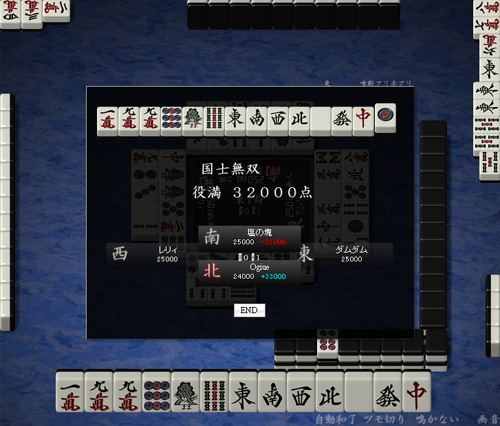
I was like that too, until yesterday when I scored one of the rarest and most difficult-to-achieve hands in the game: Kokushi Musou, also known as 13 Orphans. The hand was so powerful it knocked out one of my opponents in the first round and ended the game instantly. At this point, I almost feel as if I should just stop playing and leave on that very, very high note.

For those of you who know mahjong and are probably much better players than I am, you already know the score. For those who don’t, to properly understand the sheer improbability (there’s that word again!) of a Kokushi Musou hand, I’m going to try to explain it in a way that doesn’t require you to know the rules of mahjong.

Normally in mahjong, you win by having straights and/or three-of-a-kinds as well as a single pair. Most of the hands in mahjong are like this. Kokushi Musou however, cannot be anything but a Kokushi Musou, as the hand actually consists of one pair and then 12 other completely incongruous tiles.

First, what this means is that it is impossible to call on discarded tiles. You may have seen it in Saki or Akagi, where when one player discards a tile another shouts, “Pon!” or “Chi!” or “Kan!” and takes the tile. They are making something, either a three-of-a-kind or a straight or a four-of-a-kind, out of what the opponent had. However, because Kokushi Musou cannot have any straights or three-of-a-kinds, let alone four-of-a-kinds, you cannot call on any tiles without abandoning the attempt to achieve Kokushi Musou. This also means that in order to win, you must draw every necessary tile on your own until your hand is ready to win.

Second, is that while there are other hands which pay just as much as a Kokushi Musou, they usually have a way out, where if the plan to score big fails they can try and fall back on a lower-scoring hand. Kokushi Musou however has no built-in escape routes. If it turns out the tiles you need for Kokushi Musou are 100% unobtainable, then you’re pretty much hosed for the round and you can mount a desperate attack or retreat at best, or you have all the tiles people need to win at worst, which is likely.

Kokushi Musou is called a “Yakuman” hand, essentially an ultimate high-scoring hand. There are also “Counted Yakuman,” where a hand, while not considered one of the Royal Flushes of mahjong, consists of enough high-scoring hands and bonus points to essentially become a Yakuman, not unlike five vehicles combining into a single mighty robot. This Kokushi Musou is my first and only Yakuman ever.

Another Legend is Born