THAT Anime Blog, Home of Utopian Philosophy

This past Valentine’s Day, ExecutiveOtaku over at THAT Anime Blog offered a service for all of the single ladies and gentlemen who found themselves alone on February 14th, a “Harem Finder” that would allow you to enter into a Love Hina-esque setting, custom-tailored to your specific wants and passions. Though obviously a joke, the Harem Finder is not without historical precedent, at least in literary terms. In particular, the concept resembles the writings of utopian philosopher Charles Fourier.

Fourier (1772-1837) believed that the denial of passion was the most major problem with the world, and in his utopian writings he proposed a society where everybody would be able to indulge in their passions in a way that would benefit their society. For instance, a man predisposed to death and slaughter would find a job as a butcher. Fourier (somehow) calculated that there are 810 character and personality types to be satisfied. This of course includes sexual passions, so a sadist would be able to meet a masochist, same-sex relationships would be condoned, and so forth.

Priests and priestesses would gather everyone together and initiate extensive tests involving multiple meetings between potential partners, keeping in mind that “love at first sight” does not always happen. And for those dorks who worry about their physical attractiveness, Fourier has them covered too.

In Harmony sheer physical attractiveness will not have the colossal influence that it has in civilization where everyone is transfixed by the sight of a beautiful woman. Of course the Harmonians will not fail to appreciate physical beauty; in fact their judgment will be considerably more discerning than ours. But when it comes to the selection of sympathetic patners their choices will not be determined by physical charm. For their desire for sensual gratification will be satisfied in several different ways.

In a way, the concept of the “harem” in anime and manga is a form of utopia, acting as a very localized, almost self-functioning society where happiness is being surrounded by women (or men) and everything that happens in the world comes from that harem setting. The same idea could be extended to the most slicey slice-of-life shows, especially when you factor in their utility as a form of cathartic escape. These are, after all, “better worlds.”

In a different era, I think Charles Fourier could have very well been an otaku. He would spend every day after work focused on writing about his utopia, and his devotion to passion is well-represented in anime and manga. He also had a thing for lesbians, making it very possible that he’d be a big yuri advocate, and his obsession with precise calculations seemingly pulled out of nowhere (he determined that there are 26,400 men in the world who also enjoy lesbians) would not be that far off with numbers-obsessed mecha or idol fans.

He was also a life-long virgin, but I’ll leave those jokes to you.

Wig Party: Genshiken II, Chapter 60

In my last chapter review, I predicted an Ogiue-centric chapter while also pointing out how Hato hasn’t gotten a chapter focused on himself yet but rather seemed to get a bit of focus and characterization every chapter.  Contrary to my expectations however, this latest chapter, despite taking place mainly in Ogiue’s apartment, is actually centered around Hato. Specifically, it reveals the truth as to why he cross-dresses, peeling away some of the enigma that is Hato Kenjirou.

Ogiue has a professional manga debut coming up and in order to meet her deadline she’s recruited Yajima, Yoshitake, and Hato. Yajima, who we know likes to draw, finds herself paling in comparison to Hato not just in looks but also in artistic talent. It also turns out that Hato has been gaining a reputation outside of the club as a mysterious brown-haired knockout who only seems to show up in the afternoon, and given the potential trouble that would-be suitors of Hato could bring, Yajima has to ask Hato once more: why the dresses?

Hato explains that he had kept his fondness for yaoi a secret all through high school, because if and when he revealed his status as a fudanshi, the “rotten boy” opposite the “fujoshi,” he surely would’ve been was persecuted by his peers. So upon entering college, he began cross-dressing mainly so that he could enter a club much like Genshiken and finally be able to talk with people who share his interests.

“Persecution.” The word lingers in Yajima’s head, and it makes her feel absolutely terrible for confronting Hato. While she can’t relate to Hato in terms of choice of attire, as an otaku it’s very likely that she knows the pain of being ridiculed or tormented by one’s peers all too well. Yajima decides to not press the issue at first, but then realizes that Hato’s response was only half an answer. Everyone there now knows why Hato started to cross-dress, but given that everyone in Genshiken knows his secret and his okay with the fact that he’s a fudanshi, it’s no longer necessary. So why does Hato continue to cross-dress?

He enjoys it.

He knows he looks good in it, and it helps to fuel his own fantasies, not necessarily in the sense that the cross-dressing itself is the kink, but that donning women’s clothing can give him the right frame of mind. Through it, Hato can see the possibilities, including pairing himself with Madarame, which also puts the last scene of the previous chapter in a whole new light: were Hato’s signals real or imagined by Madarame?

One significant reveal for me in this chapter is the fact that Hato self-identifies as a man. In planning future entries for the Fujoshi Files, Hato presented a bit of a problem, namely, how much of gender is biological and how much of it is social? Gender studies is not my specialty, and even among the Genshiken characters, you could see that different characters take different approaches: Yajima talks of Hato as if he were a man, while Ohno mainly refers to Hato in the feminine. As you can see as well, I’ve mainly gone with male pronouns when referring to Hato, but I ultimately decided that it would be based on his own personal preference.

So Hato’s crossdressing isn’t entirely the product of a tormented gender identity conflict, but it’s important to avoid thinking that Hato’s crossdressing is somehow less legitimate or even wrong just because it’s a little self-indulgent. Hato has a perfectly good reason to crossdress, and the way in which Genshiken presents his situation, with both serious and more lighthearted aspects, does not and should not lessen either side. Nor should Hato and Genshiken in turn make gender portrayals that are focused more in one direction (such as Wandering Son) necessarily less poignant or entertaining.

We also learn a little bit more about another character whose life rarely gets explored, as we discover that Kuchiki is that guy in more ways than one. He’s not only the guy so lacking in social skills that they became actively antagonistic, but that he’s also able to coast by in life because of nepotism. I wonder what his parents think of him?

I think that Genshiken II has been getting better and better at establishing the New Class as characters in their own right, and I don’t really mind seeing the club veterans step aside so that they can take center stage. It takes a theme already present in the original manga, that of people entering the club and leaving when they graduate to make room for new blood, and realizes it in a much bigger way. It makes me wonder how they would fare if this was the first Genshiken series ever, and we only knew the previous characters somewhat in passing.

Next chapter looks to be again about Hato, but I’ve been deceived in the past, so I’ll hold off making any big predictions until then. Sue didn’t talk too much in this chapter, so I wonder if Kio’s saving her up for something big. The last thing I want to talk about though is Ogiue (of course), and the way that Kio Shimoku has been inserting some some nostalgic references to Ogiue past. Ogiue’s inner thoughts entertain the proposal of Hato x Mada in Ogiue’s native Tohoku dialect, and when Ohno tries to start a cosplay party at Ogiue’s place we’re greeted with a familiar sight. Perhaps we could call this “Ogiue Abridged?”

Trekked to Sliedrecht, Did the Anime Thing: Tsunacon 2011

It’s been quite a few years since I was able to attend any sort of anime-related event outside of the United States, so when I found out that right here in the Netherlands are not one, not two, but three anime cons, why I had to check at least some of them out. This report is about the first of them, Tsunacon, located in the town of Sliedrecht. I’m not sure why it’s called Tsunacon, though I suspect it’s a play off of “Tsunami.”

Held in De Lockhorst, a complex devoted to athletic activities and just having spaces and rooms available for just this very kind of thing, Tsunacon is a one-day event. I’ve attended one-day events before, namely the PAS Spring Fest in New York City and Tekkoshocon‘s Tekko 1/2 held at the Carnegie Library, and if I had to compare Tsunacon to those two mini-cons, I’d say that Tsunacon feels the most like an actual anime convention. This might have to do with the fact that Tsunacon is not a free event (although the ticket price is more than fair) whereas the other two are, but it’s more the atmosphere of it.

Before I go into the con itself though, I have to point out the train to Sliedrecht. Moving between the cities of Dordrecht (not to be confused with Dordray) and Geldermalsen and about 4 cars long, I think it’s kind of adorable and also anime-related if you stretch your logic a bit. You can do it, Spurt-tan!

De Lockhorst is only a short walk from the Sliedrecht train station. On my way there, I saw two couples holding hands and possibly cosplaying as well. Ah, nerd love.

When you get inside the first thing you’ll notice is the concession area. While the collection of Japanese snacks (Yan Yan, Ramune) are likely a familiar sight to the American con attendee, there are a number of uniquely Dutch snacks, such as poffertjes, tiny pancakes in powdered sugar, and frikandel, a kind of minced meat sausage. They also had a cotton candy machine, which I’ve never seen at any US anime con.

The big culinary hit here was Cup Noodles, at €3 a cup. Now you might be asking, “3 Euros?! Isn’t that a bit overpriced?” It most certainly is, but the attendees could not get enough off Momofuku Ando’s glorious creation. I couldn’t tell you why it was so popular, but I wonder if the more traditionally Dutch foods don’t carry the same novelty. Maybe it’s just the sheer joy of eating noodles from a cup alongside your friends.

When I think about it though, the Broodje Kroket (croquet breads) ares kind of like the Croquet Pan you’d find in Japanese bakeries. Even when you’re eating “normal foods,” you’re not too far off, Dutch anime fans!

The real kicker though would probably be that they sell beer alongside everything else. And not just any beer…

That’s right, Japanese beer for the Japanese anime fans.

Given that the average age at Tsunacon was decidedly “teenager,” this might set off some alarms, but I must point out that the drinking age here is actually 16, excluding hard liquors. In fact, despite the relatively low median age of the attendees here, everyone seemed quite well-behaved. Even the “hug me” signs seemed more subdued compared to their US peers.

Tsunacon obviously isn’t devoted solely to food though, and close by were the manga library, a game room, a workshop room, and the dealer’s room.

The Manga Library had a fairly sizable collection of titles in both English and Dutch, as well as a few in Japanese. It grew more and more popular throughout the day, and as if to anticipate the creative spark that reading manga would inspire, they left pencil and paper around so that people could draw. I myself decided to revisit an old friend and read the Sai vs Touya Meijin chapters of Hikaru no Go.

The Game Room, which meant specifically video games (sorry card and board game fans, though I did see a number of Yu-Gi-Oh! players dueling it out), had systems ranging from the classic NES to the X-Box 360 and Wii, as well as popular convention games like Dance Dance Revolution. I have no idea what version it might have been.

One thing that stood out to me was the European SNES, pictured above, which resembles the Japanese Super Famicom a lot more than it does its American counterpart. If you’re wondering what game that is, it’s Battletoads vs. Double Dragon. It is a terrible game, but the thought is appreciated. And yes, 4chan memes are popular here too.

I originally planned on participating in a Super Smash Bros. Brawl tournament, but the slots filled up extremely quickly, and by the time I got there it was too late. However, it turned out that the Super Street Fighter IV tournament was short on competitors, so I decided to throw my hat into the ring. I picked Sagat, my favorite character from the Street Fighter series, and defeated my first opponent only to lose to the very next one 1:2. You might not think that to be terribly impressive, but I was quite proud of myself given that-

  1. I’ve never played Super Street Fighter IV
  2. I’ve only played vanilla Street Fighter IV once

But Sagat is Sagat, and I just threw fireballs and delivered uppercuts on my way to victory, at least for a short while.

The workshop room had workshops on cosplay and drawing manga, all in Dutch so even if I felt particularly motivated to start cosplaying I wouldn’t be able to reap its benefits.

The Dealer’s Room also doubled as the bag check room, and was mandatory if you were planning on doing any shopping, or even playing  in the game room. The main activities of the Dealer’s Room, aside from shopping of course, were the “Manga School” workshop and the goldfish-catching game straight out of your favorite festival episode. The winner who caught the most “goldfish” (they had to use rubber balls here) would win some Haruhi pins and a poster of a J-Pop singer whose name I’ve unfortunately forgotten. My goldfish endeavors came out to a big fat zero, but that’s okay.

Another interesting element of the Dealer’s Room at Tsunacon was that, perhaps due to space limitations, the Dealer’s Room also doubled somewhat as an Artist’s Alley. But while American cons’ Artist Alleys seem primarily focused with individual images, Tsunacon’s anime fan artists were big on self-publishing, often times with their very own original characters, though publications based on existing series were also present. In this regard, one table in particular caught my eye.

A Genshiken-themed doujinshi of all things! Of course I had to get it. It’s not 18+, in case you were wondering.

You know what I like? Ogiue. And you know what else I like? Pokemon. This book manages to combine both, and that is quite all right with me. I was also flattered to find out that they actually knew about Ogiue Maniax, and I was proud to have them do the doujin event thing and get some sketches. Thanks a lot to all of you! I wish you had a website URL in the book so I could direct people.

A short walk from the entrance where the concessions and around the corner landed me in the anime karaoke lounge. Now I’ve done karaoke at dedicated locations, and I’ve done convention karaoke, but what was nice about this place was that it was more or less a small bar/restaurant. In addition to the snacks you could get from before, helpful staffers worked as waiters, taking orders for food and drink while everyone sat around enjoying the fan-powered renditions of God Knows, Hatsune Miku, various Final Fantasy themes, the Chobits opening, and more. They actually had it set up so that the lyrics would pop up in romaji which the singer could follow, much like a real karaoke place. This is quite different from Otakon where they hand you the lyrics on a sheet and you have to do your best given the circumstances. Not knocking Otakon or anything, but this system was way more useful for people who felt like they kind of knew their songs but still needed some help.

I partook of a macaroon from a helpful staffer/waiter before exercising my own lungs. My song of choice: the Mazinger Z opening, which I performed a little better than I thought I would. (Fortunately) I do not have any record of the event, as while I love to karaoke, I am not what you might be calling “talented.” It might be better to say that I can display a degree of courage when it comes to on-stage performances. Despite the relative youthfulness of the crowd, they actually got quite into my performance, and by the time I was done I received a full applause from the room. Thank you all.

If you weren’t paying attention to the singing though, you might have noticed the interesting decorative choice in the form of various Disney statues placed throughout the bar/lounge.


The two “main events” of Tsunacon would have to be the competitions, both AMV and cosplay. Unfortunately, despite knowing this beforehand it somehow slipped my mind while there, and I didn’t go to either. My apologies! While I’m normally not much of an AMV or cosplay sort of person, I still wish that I’d managed to check them out. According to the schedule, the same room also housed video showings and some quiz-based panels, so it was ostensibly the video and competition/events room. Next year!

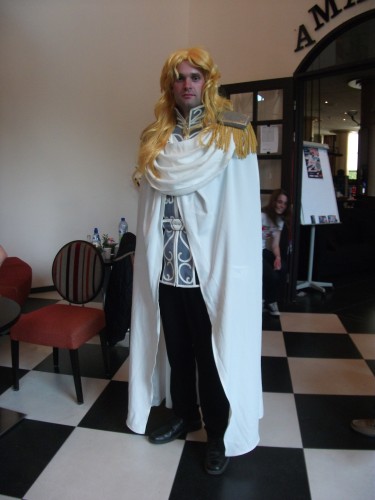
While I did not attend any actual cosplay events, I did see quite a few excellent cosplayers, which you can see below. There was a really good Crocodile from One Piece cosplayer, but I wasn’t able to catch him.

Overall, Tsunacon was a fun little one-day excursion where there the focus was primarily on letting the attendees do their thing. Rather than going from event to event or even spending the entire day in one location, the con seemed more conducive to just hanging out with your otaku comrades. In that regard, I do wish I had brought others with me, because as cool as it was a one-man trip to a con can only get you so much. It’d also be cool if they had more informational panels in addition to their workshops and games, not for me as my Dutch is abysmal, but to foster learning that doesn’t necessarily have direct utility. The space was also a tad crowded, but nowhere near as insane as some of the bigger cons I’ve attended, and if anything this is a good sign that Tsunacon is getting increasingly popular.

I’ll leave off with these collaborative drawing boards. I drew a couple of things myself. See if you can spot them!

The Fujoshi Files 18: Yabusaki Kumiko

Name: Yabusaki Kumiko (薮崎久美子)
Alias: Yabu-Hebi (やぶへび), Yabuu (ヤブー)
Relationship Status: Single
Origin: Genshiken: The Society for the Study of Modern Visual Culture

Information:
Yabusaki is a college student at Shiiou University, where she participates in the school’s Manga Society, or “Manken.” Hailing from the Kansai region of Japan, she is quite proud of her background and purposely does not hide her Kansai dialect when speaking to others. However, she can also be somewhat easily embarrassed, namely when dealing with situations outside of her comfort zone such as the eccentric American fujoshi, Sue. She has some close friends, namely fellow club members Asada and Katou. She also often butts heads with former Manga Society member Ogiue Chika, namely due to the latter’s disparaging remarks about female otaku. Despite their initial animosity, they have become friends of a sort.

Yabusaki draws doujinshi, and while not much is known about Yabusaki’s taste in anime and manga, she appears to at least share some common interests with Ogiue. In time, much like Ogiue and her role in Genshiken, Yabusaki seems to have also assumed some position of authority within Manken. Her circle name, “Yabu-Hebi,” refers to someone who does too much to the point of inviting disaster.

Fujoshi Level:
While an artist who focuses her talents towards fujoshi interests, her fujoshi level is perhaps best exemplified by her staunch defense of the fujoshi lifestyle. Her frequent conflicts with Ogiue in the Manga Society show that she takes her identity as both an otaku and a fujoshi very seriously.

Mysterious Madarame X: Genshiken II, Chapter 59

This month’s Genshiken II focuses on club alumnus Madarame. If you’re the kind of person who likes to pair anime characters up, then this chapter has a lot for you to chew on. Romance! Sort of.

Madarame has always been a fan-favorite, due in part to the fact that he seems the “Truest Nerd 4 Life” and thus the one closest to us. This is especially evident in his unrequited love for Kasukabe; sinking back into the recesses for fear of not ruining your friendship is the hallmark of the nerd with heartache, that “noble nerd” mindset with which many deceive themselves. I don’t know about you, but I’ve definitely felt that before, even if it wasn’t directed at any girl in particular.  So when Sasahara’s sister Keiko confronts Madarame about his feelings towards Saki in the tactless way that only Keiko can (as opposed to the tactless way only Sue can), Madarame gets taken for a psychological ride and we’re taken along with them.

Keiko, who has herself shown affections for the other half of the Kohsaka-Kasukabe Combination, makes it very clear that not only is she well aware of Madarame’s crush on Kasukabe, but that just about everyone else is too, possibly even including Saki herself. Of course, this comes as a complete shock to Madarame, who failed to realize that in his concerted efforts to minimize his longing gazes at Saki actually made his feelings completely obvious. Though this has very much to do with the fact that Madarame is such a huge dork, believing you’re subtle when you’re really not is a problem many guys have, and I can really empathize with him. Madarame has a track record of doing this, too. I mean, let’s not forget the “nose hair” incident.

By the way, I’m unsure of how popular it is among English-speaking fandom, but I know there’s a decent amount of Japanese Genshiken fans who are way into Madarame x Keiko (or Keiko x Madarame). I wonder if Kio Shimoku is aware of that?

Madarame and Keiko’s conversation never quite resolves. Sue walks in at an (in-) opportune moment, suggesting that not only do Sasahara and Keiko have more in common than expected, but that perhaps Sue is actually a cosmic being who takes strength from the meta-fabric of Genshiken itself, particularly in channeling Ogiue references. I hope that Sue gets her own dedicated chapter at some point in this run. Shifting character focus from chapter to chapter seems to be the direction of Genshiken II, so I think there’s a fair chance of it happening. Maybe Angela will make a brief return.

In any case, despite Sue’s interruption, Keiko leaves Madarame with a profound message: the only reason he can continue to spin in place is because he’s never had his heart broken. And again, if we look at Genshiken history, right there on-panel in the beach chapter was Keiko confronting an old boyfriend. Whether that bad outcome was the result of “heartbreak” or not is unclear, as is whether Keiko has truly given up on Kohsaka, but the comparison between then and now shows the kind of maturity that Keiko’s developed since we first saw her trying to wrangle money from her brother, incomplete as that maturity may be.

So while the chapter was Madarame-centric, Keiko also got a lot of development, or at least we see that she’s developed some since her last appearance.

Book-ending the chapter is Madarame’s interactions with Hato, who has been using Madarame’s apartment to change in and out of his feminine clothing. The impossibly attractive Hato is messing up Madarame’s wiring a bit, and even he can’t tell whether his friendliness with Hato is more of the male companionship he clearly misses from his club days or if it’s something else entirely (or possibly both). Again, for you shippers out there, I’m sure this chapter pleases Caesar. Interestingly, Hato himself seems to be getting the most consistent amounts of page time. I wonder if it just has to do with the fact that he is the biggest mystery of Genshiken.

Ogiue meanwhile is poised to make her published manga debut, and I am continually fascinated by her relationship with Sasahara, notably in the way they butt heads due to their respective professions of artist and editor, and how it ultimately results in better work. Ogiue’s experience with Sashara-as-editor, which we’ve seen ever since the last volume of Genshiken, is itself likely influenced by Kio Shimoku’s own time at Kodansha’s Monthly Afternoon, and seems to confirm Peepo Choo artist Felipe Smith’s own account of creating manga for sister Kodansha publication Morning Two. I’m also curious as to whether or not Sue stays over at Ogiue’s place often and interferes with Sasahara and Ogiue’s alone time, as the chapter seems to imply.

But the real story is that Ogiue’s manga schedule is conflicting with her Comic Festival schedule, and that seems to be the focus for the next chapter.  As you might expect, I’m looking forward to it quite a bit.

My Anime Regions

Born and raised in the US, having studied in Japan about 5 years ago, and currently living in the Netherlands, I consider myself quite fortunate to have been on three different continents for long periods, enough to say that I wasn’t simply a tourist. The benefits have been many, but the one that is perhaps most important to me is that I’ve gained a bit of perspective on how things work differently from country to country. As an otaku, this of course applies to my pursuit of anime and manga as well, and so I want to just talk about my own firsthand experiences in this regard.

Before I go into detail though, I think it’s important to highlight a few points about myself:

First, my English is my native language, and I have studied Japanese for a number of years and am reasonably fluent in it. I cannot read any other languages to any decent extent, and I can only understand one other when spoken.

Second, my available “access points” varied from place to place, meaning television, internet, etc. Also, I was in Japan before streaming anime became a big deal, whereas currently I am living through the age of the official streaming simulcast alongside everyone else. Well, sort of, but I’ll get into that later.

United States

Now because I’m native to the United States, I’ve seen my fair share of how anime/manga and its surrounding fandom and industry have changed over time, but as I’m not looking to make this a history lesson I’m going to mainly focus on the state of obtaining anime from about 2005-2010. In that period, whether it was in college or back home, I had cable television and high-speed internet, as well as the fortune of living in a city with Japanese book stores (or at least a Japanese grocery when it came to college). I used the TV and internet to varying degrees to satiate my desire for anime, and as my Japanese improved I was encouraged to start buying manga in Japanese as they tended to be less expensive even with import mark-up, especially if they were used books.

Even ignoring the untranslated titles, anime and manga have been quite accessible, whether it’s through downloading, Cartoon Network’s (increasingly sparse) anime line-up, or just going to the Barnes & Noble to pick up a volume of something. Companies are currently trying to increase their internet presence, with more and more titles, including older ones that are no longer available otherwise, being streamed on sites such as Hulu and Crunchyroll. The genres available were and are surprisingly diverse, particularly when it comes to manga, though they don’t cover everything Japan has to offer, just because some things simply do not sell in the US (and some titles that were released certainly did not either).

It’s important to note that anime took quite a long time to get big, and it was only really with the advent of Pokemon that it became such a big deal. While it’s come quite a long way, it’s still considered quite a “niche” thing, and a lot of works which can survive in Japan based on overall higher readership there will most likely tank in the US. Anime as “anime” is still quite young compared to the rest of the world. Anime and manga are definitely accessible in the America, it just takes a bit of effort to really sink yourself in, and although it takes a while to feel the limitations in genre, you may eventually feel it. Also remember that the US is big, and that my experience can be quite different from someone living in, say, the Midwest.

Japan

In Japan I had television but no reliable internet, and while I hear that most otaku in Japan use a Tivo, I unfortunately did not own one, which meant that I had to follow the official schedule in order to keep up. While it could be trying at times, there was a certain thrill in planning my days around the TV broadcasts. The fact that Futari wa Pretty Cure Max Heart and Zoids: Genesis ran simultaneously on two different stations meant I had to choose, which is something that has never really been an issue with anime fandom in the US, at it was rare that two stations would be showing anime at the exact same time. I myself didn’t have to deal with this since the days when Pokemon would chase Digimon out of its time slots. If there was a show on late at night that I really wanted to catch, say, Glass Mask, I would go to sleep early so that I could wake up at 1 or 2am, watch it, and then go right back to sleep. I also remember getting home from a trip to Akihabara, pedaling hard as I could so that I wouldn’t miss the beginning of Gundam SEED Destiny. That also reminds me of when I had faith in Gundam SEED Destiny. Those were innocent times.

(By the way, I chose Pretty Cure).

Manga though, it’s hard to live in Japan and not see comics available for sale. In addition to larger bookstores and specialty shops, you could find the latest manga magazines in convenience stores, your Jumps and Sundays and such. While those stores didn’t carry everything, you could still find some surprising titles; it was through a convenience store that I found the Hulk Hogan manga. The ubiquity of manga was especially advantageous for just sheer exposure: by buying just a few magazines you could get a pretty wide range of works, from good to otherwise.

One unique advantage I had while in Japan was that I had access to the library of the school at which I was studying abroad, which meant access to their extensive collection of anime on DVD. Nowadays it’s not that hard to go online and find all these obscure titles, but back in 2005 this library’s DVD collection went well beyond what was fansubbed (and probably still does today), with series such as Zambot 3 and Tetsujin 28 in their entirety. I know I just picked two robot titles too, but trust me when I say there was more.

So when it came to anime or manga, despite my internet situation I probably had more titles available to me than I ever had before or since. The only trouble of course is that it’s all in Japanese, and while my Japanese is good I’m still not comfortable with it, let alone comfortable with it five or six years ago despite the rapid improvement that living in Japan itself caused. In any case, the main point to take away here is how easy it was to just be surrounded by the stuff.

The Netherlands

A few months ago, Irish anime podcaster Eeeper wrote this letter where he pointed out the difficulties in being a European anime fan, particularly in this current age where anime is officially streamed. Before I arrived in Europe, I could see his point and could agree, but it was only after I actually started living here that I could really feel it.

Having high-speed internet but no TV here, online is mainly how I watch things. When it comes to the streaming of anime, Europe seems to get left out pretty often. The entirety of Hulu is off-limits save for a single, terrible-looking show (not anime in case you’re wondering). Funimation’s video site automatically redirects to a generic company page. This is something I previously only really experienced when I couldn’t watch the official Japanese-only episodes of Bakemonogatari on their official site. It’s not all bad, as some shows on Crunchyroll work just fine. However, others do not, and you get these really odd situations, like how Naruto Shippuden is available for me to watch but the original Naruto is region-blocked. The fact that I just came from the US, where I recently watched all of Kekkaishi and Slayer Revolution (and Evolution-R) on Hulu, makes me very aware of this disparity. That said, internet here is quite fast and what I can watch I get in a flash.

Manga is a bit of a different situation. In terms of the internet, no official sites as far as I can tell have blocked their manga from European access. In terms of actual physical books, comic stores aren’t amazingly common in the Netherlands, but cities are generally small enough that you don’t need too many, and cities with more comic stores are only a short train ride away. Going to Amsterdam takes about half an hour, which is longer than it took me to get to Manhattan, and the selection of manga (as well as European comics) can be surprisingly extensive, usually taking the form of English-translated titles  imported from the US or Dutch-language books. One interesting thing to note is that some titles get translated into Dutch before they are translated in English, possibly owing to the fact that manga and anime have had a strong presence in Europe way before the “anime boom” ever hit the United States. In fact, a friend told me that Urasawa’s works were available in Dutch way before they were in US bookstores. It might also have to do with the proximity to Belgium, which has its own rich comics history and influences the regions around.

On that note, one big difference with the Netherlands and Europe more generally is that everything is more packed together. While traveling by train in Japan is somewhat comparable to doing so in the Netherlands, Japan is still an island, while going from where I live to Belgium, an entirely different country, is a mere 3-hour train ride. Europe also gets a good deal of titles that the US does not, but they’re mainly for people who speak French and alas neither I nor Eeeper (I assume) are capable of this feat.

Final Thoughts

So there’s a bit of my anime experience across three countries. I of course cannot speak for every anime fan who has lived in the countries I have, let alone the countries where I have never set foot, but I hope that this post helps to bring a bit of understanding to fans around the world, to see the varying circumstances that affect our fellow fans. If you want to chime in with your own experiences for any country/area that I did not cover, feel free.

Best Anime Characters of 2010

BEST MALE CHARACTER

Koibuchi Kuranosuke (Kuragehime)

A handsome ladies’ man from a wealthy background with a talent for crossdressing, Koibuchi Kuranosuke is larger than life, the kind of character who you would almost be able to say is “too unrealistic” if weren’t for how natural and convincing he is as an individual, and if you’re used to this sort of thing via extensive experience with shoujo and josei, he stands out that much more. Straightforward yet enigmatic, helpful yet selfish, intelligent and savvy yet frightfully naive at times, Kuranosuke is equal parts intriguing stranger and close personal friend, and it makes him both fascinating to watch and easily relatable.

From the very first time he saves Clara the jellyfish and enters Tsukimi’s life, you know that Kuranosuke is a man you can respect, even before you know that he’s a man. He’s not a saint and he won’t solve everyone’s problems as he has his own to deal with, but he tries hard to help others, in particular working to help Tsukimi and the rest of the “Sisterhood” recognize that their stereotypes of themselves are self-imposed. It’s a fight I can definitely get behind.

BEST FEMALE CHARACTER

Kurumi Erika, Cure Marine (Heartcatch Precure!)

Though I can describe Kurumi Erika by her general traits — talkative, friendly, clever, energetic– I feel that it doesn’t quite do her justice. With Erika you have someone who is much more than the sum of her parts, an endearing character whose traits cannot simply be divided into “strengths” and “flaws,” but are aspects of Erika that have both positives and negatives. Erika’s gift of gab is tempered by the perils of being a motormouth. She is incredibly hardworking and focused when it comes to her interests and will go out of her way to accomplish her goals, but can be incredibly lazy and ignorant towards anything that fails to inspire her passion. All of this stems from Erika’s sense of emotional honesty and her full-speed, no-brakes approach to life.

In a series with particularly strong characterization, Erika stands out in a big way, and I hope that she and her fellow Cures have a positive impact on not just the way characters are written for anime, but also how they are received by the fans and how they may influence those watching to better themselves. Erika feels real, not in the sense of evoking reality or being a simulation for it, but in that she is an emotionally complete individual. She is an inspiration for anyone who has every hesitated due to fear of being unable to grow as an individual.

Final Thoughts

Though not intentional on my part, I realized while writing my thoughts on Kuranosuke and Erika that the two have much in common. Both are outgoing with sunny dispositions. Both are highly passionate about fashion and believe in the positive transformative effects it can have on people. And both are eager to meet and help others, but their enthusiasm and extroverted natures can make them seem abrasive to those who can’t keep up with their pace. They feel human. On an additional storytelling level, both are able to show that you can have incredibly straightforward and simple characters that are also complex and fully developed, whether it’s a show for adults (Kuragehime) or for children (Heartcatch Precure!). Perhaps most importantly, having people who can encourage you to grow for the better can be incredibly uplifting, whether they’re real or fictional, and that’s exactly what they do.

Have You Heard About the Yaoi Role Playing System

It’s called “Big Eyes, Big Mouth.”

What is Soul Society Captain Yamamoto-Genryuusai’s Favorite Sentai Series?

JAKQ

The Man in the Moe

“If the emphasis in moe anime is on the female characters, where does that leave the male characters?”

I asked myself that question, and after some deliberation it turned into, “What do you look for in male characters in moe anime?” I want to turn the question to you the reader as well, provided you’re someone who has enjoyed moe anime in the past, even if you’re not necessarily a fan. Keep in mind that I don’t mean that the male characters themselves have to be “moe,” but just that they exist within those types of anime. If you want to extend the question to yuri shows as well, that is also okay.

For me, the first thing that popped into my head was Maria-sama ga Miteru, namely the all-male student council that exists outside of the all-girl school where Marimite primarily takes place. Marimite has a heavy emphasis on female characters, so when one of those male council members, Takada Megane, talks about how he loves to work out and eat meat all while flexing at the girls, it really stands out. It’s as if Takada and his muscles are inadvertently shattering the yuri-heavy atmosphere of Marimite, and the first time I saw him I thought, “Yes, you are the best male character in this show.” Applying that back to my own question, it makes me think that while I definitely enjoy Marimite for what it is (and own almost all of it on DVD), I like the idea that there exists something a little beyond the world of the girls, even if it’s not that far removed, and male characters who act kind of contrary to that setting actually serve to emphasize the feel of Marimite.

One concern I have is a possible philosophy that the male characters in such series don’t matter, as I feel that even if they’re out of the spotlight they can have a huge impact on the work itself.

So what do you think?