Seeing Manga for What It is

New York Anime Festival, much like the teenagers who attend it, is a fairly young convention especially when compared to other cons. This year saw it merged with its sister convention, the New York Comic Con, and while I did not attend, a number of reports have stated how the Comic Con side so dominated the Jacob Javits convention center that the Anime Festival became relegated to what has now been commonly referred to as the “anime ghetto.” There is no word as to why the ghetto formed, or whether the sharp delineation between comics (and everything else) and anime was a sign of disrespect towards anime fans, but regardless of intent, it is quite clear that things were Different. Dave over at Colony Drop writes:

Far from the exhibition floor, there was an invisible line in the Javits Center that weekend: one that denoted where the comic con ended and where the anime con began. I marked this line down in my mind late in the first day, when I stopped to make a phone call and saw my first pack of running, screaming Hetalia cosplayers. This display was immediately followed by a creepy girl who was going around the hallway alone and serially glomping any character she recognized. It had taken me all day to get there— NYCC offered me more as a gamer than NYAF offered me as an anime fan— but there was no mistaking that I was now in Anime Country.

That invisible line that Dave mentions is largely social; all the con did was greatly exaggerate it through the structure of the convention center itself. Anime fans want to be seen as anime fans. They want to be different and special. Others are glad to oblige, doing so by expressing their disdain for “those damn anime kids.” In either case, a division is formed, between “anime and manga” and “not-anime-and-manga.” Meanwhile, others are quick to step in and give the message that “it’s all just cartoons and comics anyway.”
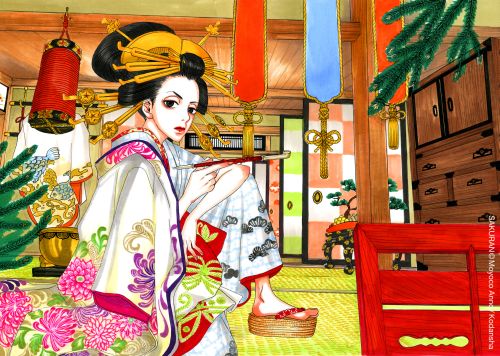
The trouble with both the acknowledgment and disapproval of such categorizations is that each side has its own fair share of pitfalls. By regarding manga as special (and from here on out I’ll be sticking to manga for the sake of convenience), supporters can end up tying it down, obscuring (or even willfully ignoring) the fact that one of manga’s real strengths is its sheer diversity in style, content, and tone. Instances of this can be seen in the way that early iterations of the Morning International Comics Competition (back when it was called the Morning International Manga Competition) were less aesthetically diverse than the more recent ones. This is further compounded when its detractors regard manga as being narrowly defined by negative traits. And yet, while it is in no way disrespectful to refer to manga as “comics,” doing so becomes problematic when the traits that have developed as the result of a unique comics history are intentionally brushed aside for the sake of generalizations. A person who regards manga as being no different from other comics inadvertently disregards the histories of comics cultures the world over.

One mistake people commonly make when they talk about what separates one form of comics from another is that they start at the visuals first. Some never get beyond the surface, and they define a form of comics entirely by the look of characters and details. Others can look beyond the first layer and delve deeper, finding meaning behind those images. Now taking the top-down approach is actually perfectly valid, but it only provides half of the total picture. By also taking a bottom-up approach, you can begin to see how the various non-visual contents of stories in comics manifest themselves on the pictorial level. It is good to not only see how the river-like flow of panels in manga affects storytelling for instance, but also how the storytelling can influence the panel structure in manga. From there, you can really begin to see what makes manga special, and at the same time discover its connections with the greater category of “comics.”

It can seem like a complete contradiction to say that manga should be seen as both unique and like all other comics, but that’s only the case if you define it in black and white terms. Look carefully, and you’ll see that the actual lines which separate manga from other forms of comics are actually quite nebulous. Rather than having manga’s identity be frozen in time, forever unwavering and unchanging, it is important to see manga as the result of decisions made over the years, trends that ebb and flow, and the combined efforts of people who dared to pick up a pencil and merge words with images in sequential format. Even as comics creators increasingly take notes from their peers two continents away and the divisions begin to crumble, they do not automatically wipe out what has come before. Just the same however, manga is not beholden to its past, and can grow in unpredicted ways. The past provides a foundation for the unseen future.

“Hey, Your Sister’s Pretty Cute,” He Said

Ore no Imouto ga Konna ni Kawaii Wake ga Nai, literally “My Little Sister Can’t Possibly Be This Cute,” is a Fall 2010 anime based on a light novel by the same name. Known as Oreimo for short, the series follows an “average” high schooler, Kyousuke, and his hardcore otaku of a younger sister, Kirino. Though only two episodes are out as of this writing, the show quickly explains the unwieldy title of the show by pointing out that “This Cute” basically means “like the loyal and affectionate little sister character you’d find in a moe anime or a visual novel.”

However, while the series emphasizes how Kirino is not “This Cute,” Kirino is shown to be so objectively good-looking that she works as a clothing model. Kyousuke expressing how he cannot see Kirino and her disrespectful, overachieving attitude as anything resembling adorability is akin to a man going into a crowd and loudly proclaiming his absolute hatred for chocolate. Even if he were telling the truth, an outburst like that would still make everyone think of chocolate.

The degree to which Kyousuke and the show itself remind the viewer that he is as far from a sister complex as possible reminds me of a certain situation in fanfiction, where an author notorious for creating Mary Sues, impossibly perfect characters often used as wish-fulfillment for the writer, tries to prove that they are capable of doing otherwise by creating extremely flawed characters. Ultimately though, these “Reverse Mary Sues” are just that: the tails to the Mary Sue’s heads, equally as “special” in terms of how much attention is given to them, even if it’s just about how imperfect they are.

Does that describe Kirino? Well, the easy assumption would be that Kirino exists on one side of the coin while the standard “moe little sister” resides on the other, but that wouldn’t be quite accurate. Kirino is not simply the opposite extreme, but more of a moe little sister character who also incorporates elements from the more established little sister archetype of smart-alec brat seen in American shows such as Boy Meets World and Full House and perhaps best exemplified in anime by Pop, the younger sister of the titular Ojamajo Doremi. Kirino, who nonchalantly disrespects her older brother, complains about a lack of privacy, and also expresses vocal disgust at the idea of a sibling romance, has those bratty qualities juxtaposed with the amount of time and effort the show devotes to putting Kirino’s cuteness on display.

By establishing Kirino as being not-cute-but-actually-really-cute, as well as giving her qualities closer to a more antagonistic and thus arguably more “realistic” younger sister, it begs the question of whether or not Oreimo is trying to diversify the concept of the moe “little sister” by incorporating those bratty elements, perhaps in response to any possible growing weariness with established and rigid moe tropes. In other words, could Oreimo be an attempt at reconfiguring moe from within, and if so, is that a sign of the times? Assuming these to be true, it would not be Kirino herself who equates to the Anti-Sue, but rather the genesis of Kirino as a new type of little sister bearing similarities to the initial motivation by which the Anti-Sue is formed, though handled with more skill and professionalism than your stereotypical fanfiction.

Further complicating the whole matter is the fact that Kirino herself is an otaku fanatically devoted to the “little sister” type who, instead of envisioning herself as the little sister yearning for the affections of her older brother, sees herself in the role of that fictional older brother. Moreover, Kirino is actually embarrassed about her hobby and is a closet otaku. When these aspects of Kirino are taken into account alongside Kyousuke and the degree to which he expresses his disinterest in little sisters both “real” and “fictional,” Kirino’s existence as an “attractive girl” actually takes priority over her existence as a “little sister” in certain respects. In particular, by making her the “otaku” and making Kyousuke the “normal one,” the (male) otaku watching may find themselves relating more closely to Kirino than her older brother, despite gender differences. That’s not to say that she is the viewer surrogate, of course, as Kirino is still very much designed to be the object of desire for the audience.

Essentially, Kirino’s charm starts to become that of a cute girl who is also someone’s younger sister, something is much more applicable to the real world than the typical visual novel archetype, seeing as how many females out there are younger sisters to someone. At the same time however, the trappings of Oreimo, namely the frequent and prominent use of the term “little sister,” also bring that fandom/fetish to the forefront of the viewer’s consciousness. Oreimo thus occupies a sort of contradictory space, where it appears to both reinforce and subvert little sister moe by being a variation on the established formula which also goes about reminding the viewer of that original formula. In doing so, the series then casts into question, perhaps unintentionally, the nature of the “little sister” character itself, as well as whether or not someone can enjoy a character who falls into a moe archetype without being specifically catered to by that archetype’s inherent qualities. Given such a contradiction, I have to wonder, is the overt “little sister” aspect of Oreimo a boon or a detriment? Or to put it another way, would Oreimo be better off if it weren’t about a little sister at all?

That all said, it’s only been two episodes. I’ll have to ask again at a later date.

The Cross-Cultural Exchange of a Couple of G’s

In 1996, Russian-American animator Genndy Tartakovsky premiered Dexter’s Laboratory and pioneered the thick-lined,”flatter” animation style. This style can also be seen in Samurai Jack and Star Wars: Clone Wars, as well as in Powerpuff Girls, where Genndy was director.

Flash back a few month to 1995 and we get one of most the influential anime ever, Studio Gainax’s Neon Genesis Evangelion. Gainax, known for a variety of works from various genres, are especially fondly remembered for their giant robot fare, most notably Evangelion but also Aim for the Top! and Tengen Toppa Gurren-Lagann.

Now, in late 2010: Gainax’s latest anime is a tongue-in-cheek cartoon about a pair of misfits and heavily utilizes thick outlines and very flat character designs, while Genndy Tartakovsky’s newest show is an honest, non-parody attempt at a super robot-themed series. Both series’ debuts occurred less than three weeks apart from each other.

While the relationship between Japan and America’s cartoons and comics have been put in the spotlight recently with collaborations such as the joint Iron Man and Wolverine projects involving Marvel and Studio Madhouse, the fact that Genndy Tartakovsky’s Sym-Bionic Titan and Gainax’s Panty & Stocking with Garterbelt have come into existence so close to one another puts an even greater focus on the two nations’ cartoons. Here in one cross-section of time, we can see the active/passive exchange of ideas as these cultures’ animation styles appear to intertwine so tightly that they sling each other across the Pacific Ocean.

Neither show is so like the animated series of the others’ country that they come off as weak imitations. Sym-Bionic Titan takes fusing robots, a fight against a powerful invading force, and various other giant robot tropes, mixes them in with Genndy’s own character aesthetics, and places the story firmly within America and its own cultural norms. Meanwhile, Panty & Stocking utilizes the visual elements and humor of early “Cartoon Cartoons” (as Cartoon Network referred to them) while also injecting very anime-esque expressions and reactions from its characters, most notably in their faces, and also ramping up the humor to more “adult” levels. The two series and their hybrid styles reinforce both the idea that creativity is not limited by national borders and that individual cultures can still maintain some of their distinctiveness when it comes to artistic output.

This is not a bad thing.

As a final aside, the personal robot used by the character Lance in Sym-Bionic Titan reminds me of the titular robot from Galaxy Gale Baxinger.

I can’t be the only one, right?

Four Concealed Triples Contain Ten Times As Many Perils

Almost a year ago, I wrote about how glad I finally was to achieve a San An Kou, or Three Concealed Triples, in mahjong. It is a hand where you manage to draw three sets of 3-of-a-kinds all on your own. When I first got the San An Kou, it felt like an eternity before I was able to achieve one. What I didn’t know was that getting its beefier older sibling would take a lot longer.

This is Suu An Kou, or Four Concealed Triples, and is highlighted in Saki episode 10, where perennial newbie Senoo Kaori mistakenly refers to it as a “Riichi Tsumo Toi Toi (All Pungs as the subs put it),”a hand which would be worth significantly less if you took her words literally. Like the Kokushi Musou and the Sho Suushi, it is a Yakuman and therefore one of the strongest hands in mahjong, possessing enough killing power to end the game in one shot. It is also significantly more powerful than the San An Kou, and to give you a basic idea of the sheer disparity, you could get six San An Kou in a single game and it still might not be worth as much as a single Suu An Kou.


Oh Kaori, this is why Sub and I made you our mascot for our mahjong panel.

Like all Yakuman, it is an exceedingly rare hand, and what I’ve begun to find interesting about Yakuman in general is that they can often be rare for entirely different reasons. While the Kokushi Musou is difficult to obtain because it is a hand that cannot be anything but a Kokushi, and the Sho Suushi similarly rare because the tiles in it are always valuable to someone at the table (and thus there is a very good chance that someone will hold onto them), the prospective Suu An Kou seeker faces yet another issue, one that I would simply call “temptation.”

Imagine that there was a 0.1% chance for you to win $1,000,000, no questions asked. So of course you take the opportunity, but as you move closer and closer to that cold million, another sign pops up:  “Go for $100,000 instead and your chances of gaining a cash prize go up to 50%!” Then another flashes in giant neon letters, “$200,000, 25% chance to win!” Similar deals continue to pop up over and over again and try as you might, you can’t seem to block them out of your mind. What should you do?

In a situation like that, I wouldn’t look down on anyone who settles for less. Hell, I would probably abandon the million myself, but that’s essentially the obstacle that stands in the path of those who seek the Four Concealed Triples. Along the way to getting that Yakuman, you are continuously enticed by hands that, while not nearly as majestic as the Suu An Kou, can still be quite good, and to ignore those hands is almost as insane as ignoring a 50% chance to get 100 grand for a 0.1% chance at a million. Here, the biggest obstacle is that you are constantly being steered away by appeals to your rationality and common sense, and when your aim is to take huge risks, that is perhaps the most dire threat of all.

Of course, the probabilities I’ve given are in no way accurate to actual mahjong, but I think they give you a fair picture of it. Call it embellishment for dramatic effect.

Shounen Opening Pattern

Recently, after years away from the Naruto anime, I decided to check out a few recent episodes of the second series,  Naruto Shippuuden. Watching the opening, I saw the Konoha ninjas fighting off an invasion of their home village, with each character getting their own time in the sun, as if the intro wanted to tell you that each and every character is Important. Given the immense cast of Naruto and the 90 second limit of the opening, this means that each character gets no more than a few moments. In fact, Uzumaki Naruto himself, our titular protagonist, hardly has more screen time than others. All in all, the opening is quite hectic.

Afterwards, I decided to go back and watch the very first Naruto opening, and right from when the orange ninja beckoned me to “C’mon,” I was getting an entirely different feel from  the Shippuuden intro. Instead of the scores of figures that currently populate the series, the first opening features only four characters. Rookie ninjas Naruto, Sasuke, and Sakura, as well as their teacher and leader Kakashi are each focused upon extensively, and it makes the newest opening feel almost claustrophobic by comparison.

Part of this has to do with the open-endedness of the first opening. With no specific plot developments to hint at, it’s as if the characters and the intro itself are given room to breathe. You get a real sense that these characters are important, Naruto in particular. In a way, it’s quite relaxing.

I compared Bleach openings, too. Once again, the simple, yet heavy emphasis the first opening puts on Ichigo and Rukia differs a good deal from the almost overwhelming number of characters featured in the current opening. Taking a step back, the sheer contrast between then and now seems to speak towards the character bloat that the most popular shounen fighting series almost inevitably experience. If you go and watch every opening back to back, be it Bleach or Naruto, you can really experience the cast creep.

Having an enormous cast of characters in a shounen title is not anything new. Kinnikuman for example sports so many wrestlers that it can be difficult to keep track of everyone. However, the anime’s openings do not try to partition roughly the same amount of time for every character. They do not try to say that everyone else is almost as important as Kinnikuman himself. And while there are a number of differing factors between Kinnikuman and Naruto, not least of which is the fact that Naruto simply has more openings, I think it also highlights the increased focus on a “pick your favorite” method of presenting characters in anime and manga.

Essentially, I believe the reason that later Naruto and Bleach openings feature so many characters with roughly equal screen time is that they know each character has their own fanbase, and they want those fans to feel that their favorites are getting treated right. While I don’t see anything necessarily wrong with this, it still makes me miss those simpler times, when it was mainly just Ichigo and Rukia.

If you want to check out the openings I’ve referred to in this post, Crunchyroll has the latest episodes of Naruto and Bleach. As for the older ones, I’ve provided links below. Keep in mind that due to copyright policies and such, most of these videos are modified somewhat, usually by making them widescreen when they originally weren’t.

Naruto Opening 1

Bleach Opening 1

Kinnikuman Opening 1

Kinnikuman Opening 4

Manga Artists and Their Stylistic Progression: A Video Demonstration

A while ago, I found a series of videos on Nico Nico Douga wherein manga characters from the first volume of their respective titles are compared to their later incarnations in the same series. In most instances, this is done to show some kind of great contrast, either by a marked improvement in drawing ability or an unusually large shift in style. I think it’d be to everyone’s benefit to take a look, and because I understand that not everyone has a Nico account or wants to fumble with the Japanese language registration, I’ve taken the liberty of uploading all three videos to Youtube. You can find them at the bottom of this post.

Regardless of how exactly the change comes about, the shift or transformation in art style seems to most often come from increasing familiarity. Speaking somewhat from personal experience, when you first start to draw a character, even if you’ve planned them out extensively, there’s still a period of struggle where the character’s design and by extension their personality and physical language are not yet ingrained in your psyche. The more you draw the characters, the more natural they feel to you, possibly eventually reaching a point where you’re so comfortable with them that your aesthetic sense and personality start to shine through the characters, almost subconsciously. It’s like your body and mind start to prioritize what’s really important to you, and I think you will definitely see this happening for at least a good number of your favorite artists.

So take a look, be amazed, and lay down your own thoughts and feelings about art in manga. If you’d all prefer, I can even compile a list of all of the artists and titles mentioned here.

Mitsuya Yuuji Throughout Combattler V: A “Lesson” in Voice Acting

At Otakon 2010, voice acting veteran Mitsuya Yuuji (or Yuji Mitsuya) was a goldmine of valuable information about the industry and the art of voice acting, using his own experience as a complete seiyuu rookie on Choudenji Robo Combattler V as an example During the panel, he mentioned that an interesting exercise is to compare a voice actor’s performance in the first episode to their performance in the final episode.

Taking that suggestion to heart and expanding on it a little further, I’ve compiled a clip of Mitsuya’s voice acting progression from the beginning to end of Combattler V‘s 54 episodes. Not every episode is shown here, but it still gives a good indication of how much effort he put into improving.

Early on, you can hear that he’s clearly an amateur and not entirely sure what to do with the role. He also sounds much deeper, having not yet hit upon the right voice for the main hero Hyouma. You can also hear him experimenting with all sorts of ways to say Combattler V’s name, stretching this syllable, shortening that one and so on. Towards the middle around when the story starts to really ramp up, he puts a lot more intensity into his performance. Then, in the second half you’ll notice that he’s starting to find a “standard” of sorts on how to shout, “Combattler….V!” until it pretty much solidifies, for better or worse.

Remember that this was Mitsuya’s debut role, and here you can really see his growth as a voice actor. It’s no wonder he’d go on to form his own voice acting school.

At his panel, Mitsuya placed great emphasis on the fact that a lot of male voice actors these days try too hard to maintain the “coolness” of their characters and don’t put their all into their performances, citing that this probably has to do with the fact that not nearly as many voice actors these days come from a theatre background (if any at all). It’s interesting then to think about how Mitsuya’s own theatrical experience still had to be molded to fit voice acting.

As a bonus, take a look at his performance in 2000’s Super Robot Wars Alpha, where he has to perform the same line as in the above video roughly 25 years later. Skip to 0:46 to hear it (or watch the whole video, it’s cool). Amazingly, his voice appears to have gone up with age.

Review Time

How soon after you watch something should you review it?

Over the course of writing Ogiue Maniax, I’ve taken different approaches to writing reviews. Sometimes Iwrite them almost immediately after watching something, while other times I wait a day or a week. In some instances the delay is a month or more. Writing a review right after finishing something means that the experience is very fresh, that a lot of the emotions you felt in watching it are still welling up inside, but expressing your thoughts so soon after can also mean that you haven’t had time to process everything. On the other hand, the longer you wait, the more distance you give yourself in order to really chew on the work, to really see what it says. Too much time however, and you might start to forget important things. But then if you forgot those things, were they really that important in your mind?

So then you might say, “Why not rewatch it? That way you’ll have your memories of having seen it the first time, and then also it’ll be fresh in your mind.” But while I’m in no way against rewatching a show for review purposes or otherwise, I have to wonder about what the process of rewatching does to your experience with a work. In my review of Xam’d, I talk about how the series pretty much thrusts you into a very complex situation with little or no explanation to the extent that you aren’t even sure who’s on what side until a few episodes later. Going back and rewatching those episodes after having finished at least a good portion of the series means you can actually see what is happening in those early episodes, but at the same time is that a good thing? Is it a positive that you have that greater clarity, or is the loss of that rushed, turbulent feeling detrimental to your experience with it? Lost memories, indeed.

One last question for you all: The concept of “reviewing” aside, do you feel the way you talk about a show or a film or a book changing as time passes, like when you compare your conversation right after you get out of the theater to when you’re talking about it one month later?

V! V! V!

Puberty is a funny thing when you’re a fan.

In some instances, a female character can enter the mind of a young boy just by virtue of being the most prominent female in his favorite show, and then stay with him as he awakens sexually. Of course it doesn’t happen to every fan, and I’d be remiss to not include female fans who carry the torch for their male childhood crushes (or varying combinations between these two areas), but as a guy who likes girls I want to focus on that area. Feel free to chime in with your own thoughts given your own sexuality.

The first examples I can think of are Sayaka from Mazinger Z and Chizuru from Combattler V. While they are obviously not applicable to me seeing as I did not grow up with either show, in Japan and Italy and other parts of the world where these shows found popularity you have a lot of devoted male fans who will sexualize them and possibly draw fanart of them, to the extent that someone unfamiliar with these series might scratch their heads, or perhaps get the wrong impression of them when they see fanart of Chizuru in an outfit that’s quite a bit tighter than canon suggests. This is not a knock on either Sayaka or Chizuru. I can easily see guys liking them for legitimate reasons, and they’re even portrayed as attractive within the contexts of their shows (e.g. shower scenes), but I think there’s more to it than that.

An even better example might be video game characters. I’m not talking about your RPG characters who get loads of development, or games that have come out more recently and have the benefit of powerful graphics to improve character design and rendering, but those old, let’s say pre-90’s video games which barely had stories to go with them. While Samus Aran has had a lot of development over the years, guys were finding her hot since the NES era. Obviously her stripping to her skivvies in the ending sequence plays a role in this, but I think what pushes that over the edge is that you play as her for so long that you get attached to her. Again, familiarity.

Of course this doesn’t happen with every fan, but being a fan makes this more likely, I think. To preserve the memories of their favorite “stories” from childhood and bring those memories with them through to their teenage years and possibly their adult life, isn’t that the kind of thing a fan does?

And then my thoughts lead towards “moe.” Modern moe shows of course don’t have that advantage of familiarity, but when I think about it, liking a video game character because of the two or three things you know about them and liking a moe girl who is a collection of moe traits aren’t that far off. So I wonder if moe in the marketing sense of the word is trying to tap into that same nostalgia reservoir, only through more “efficient” means.

I’m not here to judge what characters you like for whatever reason, but to simply put down my thoughts on the way the fan mind works, particularly for when you start thinking girls (or guys) are awfully nice-looking.

On another note, I realize my past three post titles have all been song lyrics. Yeah I don’t know either.

This Hand of Mine is Burning Red, It Tells Me to Watch Anime: Thoughts on Blogging

Ever since THAT Anime Blog came out with its guides on how to establish yourself as a blogger, I’ve toyed around with the idea of writing my own. My intended approach was to focus less on steps for “establishing” a blog-like entity and more on the act of writing one’s feelings on anime and manga. As I started to think about it more though, I realized that as much as I can talk about the way I write, the last thing I want to do is to give the impression that my style is better or that you should be trying to write how I write.

But even though I don’t think I can write a proper guide for anime blogging at this point, I still want to convey what I think are essentials for anime blogging, or at the very least are pointers that will help you, whether you’ve already been blogging for years or you’ve just started thinking about committing your thoughts to your internet journal. I will still use myself as an example, but mainly so that I can give some context to my thoughts.

Think of the Possibilities

Before I even start to write, I approach anime blogging with the notion that there is always, always something interesting to talk about or to consider. Now a lot of times I don’t even manage to reach those interesting conversation points, but what’s important here is the mindset. Somewhere out there in the nebulous space of otaku-relevant thought is at least one on-going discussion that is worth exploring, or perhaps an idea that has yet to be expanded upon, or even an area into which you can funnel your own thoughts and opinions.

Anime series, manga series, comparing anime to manga, fandom itself, story, characters, episodes, story arcs, character design, costume design, political and philosophical messages, psychological elements of games, the possibilities are near-endless, and if I fail to talk about something interesting, I don’t think it’s anime’s fault for not having enough meat, but more my fault for having my attention caught up by other things.

Which isn’t a bad thing, really. I can’t fault someone for not feeling like they can write about anime or an anime-related subject because their mind was elsewhere. However, I think you can see that there’s a difference between “I couldn’t find anything interesting to talk about” and “There wasn’t anything interesting to talk about.”

Understand Yourself, or At Least Try to

If you’re looking to foster your “voice” as a writer or at least as an anime fan, I think it’s good to have a good sense of yourself and how you approach your anime fandom. Do you see any trends? Why do you think you like one show but not the other? Can you commit those thoughts to your keyboard in a way where others can understand where you’re coming from even if they disagree with you?

My personal voice as it has been established on this blog is one of creating connections. I look to connect seemingly disparate ideas with one another to foster conversation and at the same time connect readers with ideas both old and new so that they too can think more about themselves and their fandom. However, this is not entirely how Ogiue Maniax began, and it’s something that was only eventually established as I wrote more. So even if you feel like you don’t have a voice, or you don’t feel like you understand yourself as an anime fan, you can still treat your blog as a venue for self-exploration. It doesn’t even necessarily have to be about you. One possibility is to write your thoughts on two different shows and to just kind of compare your two posts and see if they differ any in tone, attitude, or some other area. Then, simply ask yourself, “why?”

Love It Even When You Hate It

The feeling that I really want to emphasize is joy. Anime blogging should be fun even when it’s frustrating and you feel like it might not be worth it to say anything. If you can keep it fun for yourself by watching fewer shows, do so. If it’s more fun when you focus on specific things, focus on that. If it becomes a bit of a chore, don’t be afraid to experiment and find something you do want to talk about. If you can get fired up over what’s wrong with a series instead of what’s right, talk about that provided you can do so with genuine gusto. Burn-out is fairly common within anime blogging, and the chief cause is a simple loss of passion. That’s not to say that you can’t sometimes get tired of writing about anime or whatever topic you’re on, but that even when you get the strange feeling that your blogging has turned into an obligation, it shouldn’t completely extinguish the flame of fandom that burns within you.