A Look at Fanservice Through Redline and Kanokon

The Reverse Thieves recently made a post about the level of acceptance that anime fans have for fanservice (meant here as sexual fanservice and not intricate weapon details, for instance) in their shows, where they discuss how the view towards cheesecake seems to get increasingly polarized the more extreme and perhaps fetishistic broadcast anime becomes. Having just written my own thoughts on a similar subject, I feel like the question of how fanservice is both executed and perceived, and I think the film Redline provides some good insight into the matter, especially when compared to a representative otaku fanservice show such as Kanokon.

Redline is an anime very different from the norm, and especially different from what is popular with the current generation of otaku. Featuring a wild aesthetic somewhat similar to that of Dead Leaves, Gerald and Tim Maughan on Anime World Order referred to it as the anime they’d been waiting for since Akira. What that means is that Redline is a film capable of drawing in both anime fans that had left the scene long ago, as well as attract an audience similar to those people. It has a manic edge that’s got a certain dangerous appeal to it, and that extends to its fanservice as well.

The women in Redline are definitely overtly sexualized. Between two chesty music idols named the “Superboins” and the most important female character Sonoshee getting an extended topless scene, there is no argument that the film wants you to think of those characters as extraordinarily attractive. They are, to a certain extent, designed for fanservice, but compared to the fanservice from a series like Kanokon, it feels very different.

It would be easy to say that there is a “right” kind of fanservice, and to make the argument that “Kanokon’s fanservice is creepy and Redline’s isn’t. That’s not quite right, though. It’s too simple, and based on too many assumptions, like the idea that just because Kanokon is designed to sell through its harem and Redline‘s appeal lies primarily in its visual design that there is something inherently wrong with the former. Personally speaking, I vastly prefer Redline over Kanokon, but I’ll save that for a possible review in the near future. The real difference, I think, lies not in simply how the girls look (lolicon is not even a topic of discussion or possible misunderstanding with Redline), but with how they present to the viewer, particularly male viewers, what kind of qualities a man should have in order to obtain the idealized women in each respective series.

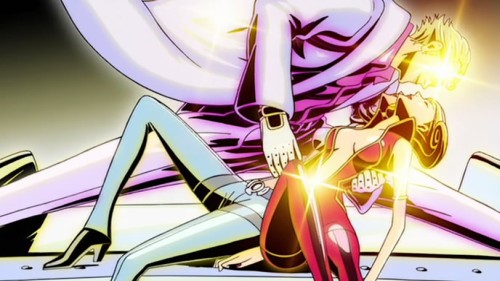
With Kouta, the main in Kanokon, the defining traits of his character and by extension the things that get the women flocking to him are his quietness, his sensitivity, and his decency. In Redline on the other hand, the portrayal of the women emphasizes “he-men, men of action,” as the old Charles Bronson Mandom commercial goes. Protagonist JP sticks up for his beliefs even if it gets him beat down, and the man he idolized in his youth can be seen in a flashback kissing two bikini babes simultaneously. Both are versions of male fantasy, the nice guy who is appreciated by all of the women and the daredevil who sets girls’ hearts aflutter, but they have a decidedly different appeal to them that doesn’t just have to do with how much Kanokon toes the line between fanservice and outright porn. They exist on somewhat opposite ends of a spectrum of male behavior, and the manner in which the women are sexualized, not just visually but also in their actions within the story, runs accordingly. With that in mind, I think it can be easy to see why there would be conflict between the two sides.

This is not an indictment on either type of male character or the series which they come from, especially with JP in Redline who is shown to be sensitive in his own way. Neither portrayal is inherently worse than the other, but problems can arise. Indeed, while both the “nice guy” and the “man of action” can be portrayed well as men of character and strength, they can also be pushed to unpleasant extremes, though the nature of that negativity can itself be different. The nice guy can be so passive as to absolve him of any mistakes he should be responsible for, and the man of action can often times be seen as a man who treats women purely as playthings to be manipulated. It is also not an indictment on the fans who identify with either character type, as the meaning of terms such as “wish fulfillment” and “role model” can get complicated. Is it better for a quiet nerd to prefer the quiet nerd character he is, or the active warrior that might wish he wants to be? I think that question lies at the heart of the difference in how fanservice is executed.

Fujoshi Characters by the Score

When I first began the Fujoshi Files, my intent was to put the spotlight on what I saw as a rising trend at the time: the appearance of the yaoi-loving female fan as a character archetype, particularly in the manga and anime targeted towards that otaku market, as well as the presence of “fujoshi-like” traits in characters who might not qualify otherwise. From what I knew, there were enough to get a decent-sized list, and as it was a burgeoning character trait, I figured if I did one every couple of months or so that I’d be able to keep up fairly easily.

That was not the case, and now I currently find myself with a backlog bigger than the amount of Fujoshi Files currently available on the site. Aware that I had been neglecting it somewhat over the past year or so, I’ve decided to start posting them more frequently. Most likely, you’ll be seeing them every other Sunday, but this is subject to change, particularly if I feel like I don’t have anything ready by then.

One problem that has faced the Fujoshi Files since very early on has been access to the works themselves, because I try to write a profile after reading as much as is available at the time. This can result in entries that are outdated, but it also makes it so that I don’t always feel I can write an accurate description of the characters themselves. Sometimes, a character’s name will be mentioned in passing in a single panel and then never again, and then when I look online and see that there are no records of a character by that name, I have to ask myself if I just imagined it. Still, the way I’m planning on posting these, I believe I will do a pretty good job of reading the source material while still posting entries regularly.

Another issue has been the sheer amount of characters that could potentially qualify. While it seems like the small “boom” of fujoshi main character may have died down recently, there are still plenty of minor fujoshi characters appearing in series, and it’s even gotten to the point where someone will make mention of a fujoshi, or there will be nameless fujoshi in the background and I can’t decided whether or not I should count such things. For example, in Baka and Test: Summon the Beasts, Himeji mentions in one episode that she has a friend who is a fujoshi. What would I even do about an image? If I counted such a “character,” would I be taking it too far? I get the feeling the answer is “yes,” but I’d like for the Files to be comprehensive.

And that’s not even mentioning Genshiken II, which has a whole new batch of characters who need profiling, or the spinoffs and alternate universes that have spawned out of Tonari no 801-chan. Those will come in due time.

What do you think? If you’ve been enjoying my little side project over these past few years, then how comprehensive should I make it? Should I include even background characters? Would you prefer I post somewhat incomplete entries and then fill them back in later?

Suite Precure Transitions

I’ve been keeping up with Suite Precure since it began last February, and while it isn’t quite the masterpiece that Heartcatch Precure! is, it’s still enjoyable enough. We’ve hit roughly the middle point of Suite Precure, and quite a few things have happened along the way, including the reveal of a new Cure or two.

I’m going to discuss some of my feelings on these current episodes (as well as previous Precure series), so if you don’t want to be spoiled, turn away.

Continue reading

Hanasaku Iroha and Its “Conflict of Interest”

Hanasaku Iroha, one of the new shows of the current season, is unusually divisive in an equally unusual way. Whereas most shows will divide people according to whether they love or hate it as a whole, Hanasaku Iroha has its fans disagreeing as to which specific episodes are the good ones and which are the wastes of time. I think the reason that this is happening is not just because different fans have different tastes and preferences, but because Hanasaku Iroha is a generically (as in genre) transitional show with a contradictory feel to its purpose and the purpose given to it by fans.

The basic premise of the show is that a teenage girl, Ohana, has to move in with her grandmother, who runs an inn. Ohana, leaving behind a boy and the rest of her old hometown, has to adjust to working at the inn and figuring out how to get along with all the personalities at the inn. It’s a big change in her life, but she enjoys it day by day. In other words, Hanasaku Iroha has both elements of a coming-of-age story and slice of life, and this is where the conflict lies, as the two are mutually incompatible in certain ways (though I think they can work well together, and Hanasaku Iroha is one such example).

Coming-of-age stories are primarily about the transition from childhood to adulthood. They are about growth. Gurren-Lagann is absolutely full of this. Slice of life stories on the other hand are about the every-day. Even if time moves forwards, the characters do not have to. The girls of Hidamari Sketch don’t ever have to change. Those are very different values, and Hanasaku Iroha has some of both, so I think it’s easy to see why someone can look at episode 1, which has a good deal of the coming-of-age element, and find it to be one of the weaker episodes of the series, and then look at episode 3, which was more every-day hijinks, and regard that as one of the better. On the flip side, it’s just as easy to see why someone would argue the opposite, and say that episode 1 is particularly strong. Overall, it results in a very character-based show where the story moves ahead primarily through subdued character development, and it is something that might not be terribly apparent because of how Hanasaku Iroha sits at the cross-section of two disparate genres.

I believe Hanasaku Iroha to be part of a larger transitional trend in anime, even if other shows aren’t quite doing the same thing as Hanasaku Iroha. Many anime since, let’s say, Evangelion for a convenient starting point, have been about expressing a certain sense of melancholic loneliness which manifests itself into several forms, from oft-mentioned topics such as hikikomori, to simply depression. If not, they have been about soothing those feelings, being a remedy for unease and internal strife, and I think the interaction between these two routes can even roughly approximate the development of moe over the past decade and a half. Both have been very good for anime and its viewers I think, but now we’re starting to see shows not just address those negative feelings but try to encourage people to find solutions for them, or at least try to show people moving forward and growing. Ano Hana, which is also running this season, shows a group of kids trying to mend their friendship and personal problems after drifting apart. Madoka Magica, for all of its gloom, leaves hope on the table. Fractale takes a look at a society of isolation. Even K-On!, which follows the “time passing with no real change” formula almost to a tee has the younger character Azusa feeling the impact of the four main girls upon her life, particularly their corrupting (but unconsciously welcome) influence upon her work ethic.

For Hanasaku Iroha, the divisiveness that springs forth from the contradiction between coming-of-age and slice-of-life is how this period of change manifests itself.

Seeing the Darkness of Madoka Magica

Ever since episode 1 of Puella Magi Madoka Magica, many bloggers have been making confident statements about how the show looks to be a dark subversion of the magical girl anime. While that is certainly accurate on some level, it seems to be the case that a lot of people don’t quite understand how exactly Madoka Magica is a subversion, simply because they don’t understand the subject itself. In other words, a good number of people writing about Madoka Magica don’t actually know the magical girl genre, despite the broad statements being made. Thus, I am going to address at least a few misconceptions.

Misconception #1: Magical Girl Anime Are About Good vs. Evil

Correction: Magical girl anime are about “before” vs. “after.”

While there are some shows which pit our heroine(s) against a dark force, the vast majority of magical girl anime and manga do not even factor in the good/evil dichotomy. Instead, they will focus on how the magic changes their own lives or how it changes the lives of those around them. Those shows which do have a good deal of fighting often have it in service to something else; in those instances, it’s generally more about protecting others than it is vanquishing villains. So when someone says that Madoka Magica is different because it doesn’t have “Good vs Evil,” they are basically incorrect in the sense that magical girl shows were never really about good and evil in the first place.

Misconception #2: Magical Girl Anime Say, “You Don’t Have to Change a Thing!”

Correction: Magical girl anime say, “the magic isn’t as important as who you are!”

Yes, the “Be Yourself!” message is fairly common in magical girl shows, but there’s a distinct difference between this statement and the misconception. One implies a static existence, while the other points to an active one. The self-improvement thus happens with the help of magical powers, but it is usually the catalyst for change, with the real reason coming from within.

Misconception #3: Sailor Moon/Nanoha is a Typical Magical Girl Show

Correction: Sailor Moon is more of a typical fighting magical girl anime and Nanoha is an atypical fighting magical girl anime, while a typical magical girl anime is more along the lines of Ultra Maniac or Fushigiboshi no Futagohime.

This ties in directly with misconception number 1 and it’s fairly understandable why people make this mistake. Sailor Moon is a very significant show in the magical girl genre, and for many anime fans the very first mahou shoujo anime they ever watched (myself included), but it wasn’t really typical for its time. Certainly it has had its influence on later series, probably most notably Pretty Cure, but Sailor Moon combined the magical girl anime with the team dynamic popular in live action tokusatsu and to a lesser extent giant robot anime, and used that as a platform to deliver action-packed fights, but don’t confuse what Sailor Moon added to the genre with what the genre is fundamentally about.

Similarly, Nanoha is a show made for otaku, taking the magical girl formula and targeting it directly towards an older male audience–much like Madoka Magica itself–but it draws a lot from Sunrise action and mecha shows and adds a cup of moe. It’s also understandable why this might be an anime fan’s main exposure to magical girls, as fans who might have avoided the genre as a whole may have been pulled in by what Nanoha did differently, but that is the Nanoha formula, not the magical girl one.

“So what exactly is Madoka Magica subverting, then?”

To understand the answer to this question, we have to know the basic theme of the magical girl anime, which is how magic can make your wishes come true, or let you do things you couldn’t before. This can be portrayed by having a character, generally a normal girl, come across their magical abilities, or it can directly target the audience (which it generally assumes to be young girls) and have a girl who already has magical powers from the start. Either way, a magical girl show typically says, “Wouldn’t it be great to be a magical girl?” You can see this in pretty much every magical girl show aimed at girls, be it Cardcaptor Sakura, Majokko Megu-chan, Shugo Chara, Minky Momo, Ojamajo Doremi, and yes, even Sailor Moon. If the show is geared more towards male otaku, then the theme might turn into “Wouldn’t it be great to know a magical girl?” but the opportunity magic gives you to change/better your life is the crux of it all.

On some level magical girl anime are about the exploration wish fulfillment, and when you keep that in mind the true nature “dark” element of Madoka Magica becomes clearer. The dreary aesthetic of the witch realms, the violence, and the ambiguous morality in the characters play a role, but the most important point to consider is how the magical mascot Kyubey offers the chance to make your wish come true at the “price” of becoming a magical girl. The fact that the wish-granting comes with some sort of unknown, unquantified, and unqualified cost is where the direct subversion is strongest.

“How much are you willing to sacrifice to make your wish come true?”

The Man in the Moe

“If the emphasis in moe anime is on the female characters, where does that leave the male characters?”

I asked myself that question, and after some deliberation it turned into, “What do you look for in male characters in moe anime?” I want to turn the question to you the reader as well, provided you’re someone who has enjoyed moe anime in the past, even if you’re not necessarily a fan. Keep in mind that I don’t mean that the male characters themselves have to be “moe,” but just that they exist within those types of anime. If you want to extend the question to yuri shows as well, that is also okay.

For me, the first thing that popped into my head was Maria-sama ga Miteru, namely the all-male student council that exists outside of the all-girl school where Marimite primarily takes place. Marimite has a heavy emphasis on female characters, so when one of those male council members, Takada Megane, talks about how he loves to work out and eat meat all while flexing at the girls, it really stands out. It’s as if Takada and his muscles are inadvertently shattering the yuri-heavy atmosphere of Marimite, and the first time I saw him I thought, “Yes, you are the best male character in this show.” Applying that back to my own question, it makes me think that while I definitely enjoy Marimite for what it is (and own almost all of it on DVD), I like the idea that there exists something a little beyond the world of the girls, even if it’s not that far removed, and male characters who act kind of contrary to that setting actually serve to emphasize the feel of Marimite.

One concern I have is a possible philosophy that the male characters in such series don’t matter, as I feel that even if they’re out of the spotlight they can have a huge impact on the work itself.

So what do you think?

Vistas: Comipo! and the Constructed Definition of “Manga”

I’ve got my first post up at the Vistas Asiascape blog, where my fellow PhD’s and I will be posting our thoughts on various things related to the fields of East Asia and media and fiction and such. Take a look, feel free to comment, and if English isn’t your main language, you are actually welcome to post in whatever language you feel comfortable.

Used that Mangekyou One Too Many Times

I recently had a conversation with OGT where he mentioned his participation at the University of Kentucky’s annual Asia Art Festival. There, he participated in a panel on anime and all that good stuff. But after the panel, an interesting conversation occurred. I’ll let OGT speak for himself.

…I chatted a bit more with the panelists (one a soon-to-graduate senior, the other a freshman) and the topic somehow swerved to the manga industry, its travails, and its push to make a market for more esoteric, alternative manga (which for all intents and purposes mostly means “not BESM-standard”).

After hearing this, the freshman subsequently asked “So, like, are they trying to make it cool to read print manga?”

What?

It turns out that in the guy’s high school, reading manga in book form meant you were at a disadvantage, not only in terms of keeping up with the story but also socially. One possible explanation for this is the fact that scanlations are of course quicker and, high school being what it is, no one wants to discuss something which has already passed its expiration date for trendiness, be it Bleach or the Super Bowl.

But regardless of the why, I must reiterate my (and OGT’s) feelings on the matter: What?

The more I think about that person’s statement though, the more I feel it to be a revelation!  It’s like through all of the discussions and debates out there on how to get people to buy manga, as well as all of the talk directed towards making people aware of piracy, we all forgot the fact that teenagers are teenagers, and the choice to read an online version of their favorite comic can be as simple as whether or not it would be acceptable by their friends and fellow manga fans. Knowing this, I can’t help but think, “How blind we all are!”

As someone who was once ages 13 through 18, I know that not every decision a person that age makes is the product of group pressure, and that a teenager can even defy that pressure, but I know that it is still a very powerful, perhaps even overwhelming force. And despite what they themselves might think, keeping up with what’s “cool” can affect nerds, especially when it’s due to the judgment values of their fellow dorks. Sure, this feeling can definitely be exploited for marketing purposes—there are industries built entirely around doing so—but all of the logic and strategy in the world can’t always account for the fickle, volatile psyche of the teenager.

So in conclusion, I feel old. You should too.

The Enemy’s the Fashions! Kuragehime’s Look at Anti-Beauty

Kuragehime, aka Jellyfish Princess, has so far been quite a genuine look at the lives of female otaku. Though certain elements of the story are exaggerated for comedic effect, the show really feels sincere overall, particularly when it comes to the uncomfortable conflict that can occur when dorks, particularly female dorks, run up against the frightening monster that is Fashion.

Already from episode 1 you get the idea that main character Tsukimi and the other girls find fashion to be an anathema. Living in Tokyo, going outside means having to deal with the constant, almost unconscious social pressure that results from not looking “like everyone else.” They know they’re different from others, and being reminded of it constantly and from all angles doesn’t make them any more comfortable. Their home, known as Amamizukan is a haven, not merely because it’s visually devoid of the perceived runway drive-bys that make the outside so dangerous, but also because it’s seen as mentally and emotionally free. So when the threat is made internal, either by a “beautiful woman” stepping through their door, or through having one of their own transformed into “one of them,” it’s like the sanctity of their home (and their existence) has been violated by that which they fear most.

In episode 3, Tsukimi is given a glamorous makeover by the cross-dressing Kuranosuke, and her reaction to seeing herself comes in two parts. First, she is unable to accept herself as attractive. Second, she frets over what her peers would think if they saw her. When Tsukimi imagines herself being crucified by her friends, she envisions it taking place on Otome Road in Ikebukuro, which is itself a haven for female otaku, particularly fujoshi, within a greater trendy shopping/fashion city, reflecting the status of their home within Tokyo. This reveals a lot about how Tsukimi defines herself, not just internally but also in relation to others.

While “beauty” can be defined in any number of physical ways (let alone more intangible ones), it’s clear that Tsukimi does not consider herself to be beautiful. By saying that she “doesn’t want to be pretty,” Tsukimi defines beauty as something foreign to her existence, or that to look attractive would mean that she isn’t be true to herself. I can relate. Having been ridiculed in the past because of my clothing, “good fashion” and “good looks” became symbols of the enemy, the barriers which prevent people from seeing that it’s the inside that counts, as taught by one Ugly Duckling. But when you think about it, if the inside is really what’s important, then people should not be judged negatively simply because they’re attractive and make an effort to be attractive.

Fashion can be seen as a way to hide your flaws. In that sense, fashion becomes a “lie” made all the more egregious by glitz and glamour, but it’s a perspective marred by pessimism, where a person allows the negative aspects their appearance to define them more than the positive ones. Instead, you can think of fashion as accentuating your better qualities, where you define “good-looking” on your own terms, and the difference between fashionable and unfashionable can be as simple as an anime t-shirt that fits versus one that doesn’t. But this isn’t what Tsukimi is doing. Rather than making a declaration that sweats and unkempt eyebrows are a sign of her own personal beauty, she has defined “being pretty” as a state that she can only achieve through deception and trickery, that whatever “beauty” is, she isn’t. To look good is to be one with the enemy, and neither she nor her housemates at Amamizukan can accept that (or at least that’s what Tsukimi believes).

So when it comes to the second part of Tsukimi’s reaction, the fear that she would be branded a traitor by her comrades in geekdom, there is more at work than simply group pressure. Tsukimi and the other girls have so violently rejected the “standard” world that they have created their own anti-fashion values, where everything is upside down. While I appear to be contradicting what I said earlier about defining fashion on your own terms, this isn’t quite what’s going on, as the girls are actually casting in a negative light the very attempt to look better. Because they feel ostracized by the outside, they shun it right back to the point that they feed their insecurities, rather than grow more comfortable, and in doing so they end up being not so different from those they wish to distance themselves from.

I know the emphasis that fashion can have on a group dynamic like this can be difficult for a lot of guys to comprehend, so I’m going to provide a more aggressive, arguably more “masculine” nerd equivalent. Imagine that a Star Trek fan gets beat up in school by a bunch of jocks. As a result, he begins to associate anything having to do with physical prowess and athletic activity with stupidity and the worst human traits. Then, he manages to find a Star Trek club and makes some friends, even going to science fiction conventions. He’s happy, but within that community he becomes the guy who judges others by their Star Trek knowledge (which by this point has also branched out to Babylon 5 and other works), and to not be up to his level is to simply not be up to par. Just as this poor nerd “bullies” with his intelligence and fandom knowledge, unconsciously mirroring the very bullies who torment him, the anti-fashion, anti-beauty attitude of Tsukimi and friends emerges in a similar fashion.

Is Amamizukan truly free then? Yes, but only if you follow their rules. That doesn’t make them bad people, though.

The Cross-Cultural Exchange of a Couple of G’s

In 1996, Russian-American animator Genndy Tartakovsky premiered Dexter’s Laboratory and pioneered the thick-lined,”flatter” animation style. This style can also be seen in Samurai Jack and Star Wars: Clone Wars, as well as in Powerpuff Girls, where Genndy was director.

Flash back a few month to 1995 and we get one of most the influential anime ever, Studio Gainax’s Neon Genesis Evangelion. Gainax, known for a variety of works from various genres, are especially fondly remembered for their giant robot fare, most notably Evangelion but also Aim for the Top! and Tengen Toppa Gurren-Lagann.

Now, in late 2010: Gainax’s latest anime is a tongue-in-cheek cartoon about a pair of misfits and heavily utilizes thick outlines and very flat character designs, while Genndy Tartakovsky’s newest show is an honest, non-parody attempt at a super robot-themed series. Both series’ debuts occurred less than three weeks apart from each other.

While the relationship between Japan and America’s cartoons and comics have been put in the spotlight recently with collaborations such as the joint Iron Man and Wolverine projects involving Marvel and Studio Madhouse, the fact that Genndy Tartakovsky’s Sym-Bionic Titan and Gainax’s Panty & Stocking with Garterbelt have come into existence so close to one another puts an even greater focus on the two nations’ cartoons. Here in one cross-section of time, we can see the active/passive exchange of ideas as these cultures’ animation styles appear to intertwine so tightly that they sling each other across the Pacific Ocean.

Neither show is so like the animated series of the others’ country that they come off as weak imitations. Sym-Bionic Titan takes fusing robots, a fight against a powerful invading force, and various other giant robot tropes, mixes them in with Genndy’s own character aesthetics, and places the story firmly within America and its own cultural norms. Meanwhile, Panty & Stocking utilizes the visual elements and humor of early “Cartoon Cartoons” (as Cartoon Network referred to them) while also injecting very anime-esque expressions and reactions from its characters, most notably in their faces, and also ramping up the humor to more “adult” levels. The two series and their hybrid styles reinforce both the idea that creativity is not limited by national borders and that individual cultures can still maintain some of their distinctiveness when it comes to artistic output.

This is not a bad thing.

As a final aside, the personal robot used by the character Lance in Sym-Bionic Titan reminds me of the titular robot from Galaxy Gale Baxinger.

I can’t be the only one, right?