You’ve Already Led: Final Thoughts on “Fist of the North Star Side Story: The Genius Amiba’s Otherworld Conqueror Legend”

Fist of the North Star Side Story: The Genius Amiba’s Otherworld Conqueror Legend is an isekai spinoff starring a minor villain from the popular shounen franchise, and it concluded earlier this year after nine volumes. This manga been one of my favorite series in recent years, so I wanted to just give my final thoughts on this ridiculous work.

For context, here are my previous two posts about the series:

Warning: Spoilers 

The “hero” of this series is Amiba, the cruel Toki impersonator who met a grisly (and hilarious) end from being forced to walk backwards off a ledge before exploding into a gory mess—a fate courtesy of franchise protagonist Kenshiro. Now reincarnated in a fantasy world, he has to fight monsters using his own bastardized version of the pressure points martial arts Hokuto Shinken, all while learning about the magic that governs his new environment. As he gains unlikely allies (because it’s really hard to make friends when you’re a self-centered asshole), Amiba ends up on a collision course with the army of the Demon Lord, including the Four Demon Generals. And all along, no matter his successes or numerous failures, the man still declares himself to be an unparalleled genius. 

There are three main recurring gags in this manga:

First, nearly everyone Amiba encounters oddly resembles people from his original world, though not necessarily sharing personalities. He travels with Lilin (Rin) and Pat (Bat), and fights foes like Southern (Souther) and Maou Kenshi Rou (Jagi). 

Second, many of his allies are alternate versions of other bad guys. My favorite is a gigantic old lady who was originally a muscly thug in a poor disguise but in this world is actually a titanic grandma. 

Third, Amiba remains a mostly delusional dickhead throughout, but people also don’t put up with his bullshit.

If you’re not a fan of Fist of the North Star, a lot of the in-jokes will likely go over your head, but I am squarely in its target demographic and highly entertained. Fortunately for other readers, The Genius Amiba’s Otherworld Conqueror Legend also features a contemptible antihero who actually grows and learns to a degree, avoiding running its premise into the ground.

In the original story, Amiba is presented as irredeemable, but here in a different world and context, we find that he has the power to do good even if he is anything but noble. He might not be healing people out of the goodness of his heart, but the results are the same. The road to hell is paved with good intentions, but what if bad intentions create benevolent results? It makes one wonder if society (or lack thereof) is what made Amiba into the absolute monster he was, instead of the somewhat less obnoxious person he is after death.

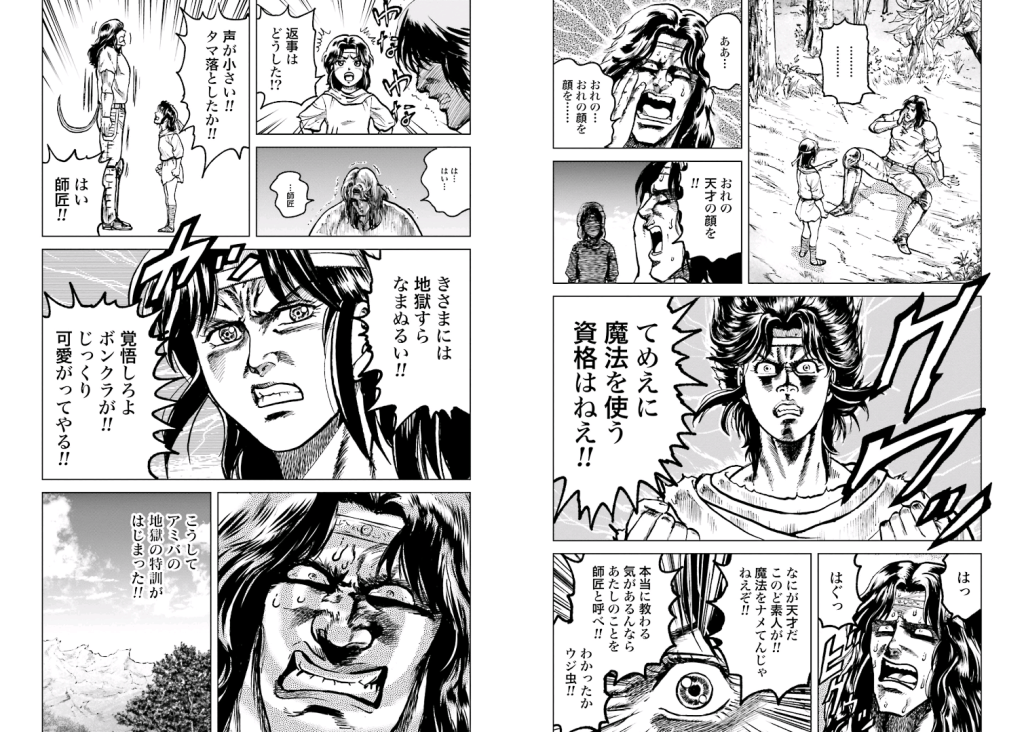
Amiba goes from one-off character to fascinating psychological study as a result. He vastly overestimates his martial arts skills, but that’s only in comparison to the impossible standard set by the warriors of the post-apocalypse he came from. His magic starts off poor at best (a nominal bump in his mana is his only isekai power-up), but his unreasonably high confidence allows Amiba to break through those limitations and create a hybrid magical kung fu. And as reluctant as he is to admit it, Amiba learns an important lesson: Other people are capable in their own right, and they can work together with him to achieve greater things. They’re just not as capable as himself, of course.

The story reaches its climax in Volume 9. After defeating the Four Generals, it’s revealed that the legendary heroic armor and weapons Amiba obtained actually house the divided soul of the Demon Lord. That demon’s name: Maoh (as opposed to Raoh). Yes, he’s Maoh the Maoh (Japanese for Demon Lord).

His last surviving general channels the Demon Lord to take over Amiba’s body as a new physical vessel. Yet, despite being nearly overwhelmed, Amiba is able to resist the takeover through sheer ego. Maoh then answers this stubbornness by plumbing the depths of Amiba’s soul and manifesting his greatest fear: Kenshiro. Suddenly, Amiba finds himself with his back to that ledge again.

On the verge of giving up, Amiba sees images of his allies in the new world giving their support. Naturally, in his inner world, they have nothing but effusive praise for his endless brilliance. With both feet back on the ground (and a body decidedly not exploded), Amiba starts fighting back, using all that he’s learned since being isekai’d. He battles Kenshiro’s Hokuto Shinken using his own magic-infused martial arts, but can only reach a stalemate at best. Then, something incredible happens: The Kenshiro in his mind compliments Amiba for getting stronger, refers to him as another powerful rival, and fades away. It’s not clear if this is simply Amiba imagining Kenshiro accepting him, or if Kenshiro is such a great hero that even a psychic apparition of him exhibits a high standard of honor, but the result is the same. Amiba wins.

The series epilogue jumps a few years into the future, mirroring the second part of the original Fist of the North Star. Lilin and Pat, both adults now, discover that Amiba has created his own peaceful kingdom populated entirely by minor bad guys. He’s said to have later tried to take over the world, inadvertently uniting the humans and demons against him, but the veracity of this (and everything else that has happened in the story) is up to the reader to decide.

I choose to believe that everything we’ve seen is super duper canon, and if they ever make another fighting game, I hope they put this version of Amiba in there. 

The Genius Amiba’s Otherworld Conqueror Legend is a lot of things: Spin-off, parody, silly take on a popular genre. But it also scratches an itch to see a fundamentally flawed and morally void protagonist somehow manage to improve his world, at least for a little while. All the terrible qualities possessed by Amiba are channeled into doing good, all thanks to the people around him. It’s perhaps an even more far-fetched dream than all the harem and power fantasies in the world, but I simply can’t resist a wacky redemption tale that gives a new perspective on one of manga’s jerkiest villains. Isekai is ultimately about second chances, and Amiba uses his to the fullest.

The Amiba Isekai Has a More Balanced Roster than the Original Fist of the North Star

Fist of the North Star Side Story: The Genius Amiba’s Otherworld Conqueror Legend is a spin-off manga that has rarely disappointed. Its silly premise is that the minor villain Amiba (aka Fake Toki) has been isekai’d, only rather than getting killed by a truck, it was death by Kenshiro. And instead of getting run over, it was being violently exploded while forced to walk backwards off a ledge

Amiba is a delusional asshole who has noteworthy skill but frequently overestimates himself. He is devoid of honor and compassion, and cares little about anything but showing what a “genius” he is. It’s why he’s such an insufferable enemy in the main series, but the funny thing is that the guy’s poor personality results in a manga with a much more balanced roster of good guys when he’s the lead.

In the original Fist of the North Star, Kenshiro is a perfect hero to a fault. He’s great for his story, but he also always overshadows his allies because he’s the strongest, kindest, and most badass guy around. A similar thing happens with other spin-offs: Whether it’s Raoh, Toki, or whoever, they’re often portrayed as being a level or ten above those around them. Not so with Amiba. 

In the new world he finds himself in, Amiba has little natural aptitude for the sorcery inherent to it. But while his Hokuto Shinken skills are woefully incomplete compared to the true masters of his original life, such martial arts skills are virtually unheard of in the other world. Many characters outclass him in a few (or many) ways, and it means that Amiba can’t do everything on his own despite thinking he can. As the roster of allies (all of whom are parodies of existing FotNS characters) grows, they function much more as a team than Kenshiro and friends ever did. Whether it’s Toluukin the great mage (Toki), Shuuza of the Clouds (Juuza), or a gigantic grandma (who is actually not an oversized goon in disguise but rather the headmaster of an elite wizard school), everyone shores up the others’ weak points.

It’s great. Amiba makes for a fun main character because he’s so utterly flawed. The series doesn’t celebrate that fact—more using it as the basis for its humor—but it also provides plenty of opportunity for growth to an extent. At the end of Volume 7, Amiba is outnumbered against the Demon Lord’s army. Defeating them would be impossible, but then all the people he met in this other world appear, ready to help him (think Lord of the Rings: The Two Towers or Avengers: Endgame). In response to the overwhelming support, Amiba talks about all he sees around him are idiots, but that together, they can accomplish what average nobodies never could—that collectively, they are geniuses.

Amiba is still the height of arrogance and selfishness, but now he’s extended that attitude to include all his allies. He won’t ever be the hero Kenshiro is, but he can make a difference in his own way (if he can manage to get over himself).

S-M-R-T! I mean, S-M-A-R-T: “Fist of the North Star Side Story: The Genius Amiba’s Otherworld Conqueror Legend”

Isekai are so ubiquitous these days that there exist genre parodies of famous properties. Whether it’s being reborn as Yamcha from Dragon Ball Z or Kycilia Zabi from Gundam, we have yet another twist to a familiar gimmick. I generally don’t pay attention to such works, but I made an exception for a recent manga that asks, “What if Amiba (aka Fake Toki) from Fist of the North Star got sent to another world?”

That’s Fist of the North Star Side Story: The Genius Amiba’s Otherworld Conqueror Legend. And upon hearing this premise, it felt so perfect. After all, one common trope is that the characters who get reborn and transported tend to be pitiful “losers” given a second chance, and Amiba is among the most pathetic of Kenshiro’s opponents. He’s also a terrible person, so the story feels ripe for both comedy and the possibility of greater development. For the most part, Amiba’s Otherworld Conqueror Legend does not disappoint.

At the start, the manga reveals that the way Amiba gets isekai’d ties directly into the events of Fist of the North Star: Kenshiro makes Amiba’s hands explode, then uses his pressure-points to force the delusional villain to walk backwards off a precipice. What’s worse, he never even hits the ground before exploding into a puddle of goo. Amiba probably wishes he got killed by a truck.

He then awakens in a new world that looks oddly similar to the post-apocalypse he once called home, but there are some notable differences. Namely, fantasy elements like magic and dragons are fairly common, no one has any clue about “Hokuto Shinken” or other martial arts, and a number of characters resemble established FotNS faces. Unlike Kenshiro’s young companion Lin, the girl Amiba first runs into is Lilin, a foul-tempered mage who reluctantly teaches him magic—which he turns out to be awful at. Amiba, of course, insists that can’t be the case because he’s a genius. He does manage to make effective use of his piddling magic by the end of Volume 1, so maybe there is something to his claims, but the manga makes it clear that Amiba is perennially just as much a dumbass as he is intelligent.

The series is quite good at playing on expectations from both isekai and FotNS. Amiba isn’t a terrible fighter—he’s just hopelessly outclassed in his original world. However, in his new world his combination of fairly extensive knowledge of Hokuto Shinken and its counterpart, Nanto Seiken, makes him a unique presence as per the standard isekai protagonist trope. The manga also shows that he got a power-up after reincarnating in true isekai fashion, though the gag here is that the boost is very minimal. 

As mentioned, many of the characters are intentional knock-offs of minor FotNS characters: Lilin, Pat, Devil Reversible, and so on. While their appearances are close, their personalities can differ tremendously, and often the “bad guys” aren’t so bad. A fairly major character’s counterpart even shows up at one point. I appreciate the joke, but wonder if it’s being overused, and if the series could benefit from having more characters who are original.

The idea that this is Amiba’s chance to find glory, and the way his arrogant personality both helps and hinders him, is what makes The Genius Amiba’s Otherworld Conqueror Legend work. Is he going to find an odd sort of redemption? Or is he going to repeat the same mistakes? The fact that he likely will end up doing both makes me want to see where the story goes from here.