“High School Girls Are Funky” and a Lesson in Sport Fighting vs. Combatives

I occasionally enjoy watching martial arts Youtubers. They run the gamut from professional fighters to dedicated practitioners to, well, scam artists, so they can easily devolve into a whole lot of nonsense. I’m the furthest thing from a competent fighter, though, and my interest goes more towards those who exhibit a desire to actually spread knowledge and understanding while avoiding macho posturing. 

One person I watch is Adam Chan, and while I don’t agree with some of his beliefs about how the world works, he comes across as someone who tries to check his ego at the door. He tries to communicate that a martial art is not “a way of fighting” in itself but rather a recipe or set of tools that should be adjusted for the situation or goal you desire. Self-defense is not sport fighting, and neither are combatives: The first is about escaping harm, the second is about a mutually agreed contest, and the last is about prioritizing maximum force and even concealing your weapons (both metaphorically and literally).

The categories can be easily conflated, and they commonly are. In the past, I wrote about out how the series Mashle highlights these distinctions. However, there’s actually another example that demonstrates these differences even better, and it can be found in the anime The Daily Lives of High School Boys, of all things.

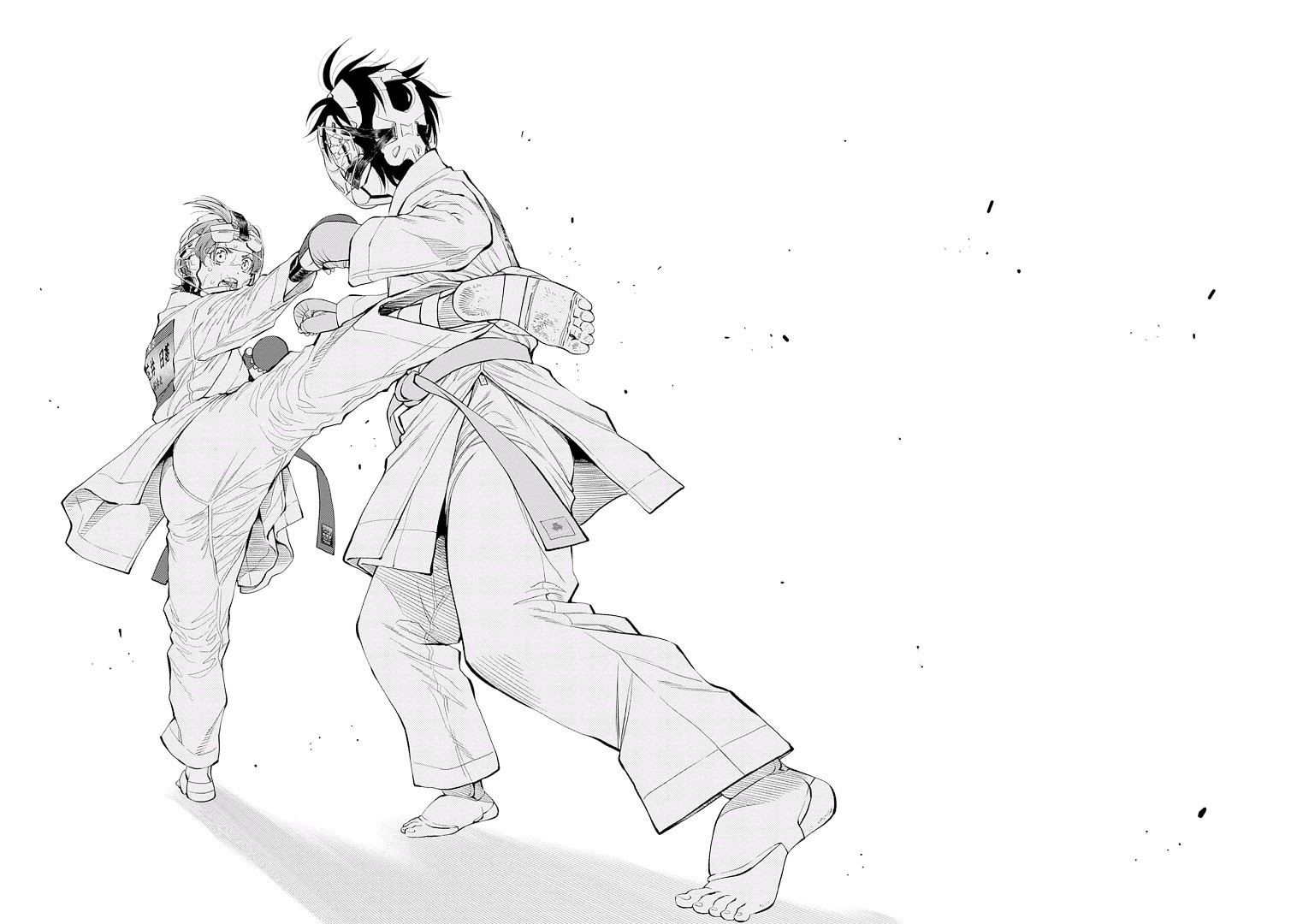
The Daily Lives of High School Boys is a comedy about dumb teenagers, and it occasionally has a spinoff at the end of episodes called High School Girls Are Funky. These shorts feature a trio of girls: two loud and mean-spirited girls named Yanagin and Ikushima along with Habara, the meeker one. But it’s revealed that Habara used to be an absolute terror who had to be subdued by an alliance of the strongest kids in school. In one short, Yanagin and Ikushima decide to see who’s stronger in a fight. Habara tries to get them to stop, only to have her plea ignored.

However, when they try to establish the parameters for their bout, the “normal” Habara earnestly asks them why they would need rules in the first place for a fight. In this moment, the two realize what a mistake they’ve made: While they’re trying to compare skill in a fair contest, Habara doesn’t comprehend the very notion of limiting one’s violence. The other girls back down, anxiously claim it was all a joke, and avoid disaster in the end. Right as the third girl breathes a sigh of relief, though, the other two notice her tossing aside a large rock.

In this scene, you have the two girls approaching the situation with a sporting mindset, trying to agree upon the rules of engagement. You have the third girl thinking purely in terms of combatives and looking for ways to inflict maximum violence without compromise, including hiding a crude but effective weapon. And when the two de-escalate the situation, you have self-defense of a less flashy kind.

Even the best martial arts anime and manga tend to assume that all fighting and conflict is essentially the same, so it’s funny to see a gag series represent such subtle yet profound distinctions. 

Ironmouse, Opera, and a Kung Fu Analogy

Ironmouse, a pink-haired Virtual Youtuber, holding a slipper in her left hand

Sometimes, the perfect analogy to explain something can come from an unexpected place. For me, I recently found a way to organize some thoughts I’ve been having about martial arts, and it’s all thanks to VTuber mega star Ironmouse. 

As I peer more into the world of kung fu and the like, I’m frequently encountering the idea that many martial arts are not built around merely being a catalog of techniques one can add to their arsenal. Rather, they’re often systems of efficient power generation for particular circumstances, which then form the foundation for executing techniques. 

Something like western boxing has been proven effective for fighting, and it’s a system where specific implementation of techniques can be made functional by anyone if initially taught correctly. From what I understand, a less experienced person can learn to throw a 100% proper and effective punch even if it might not be as good as a veteran boxer’s. In contrast, many techniques across various kung fu disciplines will be largely ineffective without having trained extensively in how a style is meant to generate power and having passed a certain point in which your body has adapted to this counterintuitive movement.

It’s a difference that can be hard for people to grasp, myself included. I’m not a fighter or a martial artist, so it’s not something I can intuitively understand. But this is where Ironmouse comes in.

One of the many impressive things that Ironmouse is known for is that she actually has training in operatic singing. However, her opera voice is not her “normal” singing voice. During her 2023 birthday concert (see below), she sang well but without going into opera mode, and the difference is noticeable. In other words, a person can’t just improve their singing until it reaches “opera level”—it requires dedicated training in a particular way of producing sound

While not the only VTuber to have studied opera (Tokino Sora from Hololive and Banzoin Hakka from Holostars EN), Ironmouse is probably the most powerful example of how specific the training can be. This is because singing opera style can literally cause her physical pain due to chronic health issues, so she doesn’t often perform that way. When she does, though, Ironmouse sounds incredible. 

The similarities to different types of martial arts also extends to the topic of subjectivity. Opera may require a certain type of training to make a certain type of sound, but is it inherently better than other forms of singing? Not necessarily. It’s all down to personal wants, needs, and preferences, as well as what you aim to do with it. Is it the right move to train for years in a specific way of generating power found in certain martial arts, or to work from what one’s body can already do?

So thanks, Ironmouse. I don’t know if it makes sense to everyone, but your singing has helped me in a most unexpected way.

Mashle and the Difference Between Fighting and Self-Defense

In the past few years, I’ve developed a terrible interest in reading and viewing arguments about martial arts, from kung fu to MMA and beyond. There’s a combination of established knowledge, lost knowledge, myths and legends, fraudsters, hero worship, dick-waving, differing philosophies, and genuine curiosity that makes it a weirdly compelling shit soup. During these trawls, I occasionally see an argument that goes something like “If their kung fu is so great, why don’t they prove it in the ring, and also make a ton of money?” 

But what I was surprised to find is a response of sorts to that question in the pages of the manga Mashle—a series that asks, “What if Harry Potter was a non-magical himbo who overcame all obstacles through comically absurd physical prowess like Saitama from One Punch Man?” Not only does Mashle do a surprisingly good job of addressing the inequality inherent in its world, but it also cuts through expectations in other ways too, including how and why people learn to fight.

It’s important to note that con artists are a dime a dozen in the world of martial arts. It’s the realm of claims of supposed no-touch knockouts, poison fists, and chi energy. Even when you put such ridiculous “feats” aside, there are plenty of generic schools that are justifiably derided as “McDojos” or “belt factories,” essentially teaching nothing of substance. Because of this, many have reasonably become skeptical towards anyone who purports to fight with superhuman abilities. Asking for real proof makes sense, but there’s this peculiar jump in logic I see sometimes, where “prove it in the ring“ becomes “doesn’t everyone want to prove themselves?”

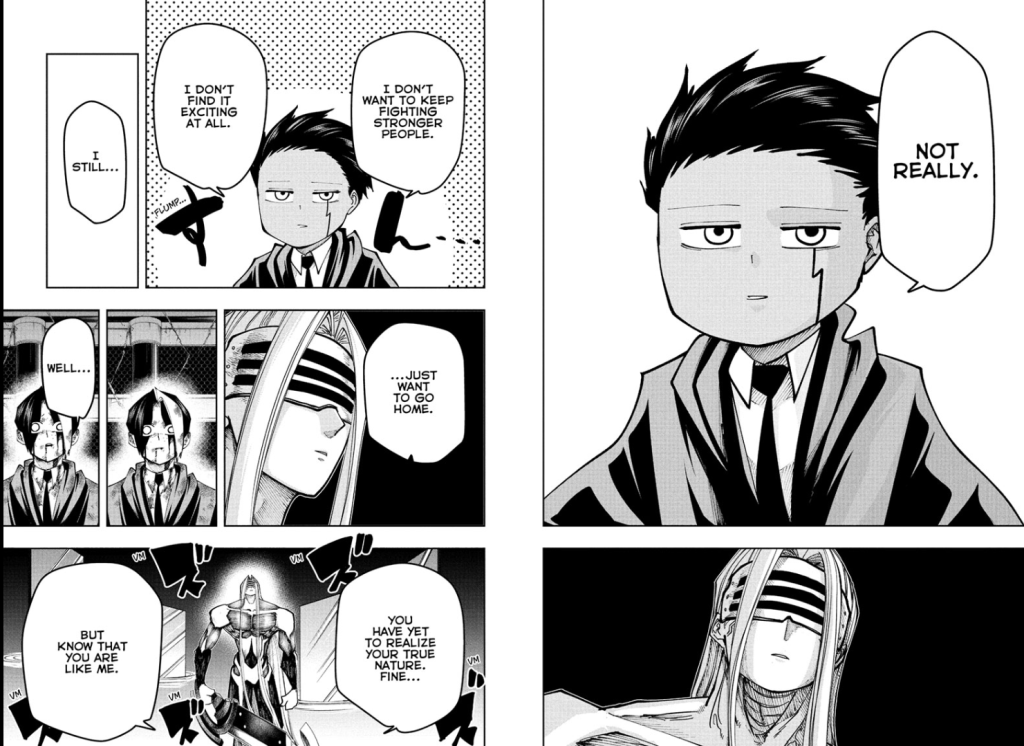
That’s where Mashle and its hero, Mash Burnedead, come in. During one of Mash’s most fearsome battles to date, his opponent says, “I’ve found someone who I can unleash my full powers against. I feel…invigorated. You must feel it too—the desire to fight even greater opponents.”

To which Mash responds, “Not really. I don’t want to fight stronger people. I don’t find it exciting at all. I still…just want to go home.”

This whole scene is a brief gag in a larger action scene, but Mash’s answer is a succinct counterpoint to the notion that everyone who truly learns how to fight has this killer instinct they need to unleash upon the world, whether for profit, fame, or to prove something. It actually takes a particular kind of person to want to willingly get in harm‘s way in order to show the world what they’re capable of.

One of the martial arts videos I‘ve watched (see above) is from an instructor on Youtube named Adam Chan, about the Hakka fist. As Adam explains, the Hakka are an ethnic group in China who were historically very poor and had to migrate a lot, and the various martial arts they developed came from civilians needing to survive against prejudice and xenophobia rather than as part of an army or in order to engage in duels. This is where Mash is: he didn‘t learn how to fight because of ego, bravado, a thirst for more, or because of a chip on his shoulder. He did it to protect himself and those dear to him. 

Within online discussions of martial arts and fighting, conversations end up getting geared towards “Whose kung fu is strongest?” in the literal sense. But Mash Burnedead represents the reminder that sometimes it’s the wrong question to ask. The desire to hurt others and risk getting yourself hurt in the process is not the only way to view things, even if there is a certain glamor to the idea of honing oneself into a human weapon.