
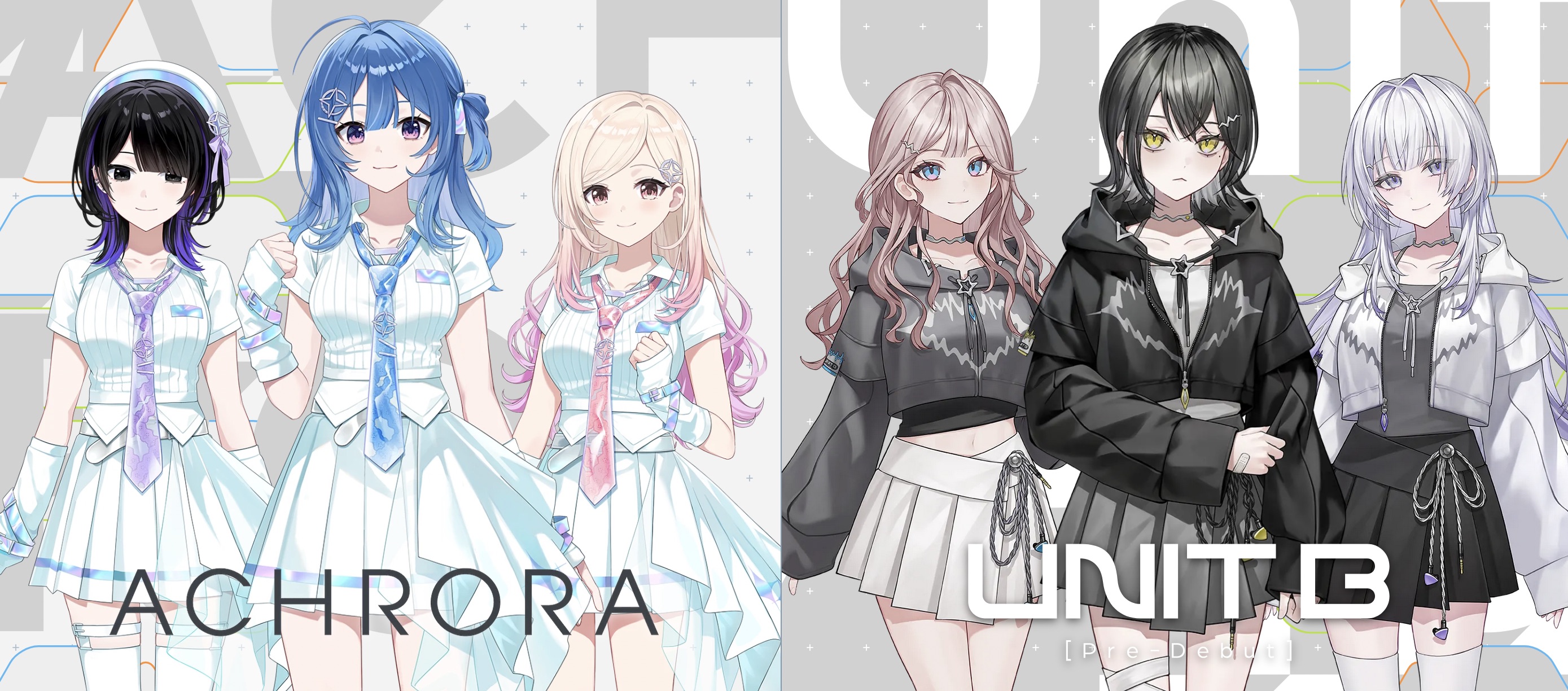
As one of the biggest names in VTubing, hololive has done a great deal of growing and expansion in recent years, and part of that process has involved experimentation. Some things have worked out after some bumps (such as the musical performance–focused DEV_IS branch), while others have been canceled or downsized for better (the holoEarth metaverse) or worse (Holostars). One of the latest projects goes in a new direction: a kind of preliminary branch called mekPark, where the talents are not technically part of hololive proper but have a visible and public path to there.
Recently, the two inaugural groups announced for mekPark back in May—Unit A (aka ACHRORA) and the still unnamed Unit B—finally all debuted. Given that, I wanted to give my thoughts on the endeavor thus far.
The Perils of Being at the Top
The size and fame of current-day hololive can be a double-edged sword. As with so many forms of entertainment, there is something charming and special when the stakes are lower, things are less polished, and there’s fewer expectations overall. A lot of moments become beloved memories because things aren’t perfect, and what’s missing in “refinement” is made up for in entertainers and audiences willing to bridge that gap and give some grace. I will sometimes watch the first and second hololive fes concerts, and they feel like they come from an entirely different era in a good way.
I think there’s a magic in such times that can be hard to re-capture once something becomes too big and professional, and some talents even try to fight against this. Gawr Gura was especially good at maintaining that amateur feel, and Gigi Murin revels in purposely allowing “scuff” into her streams as opportunities for laughs.
Returning to Basics
I find mekPark to be an attempt to re-create the relatively humbler roots of hololive and VTubers, albeit in a way that’s relatively safe for its company, Cover Corp. None of the girls involved have full models, which can feel unfair to them, but it also means that they can’t rely too heavily on the magic of more thoroughly rigged and animated VTuber models. mekPark seems to be a relatively low-risk space to try new ideas and technologies, while also a way to put the focus on the talents’ personal qualities. In many ways, it reminds me of the developmental programs found in pro wrestling, whether it’s the Young Lions of New Japan Pro-Wrestling or WWE NXT. They’re given fewer resources and are allowed to do less, but they ideally learn the ropes.
Nijisanji has something similar called the Virtual Talent Academy, but one key difference seems to be that mekPark places a far greater focus on group cohesion. ACHRORA and Unit B are explicitly presented as small teams, with one channel shared by the same members of a unit, and I suspect this is because hololive has noticed how much they benefit from making sure genmates have rapport and that they feel they’re in this together. Both Advent and Justice from the English branch have mentioned actually spending time together in real life (including in Japan!) prior to their debuts.
The mekPark Girls
As for the mekPark units themselves, there’s a very clear difference in philosophy behind each one. Unit B (which actually debuted first) is made up entirely of people who have backgrounds in music and performance, but very little in streaming. Neon is a singer with a personality that’s extroverted in a way that extends to her offline life (sort of like Matara Kan). Lyra is a singer-songwriter with a passion for composing. Mira is classically trained in piano, and has been playing since she was very little on account of her parents both being pianists too.
In contrast, the ACHRORA girls clearly have experience as streamers because they convey a sense of ease that’s almost impossible to have if you’ve never done it before. Sayana has a unique voice that comes across as honed without being forced. Rirara banters with chat and her fellow unit members very smoothly. Hinami’s gentle voice (reminiscent of voice actor Hayami Saori), silly sense of humor, and debut preparation have all stood out.
Essentially, Unit B and ACHRORA represent the two paths that hololive talents tend towards, where you’re basically either a musical performer who streams sometimes (e.g. Hoshimachi Suisei) or you’re a steamer who does musical performance on the side (e.g. Inugami Korone). Both are valid paths, but in the context of mekPark, it’s going to be interesting to see how the two sides develop in comparison to each other. A music-forward approach has greater potential to appeal across language barriers, but we’ve also seen that making a human connection through activities like chatting and gaming can be crucial for getting more people to tune into you in the first place, like with AZKi and GeoGeussr. At the same time, having a less “broadcast-ready” voice can come across as more natural.
Closing Thoughts
As mekPark continues to move forward, a couple questions come to mind. First, can something as big as hololive really evoke that smaller feel it seems to be aiming for? Second, if one or more talents are faltering and floundering in some way, what will happen, especially if cutting them might be the best solution? While I really believe all six girls (and presumably their less visible managers) are doing great so far, I have to wonder about bad or awkward scenarios.
For now, I’m still optimistic, and I hope that remains the case.

