The Insular Nature of VTuber Fan Humor

I’ve been thinking more about one peculiar quality I see in the VTuber community: the extremely insular humor from the fans.

Sometimes, humor is meant to be broadly accessible, such as how a good stand-up comedian will deliver a joke with proper setup so that even a first-time audience can understand it. A lot of actual VTubers are also skilled in this regard because part of their goal is to grow their community by appealing to new viewers. However, from the fandom side, many things considered funny begin with what is the common refrain of the in-joke: “You had to be there.”

As a hypothetical example, a VTuber might have a four-hour stream, where halfway in, they mispronounce a word in a humorous manner. This might then get clipped into a concise form. From there, it becomes the subject of a hastily photoshopped image, and then another, until it’s so abstracted from the original that it’s nearly impossible to understand for anyone who isn’t in the know.

That’s not to say that this makes such humor objectively bad—there are plenty of VTuber memes that I myself find hilarious. But I also understand that I had to have been watching enough to attune myself to the wavelength of that humor. Unless something is general enough, it’s hard to create new fans when everything looks strange and obtuse.

The interesting thing about all this is the fact that it’s like a marriage between two popular forms of nerd humor—references and image memes—without fully possessing the traits of either. References are often practically reverent to the original source, either some combination of a knowing nod to a quotable line or perhaps a show nudging and winking while essentially saying, “Hey! Remember THIS?” Image memes are often so divorced from their original sources that they take on a life of their own far removed from however it began. But VTuber fan humor is both reverent and transformative, combining the best and worst of both worlds. It’s like Simpsons “steamed ham” memes, only restrained in specific ways to make it grow back in on itself and create an insulated shell.

Take all this as a very light criticism of the fandom. Humor is subjective, after all, and there’s nothing inherently wrong with jokes only understood by those who have the proper context. Ultimately, I think it just means that the VTubers themselves are the ones to bring people down the rabbit hole. Maybe that’s not such a bad thing.
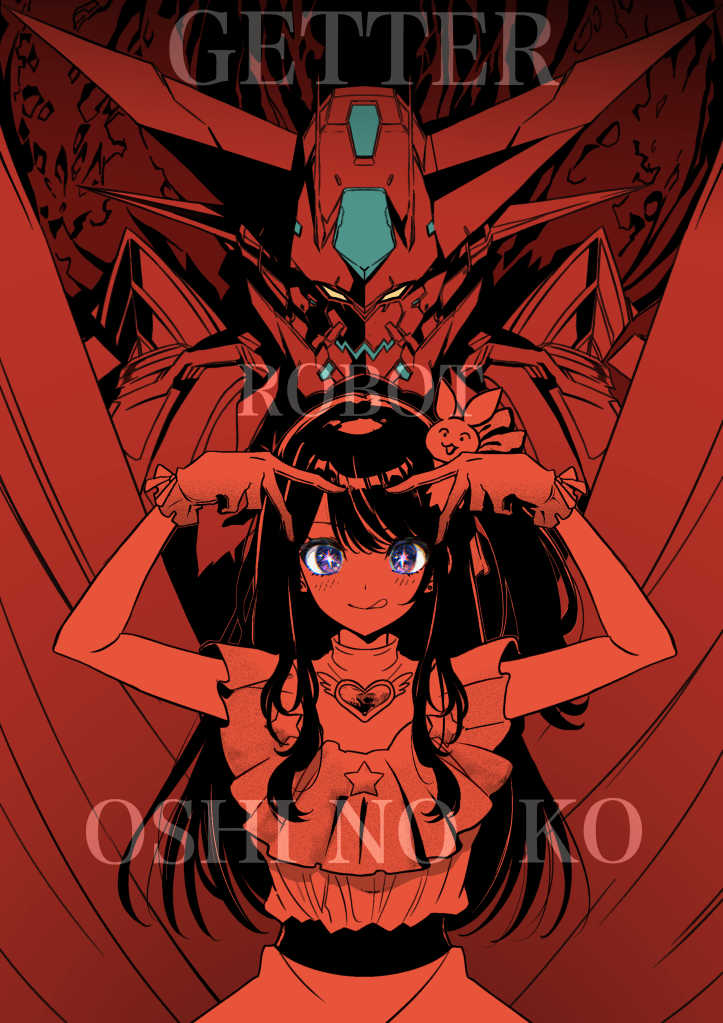
Oshi no Ko vs. Getter Robo: A Hot-Blooded Killer Combo

Sometimes it takes a meme to put a giant robot anime in the minds of the people. Hot on the heels of “Is this a pigeon?” comes the Perfect and Ultimate Getter mashup. 

For those who don’t quite get the joke, this is a mashup of the anime opening themes for 2023’s [Oshi no Ko] and 2000’s Shin Getter Robo vs. Neo Getter Robo. The two songs, “IDOL” and “STORM,” share a similar build-up during their respective choruses that makes one transition into the other almost seamlessly, with only a tweek to the tempo being necessary.

As a fan of both (the latter of which I watched during my formative years as an otaku), it makes me happy to see these two shows and their respective theme songs getting love. More than that, it made me think about a few things. 

First, I’m actually kind of surprised that so many people have a fondness for Shin vs. Neo. I know Getter Robo is just part of the bedrock of anime and the mecha genre, but I had always assumed Shin vs. Neo was just known in the little corner of the fandom I had occupied. Glad to see people have a sense of nostalgia for it, though that does make me feel old.

Second, if this is how newer anime fans discover Shin vs. Neo, then so be it. I hope they enjoy seeing a shirtless man beat a dinosaur soldier into submission, in addition to all the robot action. At the very least, the fact that this joke incorporates more footage of the anime means it’s able to show itself off better than Fighbird and the aforementioned pigeon meme.

Third, it’s a bittersweet reminder that one of the singers of “STORM,” Mizuki Ichiro, passed away earlier this year. IAs one of the elder statesmen of anime music, he might have very well leaned into this, and we might have legitimately gotten a cover of this. At the very least, Kageyama Hironobu and the rest of JAM Project are all around, and they are definitely game to perform memes (see their cover of “Okkusenman.”)

I think what I ultimately really like about Getter no Ko is that it showcases both series well. Their original content doesn’t get lost in layers of obfuscation, and I hope anime fans are able to experience and appreciate both.

Internet Culture, Fandom, and the Tendency to Offend

I’m someone who’s interested in anime and manga about “nerds,” be they otaku, fujoshi, geeks, or any number of labels. I’ve spent a lot of time looking at this stuff, and I’ve noticed that often when a character speaks using internet lingo in real life, the translation to English, whether it is official or fan-derived, often utilize some fairly offensive terms. A riajuu (someone who is content with their real life situation) becomes a “normalfag.” An otoko no ko (a boy who dresses rather convincingly as a girl) becomes a “trap.” On the one hand, it would be simply a matter of just not using those terms. On the other hand, I could see the argument that if a character is, say, someone who spends most of their time on internet messageboards, that the Japanese equivalent terms should be met with equally ubiquitous terms among English speakers. If term A comes from 2channel, why not look to 4chan for the English equivalent? However, the very fact that the vocabulary has this negative quality makes me feel that there is something buried deep within how internet anime fandom has structured itself that tends towards insults.

Obviously not all anime fans use these terms, but they pop up in a number of places that are not directly connected to the fandom that populates 4chan and similar sites. In this respect, one thing I’ve noticed is that when it comes to how these phrases are used, it’s not simply a matter of trying to offend or upset others. For example, just as often as someone will call another person a “normalfag” or something similar, internet posters will use these terms to refer to themselves. At the same time that such phrases are clearly derived from words being used as insults, they’re also embraced on some level, becoming what I see as self-deprecating badges of honor, somewhat like willingly calling oneself an otaku or a geek. That said, the –fag suffix is clearly meant to maintain its offensive qualities, and as much as attempts are made consciously or unconsciously to separate the purely insulting quality of the phrase from its origins deriding homosexuals, it is nevertheless still present.

In contrast, “trap” is  a term where the connections to homophobia cannot be denied. This is not to say that everyone who uses the word is trying to be insulting, and even I’ve thrown the term out in the past before later reconsidering my own vocabulary, but the origins of the term and the implicit meaning behind it is obvious. The basic etymology is that an extremely feminine male character excites a presumably straight guy, and when he finds out it’s really a boy it makes him feel “tricked.” The important thing to consider here is that this is not merely some imaignary scenario but that people have genuinely felt this way, and the term is on some level a way of maintaining a sense of heteronormativity. Just the same, however, is the fact that some of those guys who have been “fooled” into arousal eventually realize that they are especially sexually attracted to the concept of the crossdressing boy. Whether or not that makes them actually gay or not (Is attraction towards men somehow solely about the “penis” or is it something more holistic? For that matter, what about the Kinsey scale?), often I see the term “trap” then used willingly, from people asking for more. Again, as with “-fag,” there’s this sense of mild self-hatred with use of the term trap, because just as people announce their love for them there’s also the implicit idea that they are not normal because of their interest and do not consider themselves normal. In some cases, they might not even be realizing what they’re saying.

What I find is that these terms are turned against others, as if to maintain divisions (we’re this way, you’re that way), or they might turned inwards to be used as a defense mechanism to keep outsiders away. Can a person survive the barrage of insults they receive and still be there? Are they “one of us?” To share a common vocabulary, after all, is one of the easier ways to become “accepted” in a community. At the same time, the fact that these phrases are often used in a self-deprecating manner communicates the idea that they don’t necessarily feel as if they belong to the majority, be that the majority of society or the majority of an immediate online community. The easy thing to say would be that this all derives from “hate,” but the fact that it appears to be “hate” not only for others but also for oneself leads me to believe that the use of these terms is an attempt to carve out an identity while feeling somehow “abnormal.”

If you liked this post, consider becoming a sponsor of Ogiue Maniax through Patreon. You can get rewards for higher pledges, including a chance to request topics for the blog.