Why Are They Making Ash Ketchum’s Eyes So Huge? I’ll Tell You!

In anticipation of the latest Pokemon Black & White games, the anime of Pokemon is undergoing a revamp, and with this newest iteration comes a great amount of aesthetic change for a series which has up to this point remained fairly static in that regard (or at the very least has experienced change so gradual as to be unnoticeable). Many long-time characters are undergoing design changes, but perhaps the most prominent is that of main character Satoshi, possibly better known as Ash Ketchum, whose irises appear to have doubled in size.

Around the internet, people have been wondering what could possibly be the catalyst for this change. The truth lies with the character designer for the Pokemon games, Sugimori Ken.

Sugimori was the original Pokemon artist, drawing up all 151 of the originals as well as all of the character artwork. Even now he remains in that position, with his works being the official depictions of all humans and Pokemon in the franchise. Essentially, this means that Sugimori has been drawing for Pokemon for 15 years now, and his artistic sense and style have grown accordingly. Whereas the designs for the anime originally drew inspiration largely from Sugimori’s original designs for the first generation of Pokemon games and have remained fairly constant since, Sugimori’s own artwork has gone through a one and a half decade process of refinement.

Left: 1995-1998, Right: 2010

When you look at the anime’s new character designs, you can see that they are simply re-aligning themselves with Sugimori’s work.

So in a way, the artwork for the Pokemon anime is pretty much ending up where it should be.

To Be an Electric Type is to Be One with the Speed of Light! …or Not

Ever since the first games, I have been a big fan of Pokemon, particularly when it comes to multiplayer battling. I remember the absolute Psychic dominance of Red, Blue, and Yellow, and I know well the competitive trends from sequel to sequel. And even though Pokemon as a whole is not the most balanced of games, it’s clear that the creators have tried to make some concessions to multiplayer fairness, strengthening some things while weakening others.

While this effort towards balance is much appreciated however, I feel that there has been an increasing amount of homogeneity in Pokemon moves, removing some of the individuality and uniqueness of each Pokemon type.

Since the early games the Normal type has had a certain identity associated with it. In terms of effectiveness versus other types, the Normal type is the only kind that is not super effective against any other type. On the other hand, very few things resist it, so it’s fairly neutral overall. But what made Normal type attacks so special is that they had by far the most range and utility in the game. You had kamikaze attacks in Selfdestruct and Explosion. You had Hyper Beam, a powerful technique which exhausts the Pokemon after each use. You had the purely random Metronome. You had Swift, an attack which always had perfect accuracy. You had Quick Attack, a move which lets the Pokemon hit first no matter the actual difference in speed.

And so each Pokemon type had associated with it certain strengths and weaknesses well beyond that 17 x 17 grid denoting super effectiveness. But let’s take a look at what’s happened to Quick Attack since then. You now have Extremespeed, a rarer form of Quick Attack which is twice as powerful. But then you also have Mach Punch, Aqua Jet, Bullet Punch, Ice Shard, Shadow Sneak, and Vacuum Wave, all differently typed attacks which do the same thing as Quick Attack. Where is the type identity? What happened to the time when you could say that Fighting attacks tended to be powerful yet risky, or that Grass attacks tended to be fairly weak but had their place in taking out specific threats?

I will say though that there have been some advancements. The Dragon type for example has benefited greatly in terms of becoming more pronounced in its identity. Dragon is the only type more neutral on offense in Pokemon than normal, hitting 15 of 17 types for normal damage. In the first game however, there was only one Dragon attack, and because it inflicted a set amount of damage no matter what, it was almost pointless for it to be a “Dragon” type attack. But as the games continued, Dragon gained a reputation for extreme power and the ability to end matches quickly.

I just hope that with Pokemon Black and White that we move towards more pronounced differences in Pokemon types so that each of them can shine in different ways, as opposed to the exact same glimmer.

Kamoflage

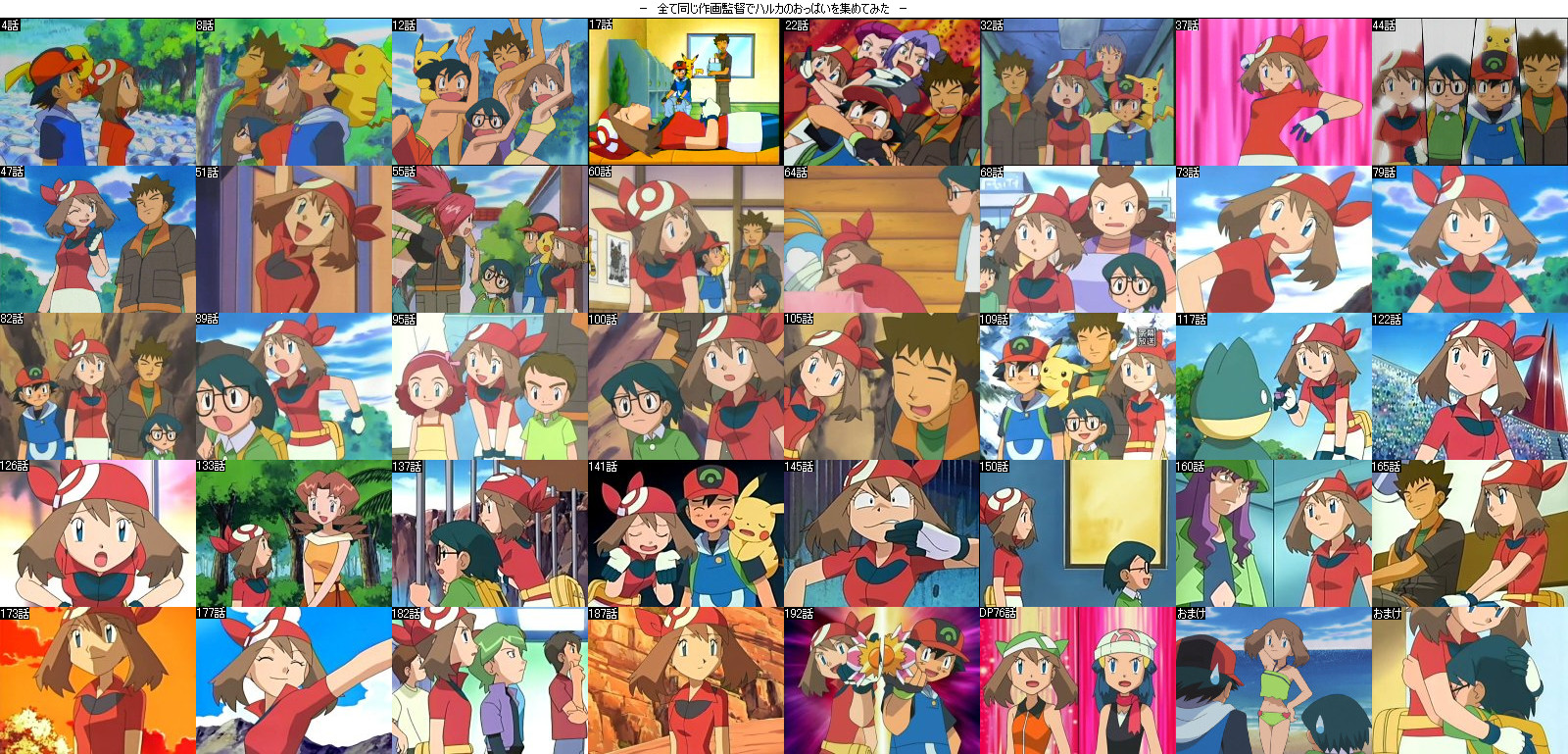
For those of you who’ve been watching the Pokemon anime for years now, you may recall the female character May (Japanese name Haruka), who was the main heroine for the entirety of the Game Boy Advance era of Pokemon games.

What you may not have noticed however is that her character design, well, changed throughout the course of the series. See if you can spot the difference below:

Thanks to kransom for finding this.

What in the world could be responsible for Haruka’s, shall we say, simplification? The easy knee-jerk reaction would be pressure from foreign countries to reduce the amount of eye candy in their internationally famous Japanese franchise cartoon, but something tells me that it has a little more to do with someone realizing that the girl is supposed to be ten years old.

A Form of Evolution, Perhaps

A couple days ago I talked about how I like the idea of broad interpretations of  video games for film and TV adapations, citing examples such as Tekken, Super Mario Bros, and Pole Position. But soon after making that post, I realized that I forgot probably the best example of taking necessary liberties with a video game property in order to adapt it into some kind of narrative media. That game is Pokemon.

Although the series stays true to the basic premise of Pokemon, a young kid goes out to capture and battle with monsters of which there are at least 150, it also plays around with and introduces a lot of ideas. As it would be difficult to write a long show without giving our hero Ash (Satoshi) some traveling companions, the writers took the first two bosses of the game, the “Gym Leaders” Misty (Kasumi) and Brock (Takeshi), and made them into supporting characters. They even went as far as to revise their outfits to be more suitable for travel. In case you forgot or just never knew, Misty originally wore a two-piece swimsuit and Brock was shirtless.

The Team Rocket in the show consisting of Jessie (Musashi), James (Kojirou), and Nyarth (Meowth) are entirely the product of the anime. Instead of having recurring antagonists in the form of faceless foot soldiers, the show saw it fit to give their primary representation of Team Rocket distinct looks and personalities. And just like Harley Quinn from Batman: The Animated Series, they were popular enough to be introduced into the original source material after the fact.

Then there’s the Pokemon themselves. In the video games, they made digitized sounds meant to be perceived as cries and roars, but that sort of thing can’t really fly in a TV show, so they introduced the concept of Pokemon talking by saying their names over and over again. And now it’s the way we think Pokemon talk. The show, especially early on, also modified the idea of the “Pokemon Battle,” converting the turn-based battles of the game into something more dynamic. They often played fast and loose with the rules, with ideas like a Bellsprout that knows kung fu, Whirlwind as an offensive technique, even outright ignoring the game’s type weakness chart by having it be possible to “super charge” Pikachu to the point where it could overcome the Ground type’s immunity to electric attacks.

Speaking of Pikachu, it might very well be the greatest liberty taken of all by being Ash’s starter Pokemon. The starting Pokemon in the original games were Bulbasaur, Charmander, and Squirtle, but in order to keep kids from thinking that their own personal pick for their first Pokemon was somehow “wrong,” they picked a neutral Pokemon. Actually, at first they planned to use Clefairy, but found Pikachu to be more popular.

So think about how much of Pokemon comes from outside of the games, and once again consider the possibilities of adaptation.

Praying Towards Castle Grayskull

When it comes to the international phenomenon that is Pokemon, producer Ishihara Tsunekazu had the following to say:

石原: 北米ではけっこうクラシカルに伝説系のポケモンの人気があるんですけど、リザードンのような見た目か ら強そうなタイプのポケモンが好まれています。それとミュウツーでしょうか。

Ishihara: In North America, classical-style Legendary Pokemon are popular, but Pokemon who look strong like Charizard are also preferred. Mewtwo as well.


Charizard and Mewtwo

While Ishihara then goes on to say that  universally speaking, Pokemon like Pikachu are popular everywhere, I want to to focus mainly on this unique bit of difference North America has.

While I can’t speak for Canada, Mexico, or Central America, I think it’s very well-known that America likes powerful characters. More broadly, America likes the hero who rises above all, the larger-than-life figure. He may have a humble background, but the end result is still strong. It speaks to our culture of individualism, and it is reflected in the popularity of action movies as well as in the existence of iconic heroic figures in cartoons and comics such as Superman, Captain America, He-Man and Flash Gordon. When the US encounters the creative output of another nation such as Japan, it very profoundly reflects this ideal.

This is also partly why I think many of the anime that have been popular in the US are or were popular. Compared to the less popular One Piece, Naruto and Bleach exude seriousness and power in their aesthetics, doubly so for something like Dragon Ball Z. The hyper violence of MD Geist and its contemporaries in the 80s and 90s felt new and fresh to some extent, but that level of violence is I think something comfortably American, animated cousins of action movies.

I think it’s very easy to take one’s own cultural upbringing for granted, to think that the ideals of your own culture are the ideals of everyone else’s. It’s not small-minded or biggoted so much as it is a fairly natural progression if there is nothing to jar you out of it. In an article from 1987, Frederik Schodt, author of Manga! Manga!, points out that American superhero comics do not do well in Japan. Back then, they were considered too plain and too wordy, and today I can tell you that superheroes are better known through their movies than anything else. When I was studying in Japan, I had a conversation with a Japanese classmate, where I tried to explain the Flash to him. I told him he was “red and very fast,” to which he responded, “Daredevil?”

That said, there are a number of manga artists influenced by Americann superhero comics, such as Nightow Yasuhiro (Trigun) and Takahashi Kazuki (Yu-Gi-Oh!). In anime, it goes at least as far back as Gatchaman. Still, you will find that just as we have taken anime and said, “This is what we like in our anime,” they have said, “This is what we like in superheroes” and transformed it into something more in-line with their culture.

Cultural exchange, as they call it.

One last thing to dwell on is the way Europe has approached anime and manga. Taniguchi Jiro, who is influenced by the French comic artist Moebius, is much more popular in Moebius’s home country than he is in the US. His style is very European, incorporating complex and detailed backgrounds and placing a great visual emphasis on environment (not to be confused with “the environment”). But as I said before, I’m no expert on European comics, so I’ll leave someone else to fill in that blank until I catch up.

I Want to Be the Very Best, Ready to Fight for What’s Right Against Wrong, in America

Heroman feels like a return to an old idea, and probably not in the way you’re thinking.

When we think giant robots, we usually think of robots being piloted from within or being some kind of sentient being, but Heroman is neither (at least, not as of Episode 2). Instead, he’s an entity separate from the human, controlled through a remote device. Sound familiar? It’s the same premise as that progenitor of giant robot anime heroes, Tetsujin 28.

But as I implied, the giant robot moved away from having its hero exist separate from it, and that’s been the trend ever since. While there were attempts to bring back this idea on occasion, I think the reason it failed to succeed was that it just didn’t seem as exciting or as practical as having a cockpit. After all, I’m sure just about anyone who watches any incarnation of Tetsujin 28 will wonder why they don’t just target the completely vulnerable human controlling it. The answer, of course, is that Shoutarou would stab you in the neck and set you on fire because that’s how Shoutarou rolls (no, really), but the basic idea is that it just makes more sense on a variety of levels to in the protective bosom of your mecha. At least, that’s how I see the evolution of that general trend in giant robots.

But then when you think about it, the idea of the remote-controlled giant robot is surprisingly similar to a genre which supplanted mecha in popularity, profitability, and marketability: the monster battle anime, of which Pokemon is by far the most famous. And in time, this turned into not only monsters but mechanical creatures as well.

So we’ve gone from a remote-controlled giant robot to piloted robots to kids battling using monsters to kids battling using mechanical devices, and now with Heroman, a remote-controlled robot servant fighting alongside his owner, it’s  like we’ve come full circle.

As an aside, does anyone else get the feeling that this post is a product of me having recently finished Tetsujin 28 combined with me getting back into Pokemon? Yeah, I thought so.

A Brief History of Pokemon Battling

Pokemon’s been a big part of my life, and I can’t count the number of hours I devoted to playing it and formulating teams to engage my friends both online and off in vicious combat. And pretty much just as I and everyone else bought Heart Gold and/or Soul Silver, a new series is coming out in the form of Pokemon Black and White.

As with every new Pokemon game, people will come out to complain that the game “is pretty much the same thing,” and while I can see where they’re coming from, I always engage this question first from the perspective of multiplayer battling. There, despite the fact that only a handful of changes and new moves get made from generation to generation, and the numbers themselves don’t change that much, those additions result in fundamental, sweeping changes to the metagame.

So, I’m going to briefly summarize each generation’s trends in terms of 1v1 (2v2 might be for another day).

The original generation, Red, Blue, and Yellow, was characterized by an almost frightening level of luck vs skill. Double damage-dealing critical hits were plentiful, speed ruled, and even the most well-thought-out plans could be laid to waste within a few turns. Here, out of 15 Pokemon types, Psychic was by far the most dominant, and everything worked towards either using Psychics or using Pokemon that could potentially defeat them. In a way it was the most frightening generation of games to play.

With Gold, Silver, and Crystal, the addition of the concept of “held items” which could do things like heal status ailments one-time or recover a bit of Hp every turn, a host of techniques that could repair or prevent damage, and two new typings with lots of immunities and resistances, the game became a lot more defensive. This was also the first and last time the games would actually modify the base stats of Pokemon compared to a previous game, which also contributed to the emphasis on defense. Games lasted many, many turns longer than the typical RBY match, and the path towards victory was gradually chipping away at the opponent’s team in just the right way.

Ruby, Sapphire, Emerald, Fire Red, and Leaf Green is noted for both its extreme offense and its extreme defense, with the attacker slightly favored. The reason this was the case was because the way leveling up and gaining experience worked now, a Pokemon could not be completely offense-oriented without sacrificing defense or vice versa, and so overall Pokemon were either a lot more frail or a lot less powerful. The game also introduced the concept of “abilities,” constant effects which would apply to the Pokemon regardless of their actions, things such as the ability to levitate and avoid ground-based moves and creating weather effects upon entry, which would add subtle, yet profound changes to how Pokemon worked with the other members of their team. All in all, complex plans leading to overwhelming victory were common here.

Now we’re at the current generation, Diamond, Pearl, Platinum, Heart Gold, Soul Silver. I haven’t played this one nearly as much as the others, so my observations are not as keen, but I’d say the biggest change here was the complete revamping of the concept of “Physical” and “Special” attacks. Where once these designations were inherent to the Pokemon type of the attack, resulting in the existence of  “physical” Fire moves and “special” Fighting moves, for example. So because the defensive side of Pokemon did not receive a similar reworking, it became a lot more difficult to actually use defensive Pokemon, predicting when and where to send them in and when to withdraw them. That said, however, stalling and playing defense can still work, and work well. This is probably the most “balanced” generation in terms of strategies.

And all through this, I had a ton of fun exploiting holes and weaknesses, both technical ones and psychological ones, and trying out every Pokemon I could. I was never anywhere close to the best player, and probably have no chance, as my desire to learn and experiment tend to override my desire to win.

So there you have the path of evolution for Pokemon Battling. Who knows where it’ll go next?

I Actually Woke Up Thinking About This

Poketousen
Dragonair Destiny Bond
Growth Gardevoir
Extremespeed Exeggutor

Yes, I know they’re all illegal moves.

The Elite Fourdinators: Pokemon Contest and What Could Have Been

Ever since the first games, the Pokemon franchise has tried to include side quests and activities, things that change the game from the classic “beat 8 gym leaders and fight the Elite Four.” There’s the “end of game” content that only happens once you become champion. There have been ideas like the Safari Zone and the Bug-Catching Contest, which were alternative methods of catching Pokemon, as well as alternate venues for battling such as the Battle Tower and Battle Frontier, both of which function as a sort of arena for “advanced” players. But it was in Ruby/Sapphire/Emerald that they introduced a concept which came the closest to being a true alternative from the gym badge system: Pokemon Contests.

In Pokemon Contests, elemental types don’t really matter. Nor do things like attack power and hit points. Unlike the Safari Zone, the Battle Frontier, and all of those other extra features, the Pokemon Contest system is the only competitive activity which was so different from the rest of the game that almost none of the traditional rules applied to the way contests worked.

The goal of a Pokemon Contest is to win the votes of a panel of judges in a specific category, such as “Beauty” or “Intelligence,” and in order to do so you must have your Pokemon be more appealing than the others. To this end, every attack has its own unique features and functions entirely separate from battling and trying to KO your opponent. For instance, the attack “Flamethrower,” which is a Fire-type attack in battles, is a move which shows off “Beauty” in a Pokemon Contest. Contest Pokemon have to be fed strict diets and be groomed properly to win the visual portion of the competitions. They eventually even included dancing.

It might sound pretty boring compared to the intensity of taking on your rival in a flurry of lightning and sandstorms, and this might even be the reason that Pokemon Contests are non-existent in Pokemon Heart Gold/Soul Silver, but the big thing that Contests had that previous side games in Pokemon didn’t was 1) rewards and 2) increasing levels of difficulty. Instead of getting Gym Badges, you get Contest Ribbons, and as you go from city to city, the Contests get more challenging. In a way, it could be seen as an alternate path to the Gym system, something that wasn’t so much a game within a game as it was another activity entirely. It might even be perceived as something on par with battling. In fact, the anime tried to push this idea, by having characters like Haruka (May) and Hikari (Dawn) decide to forego the path of collecting Gym Badges and have them focus on obtaining Ribbons. The only problem is that in the anime, Contests resemble battling with a somewhat different flair, and the games themselves don’t give any rewards other than the Ribbons, essentially meaning that it’s still considered “inferior” to hitting the Gyms.

I think that Pokemon Contests could have become a really viable alternative to Gym Battles, and that it should be an option at the start of games to go on the path of a “Pokemon Coordinator,” the term the series uses to denote people who have devoted themselves to Pokemon Contests. There should be personalities you get to know and the opportunity to practice against opponents. Perhaps winning should net you TMs that are rare and powerful within the context of Contests. There should be an equivalent of the Elite Four to take down, and when you win over them, there should be an ending. Most importantly, you should be able to play against your friends.

I understand that it might be virtually impossible to try and balance two completely disparate systems running off the same basics in the same game. I also think the concept of the Pokemon Contest could stand to have some tweaking, such as making Type matter more, or perhaps even taking a cue from the anime and having it come down to battles where you’re judged on not only your ability to take down your opponent but to look good doing so. But I really believe that, done properly, Pokemon Contests could truly add another layer to the world of Pokemon by giving kids a different kind of opportunity to go off on an adventure.

Here’s hoping to their return in Generation V.

Pokemon types don’t really matter. Nor do things like attack power and hit points.

Do You Truly Know What It Means to Draw the Right Card?

Last week while taking the train home, I saw a kid with his head buried in some kind of Bakugan guide, and it got me thinking. The first thing was that it reminded me of when I used to sit on the same train with a printed Pokemon pokedex, poring over move lists and trying to imagine new movesets and strategies. It filled me with a sense of nostalgia. The second thing was that it got me thinking about the future of anime.

Bakugan, one of those collecting and battling game franchises designed to separate kids from their money, has an anime to act as a half-hour commercial for the product. It’s one of the latest in a long line of merchandising engines, from Pokemon to Digimon to Yugioh to Beyblade and so on. The shows can still be pretty decent; there’s no illusion about their true purpose, but it doesn’t mean they can’t be entertaining.

That said, what if someone made a collecting and battling anime that wasn’t there primarily to push a product? “Impossible!” you might say. And to some extent you’d be right. Shows are made because they have some kind of chance at making money. But my response is, give it a decade.

In those ten years, the kids who grew up with those trading card games and battle tops will be getting older and older. They’ll be adults working full-time jobs and looking back fondly on their childhoods. It would mirror the progression mecha anime has had, with shows now being made for adults and having more advanced and mature concepts. In this situation, a collecting and battling anime which really takes an artistic and philosophical look at the nature of collecting and battling anime would be perfect.

It could look at the nature of probability and psychology. Perhaps it would ask what it means to play a game where you must collect to improve your chances of winning. There could be legitimately well-written characters and a skeptical eye, but still a love letter to the genres of TCGs and monster battles. It would really master and perfect the sense of timing and tension that would make the heroes’ actions seem all the more worthwhile. Actual rules to the game are optional.

It would be the Gurren-Lagann of collecting and battling anime.