Saki 08th Mahjong Team

As a promoter of mahjong anime alongside my comrade-in-tiles Sub, it was inevitable that I would follow the new series, Saki: Episode of Side A (aka Achiga-hen). Taking place in the same setting as the original Saki anime and manga, the series follows another set of girls working together to take down their fellow tile slingers with yuri subtext so heavy that it might as well be called yuri supertext. Despite its origins and the many similarities between the two Saki series, however, they end up feeling quite different.

I know that this has very much to do with the fact that the manga for Episode of Side A is not drawn by the original artist, Kobayashi Ritz, but by Igurashi Aguri of Bamboo Blade. The girls in Achiga aren’t quite as exaggerated in terms of their personal attributes, which lends them more of a well-roundedness to their characters. In a certain sense, this can be seen as quite a good thing, as Achiga does come across as simply a more tasteful, somewhat more subtle form of Saki (though the yuri is decidedly less subtle), but at the same time I’ve noticed that it becomes more difficult to pick and choose favorites compared to the original series, to think of the characters as iconic extremes. As a quick and informal experiment I asked people on Twitter who their favorite Achiga characters are, and while I received a few responses here and there, it seemed like people thought they were merely okay and much preferred that original cast, and I think that says something.

If you look at the differences between the characters of Saki and Achiga just merely in terms of how they show their mahjong, the original cast of Saki just has way more characters with specific gimmicks and powers. If you look at the main crew of Saki, every single girl in Kiyosumi hassomething. Saki has her tendency towards kans. Nodoka is the pinnacle of the “digital-style” player. Yuuki has tacos and an affinity for the East Wind. Mako can access her memories of mahjong matches like a data bank. Even Hisa, who is the most normal of the bunch, still has her easy-to-summarize gimmick of “intentionally making bad waits.”

In contrast, three out of the five Achiga girls have no identifiable gimmicks. The main character Shizuno appears to just have “tenacity,” and even the Matsumi sisters’ abilities aren’t as wild as Koromo’s ability to always win off of the last tile. Taking this into consideration, I have to wonder if Achiga was set up to intentionally show the “common man,” the more down-to-Earth players.

One of the side effects of having less bombastic characters is that, because Saki primarily conveys its mahjong matches through the use of mahjong super powers, and Achiga‘s characters with their softer abilities can’t be utilized as much in that sense, it becomes harder to clearly identify the attributes that will make a character your favorite. It’s not impossible to pick one of course (Sagimori Arata the bowling girl here), but there’s not much to instantly catch your attention. This isn’t necessarily a bad thing, as I think it’s more than possible to make up for a lack of thrilling game-breaking magic, and in fact I’d probably prefer a series which places the game more in the characters’ psychological states than their special abilities (see the obvious example of Akagi), but Achiga doesn’t really add anything to make up for it in terms of the mahjong, and in fact just blazes through the games, making the yuri aspect seem that much more prominent.

I know there’s this idea that Saki is really just all about yuri, but while I think that it’s certainly a prominent aspect of the series I also think that the mahjong itself as a vehicle for simplified character expression played quite a role in attracting people to Saki as well. I don’t expect people to actually learn the rules of mahjong, and there’s nothing that says tenacity has to be less amazing as a character attribute than using a mahjong Sharingan (and probably shouldn’t be), but the degree to which the mahjong gets skipped over or rushed through in Saki: Episode of Side A sure makes it seem that way.

(But don’t get me wrong, I’m still enjoying the whole thing.)

Mahjongs at Dawn

Friend, mahjong ally, and translator kransom is currently in Japan, and in a conversation online he mentioned to me the fact that Texas Hold ’em has a similar reputation in Japan that Japanese-style mahjong has in America. In other words, it has a small but devoted following where if you say to someone that you know how to play Texas Hold ’em, they’ll get really excited and invite you to play, possibly showing off their Real Authentic poker set in the process. Having a passing familiarity with Texas Hold’em and more of an understanding of mahjong, I can see why they would have a similar exotic and wild appeal. They’re both games where you have to manage your luck.

The only thing that’s missing for Japan is an Akagi equivalent, an intensely dramatic series that thrills you into loving poker. If such a thing could be produced in the US, then the circle would be complete.

Thinking about mahjong as a storytelling device however, I realize that there is an inherent “flaw” of sorts with the game that doesn’t quite exist in Texas Hold ’em, and that is mahjong’s inability to naturally come down to a one-on-one situation. That’s not to say that a 1v1 battle is impossible, but mahjong is inherently a four-player game, with a strange three-player variant if you’re one man short, but no long-standing rules for two players. As a result, mahjong stories have to go through great efforts to transform the game into a duel, whether it’s coming up with an entirely new (and untested) rule set (Ten, Shin Janki), pushing two of the players into supporting or even essentially non-existent roles, or modifying it into a 2v2 game. Texas Hold ’em however can start with a large group and as more and more players lose all of their money, the game can end up in a 1v1 with no wild changes made to the basic rules of the game.

So Texas Hold ’em has potential, though I think anyone who’s seen games knows that. Make it a series about female poker players who really enjoy each others’ company if you have to.

Speaking of, I realize that Saki prefers to have all four players in a mahjong game be their own characters, as opposed to lackeys for more prominent figures in the story, and is kind of an exception as a result. That route is, of course, also a good one.

Four Concealed Triples Contain Ten Times As Many Perils

Almost a year ago, I wrote about how glad I finally was to achieve a San An Kou, or Three Concealed Triples, in mahjong. It is a hand where you manage to draw three sets of 3-of-a-kinds all on your own. When I first got the San An Kou, it felt like an eternity before I was able to achieve one. What I didn’t know was that getting its beefier older sibling would take a lot longer.

This is Suu An Kou, or Four Concealed Triples, and is highlighted in Saki episode 10, where perennial newbie Senoo Kaori mistakenly refers to it as a “Riichi Tsumo Toi Toi (All Pungs as the subs put it),”a hand which would be worth significantly less if you took her words literally. Like the Kokushi Musou and the Sho Suushi, it is a Yakuman and therefore one of the strongest hands in mahjong, possessing enough killing power to end the game in one shot. It is also significantly more powerful than the San An Kou, and to give you a basic idea of the sheer disparity, you could get six San An Kou in a single game and it still might not be worth as much as a single Suu An Kou.


Oh Kaori, this is why Sub and I made you our mascot for our mahjong panel.

Like all Yakuman, it is an exceedingly rare hand, and what I’ve begun to find interesting about Yakuman in general is that they can often be rare for entirely different reasons. While the Kokushi Musou is difficult to obtain because it is a hand that cannot be anything but a Kokushi, and the Sho Suushi similarly rare because the tiles in it are always valuable to someone at the table (and thus there is a very good chance that someone will hold onto them), the prospective Suu An Kou seeker faces yet another issue, one that I would simply call “temptation.”

Imagine that there was a 0.1% chance for you to win $1,000,000, no questions asked. So of course you take the opportunity, but as you move closer and closer to that cold million, another sign pops up:  “Go for $100,000 instead and your chances of gaining a cash prize go up to 50%!” Then another flashes in giant neon letters, “$200,000, 25% chance to win!” Similar deals continue to pop up over and over again and try as you might, you can’t seem to block them out of your mind. What should you do?

In a situation like that, I wouldn’t look down on anyone who settles for less. Hell, I would probably abandon the million myself, but that’s essentially the obstacle that stands in the path of those who seek the Four Concealed Triples. Along the way to getting that Yakuman, you are continuously enticed by hands that, while not nearly as majestic as the Suu An Kou, can still be quite good, and to ignore those hands is almost as insane as ignoring a 50% chance to get 100 grand for a 0.1% chance at a million. Here, the biggest obstacle is that you are constantly being steered away by appeals to your rationality and common sense, and when your aim is to take huge risks, that is perhaps the most dire threat of all.

Of course, the probabilities I’ve given are in no way accurate to actual mahjong, but I think they give you a fair picture of it. Call it embellishment for dramatic effect.

May’s Live Mahjong Event: Where a Boy Becomes a Mangan

The United States Professional Mahjong League is holding another free play event this Sunday, May 16. If you’ve only played mahjong online and live in the New York City area, this is your chance to play against live opponents in Japanese-style mahjong aka “riichi” mahjong. Saki was right when the show said that playing on the internet and playing live are subtly different due to the external factors, and it’s an experience I recommend anyone try out. And it’s free!

Sadly I can’t make it this time around either, but don’t let that stop you from enjoying yourself.

Now if you’re really not sure whether you should be hanging with the “big boys,” no one is particularly amazing at mahjong to the extent that you’ll feel helpless. This is indeed one of the strengths of mahjong. You might see me talking about the game pretty often now, but realize that I’m not good at the game. It would be a stretch to call me “intermediate.” But I still win some sweet hands and have lots of fun. If you have experience playing at all, even if it’s just a little, you’ll likely do fine, and no one will admonish you for forgetting some rules.

But if you’re really worried about not knowing enough to play, or you know so little that you’d prefer to read “Baby’s First Riichi Mahjong,” then take heart in the fact that they’re also holding a tutorial event for absolute beginners on Sunday, May 23. The rules can seem quite overwhelming, but actually mahjong is a game you can ease yourself into with just a bit of patience.

The location for both events is:

Simple Studios
134 W. 29th Street (b/t 6th and 7th)
2nd Floor
New York, NY 10001

Don’t forget to RSVP on the forums, particularly with the tutorial session, as space is limited.

Take My Place, Fair Citizens, at the Mahjong Table

So a bunch of stuff has come up all of a sudden in my life, and this will prevent me from going to the monthly Riichi Mahjong sessions held by the US Professional Mahjong League in New York City.

But while I am unable to go, another continues to champion the cause, and you can join him in his endeavors to bring on the “its.” If you barely know how to play, that’s really not a problem, as it’s a friendly learning environment, and you get free snacks and soft drinks to soften the blow to your fragile ego. You’ll reach Akagi level someday. Or at the very least, Kanbara levels.

Wahaha.

This month’s Open Play session will be this Sunday, April 25th. The address is below.

Simple Studios
134 W. 29th Street (b/t 6th and 7th)
2nd Floor
New York, NY 10001

I’ll see you there.

I Thought We Liked Mahjong Series!

While Akagi and Saki were probably a lot of people’s introduction to the notion of manga based on the game mahjong, I don’t think I’m alone when I say that my first introduction to “mahjong manga” was from Frederik L. Schodt’s seminal book Manga! Manga! The World of Japanese Comics.

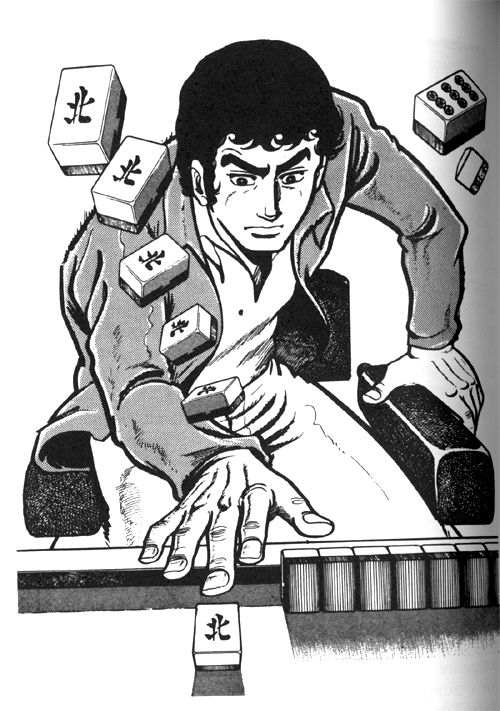
In it, Schodt explores the burgeoning genre and talks about popular titles such as Mahjong Houroki (“Tales of a Wandering Mahjong Player”) and Jigoku Mahjong (“Mahjong Hell”), even citing the author of Mahjong Houroki, Kitano Eimei, as the sort of “father” of mahjong manga, who showed that a comic about dealing tiles could look and feel exciting.

Truth be told, while I was fascinated by the idea of mahjong manga back when I first read Manga! Manga! ten years ago, I am not so different than the people who discovered it through Akagi, as that was the first mahjong series which I actually had the privilege to see. And while I don’t expect mahjong manga to become a runaway success in even the scanlation community, it’s clear that it has its devoted followers.

Here’s the odd thing though: Where are the scans of Mahjong Hourouki? If Akagi and Saki have resulted in people from all over the fandom getting into mahjong even at a periphery level, why hasn’t anyone bothered to look into these significant works which established the genre that so many are enjoying now? And it can’t really be the case where fans of these newer series might not like the older series due to the artwork. After all, we’re talking about Akagi fans here, and I’ve never seen anyone proclaim, “If the characters don’t have ultra pointy faces and noses and everyone looks shocked all the time, then I refuse to read it!” And I see you considering making a comment where you reiterate what I just said. I’m watching you.

Oh, and of course the reason I’m talking about it in the realm of scanlations and such is that no sane company would license a mahjong series in the United States. The closest you’d get to one that could conceivably do well is Saki which is streamed on Crunchyroll, and even that is a bit of a stretch when you consider the not-internet.

The most likely culprit is probably scarcity. It’s no doubt difficult to find these old series in the first place, especially with a niche genre like mahjong. And I’m as guilty of not contributing to the pursuit as any other. This is the first post I’ve made about it, and it’s only because I was re-reading Schodt’s book today. But still, I’m making the call out. We have to find these old works, titles like Mahjong Fuunroku (“Mahjong Crises”) and Gambler no Uta (“The Son of the Gambler”), and bring them to the forefront of consciousness.

I Played Mahjong with Real People and Also Ate Potato Crisps

When it comes to playing mahjong, I am a very recent convert. I’m not good by any stretch of the imagination and I generally make bad decisions, but it’s generally fun and I like the way the game gives you the ability to make constant decisions so that you don’t feel entirely subject to the whims of fate and luck while  still incorporating those very same aspects into the game itself. But as fun as it’s been, I knew I had been missing out on the full experience by playing only against people online and against Char Aznable on my DS.

Then fortune struck. Sub of Subatomic Brainfreeze (aka Dave of Colony Drop), himself a newbie in the wild world of mahjong, notified me that someone was holding a live gathering in the NYC area to play reach mahjong, i.e. the Japanese style of mahjong used in all anime and manga. And so we decided to hit it up, see how we stacked up against these other players who more likely than not had far more experience than we did.

The first thing I noticed was just how tiny the Japanese mahjong tiles are. They are significantly smaller than Chinese tiles, almost to the point of being cute. The second thing I noticed was that playing live is awesome.

Having played against real people with real mahjong tiles at a real mahjong table while eating real Pringles, I have to say that I much prefer it to online mahjong. On a basic level, it’s like playing video games with people next to you on the couch instead of playing against them through X-Box Live. But more than that, I loved the feel of the tiles and the way in which I had to manually pick them up and discard them.

I also loved how there was more to go by than just people’s tiles, like their energy; I’m definitely no Akagi Shigeru, but I think anyone can appreciate that element of the game.

Speaking of Akagi, it turns out that almost everyone there had learned how to play reach mahjong because they saw the anime. Basically, everyone was a nerd and that is definitely an environment to which I’m accustomed. I’m waiting for the people who got into mahjong because of Saki to start arriving.

In the end, I played two games total, one East-only game, and an East-South game that was aborted early due to time constraints, getting second place in the first game and first in the second, scoring a few decent hands and calling, “Pon!” and, “Chi!” with gusto. Knowing my results you might think that I was being modest when I said I wasn’t good, but I really do mean it. I don’t know how to score, I can’t do multi-sided waits, and a lot of it I would chalk up to luck. Next time I play, I’m likely going to end up in last place. But that’s the way mahjong rolls, and it’ll still be fun as hell.

Getting to Know the Characters: An Example

In my look back at the first decade of the 21st century, I talked about the shift towards character and the idea of “getting to know the characters.” While I think I made it pretty clear as to what I meant in the original post, I thought of a good example to explain the idea: the mahjong anime and manga Saki.

Mahjong has been a topic frequently explored in manga for decades now, with even Frederik Schodt’s “Manga! Manga!” pointing out its existence. It’s a favorite topic among salarymen and older audiences, but it wasn’t until the game was paired with moe and a heavy dash of yuri that it began reaching out to the otaku market in the form of Saki.

Anime nerds are playing mahjong in greater numbers now, and it’s not like Hikaru no Go where the manga itself explains the rules to a certain extent; characters in Saki just come in and do their thing and winning magically happens. And yet the otaku still want to play.

The reason that fans of Saki play mahjong, instead of just admiring the girls through fanart and doujinshi (and possibly their own dreams) is that mahjong is the focus of the Saki world, and by playing mahjong a person can feel closer to the characters in the series. I’m sure Miyanaga Saki fans smile every time they get +/-0 in their final scores, while achieving Haitei Raoyue is a wonderful feeling for supporters of Amae Koromo.

Performing an activity that is done by the characters gives a sense of connection, and the characters themselves make you want to connect to them through the power of their cute, moe designs and notions of very close friendship. That is the feeling of being “one” with the characters.

2000-2009 Part 2: Looking Forward


Make Way for the New Generations

Introduction

Anime and manga continue to change and develop, becoming at times almost unrecognizable from what they once were in the past. Having first taken a broad (but also detailed) look at the significant parts of the decade of anime and manga from 2000-2009, I think it is only appropriate that we also look ahead. As such, I have written out a number of topics pertaining to where I think anime and manga will go in the coming years. They’re half-predictions, half-observations, and all things that I think people should watch out for.

The First Digital Generation

In the previous part, I discussed how the advent of digital animation is one of the biggest markers of the current decade of anime and that anime is affected by this switch. One vital point to consider is the likelihood of a generational shift. In about 20 years or so we are going to see an entire generation of adults in Japan (and around the world) who have grown up primarily on digital animation. When you consider the level to which nearly all people in and out of the industry still look fondly back towards the anime of their youth (or from the time they discovered anime), the style that has begun to grow out of digital animation is likely going to have a profound impact on where anime goes, especially as that first digital generation grows older and the cel generations die off.

Over time, I think that the peculiarities of digital animation, such as the computer-based shortcuts, will become part of the style itself, but less direct about it than, say, Studio SHAFT’s current output, and not necessarily influenced by Shinbo’s work either. But if there are any, they will be making in-jokes and references about the early, nostalgic days of digital animation and not light boxes and such.


SHAFT’s Bakemonogatari is a hint of where anime may go in 20 years.

For better or worse, as a new range of ideas and techniques emerge, parts of animation technique and philosophy born out of cel-based anime will fade away, perhaps forever. After all, Miyazaki can’t live forever.

Flash Animation

In this decade the US animation industry has embraced Flash Animation as a way to reduce cost, particularly by eliminating the need for animation teams in South Korea and other places to do everything for you, as well as being able to create works domestically without incurring the exorbitant costs required to animate things traditionally in the US. The results have been mixed, as Flash as a program lends itself to “flat” animation.

In light of the anime industry’s history of low budgets, I think that more companies, be they animation studios, broadcasters, or otherwise, will start to look at Flash as a viable method to keep things low-cost and at-home. Now I don’t think it will eliminate today’s more “traditional” animation, especially when it comes to bigger-name, bigger-budget works, but it will be an appealing tool for those middle-of-the-road shows, and shows for kids. We’re already kind of seeing it with something like Shugo Chara Party!, where one of the segments feels very much like a flash animation.

There are two key points here. First, is that I do not think, if Japan starts to use Flash more regularly, that they will utilize the same methods the US does, particularly because US animation is generally characterized by lots of movement and Japanese animation is not. Also, I think that animators will be trying to apply their existing principles to flash, rather than trying to master the “science” of it. Second, this will create another bridge between the industry and the internet, where flash animations come out of 2channel periodically and some achieve terrific success. The main challenge from there will be pushing the limits of flash animation in terms of how successfully the visuals can be used to convey a story, as well as the breadth and depth of the subjects explored.

“How effectively can stories be told in this format?”

Changing Views on Hikikomori and NEETs

The chronic shut-in known as the “hikikomori” is a topic that Japan for the past decade has been in debate over, and as with the “NEETs” and the “Freeters” and so on, the focus has been on the future and fate of Japan, especially when factoring in the shrinking Japanese population and the fear that arises from that scenario. “Why aren’t these people going out and making something of themselves? Why aren’t they growing up?” Essays and news reports and even anime, manga, and light novels have been made of the topic, with Welcome to the NHK providing prominent examples of the last three.

But the reality of the economy is such that not having a good job (or a job at all), living at home, and having your parents’ support will be an increasingly common sight. Some will become hikikomori and try to close themselves off from the world, but there may be a sizable group that is only partially hikikomori, who will not completely lose their ability to interact with others or to engage in meaningful activity, and they will have a cultural and social “pulling” effect on the full-blown hikikomori. In turn, those “full hikikomori” may drag some down with them.


Writings on hikikomori will evolve.

The result may be that Japan’s view on the hikikomori and the NEET, especially in the face of having these groups increase in size, will be a mixture of greater panic and greater relief as they will fret once again that this is potentially very dangerous for Japan, while the internet will provide this larger hikikomori population with the group setting in line with Japanese ideas of “group,” where the interactions between partial hikikomori and full hikikomori will take place.

Thematic Responses to the Economy

The anime industry, much like every other industry, is feeling the sting of the poor economy but also has the sting of disappointment and high expectations from the US and other markets. The result is that production of anime is feeling the squeeze, with reduced budget and staff and less wiggle room for creativity. All in all, anime is being affected on a technical level by the world economy. In a certain sense however, this is only the beginning.

In about three to five years, I predict that we will begin to see both anime and manga which address the idea of global recession itself and incorporate it into the themes and settings in these works, to have it become a concept that is to be explored, whether directly or indirectly. Evangelion and other shows were responses to the recession that befell Japan starting in the early 90s, and I don’t think it would be unusual for an international economic downturn to have a similar effect.

Money will matter on more than a practical level.

Some works will be more explicit about the topic, and probably mention governments and businessmen who played roulette with the world’s economy, or businesses which had too much hubris, while others will be Silent Service-style “what ifs” but for the economy. There will also be shows which are more subtle about these elements or will have them as part of the background.

The New Escapes

Fiction, even realistic fiction, is often an escape, and over the course of anime and manga’s histories we have seen the idea of the “escape” take on many forms. More recently, escape has been manifested through the idea of “moe” and all that it entails. Moe however, like every other genre of anime, cannot last at the forefront forever, and in time new escapes will appear. Some of them may resemble older trends, but they will all ultimately still be ways to not approach reality head-on.

There are two basic forms to “escapism.” The first is a type of introverted escapism, that is, to become increasingly insular. The second is an extroverted escapism, where you want to project outwards, to go beyond yourself. Almost all genres have both to some extent in different ratios. Moe for example is very insular in the sense that it seems to want to keep characters and emotions isolated in time, but is also somewhat extroverted in that these shows are generally trying to portray the strong emotions of other characters and the ideal of being able to see these qualities at the forefront.

In that sense, I think that in the near future the escapism for anime and manga will be increasingly introverted, but will soon give way to a more extroverted form as a response to the desires of more and more fans who want to be released into other worlds. Though I don’t think that anime and manga will be reaching that early period where stories tended to feel very “epic,” I think we will see a lot of stories about worlds with wide scope focused through the lens of personal characterization, and in a way in which the former affects the latter significantly and vice versa.


Many series will try to balance daily life with a greater world.

Increased International Integration in Collaborative Efforts

Like all companies, manga publishers want to increase profit every year, and at some point a decade or three ago, Japan began to realize that one direction they had not gone was to appeal to people outside of their fanbase and readership. The classic example at this point is Shounen Jump, which noticed that it had developed a sizable female audience, and so made the move to start releasing series that are designed for female readers (without driving the boys away, of course). The result is Jump‘s approximately 50% female readership.

But then I recalled something Ed Chavez, currently of Vertical Inc. and formally of Kodansha, has said on multiple occasions: The “problem” with the Japanese manga industry today is that it has no room to grow in the nation itself. For all intents and purposes, the Japanese market has been saturated, as manga selling a million copies is completely normal and the fact that there’s pretty much something for everyone.

The only way to go then is outside of Japan, but the problem facing the industry there is that it’s difficult to pinpoint the manga-reading audience for different cultures and nationalities around the world. The same thing applies to the anime industry, which has been trying to really grow outwards for a while but lost its footing along the way. The tricky part in all this is that anime and manga have to achieve a certain level of distinctness, but still have to be familiar enough that people are comfortable with the material, and this is something that is even more of a challenge to achieve when the people making the work are unfamiliar with the culture they’re trying to attract. Naruto, Bleach, and Dragon Ball Z are pretty much the most popular things out there for boys in the US, and when you think about it they’re not that different from American superheroes.

This is why I predict that over the next decade and beyond, we will be seeing collaborations on animation and comics where the staff producing these works will be much more closely integrated. International collaboration isn’t new to manga and especially not to anime, but the work is usually cleanly divided between the countries involved. So it’ll be less Gurihiru drawing for Marvel’s Power Pack and more Oban Star Racers. This way they have a better chance of hitting that cultural sweet spot, though nothing is guaranteed and there’s going to be some serious misses as a result of trying to mix two cultures together at the base level of production.


French and Japanese Collaboration Oban Star Racers

Incidentally, by necessity translators will have to be more closely involved in the process as well.

Age Demographics in Japan vs Age Demographics Abroad

Anime and manga in the US has had a contradictory reputation for the longest time, being viewed both as “cartoons for children” and “raunchy pornography.” These days however, if we were to look at the fandom we would know the truth: In the US, anime and manga are primarily for teenagers with both childish and adult elements in different proportions, and it’s been this way for a number of years now. One concern I’ve seen from people is that they fear that a lot of these works, particularly in manga, will never get brought over here because they will simply never have an audience. And to an extent they’re right, but I believe that in time the manga audience in the US will slowly mature and eventually reach a point where they want something that is more in-line with how they feel about entertainment, their lives, and the world at large.

The key however will be whether or not Japan realizes that age demographics do not map one-to-one between Japan and the US. Not all “seinen” works will appeal to an older audience, and they will have to somehow find a way to understand just what this slightly more matured manga-seeking audience is looking for, possibly through the greater international collaboration I mentioned earlier.


Seinen may become more “shounen-friendly.”

Josei in Japan went through a similar growing pain in that it tried to be more “adult” in certain ways until creators and editors realized that older women still want the shoujo series trappings of their youth, but with more mature concerns and characterizations. In time, I think Japan and the US will get a better handle on it, but it won’t come without some serious bumps in the road capable of taking a company or three under.

Multimedia Customization

When it comes to streaming anime, you can’t please everyone, and methods of distribution and how to turn those view counts into sales is a mystery which eludes even big sites like Hulu, let alone smaller players like Funimation or Crunchyroll. While streaming anime is a step in the right direction, anime finds itself to some extent in the same bind as scanlations: sometimes people want to actually own a hard copy for themselves. However, the cost of printing DVDs for a series that won’t sell can be prohibitively expensive, meaning even if you really like Saki, unless someone decides to pick up the license to produce a box set you’re not going to have it sitting pretty on your bookshelf.


People outside of Japan will be able to own Saki however they want.

I think that starting in the next few years this is all going to start changing until we reach a point of personal customization in our anime and manga: You will be able to make exactly the purchase you want with exactly the things that you want, on-demand. As an example, let’s say it’s 2015 and you’re watching a streaming video of the latest series New Mobile Fighter G Gundam: Second Generation. Sadly the show has no box set you can buy in stores, but you still really want to own it. What you’ll be able to do is specify just how you want to have it in your possession, and you will get that package. Do you want it on blu-ray or DVD? Do you want to shove all the episodes onto fewer discs, cutting out the extras and possibility some of the quality? Do you want to just download the episodes so you can watch them without relying on internet access? Do you want to also purchase merchandise for Neo-Japan’s “Typhoon Gundam?” You will be able to get what you want, weighing cost versus extras, and in a way that doesn’t just limit you to “Normal,” “Super Deluxe,” and “Bare Bones” packs.

Choice is the future.

New Paths for New Talent to Appear

Shinkai Makoto made a big splash on the anime industry when he released Voices of a Distant Star, a science fiction-themed OVA which he wrote, directed, and animated all by himself on his Macintosh back in 2002. More recently, Aniplex has introduced the world to Cencoroll, by another independent writer/director/animator named Uki Atsuya. The idea of the Anime Renaissance Man is appealing, but it’s something that people cannot expect all the time. Skilled creators can be born independently, but it’s clear from Shinkai’s example that, given proper resources and experience, even a genius has room to improve.

Works like Cencoroll will continue to be rare, but lessons can be learned.

I think anime is heading in a direction where people won’t have to be skilled at every aspect of animation production to be considered a Big Deal. One possibiliy I’ve thought of is “anime festivals” for amateur creators, be they industry-sponsored or independent, with competitions and awards for categories such as storyboarding and writing in addition to full-on animations. More importantly however, these anime festivals could take place entirely online.

The primary advantage of having festivals be online would be low overhead costs, and in this age of streaming video (which will only get more efficient over time) people will be able to see each others’ works and comment on them, possibly through chat rooms or Nico-style scrolling text. This will also encourage people to send in works from abroad, as they would be on an equal footing of sorts with those living in Japan, and would be able to enjoy seeing the results all the same. Of course this is not to say that online animation festivals would replace actual ones, but the ease of setting one up would make it an attractive prospect, and it would give amateurs opportunities to be noticed.

Manga too will start to have online festivals. There is already the International Manga Competition, but these will be a little more like Comic Market on the Internet, and will have a lot less pornography. The same idea applies however, in that people will be able to enter in a variety of categories and not just “Overall Excellent Manga Creator.” It’s not so much specialization as it is realizing again that not everyone talented is multi-talented.

Conclusion

Although I have written all of these ideas of the future of anime and manga, I of course do not pretend to be a soothsayer and cannot guarantee that any of my predictions will come true. I’ve always been better at observing the past than predicting the future, and I know my views on anime and manga are tinged by a certain degree of optimism, so in time we will all see  just what I was able to sense correctly and what was just my wishful thinking.

Still, I think that even if I get everything concrete wrong, every single item I’ve written about is something to consider and analyze further as anime and manga reach into the next decade.The main themes I’ve discussed are the ways in which the industry and the fans will handle the significant changes to the economy that have occurred, shifts in philosophy on the creation of anime itself, and new steps towards customizing and tailoring for audiences. Taken all together along with the advancement of technology in society, and even if I’m wrong I think that my ideas all have more than a few kernels of relevance to them.

So let’s approach 2010 with open arms, not so much to simply accept whatever anime and manga may come, but to give the same consideration of the past that we do the future, and to know that no matter how it might change they are still capable of inspiring.

Got a Self-imposed Mahjong Goblin Off My Back

What you see here is a “San An Kou,” or “three concealed triples,” a fairly good hand in mahjong that scores some impressive points because it also happens to be a “Toi Toi Ho,” or “all triples.”

It might not seem like anything special, but it is for me, because this is the first time I’ve ever managed to pull it off, and it’s something I’ve been stubbornly wanting to achieve since I started playing (and actually knowing the rules). It’s not worth nearly as much as the Kokushi Musou I got a while back, but it’s a relief for me.

Kind of similar to the Kokushi Musou, the hand requires you to not steal any tiles from other players, and so relies pretty much entirely on luck, which I got plenty of from my starting hand. In certain ways, it’s almost harder to obtain because you have to fight the temptation to not call on any tiles.

Anyway, now that Saki is over (for the time being), I hope you guys don’t give up on playing mahjong. I’ll be right there sucking along with all of you.