Saki Reveals Previously Sillhouetted Character

In Episode 11 of Saki, Kiyosumi High School Mahjong Club captain Takei Hisa recounts a time when she was explaining to the technical and methodical Haramura Nodoka that there are certain characters who believe strongly in the “flow” of a game and work to control it in order to obtain victory. One of the girls referenced is Ryuumonbuchi’s Inoue Jun, who could previously be seen calling for tiles at key moments to disrupt her opponents. The other girl was merely in shadow, with no information about her other than a vague hint at her play style. That is, until now.

Here she is, standing with her teammates at the National Team Finals.

Things are going to get serious for next season.

Ogiue Maniax Posts a Mahjong Screenshot, But This Time Actually Explains It

If you’ve been watching Saki like me, you may have been impressed with the sheer improbability of many of the characters’ playing styles. If you’ve been playing mahjong along the way too, you may have lamented that you’ll probably never get any of the mega hands that seem to flow like water for Saki characters.

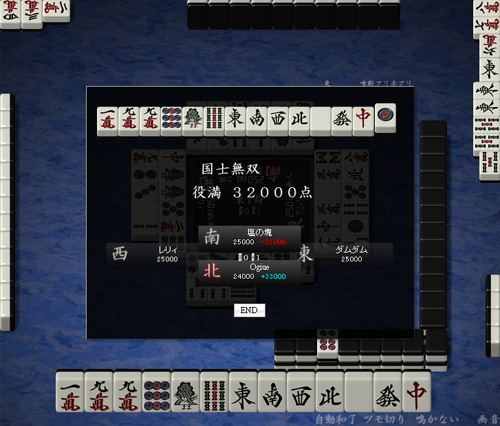
I was like that too, until yesterday when I scored one of the rarest and most difficult-to-achieve hands in the game: Kokushi Musou, also known as 13 Orphans. The hand was so powerful it knocked out one of my opponents in the first round and ended the game instantly. At this point, I almost feel as if I should just stop playing and leave on that very, very high note.

For those of you who know mahjong and are probably much better players than I am, you already know the score. For those who don’t, to properly understand the sheer improbability (there’s that word again!) of a Kokushi Musou hand, I’m going to try to explain it in a way that doesn’t require you to know the rules of mahjong.

Normally in mahjong, you win by having straights and/or three-of-a-kinds as well as a single pair. Most of the hands in mahjong are like this. Kokushi Musou however, cannot be anything but a Kokushi Musou, as the hand actually consists of one pair and then 12 other completely incongruous tiles.

First, what this means is that it is impossible to call on discarded tiles. You may have seen it in Saki or Akagi, where when one player discards a tile another shouts, “Pon!” or “Chi!” or “Kan!” and takes the tile. They are making something, either a three-of-a-kind or a straight or a four-of-a-kind, out of what the opponent had. However, because Kokushi Musou cannot have any straights or three-of-a-kinds, let alone four-of-a-kinds, you cannot call on any tiles without abandoning the attempt to achieve Kokushi Musou. This also means that in order to win, you must draw every necessary tile on your own until your hand is ready to win.

Second, is that while there are other hands which pay just as much as a Kokushi Musou, they usually have a way out, where if the plan to score big fails they can try and fall back on a lower-scoring hand. Kokushi Musou however has no built-in escape routes. If it turns out the tiles you need for Kokushi Musou are 100% unobtainable, then you’re pretty much hosed for the round and you can mount a desperate attack or retreat at best, or you have all the tiles people need to win at worst, which is likely.

Kokushi Musou is called a “Yakuman” hand, essentially an ultimate high-scoring hand. There are also “Counted Yakuman,” where a hand, while not considered one of the Royal Flushes of mahjong, consists of enough high-scoring hands and bonus points to essentially become a Yakuman, not unlike five vehicles combining into a single mighty robot. This Kokushi Musou is my first and only Yakuman ever.

Channeling Miyanaga Saki

Saki Tacos: Yes This is the Best Promotion

In a move I would have been angry about if no one ended up doing it, Japanese taco chain Taco Derio has decided to start using the face of this year’s most popular taco enthusiast in Japan, Kataoka Yuuki from Saki. Order at a Taco Derio and you can get a Yuuki-themed tray mat to show off to your friends and co-workers, and score hot dates with taco-loving ladies. The mat, by the way, says, “With Tacos Power, Victory is a Cinch!”

For those who don’t know, Saki is a manga and recent anime about girls who play Mahjong and possibly definitely like other girls, a one-two punch that few dare to attempt. In it, Kataoka Yuuki is a supporting character, voiced by Kugimiya Rie, who is a strong and aggressive player despite her diminutive stature, and is mostly characterized by her love of tacos. So great is her taco addiction that she cannot play at full strength unless she has a steady supply to keep her going.

To put it simply, this is an awesome idea and everything that I want out of anime cross-promotions. Code Geass and its Pizza Hut angle was great and all, especially with all the imagery of CC chowing down on pizza, but that was practically built in during conception. It’s almost cheating, in a way. But with this, Yuuki was originally from a manga and so the tacos thing was designed not so much to promote tacos but to add an additional moe aspect to Yuuki (as if the cat belt wasn’t enough already).

It’s not quite as extreme as the rise in sales of left-handed basses caused by the popularity of K-On! or the increase in tourism to one Japanese town due to Lucky Star, but it’s a step in the right shameless propaganda direction. And there’s no propaganda like shameless propaganda.

I’m going to end off on a personal message directed at something significant: Akikan.

You totally missed the boat! Why didn’t I hear of any soft drinks sporting Akikan characters, or custom Akikan flavors that are just the older flavors with new names, e.g. Akikan Cooler?

For shame. Learn your lessons from those mahjong-playing tribades and try again!

How to Tell If You’re Tiring of Bleach: BANKAI GYAKUTEN

Now there are a lot of fans of the Shounen Jump manga and anime, Bleach. It’s one of the more popular series in the US, and of course does well in Japan too. However, along the way many fans fall off of Bleach or start to feel as if it’s dragging. Something is missing, something that drew you into the series initially and kept you reading for a long time. I believe there to be a simple indicator of whether or not you feel like either dropping Bleach or putting it on hiatus or whatever.

When a character reveals their Bankai for the first time, are you excited?

If you said, “No,” then it’s possible you need a break.

It’s difficult to tell with whom the “fault” lies. Maybe it’s that you the reader have read so much Bleach that it’s starting to become old hat. Maybe you’ve lost a taste for endless Shounen Fighting. Or maybe the author Kubo is losing his touch, or at the very least losing his touch in your eyes. Whatever the reason may be, you have the option of sitting back, avoiding the comic, and who knows? Maybe you’ll come back to it a month later and appreciate it anew. Or you might just never read it again.

But really, it all comes down to the Bankai. The reason why I use this specifically is that because the Bankai Reveal is always supposed to be a Big Deal in Bleach, and if the Big Deal moments aren’t grabbing you, something is up.

Oh, and if you tired of the manga before the first Bankai is ever revealed…well I can’t help you there.

One of the Strengths of Modern Animation as Displayed by Mahjong Anime

Incorporating 3D animation into 2D animation has always been a tricky thing, but as technology has improved the integration has become better and better. It can be a time and budget saver, and all it takes is using it intelligently.

Enter the modern mahjong anime. The first screenshot is Saki, and the second is Mahjong Legend Akagi: The Genius Who Descended into the Darkness. What they’ve done in each of these shows is designed a full set of mahjong tiles in 3D, and basically use those same tiles throughout, aside from Akagi’s trip through WASHIZU MAHJONG. There’s no need to redraw the delicate details of a mahjong tile every time when you can meticulously etch out the details in Maya or whatever. Maybe YOU should make a mahjong anime with fully rendered tiles!

Go on, I’ll wait.

So you’ve got their mahjong tile set in 3D and you’re wonder, what to do with it? Why, EVERYTHING YOU CAN. Tiles spin around and taunt the players. One tile floats in a player’s head as he contemplates his decisions. Tiles form an unpassable mountain, or perhaps even a golem or giant robot! These are all just representational metaphors for the game of mahjong!

Integrated 2d and 3d which saves time and money! Behold the power of modern animation!

Aim for Mediocrity

There’s two new shows this season where the apparent premise is that the main characters do not strive to be the very best, like no one ever was. One of these is the moe-powered 25-minute mahjong commercial Saki, and the other is the latest Kyoto Animation cute girls fest about a high school band K-ON! While the titular Miyanaga Saki is simply a mahjong genius who has found a way to merely seem mediocre, and K-ON!‘s Hirasawa Yui is simply a no-talent clumsy girl who’s trying to find something she can sort-of kind-of do, both girls are clearly going for the same goal, which is to be okay.

While both shows are clearly aimed at otaku with their ensembles of adorable girls with relatively harmless personalities, I don’t think it’s necessarily a case of “otaku are afraid to succeed and that’s why these girls aren’t striving to be the very best!” How I personally feel about it is that it’s actually kind of refreshing to not have characters who are entirely about toppling their opposition in a given field. Even if the story turns out that way eventually (a likely scenario for Saki), the fact that it started out that way is pretty nice.

Also, Saki is basically Takumi from Initial D only with mahjong tiles instead of a AE-86 Sprinter Trueno.