Attack on Titan: The Final Conclusive Ending Denouement

“Why I Like Eren Jaeger.” That’s the title of a post I wrote 10 years ago. 

A lot of things sure have happened since then.

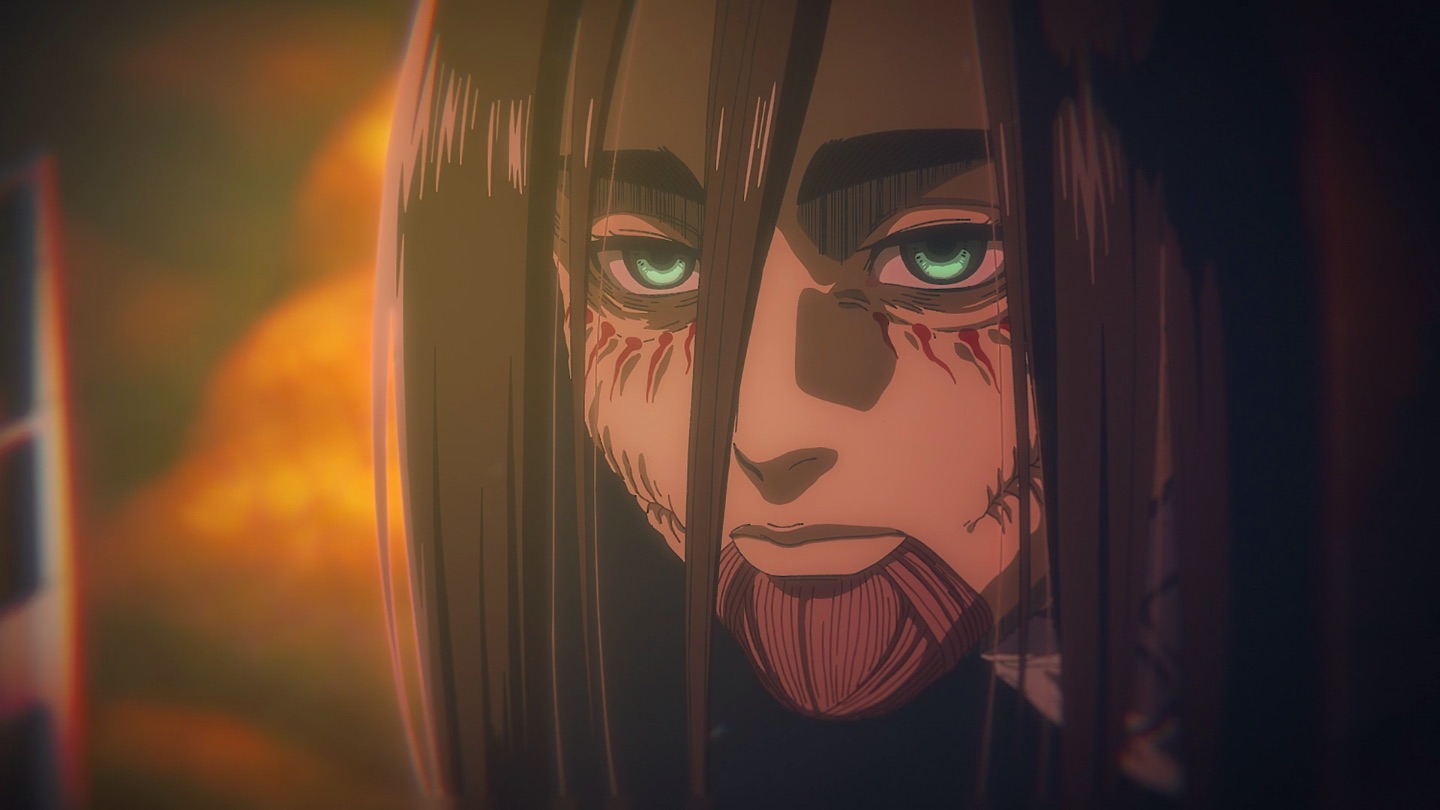
The anime Attack on Titan recently concluded after what seemed like an eternity, and we the viewers have been left to interpret Eren in his entirety, from the hotheaded protagonist he was at the beginning to the apocalyptic villain he becomes by the end. Given all that has transpired, not least of which includes mass genocide, can I still say that I “like” Eren?

WARNING: SPOILERS OF THE END OF ATTACK ON TITAN AHEAD

Obviously, I can’t condone genocide no matter how it might have come from a place of wanting to protect his friends, or even if the alternative was a different form of genocide. But the reasons I was fond of Eren as a character ten years ago had little to do with anything like moral and ethical values or good decision-making. Instead, it was because he’s a deeply flawed character with some genuinely positive traits—namely his ability to motivate others through the sheer force of his ceaseless drive to press ahead. 

In 2013, this is what I had to say:

I see Eren as the kind of guy who makes people better than him feel worse for not accomplishing as much…. This is mainly what drives his relationship with Jean, as Jean is clearly smarter, wiser, and comparable in physical ability to Eren, but lacks his ability to throw himself into danger. On the other hand, Eren’s narrow-mindedness is the reason he can’t accomplish everything on his own, and…if he were a leader of men…he would probably send them all to their deaths just by being himself….

The result is that the Scout Regiment (or Survey Corps), a group infamous for being full of eccentrics with death wishes, gains and benefits from one of the most rational and reasonable individuals. At the same time, it means Eren has always been someone who needs others to keep him from being a living train wreck.

This is not a defense of Eren but an understanding of his relationships and the effects he has on people who are better than him. He inspires others to do what they thought impossible or inconceivable. Nowhere is this more relevant than with his closest friends, Armin and Mikasa. He pushes them to achieve greater heights through the example of his will, and this remains true even as Eren turns them against himself.

Eren, Mikasa, and Armin are parts of a whole, and it’s a relationship that persists even in opposition. I think that Eren purposely pushes his friends away because he knows they have what it takes to stop him. Similar to Dr. Manhattan in Watchmen, Eren becomes able to move in four dimensions, and this ironically makes him unable to challenge fate. But Mikasa and Armin are not beholden to such cursed omniscience, and they ultimately defeat him and help remove the titan ability from the entire world.

Mikasa killing Eren is not only one of the most powerful scenes of the finale, but a key moment in the series as a whole. The presence of titans in their world for 2000 years is because Ymir, the Founding Titan, is trapped by her undying and contradictory love for King Fritz, her longtime master and abuser. Despite knowing how much Fritz saw Ymir as nothing more than property, her feelings keep her loyal out of a desperate need for human connection. Seeing Mikasa behead the love of her life for the sake of the world shows Ymir that it’s possible to break the mental and emotional chains binding her. And all of it comes back to what made Mikasa fall for Eren in the first place, back when they were children: When others would have said to run, Eren implored her to fight. He pushes others to not give up, even if it means he himself becomes the enemy. 

So the answer is yes: I still like Eren Jaeger for the mess that he is. I can’t support the consequences of his actions, but the story of Attack on Titan is very much about the ugliness of humanity, and in many ways, Eren exhibits some of its worst qualities. However, much like how there are glimmers of hope that flicker in and out amid despair, he casts a light on others and gives them power, however great or small, to do more—even as he himself is subsumed by darkness. Ultimately, he ends up being a unique protagonist turned antagonist, a child given far too much responsibility and burden, a cautionary tale of why you don’t have to automatically cheer for someone just because they’re the main hero, and a figure remarkably complex because of his profound limitations.
Why I Like Eren Jaeger

In Episode 117 of the Anime World Order podcast, Daryl Surat, Gerald Rathkolb, and Tim Eldred briefly discussed the idea that, in order to modernize a classic, the creators of Space Battleship Yamato 2199 gave its protagonist Kodai Susumu a less gung-ho personality to match the current male audience for anime. Daryl pointed out that such heroes were the exception these days, and gave Eren Jaeger from Attack on Titan as an example of someone cut from an older cloth in terms of shounen main character tropes. I agree with the overall statement, but I also find that Eren works especially well as a protagonist in this current age because of the perspective it provides for his actions and personality.

The character of Eren Jaeger is essentially a boy who has dedicated himself to a singular goal in life, to wipe out the enemy Titans that destroyed his village and killed his mother. Characters in the series point out his immense drive and the willingness to work hard to accomplish his desires, and in this sense he exhibits the same qualities as many of the most famous shounen heroes. However, unlike Naruto whose overwhelming personality and “act before you think” approach is generally seen as a positive and the source of his series’ fundamental themes (heart is what’s important for instance), Eren Jaeger’s similar mindset is shown to have not only strengths but also critical limitations.

I see Eren as the kind of guy who makes people better than him feel worse for not accomplishing as much. Aside from his transformation, Eren is shown as not being particularly exceptional when it comes to fighting Titans, but he’s more willing to just go and do it, and not let his fears get the better of him. This is mainly what drives his relationship with Jean, as Jean is clearly smarter, wiser, and comparable in physical ability to Eren, but lacks his ability to throw himself into danger. On the other hand, Eren’s narrow-mindedness is the reason he can’t accomplish everything on his own, and that if he were a leader of men, for instance, he would probably send them all to their deaths just by being himself, as opposed to Naruto who’s supposed to become a leader with pretty much the same personality.

This is what drives the dynamic interaction between Eren, Armin, and Mikasa. Eren’s lack of forethought is tempered by Armin’s strategic insight and willingness to sit back and observe, but Eren’s fearlessness also helps keep Armin from overthinking things or succumbing to self-doubt. Similarly, although Mikasa lacks the vast dreams of Eren and Armin in terms of wanting more out of the world, her cool head and decisiveness help to keep both of them moving forward.

The fact that Eren has trouble transforming into his Titan form in one instance basically comes down to the fact that Eren has vision and drive but lacks perspective. When the Titans were simply an absolute enemy, someone who cannot be compromised with and who must be destroyed no matter the cost, it was easy for Eren to obtain the level of focus needed to become his Titan form, but when it turns out that his enemy is actually someone he considered an ally and a fellow human being, he cannot process this idea due to that same rigidity. It is ultimately his friends, who each see the world from a different place, who help him resolve this issue, and even that comes at the price of Eren having to throw away the basic love he has for humanity.

Sasha Blause in Potato Confront

I thought it to be the most appropriate music for the occasion.

Attack on Titan is the Mobile Suit Gundam of Shounen Fighting Manga and Anime

Attack on Titan, the manga and now anime about a world where humans live in walled cities for fear of being eaten by nigh-invulnerable giants, is an interesting and unique title in that it goes against the grain of shounen action series and their conventions, especially when it comes to heroics. In particular, I find that Attack on Titan emphasizes people as a group over individuals in a way which doesn’t really happen in other popular titles.

When it comes to shounen fighting series, especially over the past ten years or so, gigantic ensemble casts are the norm. In something like Inuyasha or even Hajime no Ippo, you have the main characters, their friends and family, rivals, enemies, enemies turned allies, and so on until they require multiple volumes of guide books to keep track of them all. It’s even more the case that titles in the shounen fighting genre will emphasize group-oriented concepts, such as friends (One Piece) or fighting for a greater cause (Saint Seiya), but ultimately it boils down to unique characters cooperating. Where Attack on Titan differs, at least initially, is that it gives you a sense of a world where individual heroics are much more ineffectual, and it is only through the massing of people that they can have any hope of surviving in their world, and a slim one at that.

The reason why I make the comparison to Mobile Suit Gundam (though I understand that the comparison is not perfect) is that Gundam is known for bucking the trend of giant robots as metal superheroes, instead positioning it as an individual war machine as part of a greater force. The Gundam is still glorified to an extent, but compared to the shows which came before it, this is much less the case.

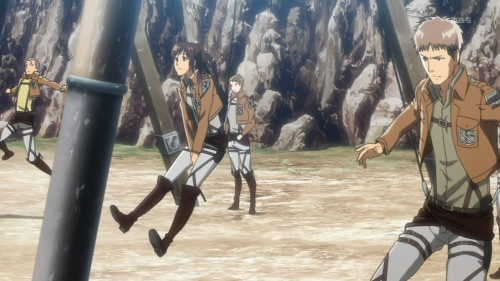
I think my point can be seen by just looking at the opening to Attack on Titan and comparing it to intros from other shounen fighting anime. Popular and long-running shounen fighting anime go through a process where their first openings emphasize a core group of characters, but as the cast expands they find it important to at least show a bit of each remotely significant characters. Whether it’s those slower-paced initial openings or the later frantic ones, though, there is still that focus on a multitude of individuals. In Attack on Titan‘s opening on the other hand, you barely get glimpses of the core cast, who are shown running and jumping from one structure to the next, almost as if the camera can’t stay on them for too long. Even Eren receives only a few brief moments centered on him, and in some of those cases he’s still seen as part of a group of fighters. The fact that the soldiers are all similarly dressed, male or female, instead of wearing unique outfits, and the fact that they all use standardized weaponry, creates a sense of them as a unified army.

That’s not to say that Attack on Titan lacks individualized or unique characters. There’s a clear protagonist in Eren, and there is a core cast of characters who are given personalities and particular skills such as sound judgment and lack of mercy. I’ve also read enough of the manga to know that there are developments which change things up significantly. However, the sense of group which Attack on Titan portrays goes beyond the typical shounen concept of such, and it lends an atmosphere which almost (but not quite) puts more attention on the military force than the people who comprise it. They swarm the titans like ants, which is about as un-shounen heroic as it gets.