I Attended hololive night 2025 at Dodger Stadium

Before July of this year, I hadn’t been to a baseball game in a very, very long time. My last trip was as a kid, with a friend from school. Since then, baseball hasn’t really been on my radar. But when hololive announced that they were doing a second collaboration with the LA Dodgers on the same day as the Virtual Vacation 2025 concert, I figured why the hell not. The three VTubers participating were also another friend’s favorites, so it worked out. 

Before talking about my experience, I will say that there are a few factors that make my experience likely atypical. First, because I already had tickets for Virtual Vacation 2025, I had to leave early to make sure I could get there in time. Second, Takanashi Kiara’s birthday concert was also happening during the same time frame, and I didn’t want to miss her first ever performance with La+ Darknesss. My attention was divided in a few different directions, and even the amount of downtime in baseball doesn’t exactly justify it.

In the days leading up, I looked up how to get to Dodger Stadium via public transit. This being LA, the answer was “lol.” Or more specially, you have a choice between a train that puts you ¾ of a mile away or a bus that puts you half a mile away. You need to take a car or taxi of some kind. 

Everyone who bought tickets for the hololive event had to line up at a specific entrance, in the blazing early afternoon sun with little to no shade. That’s when I learned that you basically bring water just for the line. There was also a bit of a scare that security was confiscating penlights despite them being officially permitted, but it wasn’t an issue by the time I got there. Right after the security check, I received a packet with the three exclusive hololive x Dodgers baseball cards featuring Ninomae Ina’nis, IRyS, and Koseki Bijou. This alone made the trip worthwhile.

Once inside, two things I noticed were the festive environment before the game and the sheer size of the stadium. 

Baseball fans were chatting, having lunch, dressed with the colors of their team and having a generally good time. While the only cosplayers there were hololive fans, the atmosphere reminded me of Anime Expo, which was happening the same weekend. I sometimes talk with friends about the high that comes from being at a convention, as well as the “crash” that comes from having to return to our regular lives, and what it might be like to be at an anime con all year round. While it’s not exactly the same, I imagine that having season tickets to your local baseball team (or perhaps just one of the massive ones like the Dodgers) would feel close to it.

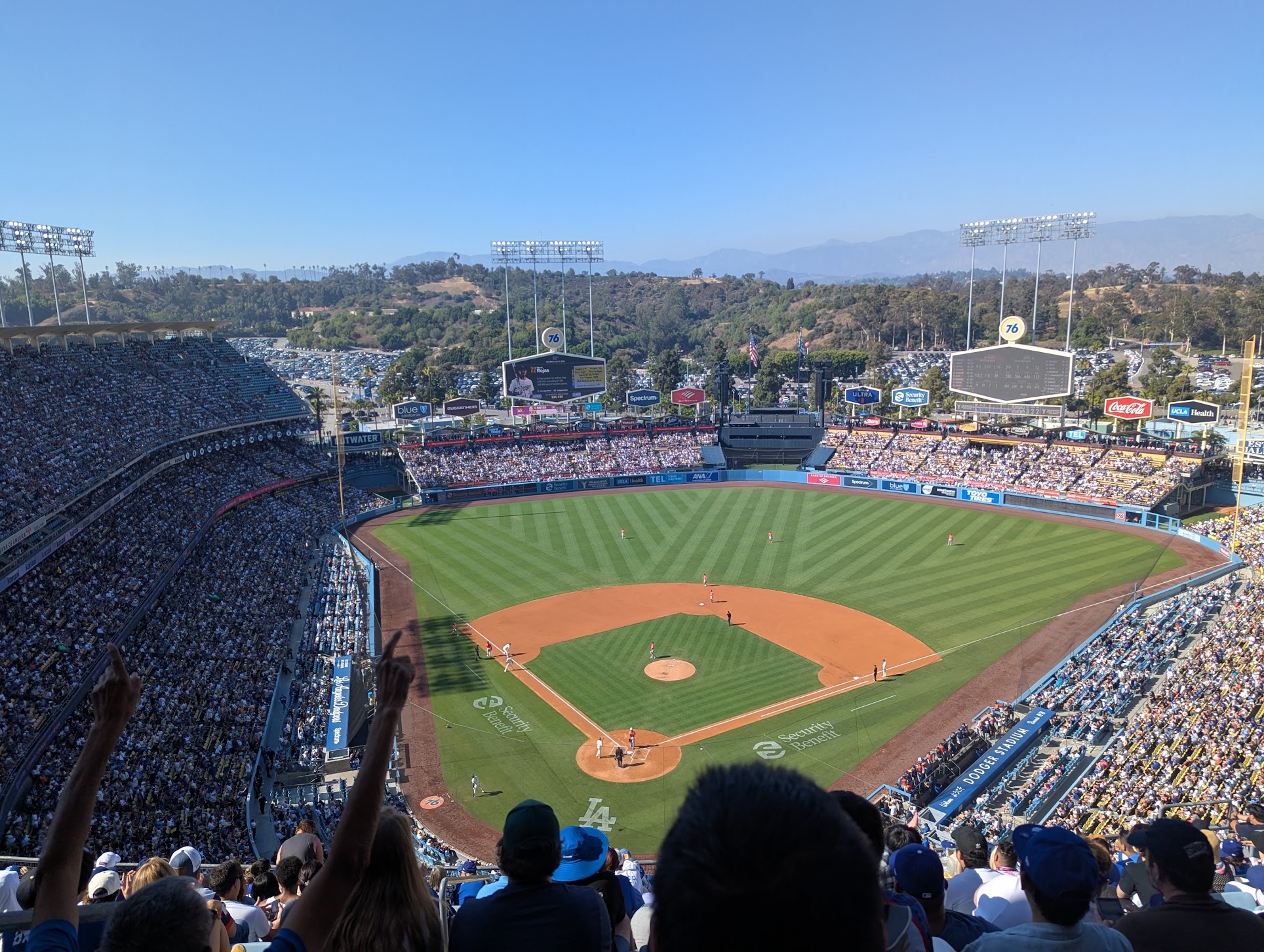
In regard to the size of Dodgers Stadium, my seat was in the nosebleed section. I didn’t think it’d be too bad it took multiple disconnected flights of stairs and a couple escalators to get there. While there was an elevator option for parts of it, the line for it was massive. I felt bad for anyone who had mobility issues. Also, because the venue is so large, I couldn’t try all the interesting food options (sushi, takoyaki, etc.) because heading to any of those stands would’ve been a trip in itself. I will say the view from the cheap seats was still very good, though the internet service for my phone wasn’t so hot. 
I heard stories about the massive bottleneck for merch at last year’s Dodgers event, and how some people missed the entire baseball game because they were standing in line the whole time. This year, the folks in charge of the event clearly learned their lesson by having many more shops carry the hololive collaborative goods. This had the benefit of allowing me to get my seat before the first inning, but it still took over half an hour, and I ended up missing the first pitch by Cover Corp CEO Tanigo “YAGOO” Motoaki as a result. I ultimately decided to purchase an IRyS t-shirt because I always wanted one, though I was taken aback by the cost: over $60. Even the more expensive anime and hololive shirts aren’t usually quite so pricey. After getting a Dodger Dog and a commemorative plastic cup, I made it to my seat.

I have some memories of the last time I attended a baseball game, but I don’t recall it being such an audiovisual bonanza. There was a lot going on besides the actual hitting, throwing, and catching of balls, and it felt like the whole of Dodger Stadium was a multimedia diss track shit talking the opposing team. I understand that bias in favor of the home team and against the visiting team is normal in sports, but this felt like another level. The organ would play funeral music every time the Dodgers pitcher struck a player out, and at one point, the jumbotron would put graphics of Dodgers caps onto Houston Astros fans to “improve” their appearance. 

As the Dodgers started to fall behind, I could feel the energy in the stadium gradually deflate a little. Shohei Otani was indeed playing, but he didn’t do terribly well that day. The Dodgers caught up a bit, but as I found out later, they wound up losing the game by a couple points.

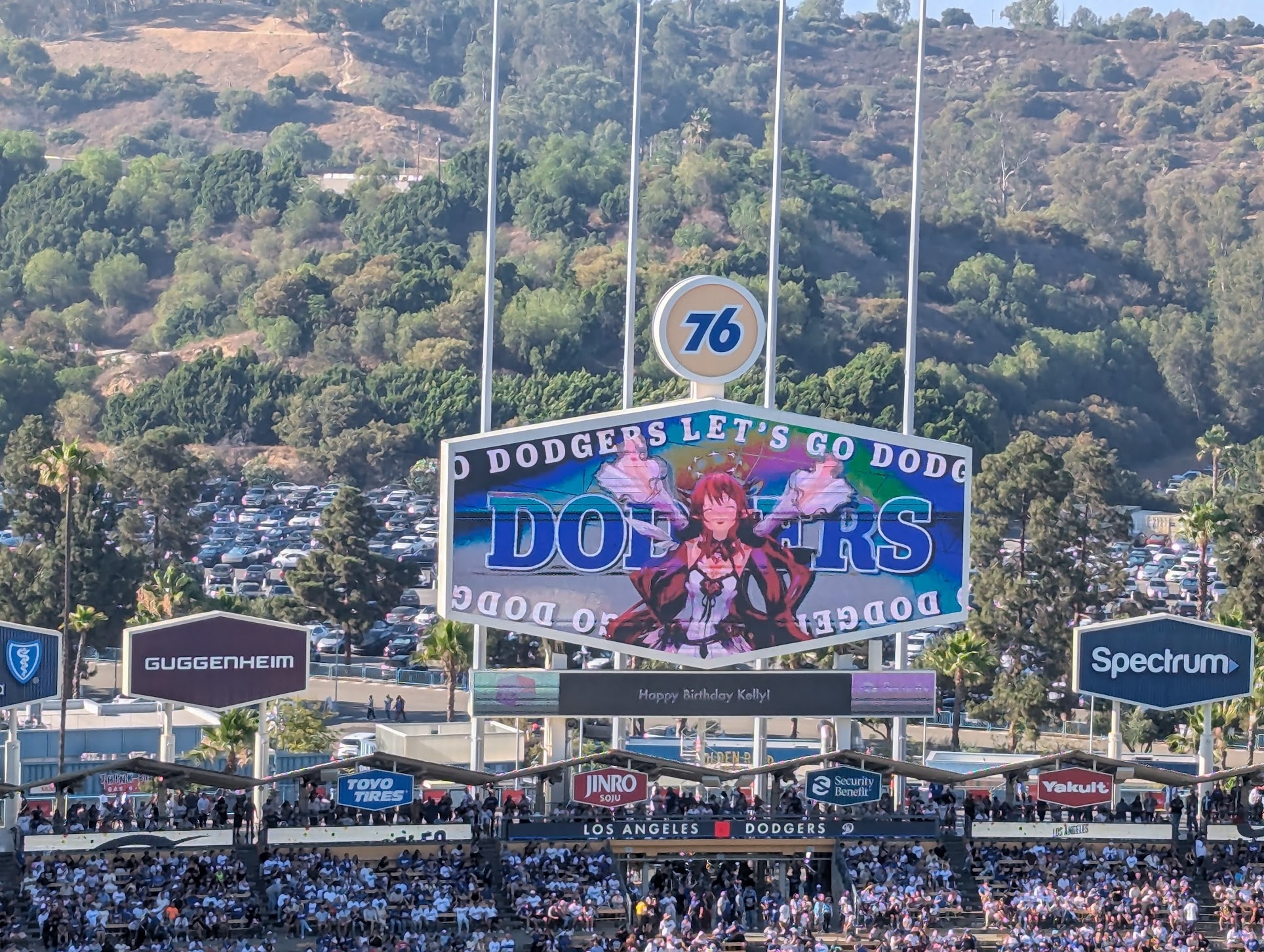
Every so often, Ina, IRyS, and Biboo would pop up on the jumbotron and say a few encouraging words. Unlike last year with Gura, Suisei, and Pekora, the three did their appearances using their 3D models (as opposed to their 2DLive models). It was fun but also kind of surreal to see them up there. I stuck around to watch the girls sing “Take Me Out to the Ballgame” before having to leave to make it to Virtual Vacation 2025.

Here is my recording of their singing, albeit one with lots of obstruction from other attendees. It’s definitely not the best choice if you want to see it, but I’m including it for posterity.

If the stars had not aligned in certain ways, I probably would not have gone, simply because baseball isn’t my thing. Even if all my favorites got together, I don’t know if it would justify the trip. Nevertheless, I was fascinated by the experience, and there is a certain joy in going to watch something different where people gather together. Maybe this is my excuse to check out other sports. Who knows? Perhaps we could get a re-creation of the Rinkside Rivalry audio drama.

The Dawn of the Sports Boys: Captain Tsubasa

Tsubasa, the spiky-haired hero of Captain Tsubasa, delivering a powerful midair kick to a soccer ball that looks more like he's launching a laser beam from his foot.

As an anime and manga fan, I enjoy checking out the big fan favorites of yesteryear. It helps broaden my perspective on these artforms, and gives me an opportunity to form my own opinions on a work and not rely solely on the views of others. And who knows—maybe I’ll get a new favorite. In this spirit, I recently familiarized myself with a manga that is not only beloved worldwide for its portrayal of soccer but also the father of the modern shounen “team sports boys” format. Before Blue Lock, Yowamushi Pedal, Haikyu!, Prince of Tennis, and Slam Dunk, there was 1981’s Captain Tsubasa by Takahashi Yoichi.

Regarding reading older major titles, Shounen Jump has been a consistent resource of works for me to tap, such as Saint Seiya and Hunter x Hunter. But while these titles are huge in their own right, Captain Tsubasa’s influence is really something special.

In Japan, Captain Tsubasa helped propel the popularity of soccer nationwide, even being published in a time when “World Cup” wasn’t even a commonly known phrase. Abroad, it gained popularity anywhere soccer was. On my most recent trip to Japan, I watched an episode of Why Did You Come to Japan?, a well-known program that interviews foreigners who are in Japan. This particular episode followed a German fan who made a pilgrimage just out of love for the series, during which he got to visit the real inspiration for the school in the series, among other things. There’s also a famous story about the occupation of Iraq by the US military, where water trucks were covered with images from Captain Tsubasa to show that they were friendly vehicles.

Creating love for soccer at home and garnering praise internationally for its portrayal of the sport are parts of the legacy of Captain Tsubasa. But it was also important in another area that has become a prominent part of anime and manga culture: doujinshi. In my review of the giant robot anime God Mars (also from 1981), I described it as one two series fundamental to the establishment of the fujoshi fandom as we know it today—the other was Captain Tsubasa. Having read the entirety of the first manga series, I now feel that I understand exactly why this story of young soccer athletes achieved the hat trick of domestic influence, international acceptance, and subculture proliferation.

Let’s talk about the actual story: Captain Tsubasa kicks off with a hell of an introduction to its main character, Ozora Tsubasa. As a small child, Tsubasa is literally saved from a truck by a soccer ball (avoiding the isekai protagonist fate, in the modern parlance), and his life is forever changed. The boy falls in love with the sport, treating the ball like an extension of his body. And as Tsubasa grows from impetuous kid to adult with soccer in his heart (though I only read up to the point where he finishes middle school), he influences every other player he meets, be they friendly or adversarial or both.

Those looking at Captain Tsubasa, especially from a modern perspective, might be surprised by its aesthetic, expecting a title known for its various fandoms to either have characters who look impossibly cool or incredibly beautiful. Instead, Takahashi’s designs feature ridiculously long and stilt-like legs, squashed craniums, and bird-like eye placement that makes it seem as if the characters can see in two different directions at once. How could this possibly be the series that helped spark soccer fandom and spawned shounen sports BL shipping? Yet, despite the odd look of the characters themselves, two things become clear even from the very beginning. 

First, the manga is fantastic at depicting action and tension. When portraying things like passing, dribbling, and goal attempts, the art is very clear and easy to follow while still creating excitement. When the athletes use their ridiculous signature moves (that aren’t meant to be supernatural but still play fast and loose with the laws of physics), there’s a satisfying sense of weight and emotion. The paneling frequently takes advantage of the double page spread to portray very wide shots, especially when points are being scored. It almost feels as if Takahashi made some kind of pact that made him a genius at depicting characters in action in exchange for being bad at drawing them standing still. 

A bunch of manga characters who are elementary school boys in soccer uniforms. Most of the kids look to be realistically young, but the one in front is weirdly lanky and muscular.
Kojiro as a gigantic grade schooler

They’re also all weirdly mature-looking. Some 10-year-olds look like they’re 16, while some 14-year-olds look like they’re 30—something we see in later titles like Prince of Tennis.

Second, many of the tropes of the shounen sports boys genre—namely having a wide-ranging cast of passionate guys engaging in intense forms of camaraderie and rivalry—are on full display here. Wakabayashi Genzo the goalkeeper starts off as Tsubasa’s first antagonist while later developing a nagging ankle injury that stymies him at dramatic moments. Misaki Taro is a student from out of town who becomes Tsubasa’s most reliable partner on offense, but who can only play for their school for a year before his family has to move away. Ace striker Hyuga Kojiro sees Tsubasa as the man he must take down, and his violent, win-at-all-costs mentality comes from a heartfelt desire to support his family. Wakashimazu Ken is a reliable goalkeeper for Kojiro who utilizes his karate background to defy what should be possible in soccer. Matsuyama Hikaru emphasizes teamwork above all else as the captain of his team. Misogi Jun is a handsome and noble all-around genius who would be the greatest youth player in Japan if not for his congenital heart disease that limits his playtime. And there are other characters.

If you were to ask who is Tsubasa’s greatest rival/partner, there really is no clear answer, making the series ripe for explorations of the imagination of various kinds. All the ingredients are there, whether one is reading for the competitive soccer or the bromances, and it’s doubly powerful when you realize how these very characters fueled their archetypal descendents in the following decades. 

It’s also worth noting that all the female characters are the kinds of managers and sideline supporters typical of sports boys series, except that this was an era when they were clearly intended to be romantic partners down the line instead of mainly audience-perspective characters. For example, Tsubasa’s main love interest, Nakazawa Sanae, starts off as a tomboyish ouendan-style cheer squad leader but becomes more “feminine” over time. I actually got a little miffed that the story couldn’t even keep that fun aspect of Sanae’s character. It’s no wonder why the female fans gravitated towards guy-guy pairings, regardless of their inclinations towards BL in the first place.

Two spiky-haired teenage manga boys (who look unusually tall and mature) trying to kick a ball at the same time in midair, which makes them look like they're clashing as martial artists.

But when Captain Tsubasa is at full strength, the excitement jumps off the page. The matches start off as exaggerated depictions of actual soccer before transforming into something that looks more like a battle manga at times. Many scenes feature opposing players clashing in mid-air like they’re Fist of the North Star characters who happen to have a soccer ball between them, and while it does start to feel ridiculous, I can’t deny the infectious energy. Though its tropes are old hat in the realm of sports boys at this point, the series holds up very well. There’s so much manly passion in this manga that it’s no wonder it formed so many different fandoms and even played a part in making soccer a national sport in Japan. 

Personally speaking, the ball is not my friend, but maybe Captain Tsubasa is now.

Rivalry at Its Finest—Haikyu!!: The Dumpster Battle

In a sports anime where relationships on the court are centrally important, the defining team rivalry of Haikyu! is undoubtedly Karasuno vs. Nekoma. In Haikyu!! The Dumpster Battle, it all comes to a head as the two face off in the big inter-high tournament.

While the high-flying Hinata Shoyo is generally the star of the series, this movie feels like one where his friend and longest rival, Nekoma’s setter Kozume Kenma, is the actual main character. A significant amount of time is spent exploring his history and inner world, elaborating on how he started playing volleyball, and what has kept him in the sport despite his dislike of physical exertion. It’s because the film is basically an adaptation of a small chunk of the manga, but I appreciate that its story can be told in a way that really shines the spotlight on Kenma and adds a new perspective on his relationship with Hinata, as well as with Kenma’s own teammates.

The two schools are set up as equal but opposite forces. The Karasuno duo are the high-flying spiker Hinata and the technical setter Kageyama, while Nekoma’s main pair consists of the quietly analytical setter Kenma and the psychology-oriented Kuroo. Whereas Karasuno focuses on heavy aerial offense meant to overwhelm, Nekoma stays primarily grounded and defensive, strategically picking apart opponents. It’s a little on-the-nose, with the whole “ravens vs. cats” imagery, but there’s nothing wrong with that if it’s executed well.

What I especially like about this film is the fact that it’s all about a single match, and the majority of it is spent in competition. It reminds me of the Girls und Panzer films, which also take the time to depict long, drawn-out battles where two sides try to outwit and trap each other. Production I.G. goes out of its way to make the volleyball look amazing, even sometimes making it feel like you’re right there on the court.

Despite obviously being meant for people who have been watching Haikyu!! from the start, I actually think a non-fan could come into this pretty easily. They might assume that Kenma is the protagonist, and might not get all the running gags, but The Dumpster Battle is just a fine piece of sports fiction that just also happens to include lots of handsome dudes.

A Collage of Perspectives: Dragon Hoops

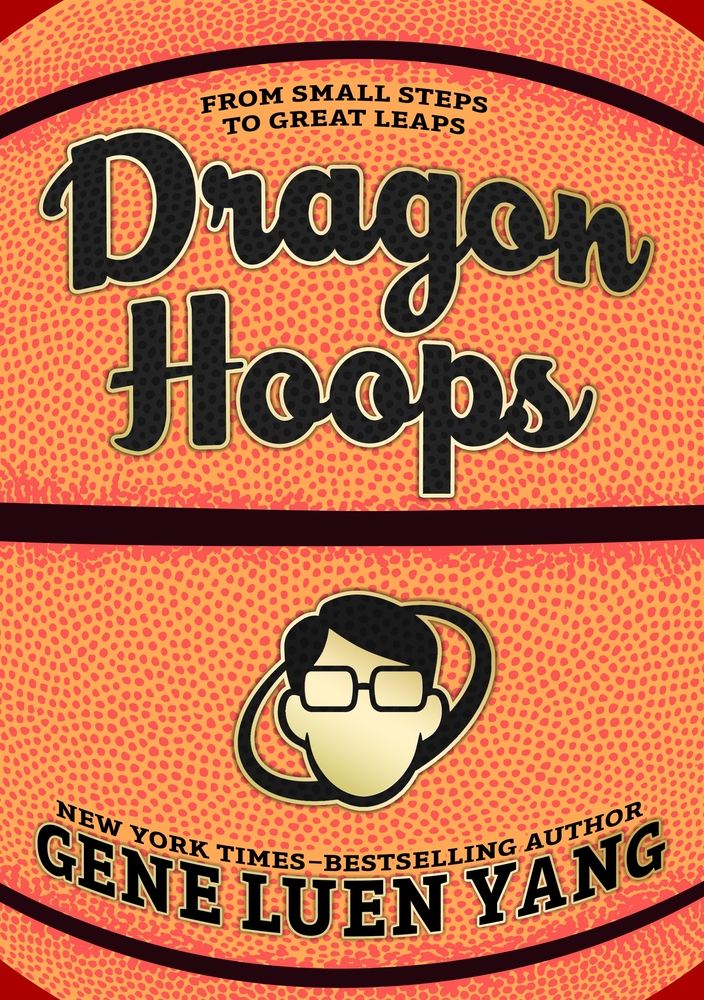
Dragon Hoops by Chinese-American comics creator Gene Luen Yang is a 2020 Harvey Awards nominee for “Best Children or Young Adult Book.” A sort of hybrid biography/autobiography, it covers Yang’s own experience learning about the basketball team at the high school where he taught math, and the complexities of race intertwined within sports and culture.

When I first heard the title, I figured that the book would be something about Chinese basketball players. But while there is a Chinese exchange student on the basketball team, the main focus is on the Bishop O’Dowd Dragons basketball team as a whole, which is made up of a variety of ethnicities. The book spotlights a variety of figures: the coach who was a former player at O’Dowd, the two black star athletes who are hesitant to talk about the details of their upbringings, a Punjabi teammate who feels out of place at a Catholic high school, the aforementioned Chinese player who dreams of being able to play real American basketball, and more. Over and over again, Dragon Hoops emphasizes their uniqueness as individuals and the intricate ways that their respective experiences shape how they see both the world and the opportunities afforded by basketball. 

Dragon Hoops also provides multiple history lessons, including the invention of basketball, the rise of the sport in China, and even how black players became integrated into professional basketball. One thing I found out from this book is that there was once a false belief that black people did not have the quick wit or the athletic ability to succeed in basketball over white people. In contrast to today, where black people are sometimes likened to “gorillas” as a way to diminish their tremendous skills and talents, the ways that racism can mold and reshape itself to fit any changes highlights how insidious it really is.

An unusual aspect of this book is that part of the overall narrative is how Yang, as a person unfamiliar with basketball, learns about these students’ stories and the lessons he takes with him in his own career in comics. As a character in his own book, there’s a great deal of 4th wall breaking, and it does sometimes feel like Dragon Hoops might be getting a little too self-centered. However, I feel that it actually successfully conveys the authenticity of Yang’s position as an outside observer, and to take a more authoritative position would arguably have been more disingenuous. I connect strongly with Yang’s approach because I used to be someone who was bothered by not having deep and intimate knowledge of any subject I became interested in, but more recently realized that it’s simply okay to not be an expert in everything. In this respect, the book feels more like Yang letting the students tell their own stories through the comics pages, even as Yang himself admits to a bit of fictionalizing to get some points across.

While Dragon Hoops did not end up winning the Harvey Award, it was actually another title by Yang, Superman Smashes the Klan, that ended up winning. The two books may seem different on the surface—one is about that most iconic of superheroes, the other based about teenagers and their relationship with basketball—but both take an intimate look at American culture with respect to race and racism. But whereas Superman Smashes the Klan bases itself in the iconography of Superman, the biographical aspect of Dragon Hoops makes it feel even more relevant to the checkered past and present of the United States and its racism. Dragon Hoops provides a context of what it means to “succeed” in a world where basketball is oxymoronically both a respite and a direct engagement with American culture.

The Safe Appeal of Fallen Champions

After a small drought of first place finishes, famed Smash Bros. Melee player Mang0 of Cloud 9 Gaming recently took home the gold medal at Royal Flush 2017. The tournament’s viewership was fairly modest throughout the tournament, but by the time grand finals rolled around the viewer count spiked to an impressive 73,000. While Mang0 is a perennial crowd favorite for his flashy, yet intelligent play and his devil-may-care attitude, I think there was another factor at work drawing eyeballs to his Mother’s Day victory: the appeal of a dominant champion turned underdog.

People love an underdog, as the saying goes, but there’s often an emotional investment to trying to cheer on a player or team with the odds stacked against them. For every Boston Red Sox or Chicago Cubs breaking their decades-long curses, there are many more across various competitive fields that wither and die in the early stages without achieving anything. Is it really worth cheering on someone who loses in the first round of a tournament every time? If it is, there’s typically some other element to consider: regional loyalty, character loyalty, etc.

But when it’s a known commodity, i.e. a former champion with a record of winning but who’s fallen off more recently, then there’s a different appeal at work. Think of Michael Jordan on the Washington Wizards, an aged George Foreman, or JulyZerg in Starcraft: Brood War. In each case, they arrived to make up for a loss of physical prowess with skill, experience, and ingenuity, but in their pushes for victory one thing was certain: though they fell behind, there is historical evidence of an “it” factor: the will to win, and the potential to snatch victories from the jaws of defeat.

In a certain sense, cheering for former champions become a case of trying to have your cake and eat it too. People cheer for underdogs, yes, but they also like to cheer for winners. When you have a former great, you get the best of both worlds. They’re a comforting pick because, even if they lose, a person can simply look back in time and say, “But I know they have what it takes!”

Mang0 is not the same as the examples I gave above. He’s still a top 3 player in his game, and slumps are often exaggerated in the world of eSports because the concept is so young and people think 3 months is a long time. However, if it were a true veteran of the past who enjoys legendary status such as Liquid’Ken, the “King of Smash,”  then I believe even more spectators would have flocked to Royal Flush.