Ishiguro

Last week saw the passing of one of the greatest anime directors of all time, Ishiguro Noboru. I’m not an expert on Ishiguro, so I don’t think it’s appropriate to talk as if I am keenly aware of his entire history. Instead, I would like to just talk about his impact on a more personal level.

Ishiguro’s list of influential works is almost second to none, and I know from personal experience that his finest works stand the test of time in a way that few can. Back in 2004, I was a college student who finally managed to get all of the original Super Dimensional Fortress Macross. The show was so utterly engrossing that I managed to finish all 36 episodes in two nights. During that time, I felt myself moving from cheering for Minmay to cheering for Misa; the way the show had developed and grown its characters amidst the backdrop of pop-songs-as-simple-ideals and war made it feel like I might  never experience that kind of thrill burning through a show again. Then came late Autumn 2008, and Legend of the Galactic Heroes.

At a daunting 110 episodes, it wasn’t a show that was really possible to marathon in a short period, but I still found myself often unable to stop. This wouldn’t have been any sort of a problem except at the time I was also studying for my Level 2 Japanese Language Proficiency Test. Was it worth it to cut into my study time so much? Well, the fact that I managed to pass probably colors my reflection, but again I was treated to one of the most well-crafted, intelligent, and hopeful pieces of fiction I’ve ever had the privilege to enjoy. I know Macross and LOGH aren’t Ishiguro’s only works, and there are even people who hold them far more dear than I do, but together they shape much of my views of the man.

I first had the opportunity to talk to Ishiguro as part of a press conference at Otakon 2009, and asked him a question about Nagahama Tadao, director of Combattler V, Voltes V, and Daimos. The way I framed my question was that since Nagahama had passed away decades prior, the only way to really know about him was to ask those who had worked with him, which included Ishiguro. Reflecting on this question, I realize that I had mentally placed the idea of Ishiguro dying far away from Nagahama’s own passing.

Then at Otakon 2011, I attended a panel which had both Ishiguro and Shinkai Makoto (5cm per Second, Place Promised in Our Early Days), and seeing the significant age gap between the old veteran and the newer talent and how that difference also meant the difference between cel and digital animation, I asked if Shinkai had any advice for Ishiguro. I caused a fair amount of light-hearted controversy for suggesting that the younger Shinkai could advise Ishiguro on the craft in which he made his name, but Ishiguro was more than open to it. For a man who was still looking for his next anime to work on, the hierarchy of age didn’t matter to him.

One question about the past and the old, one question about the future and the young, both assuming the man would live for many more years to come. Funny how things work.

I hope Angel Scandies makes it somehow.

Ogiue, Club Ace: Genshiken II, Chapter 74

The latest Genshiken is big, but in a rather narrow way that requires some clarification. Nothing climactic really happens, and what it sets up for the following chapter(s) is quite significant, but more than that, Chapter 74 is the most Ogiue-heavy chapter we’ve had since the manga’s revival.

This month sees Ogiue personally working to help Hato overcome his wardrobe-based artistic barrier. After a suggestion from Sue (who interrupts some rather personal fun between Ogiue and Sasahara), Ogiue decides that the best thing to do is to literally sit next to Hato and watch him draw to see what exactly goes awry in the process. Though Yoshitake wishes to watch as well, Ogiue decides that this has to be a one-on-one affair, especially because Yoshitake wears her corrupted intentions on her sleeves.

After much deliberation, which includes narrowly avoiding bringing up Hato’s shocking (?) high school love story and Ogiue admitting how impressed/jealous she is of Hato’s skills, Ogiue determines that as a man, Hato confines himself mentally so that when he does draw as a woman, his desires all come out at once and lead to yaoi. Acting as both wise upperclassman and as club leader, Ogiue instills confidence in Hato’s drawing abilities—which he believed to be fake as a result of what seems to be copying the style of a fujoshi he once knew (again, “high school love story”)—by basically saying, if you can draw like this, then you can draw manga as well.

Hato passes the test, drawing a character in a panel without having it descend into outright homoeroticism, but when his old “friend” from the student government comes barging in with another council member, the (imagined) fiery passion between the two compels Hato to draw some BL of them on the spot, essentially undoing much of the progress he and Ogiue had just made.

The chapter closes out by revealing the fact that pretty much everyone from the old guard will be around to attend the school festival this year, and that this includes both Madarame and Kasukabe (with Kohsaka). It’s a recipe for danger, or just a whole lot of mumbling and awkward glances as a result of unrequited love.

Normally I try to come up with a post title which references both the chapter itself and something nerdy, which is also how the actual Genshiken chapter titles work, but even though I don’t expect to win, this time around I can acknowledge a complete loss. Chapter 74 is “Itten Toppa Ogin-Lagann.” I can’t top that. But let’s put that aside.

Even though I said that this chapter is chock full of Ogiue content, my summary can make it seem like it was really a Hato chapter. It wasn’t. Sure, he had his own development, but here, we really get to see Ogiue as a central focus in a manner similar to the second half of the original series. In addition to the Ogiue we’re familiar with, it even ends up showing a couple of sides to her that hadn’t been revealed previously, or to put it more accurately, have developed since.

The chapter actually begins with Sasahara and Ogiue in her room, where Sasahara is shown actually praising Ogiue’s manga draft for the school festival, something we almost never have the privilege of seeing because these “editor review sessions” seem to typically lead to a lot of tension. The room and especially the couch, however, hold significant meanings for the two, and we get to see Ogiue actually tease Sasahara in that restrained “you’ll have to meet me half-way because it’s kind of embarrassing and it’s kind of fun” fashion. Specifically, Ogiue asks Sasahara if it’s okay that she might be in a room alone with another guy (Hato), to which Sasahara replies that it’s fine. Ogiue, on the other hand, was trying to bring out the “strong seme” side of Sasahara which she has a thing for, and which Sasahara picks up on almost immediately after. It’s similar to when Sasahara and Ogiue were alone in the clubroom in the last chapter of the original Genshiken and Ogiue hinted that it would be a good time for a kiss, but here their increasingly red faces combined with their comparatively comfortable (though not entirely awkward) body language show that they both know what’s really going on, and that is a very comfortable familiarity. They want each other, and even though Sue ends up interrupting before anything actually goes down, it’s still a sweet and beautiful sight to behold.

On top of Spotted Flower, this whole sequence tells me that Kio Shimoku has gotten better at portraying romantic relationships. Keep in mind that I already thought he was quite talented at it, perhaps as a result of being so good at character interaction in the first place, but there’s the keen sense of how intimate moments in a relationship really happen, in those quiet lulls where both parties can sense mutual desire.

The meat of the chapter though is the drawing session with Hato, and Ogiue’s thoughts and character fill that scene as well. When Hato shows the inadvertent BL that he made out of Ogiue’s characters, she has an epiphany: “Is this what it would be like if my manga had doujinshi made from it?” Though I may be reading into it too much, I feel like, in that moment, Ogiue has just begun to cross that threshold between the amateur creator and the professional, that realization that perhaps somewhere out there is a fan who’s creating work inspired by her own. Of course, as an artistic fujoshi herself, Hato’s “fanart” creates some complex feelings as well, where she’s turned on by yaoi of characters she created herself, even if they weren’t made expressly for that purpose.

That look of satisfaction on Ogiue when her advice ends up working out has a lot behind it as well. It’s really powerful, not just because it’s coming from Ogiue the older, more experienced otaku and yaoi fan which we’ve seen already in previous chapters, but the way the advice clearly comes from Ogiue’s own experiences in overcoming her own psychological blocks pertaining to drawing and being a fujoshi. Ogiue had to wrestle extensively with her personal demons in order to begin moving past them, and the words of encouragement she offers Hato are ones from the heart, and from knowing that it’s not only important to accept oneself, but that it’s more than possible to do so. I think this is one of the reasons the chapter starts off with Sasahara in the first place. It acts as a reminder of what happened with Ogiue and how far she has come with his help, and how even though the trauma doesn’t seem as dire, that process continues.

With that, I’ll end by mentioning that we even get to learn the name of Ogiue’s manga: Getsu Gankyou. It means something like “Lunar Glasses” or alternately “Lunar Insight.” Chuuni-byou indeed.

Eh, let’s throw in one more Ogiue image for good measure.

The Fujoshi Files 39: Ageha

Name: Ageha (アゲハ)
Alias: N/A
Relationship Status: Single
Origin: Fujoshi no Honkai

Information:
Ageha is a highly fashionable 15-year-old girl who actively hides the fact that she is a fujoshi. Fearing that her secret would ruin her relationship with her friends, she goes out of her way to hide in plain sight, creating decoy cellphone wallpapers and even disguising her BL books as fashion magazines. Ageha was originally antagonistic towards her classmates and fellow fujoshi, Takako and Shu Mei, but eventually became good friends with the two of them.

Ageha is a fan of the Nanairo no Shacho series along with Takako and Shu Mei. She is also particularly fond of Fujiko Fujoo A’s Ai Yue series, having been moved to tears upon meeting her, but is not aware of the fact that the author is actually a teacher at her school. Ageha strongly values having one solid BL pairing in a series over having many different ones.

Fujoshi Level:
So seriously does she take her fujoshi life that Ageha once broke up with a boyfriend in order to celebrate her favorite character’s birthday.

Forgetting Spoilers

Spoilers can be hard enough to avoid even without the internet, but in this age of Twitter, blogs, chats, Facebook, etc., it can be especially difficult.  It doesn’t necessarily ruin the viewing experience, but for anyone who’s ever had the ending to a show revealed prematurely or accidentally seen the score of a game they hadn’t watched yet, it can take the wind out of your sails a little. I have a way of dealing with spoilers already read, however, and while it isn’t fool-proof, it has worked for me on multiple occasions.

So let’s start off with some generic spoiler:

I can’t believe his dad was really a gorilla and that the conspiracy began in 1327.

First thing, don’t read that sentence again!

Now, do you have any doubts as to what it said? If so, this is good. You basically have to let the doubts in your mind make the memory of what you just read increasingly hazy. What was the sentence about? What was the big twist? If you can’t remember exactly, then the uncertainty of your memory can make even the things you know you read seem subject to ambiguity.

Once you’ve made your memories a sufficient mush, the final trick is to just let it go. Stop thinking about it, period. Give yourself some time, like a few minutes or maybe even a few hours or days, and don’t even let it cross your mind. Eventually, by the time you do think about it again, there’s a good chance the faulty elements of your short and/or long-term memory will have scrambled the spoiler to the point that it’s at least less of an issue.

Did I just create a guide to encourage doublethink? Well, best to just forget about that.

Superhero Comics and Being Sexy on an Individual Basis

Introduction

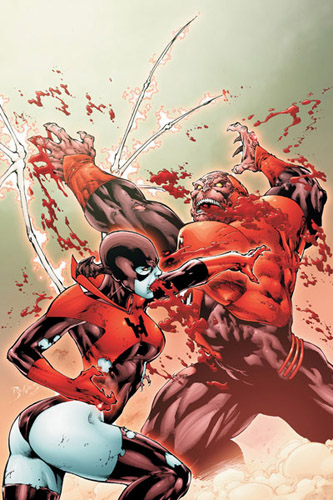
When it comes to the controversial approach to sexuality in superhero comics, probably nothing is more exemplary than the oft-seen exaggerated pose where a female character twists her torso such that both her butt and her breasts are facing at the reader directly. Known as the “brokeback,” the pose is frequently the target of criticism as an example of sexualization gone wrong. Generally, the criticisms concern the fact that, as action-based stories, the pose is a completely impossible and extremely impractical thing to do in fighting. The idea is that, by showing them as such, comics communicate the idea that when it comes to female characters the T&A is more important than their identities as heroes or characters in general.

The point at which I might diverge from other opinions is that I believe strongly in freedom of artistic expression and think that such works have a right to be drawn and a right to be enjoyed by readers on a sexual level. While I think that the disparity in idealization between genders can definitely be too much, something has to be said for the fact that the visual arts in general can make the impossible happen in the first place. If people are literally physically incapable of contorting themselves into the “brokeback” pose, then mediums such as comics are the only places where it is possible at all.

I also think people have the right to admire a character while simultaneously desiring her or the pose that she’s taking. Again, the fact that forms of fiction such as comics make it more than possible for the portrayal of a female character to be an effective fighter while doing the least physically sensible thing possible is not an inherent negative, as long as we’re being honest about the fact that it is indeed done for sex appeal. No matter how much we’re able to point out that those contorted positions would shatter someone’s spine, or that other poses come straight out of pornography, they successfully generate sexual attraction. Individual tastes may vary, but they’re also called “porn poses” because they work, and at the end of the day pornography drawn or otherwise does not automatically turn people into misogynists.

But while the act of making or consuming such products causes no harm in and of itself, when the brokeback pose becomes the default method for portraying sexual attractiveness, it creates two major problems in particular. First, while anyone has the right to enjoy any type and degree of sexualization, if the goal is to try and attract a larger female readership, then no one should be surprised when such portrayals lessen their desire to pick up superhero comics. Second, and what will be the primary concern in this article, is that by having that style of sexualization be so ubiquitous, it creates a singular image of how a female (character) is supposed to look when they’re being “sexy.”

Sex as Character

Over the month of February, comics news and editorial site Comics Alliance published a series of articles on sex in comics. One of the articles discussed Adam Warren’s Empowered, where writer David Brothers argues that, even though Empowered is more sexually explicit and has more overt fanservice than regular superhero comics, it still approaches the topic of sex in a much healthier and more mature fashion.

Although a majority of commenters have voiced their understanding of David’s points and explanations, there are a few dissenting responses which I found interesting for what they imply. The recurring criticism, which not only appears in David’s article on Empowered but also many of the other posts, basically calls out the writers for having a double standard, praising the portrayal of sex in indie comics, while lambasting the presence of sexuality in superhero comics, in something of a high art, ivory tower, porn vs. erotica-type argument. Another criticism leveled at Empowered in particular, is that its crass displays of actual sexual content and juvenile-sounding dialogue make it worse than the other superhero comics to which David compares it.

I think David actually addresses this well in the article itself when he describes the primarily sexual relationship in Empowered, that of the main heroine, Emp, and her ex-henchman boyfriend, Thugboy:

Empowered‘s eponymous heroine is a superhero with issues. Her costume is too skintight and ineffectually fragile, and neither her teammates nor her nemeses respect her. She gets tied up way too often for her liking.

They both get different things out of the relationship, aside from just sex. Thugboy clearly loves Emp, and expresses that in a way that’s both a little paternal and a lot touching. He gets her issues with her body and career, and when she doubts herself, he’s there to point out how wonderful she is. He supports her, and the reverse is true, too.

More important than that, though, is the fact that she’s comfortable expressing her insecurities to him.

The thing to take away from their relationship is that when Emp has sex, it’s not simply a display of sex but rather shows the specific scenario of “sex with Emp.” It takes all of the various bits and pieces of her characterization and doesn’t forget them even during moments of titillation. The trouble with how sexuality is frequently visualized in superhero comics then, assuming the goal is to show female characters in a sexual manner in the first place, is that this level of specificity doesn’t exist in most portrayals. Rather than a female character making a sexy pose, it becomes a female character conforming to a sexy pose template, no matter her personality, history, or quirks. When combined with the way that superhero comics can grow and reinforce bad ideas, we end up in the current situation where this approach to sexuality generates an entrenched position that causes people to staunchly defend it as if it is simply the way that comics communicate “sexy,” as if there is little alternative.

The issue of posing isn’t confined to just “bad” artists, as the above example from Jim Lee demonstrates. Taken from his famed X-Men run in the 90s, the image is well-drawn and the women are idealized without necessarily going off the deep end, but aside from Jubilee (front) all of them are taking the same sexy stance. Psylocke (left), Rogue (center), and Dazzler (right) all have very different backgrounds and personalities, so it seems strange that they would all be in the same pose. This goes double when you compare them with all of the male characters, each of whom showcase their individuality in the way they’re standing or sitting, or Jubilee once more, whose “attitude” comes across in her slouched position.

Again, there’s nothing wrong with showing attractive girls in exaggeratedly attractive poses in and of itself, nor is there any fault in enjoying them, but superhero comics are in the business of creating unique, iconic characters. This is why they have different origin stories, different costumes, and different powers. The goal is to be able to see how a particular character stands out from the rest, and if sexuality is involved, then comics can benefit from making sure that the erotic is also made to fit the characters.

Alternatives from Anime and Manga

I’m going to steer away from superhero comics and take a look at anime and manga, a territory I’m much more familiar with, and one which I find provides some strong examples of works where the sexuality of their characters is both emphasized and individualized. This is not to say that anime and manga are devoid of sexism, or that any of the examples shown below are perfect in their portrayal of women. Instead, I want to show how these works go out of their way to portray their characters’ sexuality in ways which also reflects their unique characteristics, and to point out how the issue with pushing just one type of sexuality can be an issue even when the goal is to portray characters in a sexual fashion.


Senjougahara Hitagi (above) and Kanbaru Suruga (below) from Studio SHAFT’s Bakemonogatari/Nisemonogatari

The first title is Bakemonogatari (and its sequel Nisemonogatari), which features a number of attractive and highly-sexualized female characters. The characters depicted above are both the same age and both attracted to the main character. However, Senjougahara’s seductive body language is fed by her sardonic personality, whereas the athletic Kanbaru, a self-admitted pervert and an exhibitionist, shows a more forward and aggressive approach. What isn’t as clear from these screenshots is that the show banks on their sex appeal being highly individualized down to the very way that conversations happen.

Left to right: Ran, Madoka, and Muginami, from Rinne no Lagrange by Studio XEBEC/Production IG

Next is the recent Rinne no Lagrange. The three main characters depicted above are all clearly meant to be attractive, but in addition to having varying styles of dress which set them apart at the same time that they emphasize their figures, the three girls also literally sit differently. Just having them relaxing on chairs in unique manners suggests the differences (as well as differences in physical appeal) between them, and I might even go so far as to say that a person could get a rough idea of their personalities based on this image alone.

What of the brokeback itself, then? Is the pose forced to contain only one connotation, such that it cannot become a characterization factor? I believe the answer is that any way of posing a character, even the brokeback, does not automatically void its own potential to be a factor in showing a character and their particulars. The easy answer here is that if some seductress character wanted to stand that way to entice men sexually (and I’m assuming heterosexuality here mainly because that is the site of this debate), then it would make sense, but it doesn’t require that the character herself to be hypersexual, provided that it does not take over her overall portrayal or the view of sexuality in the comic itself.

Akashi Kaoru (right), heroine of Zettai Karen Children by Shiina Takashi

In these pages from Zettai Karen Children, we have its main heroine Akashi Kaoru standing in a way that emphasizes both her chest and her rear. It’s in the context of “stretching for a run,” which lends some practicality to it, but as I said in the introduction, I find arguing from a point of realism as if to say that once you undermine the physics of the pose, you break its spell to be a flawed one, somewhat like arguing that Superman shouldn’t fly with one arm out because that would just create unnecessary wind resistance. Instead, the reasons I see Kaoru’s pose as being be different on some level compared to the typical broke back are that first, the twist of the torso isn’t quite as exaggerated, and second, it is shown to be just one pose among many within these two pages, let alone the rest of the book. Her stance is neither the primary display of athleticism nor the primary display of Kaoru herself, and on top of that she contrasts with the other girls shown.

To re-emphasize, my goal with these examples isn’t to assert some kind of general superiority of manga over American comics, but to say that the problem with having the brokeback and what it represents be the default for comics in general is problematic for more reasons than simply “sexism.” Comics and other media don’t necessarily have to go so far as to possess the highest quality of characterization, nor do they have to be the most tasteful or thought-out. Rather, if the goal is to create unique characters, then that uniqueness shouldn’t be subsumed by some generic template, sexual or otherwise.

Conclusion

The topic of poses and how they emphasize female sexuality in certain ways almost inevitably leads from the action of the body to the body itself. That is, the idea of “defaults” and “templates” can also encompass specific body types, and even a cursory glance at superhero comics shows that certain proportions on women are far more prominent than others. To address the issues of “body” and “body image” would make for an entire essay (or several) in and of itself, so I won’t touch on it except to acknowledge it, and to state that, like the brokeback for poses, the “big-breasted porn star” look isn’t inherently valueless, but it can be abused. Instead, the real problem lies not in the porn poses or the porn star bodies in and of themselves, but in their sheer ubiquity, as the singular image of sexuality that they create winds up narrowing the overall perception of beauty and idealization in comics. However, by broadening the approach to sexualization and showing that different forms of “erotic” exist, it is possible for even female characters with extremely similar bodies to show a greater degree of variety as characters, and can help to expand the number of ways a woman’s sexuality can be portrayed.

Peter Parker, Make a Contract with Me

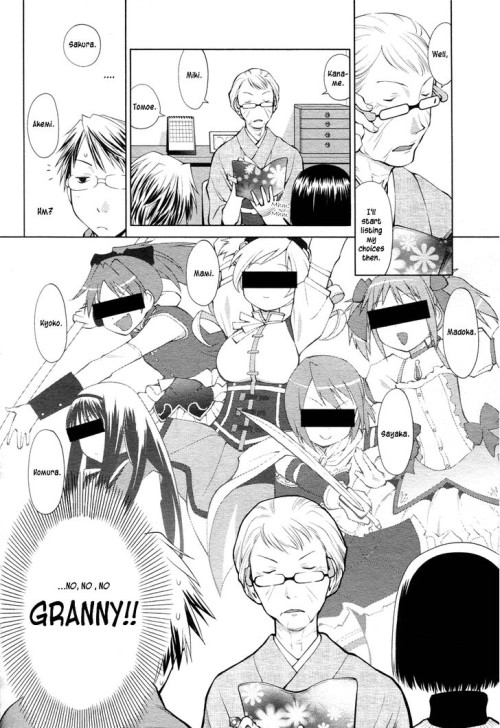
Have you read Spotted Flower? It’s a comedy manga by Genshiken creator Kio Shimoku, about an otaku and his pregnant wife. Actually, the premise isn’t that important for this post, other than to say that it made me realize something recently.

Let’s look at this page from Chapter 4:

Pretty funny and bizarre moment. But let’s modify it a bit.

Basically, thanks to Spotted Flower, I realize now that all of the girls’ names inMadoka Magica are unconventional in that they’re actually two first names strung together, a convention that I primarily associate with American superhero comics.

That’s all, really. Maybe I’ll actually talk about Spotted Flower some other time.

Meal, On-hand-to Eat: Strike Witches Rations

I like food, and I like shameless advertising involving food, but it’s often hard for the two to make sense. Sure, there was the Saki Tacos promo, but rarely do the components of edible promotion actually line up so well, instead usually involving some logos or stickers slapped onto the wrapping of a biscuit. Luckily, we now have Strike Witches rations, so that you can simulate the feel of being a teenage girl with propellers strapped to your feet fighting a war.

Japanese blog “Kyou no Gogo kara Honki Dasu” has a photo review of the product, which appears to come with “biscuit bars” and some kind of jelly to go with it. According to the reviewer, the biscuits are absurdly sweet, though I don’t know by what criteria he’s judging it (American candy tends to be sweeter than Japanese desserts for instance).

I’ll be honest, unlike Saki I don’t really know much about Strike Witches. I’ve only seen two episodes, but even so, I still feel compelled to buy this product, if only because it really exists.

The Fujoshi Files 38: Shu Mei

Name: Shu Mei (シューメイ)
Alias: N/A
Relationship Status: Single
Origin: Fujoshi no Honkai

Information:
Shu Mei is a 15-year-old exchange student from Taiwan. Though she was able to satisfy her desire for BL back home, the harsh environment of Taiwan (age restrictions, titles being canceled part-way through despite continuing publication in Japan) prompted her to study abroad in order to gain access to the full range of otaku merchandise. In Japan, she befriends a fellow fujoshi in Takako, as well as a fashionable closet fujoshi named Ageha. Like Takako and Ageha, she is a fan of Nanairo Shacho and delights in discussing pairings with her friends.

Shu Mei is an unusually sharp girl for her age, not only able to read people’s intentions down to the letter but also able to choose her words carefully enough to achieve a desired effect, whether it is comfort or agitation or subtle manipulation. She is also skilled in sewing damaged dolls back together.

Fujoshi Level:
Back in Taiwan, Shu Mei would often send her older brother to buy yaoi manga for her so that his innocent awkwardness in interacting with the male store clerk would provide fuel for her fujoshi mind.

Real Life Isn’t Graded

A while ago, I was linked by a blog which laments the state of anime fandom as a kind of “frivolous space” in which those without confidence try to shelter themselves, those with confidence try to assert a paper-thin authority in the form of blogging, and that in general geekdom is tending away from originality and towards imitation. Going into detail, it links to one of my old posts, in which I talk about a time when I was having difficulty engaging in a conversation because the people I was speaking to seemed to be without interests, and states that I am an example of the problem with geeks, who define people by their interest first and their actual selves second. Seeing as I am being pointed out as an example of what’s wrong with “nerds,” I feel I should respond to this “manifesto” and to take it as sincere (even if it might not be entirely so), not simply to act as a counter-argument but to clarify some of my own views on the ideas proposed by the post in question.

First, I’d like to address the accusation directed at me in particular, where the blogger points out that people should not be defined by their interests and that geeks should not think that having a hobby is priority one. For one thing, I agree. I think that it is a trap a lot of nerds fall into, thinking that their friendships and relationships should be predicated on common hobbies and tastes. However, that does not mean that it is an illegitimate way to begin to know someone, and the original point of my post was not to say that people who did not come prepared to talk about their interests were somehow lesser as individuals. Rather, as Starcraft commentator Day[9] once said, I like hearing people talk about things they’re passionate about.

It’s not about a specific hobby or activity or some kind of material substance, but that I find the best conversations to be ones where people are expressing something they love so much that you can see it in their faces. The “interests” in that sense are just a conduit to seeing the manifestation of joy and drive and desire, and it is how I personally connect with people best. While in hindsight I am aware that I could’ve approached that original conversation better in the first place, if wanting to hear people be passionate about something is a problem, then I am glad to be problematic. Perhaps I need to improve my own conversational abilities further, but I never claimed to be perfect.

Second, I’d like to respond to the title, “Real Life Isn’t Graded On a Curve.” And once again, I agree. Real life isn’t graded on a curve. That’s because real life isn’t graded at all unless you want it to be. Barring extreme situations like poverty leading to malnutrition, there is no rubric that the whole of mankind can reference for an exchange rate between money, health, passion, friends, family, whatever. But if you want to rank your life to see if you’ve hit a passing mark, then that “world” opens up to you, for better or worse. That’s not to say that people shouldn’t try to improve their lives or that they should be content to just coast along in life, but accomplishments are self-defined.

So when the post accuses artists on Deviantart of using art as an excuse for social interaction rather than a desire to perfect their craft, I have to simply ask, what is wrong with that? Yes, Deviantart has a sizable population of people who draw but may not have the training, talent, or desire to learn that will allow them to improve upon their mistakes and grow increasingly adept at making art. However, art, whether you believe in divisions of high and low and whether or not you believe it should have some higher purpose, is not so narrow and simple as to not have room for both those looking to perfect their craft and those who are using it as a conduit for social interaction and many other types of people as well. For some, it is an ends, for others, a means to an end, and it is short-sighted to believe that the only type of artist that should exist is one who seeks only perfection, or seeks only originality.

This applies more broadly to fandom (and people) in general. Occasionally I find myself wishing that anime and manga fans would engage their hobby more actively, with a greater desire to learn and to grow, and in that I can find some common ground with a person who wishes to see only the best of fandom and the best in fandom. However, I think it is a big mistake to disregard the ability for an online space to make people feel comfortable as some kind of “hugbox.” Competition is fantastic, but it is not the end-all be-all, and there is no absolute need to inject competition into a space where people do not need to be graded for performance.

Dead or Alive 5 and the Portrayal of Women

When Tecmo’s Dead or Alive 5 was first announced, the developers express the desire to portray their female characters better than they had in the past, with Team Ninja’s head developer Hayashi Yosuke even mentioning in an interview that “we’re trying to focus on the real women that surround us; the voice of a female, the mannerisms. We are being realistic about it.”

The DOA franchise has always been known for its sex appeal, from the first game’s available option to set level of breast jiggling to the Xtreme Beach Volleyball series where the girls trade their fighting uniforms for bikinis, so the promise of increased realism and improved depictions of women led to a some questions. Just what did they mean by real women, and could this fall flat on its face? Thus, although the guest appearance of Virtua Fighter protagonist Akira Yuki was the main headline, the new promotional trailer for Dead or Alive 5 is significant in that it gives us our first glimpse at just what the developers were aiming for.

Kasumi, main heroine, in DOA4 (left) and DOA5 (right)

Given the comparison image above and the statements from Hayashi, I think it’s clear that the changes to Kasumi’s look are not caused solely by improvements in graphics technology in the 7-year time span between the games. While Kasumi is still meant to be obviously attractive, there has been a bit of a reduction in her breast size and her face is substantially different, coming across as indeed “more realistic.” In fact, given the track record of the series, where greater realism could have meant shapelier breasts, Team Ninja has done a better job than probably anyone expected.


Ayane, Kasumi’s sister and rival, in DOA4 (left) and DOA5 (right)

Another feature that’s not really obvious without another character for comparison purposes is that DOA5 looks to be making more of an effort to give each character a more distinguishing face. When you look at any of the girls in previous titles, there isn’t much difference in their facial structure, andhen you look at the DOA4 versions of Kasumi and Ayane especially, they’re not that different from one another. With DOA5 however, their faces have substantial differences. They’re still designed to be attractive, and they still have similarly idealized bodies, but there seems to be an effort to vary the characters by more than their costumes and three sizes.

One element of Kasumi and Ayane’s newfound realism is that she seems to come across as “more Asian” than their previous iterations. Even though I haven’t actually seen this point discussed, I feel like this could potentially lead back to an argument concerning the appearance of anime characters where Japanese characters supposedly look “white” or distinctively “non-Japanese,” and that there may be some underlying psychological and historical reasons for making Japanese not look Japanese. The counter-argument to this has been that to assume the wide eyes of anime characters somehow equals “whiteness” is a cultural assumption in and of itself, but in the face of these revised looks, how does this hold up?

When I look at DOA4 Kasumi, even though her face comes across as “less Asian,” I still find that it comes across as more Asian than anything else, especially when compared to the non-Asian characters. And actually, Asianness and Whiteness as a binary is probably the most important mistake to avoid. Instead, the key difference is in another type of realism. In previous versions the characters come across across as more plastic and doll-like, especially in the eyes, with Kasumi’s own doe-like gaze, for example, acting more like an element of innocent seductiveness than anything else. In somewhat of a contrast, Kasumi in DOA5‘s eyes aren’t more realistic just because they’re closer to an Asian’s eyes in the real world, but because there is a sign of personality behind them.

I think the change in not just the way the characters’ eyes are, but the way in which they stare speaks towards what Hayashi meant when he referred to “the real women around us.” To some extent, this is aided by the improvement in technology, but it still requires the desire to move in that direction. Even as Kasumi continues to act as the sexy poster girl for the franchise, and while it can also be argued that her (and everyone else’s) bodies are ridiculous, I think that from what we’ve seen, Team Ninja actually seems quite serious about making the changes to the franchise that they promised.