The Fujoshi Files 19: Katou

Name: Katou (藪崎)
Alias: N/A
Relationship Status: N/A
Origin: Genshiken: The Society for the Study of Modern Visual Culture

Information:
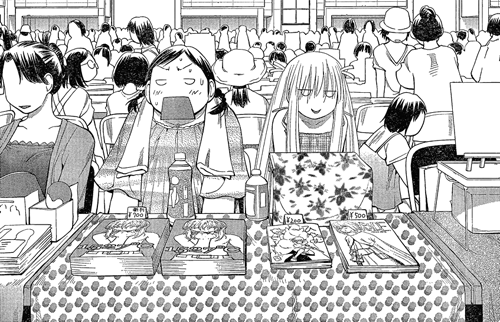
Katou is a member of the Manga Society (Manken) at Shiiou University in Tokyo, where she is often seen in the company of fellow club members Yabusaki and Asada. She is also an acquaintance of Genshiken member Ohno Kanako due to their common preference for older men.

Although not apparent at first glance, Katou is actually extremely beautiful but normally chooses to hide her face behind long bangs. Her hairstyle also works to obscure her personality; while she can be seen as quiet and even a little dark, her actual charisma and keen perception of group dynamics make her quite suited to inter-club diplomatic relations where even the aggressive Yabusaki fears to tread.

Fujoshi Level:
Little is directly known about Katou’s fujocity, but as Ohno considers her an ally it is safe to say that she is quite strong. In addition, like Ohno, she seems to be a guiding force for the other members of her club.

The REAL Truth of Madoka Magica

Seeing the Darkness of Madoka Magica

Ever since episode 1 of Puella Magi Madoka Magica, many bloggers have been making confident statements about how the show looks to be a dark subversion of the magical girl anime. While that is certainly accurate on some level, it seems to be the case that a lot of people don’t quite understand how exactly Madoka Magica is a subversion, simply because they don’t understand the subject itself. In other words, a good number of people writing about Madoka Magica don’t actually know the magical girl genre, despite the broad statements being made. Thus, I am going to address at least a few misconceptions.

Misconception #1: Magical Girl Anime Are About Good vs. Evil

Correction: Magical girl anime are about “before” vs. “after.”

While there are some shows which pit our heroine(s) against a dark force, the vast majority of magical girl anime and manga do not even factor in the good/evil dichotomy. Instead, they will focus on how the magic changes their own lives or how it changes the lives of those around them. Those shows which do have a good deal of fighting often have it in service to something else; in those instances, it’s generally more about protecting others than it is vanquishing villains. So when someone says that Madoka Magica is different because it doesn’t have “Good vs Evil,” they are basically incorrect in the sense that magical girl shows were never really about good and evil in the first place.

Misconception #2: Magical Girl Anime Say, “You Don’t Have to Change a Thing!”

Correction: Magical girl anime say, “the magic isn’t as important as who you are!”

Yes, the “Be Yourself!” message is fairly common in magical girl shows, but there’s a distinct difference between this statement and the misconception. One implies a static existence, while the other points to an active one. The self-improvement thus happens with the help of magical powers, but it is usually the catalyst for change, with the real reason coming from within.

Misconception #3: Sailor Moon/Nanoha is a Typical Magical Girl Show

Correction: Sailor Moon is more of a typical fighting magical girl anime and Nanoha is an atypical fighting magical girl anime, while a typical magical girl anime is more along the lines of Ultra Maniac or Fushigiboshi no Futagohime.

This ties in directly with misconception number 1 and it’s fairly understandable why people make this mistake. Sailor Moon is a very significant show in the magical girl genre, and for many anime fans the very first mahou shoujo anime they ever watched (myself included), but it wasn’t really typical for its time. Certainly it has had its influence on later series, probably most notably Pretty Cure, but Sailor Moon combined the magical girl anime with the team dynamic popular in live action tokusatsu and to a lesser extent giant robot anime, and used that as a platform to deliver action-packed fights, but don’t confuse what Sailor Moon added to the genre with what the genre is fundamentally about.

Similarly, Nanoha is a show made for otaku, taking the magical girl formula and targeting it directly towards an older male audience–much like Madoka Magica itself–but it draws a lot from Sunrise action and mecha shows and adds a cup of moe. It’s also understandable why this might be an anime fan’s main exposure to magical girls, as fans who might have avoided the genre as a whole may have been pulled in by what Nanoha did differently, but that is the Nanoha formula, not the magical girl one.

“So what exactly is Madoka Magica subverting, then?”

To understand the answer to this question, we have to know the basic theme of the magical girl anime, which is how magic can make your wishes come true, or let you do things you couldn’t before. This can be portrayed by having a character, generally a normal girl, come across their magical abilities, or it can directly target the audience (which it generally assumes to be young girls) and have a girl who already has magical powers from the start. Either way, a magical girl show typically says, “Wouldn’t it be great to be a magical girl?” You can see this in pretty much every magical girl show aimed at girls, be it Cardcaptor Sakura, Majokko Megu-chan, Shugo Chara, Minky Momo, Ojamajo Doremi, and yes, even Sailor Moon. If the show is geared more towards male otaku, then the theme might turn into “Wouldn’t it be great to know a magical girl?” but the opportunity magic gives you to change/better your life is the crux of it all.

On some level magical girl anime are about the exploration wish fulfillment, and when you keep that in mind the true nature “dark” element of Madoka Magica becomes clearer. The dreary aesthetic of the witch realms, the violence, and the ambiguous morality in the characters play a role, but the most important point to consider is how the magical mascot Kyubey offers the chance to make your wish come true at the “price” of becoming a magical girl. The fact that the wish-granting comes with some sort of unknown, unquantified, and unqualified cost is where the direct subversion is strongest.

“How much are you willing to sacrifice to make your wish come true?”

The Fujoshi Files 18: Yabusaki Kumiko

Name: Yabusaki Kumiko (薮崎久美子)
Alias: Yabu-Hebi (やぶへび), Yabuu (ヤブー)
Relationship Status: Single
Origin: Genshiken: The Society for the Study of Modern Visual Culture

Information:
Yabusaki is a college student at Shiiou University, where she participates in the school’s Manga Society, or “Manken.” Hailing from the Kansai region of Japan, she is quite proud of her background and purposely does not hide her Kansai dialect when speaking to others. However, she can also be somewhat easily embarrassed, namely when dealing with situations outside of her comfort zone such as the eccentric American fujoshi, Sue. She has some close friends, namely fellow club members Asada and Katou. She also often butts heads with former Manga Society member Ogiue Chika, namely due to the latter’s disparaging remarks about female otaku. Despite their initial animosity, they have become friends of a sort.

Yabusaki draws doujinshi, and while not much is known about Yabusaki’s taste in anime and manga, she appears to at least share some common interests with Ogiue. In time, much like Ogiue and her role in Genshiken, Yabusaki seems to have also assumed some position of authority within Manken. Her circle name, “Yabu-Hebi,” refers to someone who does too much to the point of inviting disaster.

Fujoshi Level:
While an artist who focuses her talents towards fujoshi interests, her fujoshi level is perhaps best exemplified by her staunch defense of the fujoshi lifestyle. Her frequent conflicts with Ogiue in the Manga Society show that she takes her identity as both an otaku and a fujoshi very seriously.

The Decision of Kyon, The Disappearance of Suzumiya Haruhi

The Disappearance of Suzumiya Haruhi does a lot for the popular franchise, giving significant development to its characters, most notably narrator and central protagonist Kyon. The film gives a lot to think about on both intellectual and emotional levels, and I find both my thoughts and feelings on it to be surprisingly intense, so I want to organize them to see if I can give myself some clarity and perhaps insight to others.

Just as a warning, while I am calling this a review, it is going to be EXTREMELY SPOILER-HEAVY.

Continue reading

Kine-Sis: Ore no Imouto ga Konna ni Kawaii Wake ga Nai

Back when I wrote my initial thoughts on Ore no Imouto ga Konna ni Kawaii Wake ga Nai (My Little Sister Can’t Be This Cute), I felt unsure of just how the show would turn out. While definitely an otaku-pandering show, it seemed to be capable of much more, and so I refrained from posting about it again until I finished the series right and proper. Now that the series is over I feel I can lay down a firmer opinion.

So, did Oreimo live up to its potential? And would it indeed have been better off if it wasn’t so focused on the “little sister” thing?

The answer to the first question is “not quite.”

Whenever I was asked what I thought of Oreimo as it was airing, I could only summarize my opinion by saying that for every good thing the show did, it also did something bad, and this didn’t really change too much as I kept watching. That doesn’t mean that the show didn’t improve some over time, but that every improvement was met by an equal and opposite reaction. Originally, the reason the show caught my attention was that underneath all of the basic little sister stuff, it seemed to address a deeper issue that concerns the otaku that are inevitably its own fanbase, that of self-confidence and self-image in otaku. It’s one of the themes that made me love Genshiken so much, so perhaps I was somewhat biased in seeing that, but little sister Kirino and the show at large brings forth the question, “Can I show my otaku self to others?”

In one episode, Kirino tries to make friends with fellow anime fans she’s met on the internet, but her initial attempt is stymied by the fact that her stylish clothes and lack of interest in bishounen and pairings creates an incompatibility with those with whom she was trying to speak. “We’re otaku, but we have nothing in common.” In another episode, Kirino has to face her best friend Ayase discovering Kirino’s obsession with little sisters and the pressure of having someone close to you, someone who genuinely wants the best for you, try to help but come across as attacking the very core of your being with very hurtful words. Her dad also discovers her collection, and will have no part of it. I know these problems. I’ve felt them myself and I’ve seen others struggle with them, and when Oreimo is on, it can really hit home for the anxious geek, at least in bringing those sore spots into the light.

Unfortunately, the resolution left something to be desired fairly often. While Kirino’s plight with making otaku friends turns out well with her eventually befriending Kuroneko and Saori Bajeena and showing that incompatible anime tastes doesn’t mean you can’t be friends, the solutions for the non-otaku finding out about her hobby essentially came out to going around them. In both the case of Ayase and her father, the problem was resolved by older brother Kyousuke purposely taking the blame for everything. This was noble of him and all, but the issue is that the problem itself is not confronted. I worried about this for a while, wondering what would come of it, if anything. In a later episode you see Ayase trying (and failing) to understand Kirino’s obsession and overcome some of her own prejudices so it didn’t completely disappear, but overall moments like those made the show feel like while it could bring the big guns to the party, it couldn’t actually fire them.

I know I might get criticized for expecting too much, and that I should have just treated it as an otaku-pandering fanservice anime, but it was not I who brought up the aforementioned otaku problems, but the show itself. If it had ignored those points or not have presented them as well as it did, I wouldn’t be basing on my opinion on that aspect, but it did. At its best, the show seemed genuinely heartfelt. Seeing Kuroneko “out of character” and just interacting with her younger siblings showed a very human side of her. It provided a contrast with the title of the show nicely, Kuroneko herself being the older sister and not in the “onee-san” character type kind of way, which complements Kirino’s own status as a not-quite “imouto character-type” little sister. At its depths however, Oreimo was like a show that talked realistically about cancer and the financial burden it can cause on the family around a cancer victim, only to magic the cancer away at the end or fall back on the same old stereotypes and tropes.

I don’t really regret watching Oreimo, as I feel that even though it didn’t do as much as it could have, it still accomplished something, and I can only hope that the otaku that could be helped by its message, however distorted, can benefit from it even a little. If it can do that, then I might just recommend it. As for the second question of whether the “little sister” aspect helped or hurt the show, I think it would have been a little better off if the show encouraged us more to see her as a girl first and a little sister second.

I also thought it could be pretty funny.

The Destiny of Kicking Ass

In very exciting news, Super Robot Wars Z 2 (Part 1) has been announced. Subtitled Break the World, the game has some surprising new entries into the world of SRW, from both recent and not-so-recent anime. Before I start elaborating on my thoughts concerning the lineup, I’m showing the complete series list uses for the game.

Italics means this anime has been in SRW before but was not in SRWZ.
Bold means this anime is brand new to the SRW franchise.

Muteki Choujin Zambot 3
Muteki Koujin Daitarn 3
Muteki Robo Trider G7
Space Emperor God Sigma
Space Warrior Baldios
Rokushin Gattai Godmars
Sentou Mecha Xabungle
Armored Trooper VOTOMS
Armored Trooper VOTOMS: The Last Red Shoulder
Armored Trooper VOTOMS: Red Shoulder Document – Roots of Treachery
Armored Trooper VOTOMS: Pailsen Files
Super Dimension Century Orguss
Mobile Suit Z Gundam
Mobile Suit Gundam: Char’s Counterattack
New Mobile Report Gundam W
After War Gundam X
Turn A Gundam
Mobile Suit Gundam SEED Destiny
Mobile Suit Gundam 00 1st Season
Choujuu Kishin Dancougar
Juusou Kikou Dancougar Nova
Shin (Change!!) Getter Robo: Armageddon
Shin Mazinger Shougeki! Z Saga
Earth Defense Corp. Dai-Guard
The Big O
Overman King Gainer
Choujuushin Gravion Zwei
Genesis of Aquarion
Code Geass: Lelouch of the Rebellion
Tengen Toppa Gurren-Lagann the Movie: Gurren Saga
Macross F
Macross F the Movie: The False Songstress
Psalms of Planets Eureka Seven: good night, sleep tight, young lovers

There’s a lot to talk about here, especially with shows like Code Geass, Gundam 00, and a major curveball in the form of Dai-Guard, but probably the two newest entrants which are the biggest deals are VOTOMS and Gurren-Lagann, though for somewhat different reasons.

VOTOMS hails from early 1980s and is considered among the “realest” of real robot anime. It has a grittiness to its robots and overall setting that is rarely seen in mecha, let alone anime in general, as can be seen from my reviews of the series (though I must apologize for never actually writing my final review). For years people thought it was a shoe-in for the SRW series, but when years and years went by and VOTOMS still wasn’t included, fans started coming up with excuses. Oh, maybe the robots would be too weak and bland, or Chirico would be too strong of a pilot, or it somehow wouldn’t fit in among the earth-shattering forces that populate the roster. But as if to lay those possibilities to rest, SRWZ2 puts it into the same game as Gurren-Lagann, one the biggest example of escalating power levels and over-the-top, universe-rending attacks in a robot anime ever (which is the “problem” with Gurren-Lagann), as if to say that while all of those possible reasons may have once been valid, they’re history. Sure this first part of SRWZ2 is going to avoid having to deal with the really crazy stuff, but it’s inevitably going to have to confront the big guns of Gurren-Lagann by the next game. And it’s the movie version on top of that!

I understand that the reason this lineup works is that the plot of the game is based heavily on Orguss, which involves going to different dimensions and universes, so they can even do things like have Shin Mazinger where they once had Mazinger, and the Eureka Seven movie to replace the TV series, but that’s all right. Plot was never exactly the strong suit of the SRW games, after all, as the latest anime proves.

So to conclude, various fanboyish notes:

-Can’t wait to see Zeus in action.
-Mazinger Z is going to get not one but two crazy powerful finishers. No need for the Kaiser here!
-I wonder if Zambot, Daitarn, and Trider are going to have a Final Muteki Special. Sun, Moon, and Phoenix?
-Re: Godmars – ポゥーン
-I wonder how much Dai-Guard will cost to replace if it blows up in battle?
-I’m looking forward to the VOTOMS BGM.
-I know I’m jumping the gun and putting expectations on the next game, but Amuro vs Ribbons? Hell yes.
-Setsuna F. Seiei gives the best (worst) pep talks.
-I think movie Eureka and Fyana from VOTOMS will get along swimmingly.
-I wonder if the geass will factor into gameplay in any way, shape, or form?
-Aquarion and Shin Getter better not accidentally deface the moon too much or they’re going to make Loran Cehack sad. They’ll also make Garrod upset but for a different reason.

My Anime Regions

Born and raised in the US, having studied in Japan about 5 years ago, and currently living in the Netherlands, I consider myself quite fortunate to have been on three different continents for long periods, enough to say that I wasn’t simply a tourist. The benefits have been many, but the one that is perhaps most important to me is that I’ve gained a bit of perspective on how things work differently from country to country. As an otaku, this of course applies to my pursuit of anime and manga as well, and so I want to just talk about my own firsthand experiences in this regard.

Before I go into detail though, I think it’s important to highlight a few points about myself:

First, my English is my native language, and I have studied Japanese for a number of years and am reasonably fluent in it. I cannot read any other languages to any decent extent, and I can only understand one other when spoken.

Second, my available “access points” varied from place to place, meaning television, internet, etc. Also, I was in Japan before streaming anime became a big deal, whereas currently I am living through the age of the official streaming simulcast alongside everyone else. Well, sort of, but I’ll get into that later.

United States

Now because I’m native to the United States, I’ve seen my fair share of how anime/manga and its surrounding fandom and industry have changed over time, but as I’m not looking to make this a history lesson I’m going to mainly focus on the state of obtaining anime from about 2005-2010. In that period, whether it was in college or back home, I had cable television and high-speed internet, as well as the fortune of living in a city with Japanese book stores (or at least a Japanese grocery when it came to college). I used the TV and internet to varying degrees to satiate my desire for anime, and as my Japanese improved I was encouraged to start buying manga in Japanese as they tended to be less expensive even with import mark-up, especially if they were used books.

Even ignoring the untranslated titles, anime and manga have been quite accessible, whether it’s through downloading, Cartoon Network’s (increasingly sparse) anime line-up, or just going to the Barnes & Noble to pick up a volume of something. Companies are currently trying to increase their internet presence, with more and more titles, including older ones that are no longer available otherwise, being streamed on sites such as Hulu and Crunchyroll. The genres available were and are surprisingly diverse, particularly when it comes to manga, though they don’t cover everything Japan has to offer, just because some things simply do not sell in the US (and some titles that were released certainly did not either).

It’s important to note that anime took quite a long time to get big, and it was only really with the advent of Pokemon that it became such a big deal. While it’s come quite a long way, it’s still considered quite a “niche” thing, and a lot of works which can survive in Japan based on overall higher readership there will most likely tank in the US. Anime as “anime” is still quite young compared to the rest of the world. Anime and manga are definitely accessible in the America, it just takes a bit of effort to really sink yourself in, and although it takes a while to feel the limitations in genre, you may eventually feel it. Also remember that the US is big, and that my experience can be quite different from someone living in, say, the Midwest.

Japan

In Japan I had television but no reliable internet, and while I hear that most otaku in Japan use a Tivo, I unfortunately did not own one, which meant that I had to follow the official schedule in order to keep up. While it could be trying at times, there was a certain thrill in planning my days around the TV broadcasts. The fact that Futari wa Pretty Cure Max Heart and Zoids: Genesis ran simultaneously on two different stations meant I had to choose, which is something that has never really been an issue with anime fandom in the US, at it was rare that two stations would be showing anime at the exact same time. I myself didn’t have to deal with this since the days when Pokemon would chase Digimon out of its time slots. If there was a show on late at night that I really wanted to catch, say, Glass Mask, I would go to sleep early so that I could wake up at 1 or 2am, watch it, and then go right back to sleep. I also remember getting home from a trip to Akihabara, pedaling hard as I could so that I wouldn’t miss the beginning of Gundam SEED Destiny. That also reminds me of when I had faith in Gundam SEED Destiny. Those were innocent times.

(By the way, I chose Pretty Cure).

Manga though, it’s hard to live in Japan and not see comics available for sale. In addition to larger bookstores and specialty shops, you could find the latest manga magazines in convenience stores, your Jumps and Sundays and such. While those stores didn’t carry everything, you could still find some surprising titles; it was through a convenience store that I found the Hulk Hogan manga. The ubiquity of manga was especially advantageous for just sheer exposure: by buying just a few magazines you could get a pretty wide range of works, from good to otherwise.

One unique advantage I had while in Japan was that I had access to the library of the school at which I was studying abroad, which meant access to their extensive collection of anime on DVD. Nowadays it’s not that hard to go online and find all these obscure titles, but back in 2005 this library’s DVD collection went well beyond what was fansubbed (and probably still does today), with series such as Zambot 3 and Tetsujin 28 in their entirety. I know I just picked two robot titles too, but trust me when I say there was more.

So when it came to anime or manga, despite my internet situation I probably had more titles available to me than I ever had before or since. The only trouble of course is that it’s all in Japanese, and while my Japanese is good I’m still not comfortable with it, let alone comfortable with it five or six years ago despite the rapid improvement that living in Japan itself caused. In any case, the main point to take away here is how easy it was to just be surrounded by the stuff.

The Netherlands

A few months ago, Irish anime podcaster Eeeper wrote this letter where he pointed out the difficulties in being a European anime fan, particularly in this current age where anime is officially streamed. Before I arrived in Europe, I could see his point and could agree, but it was only after I actually started living here that I could really feel it.

Having high-speed internet but no TV here, online is mainly how I watch things. When it comes to the streaming of anime, Europe seems to get left out pretty often. The entirety of Hulu is off-limits save for a single, terrible-looking show (not anime in case you’re wondering). Funimation’s video site automatically redirects to a generic company page. This is something I previously only really experienced when I couldn’t watch the official Japanese-only episodes of Bakemonogatari on their official site. It’s not all bad, as some shows on Crunchyroll work just fine. However, others do not, and you get these really odd situations, like how Naruto Shippuden is available for me to watch but the original Naruto is region-blocked. The fact that I just came from the US, where I recently watched all of Kekkaishi and Slayer Revolution (and Evolution-R) on Hulu, makes me very aware of this disparity. That said, internet here is quite fast and what I can watch I get in a flash.

Manga is a bit of a different situation. In terms of the internet, no official sites as far as I can tell have blocked their manga from European access. In terms of actual physical books, comic stores aren’t amazingly common in the Netherlands, but cities are generally small enough that you don’t need too many, and cities with more comic stores are only a short train ride away. Going to Amsterdam takes about half an hour, which is longer than it took me to get to Manhattan, and the selection of manga (as well as European comics) can be surprisingly extensive, usually taking the form of English-translated titles  imported from the US or Dutch-language books. One interesting thing to note is that some titles get translated into Dutch before they are translated in English, possibly owing to the fact that manga and anime have had a strong presence in Europe way before the “anime boom” ever hit the United States. In fact, a friend told me that Urasawa’s works were available in Dutch way before they were in US bookstores. It might also have to do with the proximity to Belgium, which has its own rich comics history and influences the regions around.

On that note, one big difference with the Netherlands and Europe more generally is that everything is more packed together. While traveling by train in Japan is somewhat comparable to doing so in the Netherlands, Japan is still an island, while going from where I live to Belgium, an entirely different country, is a mere 3-hour train ride. Europe also gets a good deal of titles that the US does not, but they’re mainly for people who speak French and alas neither I nor Eeeper (I assume) are capable of this feat.

Final Thoughts

So there’s a bit of my anime experience across three countries. I of course cannot speak for every anime fan who has lived in the countries I have, let alone the countries where I have never set foot, but I hope that this post helps to bring a bit of understanding to fans around the world, to see the varying circumstances that affect our fellow fans. If you want to chime in with your own experiences for any country/area that I did not cover, feel free.

Best Anime Characters of 2010

BEST MALE CHARACTER

Koibuchi Kuranosuke (Kuragehime)

A handsome ladies’ man from a wealthy background with a talent for crossdressing, Koibuchi Kuranosuke is larger than life, the kind of character who you would almost be able to say is “too unrealistic” if weren’t for how natural and convincing he is as an individual, and if you’re used to this sort of thing via extensive experience with shoujo and josei, he stands out that much more. Straightforward yet enigmatic, helpful yet selfish, intelligent and savvy yet frightfully naive at times, Kuranosuke is equal parts intriguing stranger and close personal friend, and it makes him both fascinating to watch and easily relatable.

From the very first time he saves Clara the jellyfish and enters Tsukimi’s life, you know that Kuranosuke is a man you can respect, even before you know that he’s a man. He’s not a saint and he won’t solve everyone’s problems as he has his own to deal with, but he tries hard to help others, in particular working to help Tsukimi and the rest of the “Sisterhood” recognize that their stereotypes of themselves are self-imposed. It’s a fight I can definitely get behind.

BEST FEMALE CHARACTER

Kurumi Erika, Cure Marine (Heartcatch Precure!)

Though I can describe Kurumi Erika by her general traits — talkative, friendly, clever, energetic– I feel that it doesn’t quite do her justice. With Erika you have someone who is much more than the sum of her parts, an endearing character whose traits cannot simply be divided into “strengths” and “flaws,” but are aspects of Erika that have both positives and negatives. Erika’s gift of gab is tempered by the perils of being a motormouth. She is incredibly hardworking and focused when it comes to her interests and will go out of her way to accomplish her goals, but can be incredibly lazy and ignorant towards anything that fails to inspire her passion. All of this stems from Erika’s sense of emotional honesty and her full-speed, no-brakes approach to life.

In a series with particularly strong characterization, Erika stands out in a big way, and I hope that she and her fellow Cures have a positive impact on not just the way characters are written for anime, but also how they are received by the fans and how they may influence those watching to better themselves. Erika feels real, not in the sense of evoking reality or being a simulation for it, but in that she is an emotionally complete individual. She is an inspiration for anyone who has every hesitated due to fear of being unable to grow as an individual.

Final Thoughts

Though not intentional on my part, I realized while writing my thoughts on Kuranosuke and Erika that the two have much in common. Both are outgoing with sunny dispositions. Both are highly passionate about fashion and believe in the positive transformative effects it can have on people. And both are eager to meet and help others, but their enthusiasm and extroverted natures can make them seem abrasive to those who can’t keep up with their pace. They feel human. On an additional storytelling level, both are able to show that you can have incredibly straightforward and simple characters that are also complex and fully developed, whether it’s a show for adults (Kuragehime) or for children (Heartcatch Precure!). Perhaps most importantly, having people who can encourage you to grow for the better can be incredibly uplifting, whether they’re real or fictional, and that’s exactly what they do.

Have You Heard About the Yaoi Role Playing System

It’s called “Big Eyes, Big Mouth.”