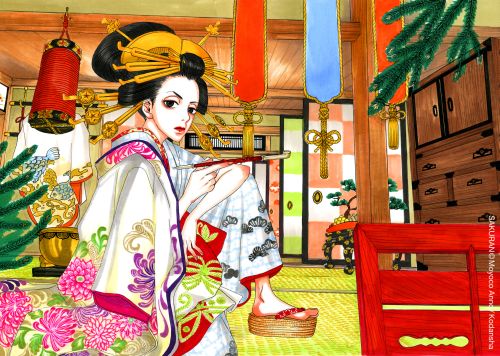
Seeing Manga for What It is

New York Anime Festival, much like the teenagers who attend it, is a fairly young convention especially when compared to other cons. This year saw it merged with its sister convention, the New York Comic Con, and while I did not attend, a number of reports have stated how the Comic Con side so dominated the Jacob Javits convention center that the Anime Festival became relegated to what has now been commonly referred to as the “anime ghetto.” There is no word as to why the ghetto formed, or whether the sharp delineation between comics (and everything else) and anime was a sign of disrespect towards anime fans, but regardless of intent, it is quite clear that things were Different. Dave over at Colony Drop writes:

Far from the exhibition floor, there was an invisible line in the Javits Center that weekend: one that denoted where the comic con ended and where the anime con began. I marked this line down in my mind late in the first day, when I stopped to make a phone call and saw my first pack of running, screaming Hetalia cosplayers. This display was immediately followed by a creepy girl who was going around the hallway alone and serially glomping any character she recognized. It had taken me all day to get there— NYCC offered me more as a gamer than NYAF offered me as an anime fan— but there was no mistaking that I was now in Anime Country.

That invisible line that Dave mentions is largely social; all the con did was greatly exaggerate it through the structure of the convention center itself. Anime fans want to be seen as anime fans. They want to be different and special. Others are glad to oblige, doing so by expressing their disdain for “those damn anime kids.” In either case, a division is formed, between “anime and manga” and “not-anime-and-manga.” Meanwhile, others are quick to step in and give the message that “it’s all just cartoons and comics anyway.”

The trouble with both the acknowledgment and disapproval of such categorizations is that each side has its own fair share of pitfalls. By regarding manga as special (and from here on out I’ll be sticking to manga for the sake of convenience), supporters can end up tying it down, obscuring (or even willfully ignoring) the fact that one of manga’s real strengths is its sheer diversity in style, content, and tone. Instances of this can be seen in the way that early iterations of the Morning International Comics Competition (back when it was called the Morning International Manga Competition) were less aesthetically diverse than the more recent ones. This is further compounded when its detractors regard manga as being narrowly defined by negative traits. And yet, while it is in no way disrespectful to refer to manga as “comics,” doing so becomes problematic when the traits that have developed as the result of a unique comics history are intentionally brushed aside for the sake of generalizations. A person who regards manga as being no different from other comics inadvertently disregards the histories of comics cultures the world over.

One mistake people commonly make when they talk about what separates one form of comics from another is that they start at the visuals first. Some never get beyond the surface, and they define a form of comics entirely by the look of characters and details. Others can look beyond the first layer and delve deeper, finding meaning behind those images. Now taking the top-down approach is actually perfectly valid, but it only provides half of the total picture. By also taking a bottom-up approach, you can begin to see how the various non-visual contents of stories in comics manifest themselves on the pictorial level. It is good to not only see how the river-like flow of panels in manga affects storytelling for instance, but also how the storytelling can influence the panel structure in manga. From there, you can really begin to see what makes manga special, and at the same time discover its connections with the greater category of “comics.”

It can seem like a complete contradiction to say that manga should be seen as both unique and like all other comics, but that’s only the case if you define it in black and white terms. Look carefully, and you’ll see that the actual lines which separate manga from other forms of comics are actually quite nebulous. Rather than having manga’s identity be frozen in time, forever unwavering and unchanging, it is important to see manga as the result of decisions made over the years, trends that ebb and flow, and the combined efforts of people who dared to pick up a pencil and merge words with images in sequential format. Even as comics creators increasingly take notes from their peers two continents away and the divisions begin to crumble, they do not automatically wipe out what has come before. Just the same however, manga is not beholden to its past, and can grow in unpredicted ways. The past provides a foundation for the unseen future.

Heroman? What About Villainman?

Question: What’s the difference between Anpanman and Heroman?

The answer is, Anpanman has an arch-enemy.

I recently finished Heroman, the BONES collaboration with American comics legend Stan Lee, and while the show had some positive qualities to it, it fell flat overall, due in no small part to a long run of episodes in the middle which pretty much just meandered about. But in the list of things the show could have done better, what really stood out to me was how Heroman and Joey Jones never got a proper supervillain to call their own. Sure, Heroman and Joey have adversaries and rivals, namely the insectoid Skrugg and their leader Gogorr, as well as Dr. Minami and “Anime Flash Thompson,” but none of them felt quite right, even if two out of the three turned out interesting in the end.

Gogorr had the most potential to be an arch-enemy.  As a galactic conqueror that can augment and evolve his body for combat, he bears a great resemblance to Vilgax, the primary villain in the American cartoon Ben 10, but the main difference here is that, unlike Gogorr, I would most definitely consider Vilgax to be Ben Tennyson’s arch-enemy. With Ben and Vilgax, not only could you sense a greater degree of personal animosity between the two, but Vilgax’s actions directly cause Ben to get his powers in the first place. In contrast, Gogorr feels a little too distant from Joey both emotionally and thematically to be a proper nemesis. Another factor is that the way Gogorr is presented makes him feel a little too powerful to be an arch-enemy, too much of a Goliath to Heroman’s David, and too much of an Archmage to Heroman’s Goliath.

Left: Vilgax, Right: Gogorr

A lack of arch-enemies might seem like an odd thing to single out, and to be sure the inclusion of one wouldn’t have solved all of Heroman‘s problems, but the reason I’m focusing on the concept is that the arch-enemy is a near-integral part of what makes superhero stories feel like superhero stories, and as a show at least partially based on the American superhero concept, Heroman could have benefitted from such a character. On a more intellectual level, they provide a nice foil for the hero, holding up a mirror to the hero’s own abilities either through being the opposite or being the same (or sometimes both), but on a simpler level supervillains expand the world of the superhero by having a great evil that can be vanquished by a great good, highlighting both protagonist and antagonist. I wouldn’t go as far as saying that Heroman needed a relationship with a villain on par with Superman/Lex Luthor or the Fantastic Four/Doctor Doom, but just having someone to stand in contrast to Heroman and Joey would go a long way in highlighting the “What does it mean to be a hero?” theme that persists throughout Heroman.

Potato Complex

It’s been about two months since I started my life in the Netherlands, and in that time I’ve been exploring the country as best as I know how: through its cuisine. Since arriving I’ve had numerous opportunities to try out various foods, in restaurants, at home, and out on the street. It’s a delightful mix of the new and familiar, where even the more mundane things take on an element of excitement. Did you know that chocolate sprinkles are a common bread topping here?

Having once been a colonial power, Dutch food consists both of dishes native to Dutch culture and those incorporated from other parts of the world, especially Asia. I noticed, however, that when I asked the people living here about Dutch food, they pointed me more towards the latter than the former. Some even went as far as telling me that “there’s no such thing as Dutch cuisine.”

Huh?

The dish above is called “Hutspot,” a mix of mashed potatoes, carrots and onions, often served with a piece of meat such as a chuck roast or shoulder. It is widely associated with a holiday called “Leidens Onzet,” which celebrates the end of the siege on the city of Leiden back in the late 1500s. Like many foods, it is a product of circumstance where the ingredients consist of whatever was available. Hutspot itself is a variation on “Stamppot,” which I believe is a more general term for mashed potatoes mixed with vegetables. Of course, when I asked people about Stamppot and Hutspot, they talked about how it isn’t very exciting and how it doesn’t really compare with Indonesian or Thai or French or Italian. A similar response is given for the enormous Dutch pancake, as well as the Croquette, a deep-fried stick usually with some kind of ragout or potato inside.

Allow me to put on my AMERICAN hat for just a second to say that, where I come from (America in case you forgot), mashed potatoes and fried finger foods are widely considered to be “awesome.” They are the things kids and adults alike look forward to eating. When I go to a restaurant and order steak, the side I get most often is potatoes, mashed. What is there to be ashamed about? I know that France and Italy and Germany are right there, and that their cuisines have found popularity all over the world, including in the Netherlands itself, but it just gives me the impression that Dutch food is something that produces shame, and I don’t think that should be the case. I’d love to have a Dutch restaurant in New York City. Why isn’t there one?

When I think about it, the embarrassment I see over “Dutch” food is not that different from the kind I see from anime fans. There’s a complex that surrounds the anime fandom, one that manifests itself in various ways, whether it’s otaku being embarrassed about the anime they like, fearing being associated with “those” anime fans, or speaking of some great divide, be it genre-based, gender-based, or generational. I want Dutch people to be proud of Dutch food. I want anime fans to be proud of anime (and anime fans). It got us this far, didn’t it?

Of course, on the other side, there’s the anime fan who goes so far as to boast anime or their favorite types of shows are the best things out there and that everything else pales in comparison. At this point, they become like the guy who boasts about his trip to France and how ever since then all over foods have tasted like dish soap.

Or perhaps a more apt example would have been the guy who goes to Japan.

“Hey, Your Sister’s Pretty Cute,” He Said

Ore no Imouto ga Konna ni Kawaii Wake ga Nai, literally “My Little Sister Can’t Possibly Be This Cute,” is a Fall 2010 anime based on a light novel by the same name. Known as Oreimo for short, the series follows an “average” high schooler, Kyousuke, and his hardcore otaku of a younger sister, Kirino. Though only two episodes are out as of this writing, the show quickly explains the unwieldy title of the show by pointing out that “This Cute” basically means “like the loyal and affectionate little sister character you’d find in a moe anime or a visual novel.”

However, while the series emphasizes how Kirino is not “This Cute,” Kirino is shown to be so objectively good-looking that she works as a clothing model. Kyousuke expressing how he cannot see Kirino and her disrespectful, overachieving attitude as anything resembling adorability is akin to a man going into a crowd and loudly proclaiming his absolute hatred for chocolate. Even if he were telling the truth, an outburst like that would still make everyone think of chocolate.

The degree to which Kyousuke and the show itself remind the viewer that he is as far from a sister complex as possible reminds me of a certain situation in fanfiction, where an author notorious for creating Mary Sues, impossibly perfect characters often used as wish-fulfillment for the writer, tries to prove that they are capable of doing otherwise by creating extremely flawed characters. Ultimately though, these “Reverse Mary Sues” are just that: the tails to the Mary Sue’s heads, equally as “special” in terms of how much attention is given to them, even if it’s just about how imperfect they are.

Does that describe Kirino? Well, the easy assumption would be that Kirino exists on one side of the coin while the standard “moe little sister” resides on the other, but that wouldn’t be quite accurate. Kirino is not simply the opposite extreme, but more of a moe little sister character who also incorporates elements from the more established little sister archetype of smart-alec brat seen in American shows such as Boy Meets World and Full House and perhaps best exemplified in anime by Pop, the younger sister of the titular Ojamajo Doremi. Kirino, who nonchalantly disrespects her older brother, complains about a lack of privacy, and also expresses vocal disgust at the idea of a sibling romance, has those bratty qualities juxtaposed with the amount of time and effort the show devotes to putting Kirino’s cuteness on display.

By establishing Kirino as being not-cute-but-actually-really-cute, as well as giving her qualities closer to a more antagonistic and thus arguably more “realistic” younger sister, it begs the question of whether or not Oreimo is trying to diversify the concept of the moe “little sister” by incorporating those bratty elements, perhaps in response to any possible growing weariness with established and rigid moe tropes. In other words, could Oreimo be an attempt at reconfiguring moe from within, and if so, is that a sign of the times? Assuming these to be true, it would not be Kirino herself who equates to the Anti-Sue, but rather the genesis of Kirino as a new type of little sister bearing similarities to the initial motivation by which the Anti-Sue is formed, though handled with more skill and professionalism than your stereotypical fanfiction.

Further complicating the whole matter is the fact that Kirino herself is an otaku fanatically devoted to the “little sister” type who, instead of envisioning herself as the little sister yearning for the affections of her older brother, sees herself in the role of that fictional older brother. Moreover, Kirino is actually embarrassed about her hobby and is a closet otaku. When these aspects of Kirino are taken into account alongside Kyousuke and the degree to which he expresses his disinterest in little sisters both “real” and “fictional,” Kirino’s existence as an “attractive girl” actually takes priority over her existence as a “little sister” in certain respects. In particular, by making her the “otaku” and making Kyousuke the “normal one,” the (male) otaku watching may find themselves relating more closely to Kirino than her older brother, despite gender differences. That’s not to say that she is the viewer surrogate, of course, as Kirino is still very much designed to be the object of desire for the audience.

Essentially, Kirino’s charm starts to become that of a cute girl who is also someone’s younger sister, something is much more applicable to the real world than the typical visual novel archetype, seeing as how many females out there are younger sisters to someone. At the same time however, the trappings of Oreimo, namely the frequent and prominent use of the term “little sister,” also bring that fandom/fetish to the forefront of the viewer’s consciousness. Oreimo thus occupies a sort of contradictory space, where it appears to both reinforce and subvert little sister moe by being a variation on the established formula which also goes about reminding the viewer of that original formula. In doing so, the series then casts into question, perhaps unintentionally, the nature of the “little sister” character itself, as well as whether or not someone can enjoy a character who falls into a moe archetype without being specifically catered to by that archetype’s inherent qualities. Given such a contradiction, I have to wonder, is the overt “little sister” aspect of Oreimo a boon or a detriment? Or to put it another way, would Oreimo be better off if it weren’t about a little sister at all?

That all said, it’s only been two episodes. I’ll have to ask again at a later date.

The Cross-Cultural Exchange of a Couple of G’s

In 1996, Russian-American animator Genndy Tartakovsky premiered Dexter’s Laboratory and pioneered the thick-lined,”flatter” animation style. This style can also be seen in Samurai Jack and Star Wars: Clone Wars, as well as in Powerpuff Girls, where Genndy was director.

Flash back a few month to 1995 and we get one of most the influential anime ever, Studio Gainax’s Neon Genesis Evangelion. Gainax, known for a variety of works from various genres, are especially fondly remembered for their giant robot fare, most notably Evangelion but also Aim for the Top! and Tengen Toppa Gurren-Lagann.

Now, in late 2010: Gainax’s latest anime is a tongue-in-cheek cartoon about a pair of misfits and heavily utilizes thick outlines and very flat character designs, while Genndy Tartakovsky’s newest show is an honest, non-parody attempt at a super robot-themed series. Both series’ debuts occurred less than three weeks apart from each other.

While the relationship between Japan and America’s cartoons and comics have been put in the spotlight recently with collaborations such as the joint Iron Man and Wolverine projects involving Marvel and Studio Madhouse, the fact that Genndy Tartakovsky’s Sym-Bionic Titan and Gainax’s Panty & Stocking with Garterbelt have come into existence so close to one another puts an even greater focus on the two nations’ cartoons. Here in one cross-section of time, we can see the active/passive exchange of ideas as these cultures’ animation styles appear to intertwine so tightly that they sling each other across the Pacific Ocean.

Neither show is so like the animated series of the others’ country that they come off as weak imitations. Sym-Bionic Titan takes fusing robots, a fight against a powerful invading force, and various other giant robot tropes, mixes them in with Genndy’s own character aesthetics, and places the story firmly within America and its own cultural norms. Meanwhile, Panty & Stocking utilizes the visual elements and humor of early “Cartoon Cartoons” (as Cartoon Network referred to them) while also injecting very anime-esque expressions and reactions from its characters, most notably in their faces, and also ramping up the humor to more “adult” levels. The two series and their hybrid styles reinforce both the idea that creativity is not limited by national borders and that individual cultures can still maintain some of their distinctiveness when it comes to artistic output.

This is not a bad thing.

As a final aside, the personal robot used by the character Lance in Sym-Bionic Titan reminds me of the titular robot from Galaxy Gale Baxinger.

I can’t be the only one, right?

DO YOU WANT TO EAT DURING NEW YORK ANIME FESTIVAL/COMIC CON?!

The Brotherly Combination of New York Comic Con and New York Anime Festival is this weekend (Oct 8-10), and while I cannot go this year due to that pesky thing called the Atlantic Ocean, I still want to help out any way I know how. As of late, I’ve noticed that people planning on attending the con, especially those from outside of NYC, are concerned about where to go eat, and it just so happens that I love eating and eating in New York.

First thing first however, there are some “harsh” truths I have to get out of the way. Namely, the Jacob Javits Center, located between 34th St and 39th St on 11th Ave by the Hudson River, is quite a ways away from everything else. Even 10th Ave can feel distant, and the closest trains, the A, C, and E (aka the “blue” trains), are as far as 8th Ave. So unless you want to pay those ridiculous convention center food prices, you’re going to have to walk, and you’ll need at the very least 10 minutes to even get to the closest place, a McDonald’s on 34th St and 10th Ave which undoubtedly be packed. Another thing to keep in mind is that, generally speaking, “avenues” are much longer than “streets” in New York. Remember that as you plan out where to go with the time you have.

Oh, and seeing as I’m not in NYC, I cannot verify everything will be as I say it is for the weekend. Food places open up and close all the time in New York, after all. My apologies!

The simplest method to obtaining food is to go along 34th and you’ll hit a number of other fast food places. There’s a Burger King, two Subways, a Wendy’s, and even a Chipotle’s by the time you reach 8th Ave. Of course if you take the food to go, you’ll save even more time.

But I hear you asking, what if we want to sit down and eat, maybe take our time? Well first, I would have to ask if you planned on going back to the con center, and second, I would have to once again point out the New York City subways. They may not be the most reliable, but they’re plentiful and they go to almost every nook and cranny in Manhattan, let alone the other New York City boroughs. At that point, I would say just find whatever, but I know that a lot of people are distinctly looking for places to eat near the Javits.

Once you understand that “near” is a relative term, you have quite a few options. There are multiple diners along 34th, such as the Tick Tock Diner and the Skylight Diner. All of them are decent enough, and good for holding a large crowd if you get there at the right time.

Also keep in mind that you’re in Hell’s Kitchen, and going north along 9th Ave (and to a lesser extent 10th Ave) is going to reward you with any number of restaurants of varying costs. As a general rule, the further up you go, the pricier the food will be, but you can still find places, like Burgers & Cupcakes on 9th Ave between 35th and 36th. According to a friend, there’s a couple of excellent bars as well, Pony Bar and Rudy’s. Don’t be scared by the appearance of smaller locations either, as they may very well serve good food. One such place is Tehuitzingo Deli Grocery on 47th St and 10th Ave, which serves the best tacos I’ve ever eaten. Try the cow tongue!

If you’re really unsure of how you want your dining experience to be, then my location of choice is 38th St between 7th and 8th Aves. Not only is this the street where you can get my beloved Go Go Curry, but if you’re looking for places that can hold more people, there’s Lazarra’s Pizza, a sit-down Balkan restaurant called Djerdan (if you’re a real anime fan you’ll get the Musaka and shout, “MASAKA?!”), Korean Fried Chicken at Bon Chon, and even a Chinese restaurant called simply 38th Street Restaurant and Bakery which serves food closer to the kind you’d find in Chinatown than your typical General Tso’s fare. Also along 8th Ave between 38th and 37th is 2 Bros Pizza, which has convenient $1 slices. There’s also a 42nd Times Square Yoshinoya, in case you want to quickly feed your desire for Japanese food and Go Go Curry is too full.

If you have a bit more time than that and a bit of cash to lay down, then I must recommend Tony’s Dinapoli, a family-style Italian restaurant located on 43rd St between 6th and 7th Aves. The place is popular so you’ll need a reservation, but the portions are big and the food is hearty, and they’re used to housing large crowds.

And if you’re vegetarian, you may want to check out some of the nearby Indian restaurants. While I haven’t been to it myself, the closest one appears to be Tawa Tandoor, on 34th St by 9th Ave.

So those are some basics to eating during your New York Anime Festival/Comic Con weekend. Happy dining! And if you want to find something specific to eat in NYC, even outside of the Javits range, don’t be afraid to ask me on Formspring or Twitter or even in the comments below.

The Fujoshi Files 17: Patricia Martin

Name: Martin, Patricia (パトリシア・マーティン)
Alias: Patty (パティー)
Relationship Status: Single
Origin: Lucky Star

Information:
Patricia Martin is an American high school student currently living in Japan. Referred to as Patty by friends, Patricia works part-time at a cosplay cafe in Akihabara, where she takes on the role of time traveler Asahina Mikuru from The Melancholy of Suzumiya Haruhi, opposite legendary female otaku Izumi Konata’s impersonation of the god-like Haruhi. The two get along quite well, even releasing a CD together.

While Patricia is friends with a fair number of her classmates, she is most often seen with fellow fujoshi Tamura Hiyori. An avid fan of Japanese anime and manga, Patricia’s view of Japan is largely shaped by her experiences as an otaku, a conception that Konata and to a lesser extent Hiyori are all too eager to reinforce. Of particular note is her relative ignorance in regards to historically significant Japanese landmarks when compared to her intimate knowledge of common otaku gathering sites, as well as the fact that her Japanese vocabulary has also been significantly influenced by anime and manga.

Fujoshi Level:
In addition to being a high-level otaku in general, Patricia Martin is enough of a fujoshi that she can easily sense when other fujoshi around her are utilizing their imaginations. Moreover, she bears little to no shame in being a fujoshi, which allows her to incorporate that side of her more readily into her everyday interactions with non-otaku.

Four Concealed Triples Contain Ten Times As Many Perils

Almost a year ago, I wrote about how glad I finally was to achieve a San An Kou, or Three Concealed Triples, in mahjong. It is a hand where you manage to draw three sets of 3-of-a-kinds all on your own. When I first got the San An Kou, it felt like an eternity before I was able to achieve one. What I didn’t know was that getting its beefier older sibling would take a lot longer.

This is Suu An Kou, or Four Concealed Triples, and is highlighted in Saki episode 10, where perennial newbie Senoo Kaori mistakenly refers to it as a “Riichi Tsumo Toi Toi (All Pungs as the subs put it),”a hand which would be worth significantly less if you took her words literally. Like the Kokushi Musou and the Sho Suushi, it is a Yakuman and therefore one of the strongest hands in mahjong, possessing enough killing power to end the game in one shot. It is also significantly more powerful than the San An Kou, and to give you a basic idea of the sheer disparity, you could get six San An Kou in a single game and it still might not be worth as much as a single Suu An Kou.


Oh Kaori, this is why Sub and I made you our mascot for our mahjong panel.

Like all Yakuman, it is an exceedingly rare hand, and what I’ve begun to find interesting about Yakuman in general is that they can often be rare for entirely different reasons. While the Kokushi Musou is difficult to obtain because it is a hand that cannot be anything but a Kokushi, and the Sho Suushi similarly rare because the tiles in it are always valuable to someone at the table (and thus there is a very good chance that someone will hold onto them), the prospective Suu An Kou seeker faces yet another issue, one that I would simply call “temptation.”

Imagine that there was a 0.1% chance for you to win $1,000,000, no questions asked. So of course you take the opportunity, but as you move closer and closer to that cold million, another sign pops up:  “Go for $100,000 instead and your chances of gaining a cash prize go up to 50%!” Then another flashes in giant neon letters, “$200,000, 25% chance to win!” Similar deals continue to pop up over and over again and try as you might, you can’t seem to block them out of your mind. What should you do?

In a situation like that, I wouldn’t look down on anyone who settles for less. Hell, I would probably abandon the million myself, but that’s essentially the obstacle that stands in the path of those who seek the Four Concealed Triples. Along the way to getting that Yakuman, you are continuously enticed by hands that, while not nearly as majestic as the Suu An Kou, can still be quite good, and to ignore those hands is almost as insane as ignoring a 50% chance to get 100 grand for a 0.1% chance at a million. Here, the biggest obstacle is that you are constantly being steered away by appeals to your rationality and common sense, and when your aim is to take huge risks, that is perhaps the most dire threat of all.

Of course, the probabilities I’ve given are in no way accurate to actual mahjong, but I think they give you a fair picture of it. Call it embellishment for dramatic effect.

Shounen Opening Pattern

Recently, after years away from the Naruto anime, I decided to check out a few recent episodes of the second series,  Naruto Shippuuden. Watching the opening, I saw the Konoha ninjas fighting off an invasion of their home village, with each character getting their own time in the sun, as if the intro wanted to tell you that each and every character is Important. Given the immense cast of Naruto and the 90 second limit of the opening, this means that each character gets no more than a few moments. In fact, Uzumaki Naruto himself, our titular protagonist, hardly has more screen time than others. All in all, the opening is quite hectic.

Afterwards, I decided to go back and watch the very first Naruto opening, and right from when the orange ninja beckoned me to “C’mon,” I was getting an entirely different feel from  the Shippuuden intro. Instead of the scores of figures that currently populate the series, the first opening features only four characters. Rookie ninjas Naruto, Sasuke, and Sakura, as well as their teacher and leader Kakashi are each focused upon extensively, and it makes the newest opening feel almost claustrophobic by comparison.

Part of this has to do with the open-endedness of the first opening. With no specific plot developments to hint at, it’s as if the characters and the intro itself are given room to breathe. You get a real sense that these characters are important, Naruto in particular. In a way, it’s quite relaxing.

I compared Bleach openings, too. Once again, the simple, yet heavy emphasis the first opening puts on Ichigo and Rukia differs a good deal from the almost overwhelming number of characters featured in the current opening. Taking a step back, the sheer contrast between then and now seems to speak towards the character bloat that the most popular shounen fighting series almost inevitably experience. If you go and watch every opening back to back, be it Bleach or Naruto, you can really experience the cast creep.

Having an enormous cast of characters in a shounen title is not anything new. Kinnikuman for example sports so many wrestlers that it can be difficult to keep track of everyone. However, the anime’s openings do not try to partition roughly the same amount of time for every character. They do not try to say that everyone else is almost as important as Kinnikuman himself. And while there are a number of differing factors between Kinnikuman and Naruto, not least of which is the fact that Naruto simply has more openings, I think it also highlights the increased focus on a “pick your favorite” method of presenting characters in anime and manga.

Essentially, I believe the reason that later Naruto and Bleach openings feature so many characters with roughly equal screen time is that they know each character has their own fanbase, and they want those fans to feel that their favorites are getting treated right. While I don’t see anything necessarily wrong with this, it still makes me miss those simpler times, when it was mainly just Ichigo and Rukia.

If you want to check out the openings I’ve referred to in this post, Crunchyroll has the latest episodes of Naruto and Bleach. As for the older ones, I’ve provided links below. Keep in mind that due to copyright policies and such, most of these videos are modified somewhat, usually by making them widescreen when they originally weren’t.

Naruto Opening 1

Bleach Opening 1

Kinnikuman Opening 1

Kinnikuman Opening 4

Shoujo is Good

Recently, debate about shoujo manga has centered around “girliness.” Although the word can have multiple meanings, in the context of shoujo it generally refers to pink hearts, sparkles, and school romance, all things you may very well see if you are to pick up a random volume of shoujo. Writers have been addressing how the girliness of shoujo is seen by people of all varieties, girls, guys, those intimately familiar with manga and those who hardly know anything, and any issues that arise from that perception.

The definition of shoujo manga comes into question as a result. Is shoujo defined by those aesthetic and thematic tropes, or is it something much broader? Is shoujo manga simply any comic that runs in a shoujo magazine, no matter the content? But while these are all very good questions, I feel like they are obscuring a very important idea that is more fundamental to manga and storytelling in general.

Setting aside whether or not shoujo is limited by tropes, average girls and impossibly handsome men covered in hearts and sparkles do not preclude good storytelling. It may not be someone’s cup of tea to read about the trials and tribulations of a 14 year old’s love triangle, but there is no ironclad rule stating that such a story cannot be not only entertaining but also legitimately good and able to speak to a wider audience.

Brigid Alverson equates shoujo manga with trashy romance novels, stating, “You read your chosen genre for relaxation, not literary quality.” While I do read shoujo for my own comfort, I also actively look for literary quality in it and am frequently rewarded as a result. I do not believe that it is some rare feat to find strong storytelling and strong characters in shoujo, whether it’s from the 70s or from this past decade, and that is also largely because I do not see shoujo as being limited by convention.

I’m not saying that one should just accept everything without a critical eye, but simply that when the reward is less stellar, one should not necessarily condemn the tropes from holding back shoujo, but perhaps view it as an individual story failing to use those elements in an effective manner. The potential for good, strong fiction is still there and the fact that the heroine’s parents died, conveniently leaving her to fend for herself, is not a death sentence for quality.  It is not only possible to appreciate both shoujo which has all the trappings of “girliness” as well as shoujo which eschews that aesthetic, but to appreciate both on equal levels. Just because you enjoy the unorthodox doesn’t mean that the orthodox is inherently worse or vice versa. Shoujo is both and everything in between, and in every case, whether the manga are adhering to convention or not, good stories can be told, and found, on a regular basis.