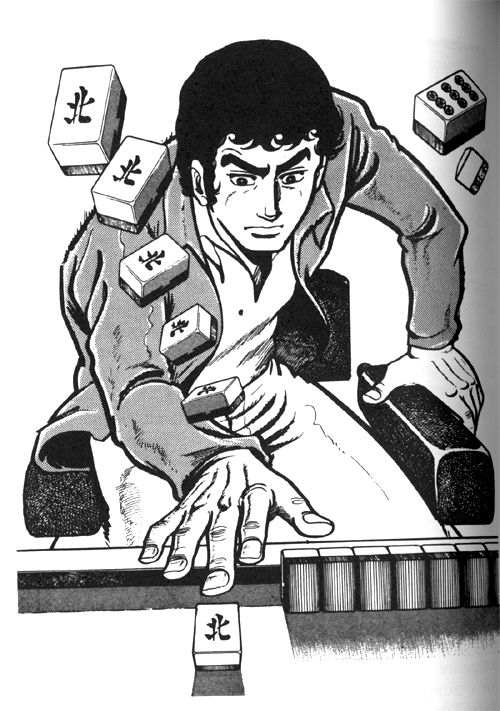
I Thought We Liked Mahjong Series!

While Akagi and Saki were probably a lot of people’s introduction to the notion of manga based on the game mahjong, I don’t think I’m alone when I say that my first introduction to “mahjong manga” was from Frederik L. Schodt’s seminal book Manga! Manga! The World of Japanese Comics.

In it, Schodt explores the burgeoning genre and talks about popular titles such as Mahjong Houroki (“Tales of a Wandering Mahjong Player”) and Jigoku Mahjong (“Mahjong Hell”), even citing the author of Mahjong Houroki, Kitano Eimei, as the sort of “father” of mahjong manga, who showed that a comic about dealing tiles could look and feel exciting.

Truth be told, while I was fascinated by the idea of mahjong manga back when I first read Manga! Manga! ten years ago, I am not so different than the people who discovered it through Akagi, as that was the first mahjong series which I actually had the privilege to see. And while I don’t expect mahjong manga to become a runaway success in even the scanlation community, it’s clear that it has its devoted followers.

Here’s the odd thing though: Where are the scans of Mahjong Hourouki? If Akagi and Saki have resulted in people from all over the fandom getting into mahjong even at a periphery level, why hasn’t anyone bothered to look into these significant works which established the genre that so many are enjoying now? And it can’t really be the case where fans of these newer series might not like the older series due to the artwork. After all, we’re talking about Akagi fans here, and I’ve never seen anyone proclaim, “If the characters don’t have ultra pointy faces and noses and everyone looks shocked all the time, then I refuse to read it!” And I see you considering making a comment where you reiterate what I just said. I’m watching you.

Oh, and of course the reason I’m talking about it in the realm of scanlations and such is that no sane company would license a mahjong series in the United States. The closest you’d get to one that could conceivably do well is Saki which is streamed on Crunchyroll, and even that is a bit of a stretch when you consider the not-internet.

The most likely culprit is probably scarcity. It’s no doubt difficult to find these old series in the first place, especially with a niche genre like mahjong. And I’m as guilty of not contributing to the pursuit as any other. This is the first post I’ve made about it, and it’s only because I was re-reading Schodt’s book today. But still, I’m making the call out. We have to find these old works, titles like Mahjong Fuunroku (“Mahjong Crises”) and Gambler no Uta (“The Son of the Gambler”), and bring them to the forefront of consciousness.

First there’s a Du, and Then I Couldn’t Hear the Rest

When it comes to uniting fans, Nico Nico Douga and episodic blogging have quite a bit in common.

Nico Nico Douga is a popular Japanese streaming video site which helped push popular Japanese memes such as the fusion of voice synthesis and moe, Hatsune Miku, and creating a small revival in the career of gay porn actor Billy Herrington by making clips from his videos running jokes among the community. Its most notable feature however is its unique comments system, where user comments are scrolled from right to left as the video plays. For some it’s an annoying feature which gets in the way of watching the video, but for others it’s the very lifeblood of Nico. Despite most of its content not being live, the comment system allows site users to experience a sense of “community” within the comments, by seeing what people had to say about a particular video at exactly the right moment.

Episodic blogging, or the act of reviewing and discussing individual episodes on a blog, usually as they are released, is even more removed from the concept of “real time,” but just like Nico Nico Douga it has the ability to unite fans by actively engaging in the very zeitgeist of internet fandom itself, by experiencing a series almost as it is airing, and having the format feel a little more permanent and a little more focused than simply sharing talk on an internet forum.

However, the ideal of episodic blogging is not often met, and in some cases this has to do with the shows being blogged about not being particularly good for the concept of episodic blogging. These are the kinds of shows where the blogger might simply go, “Eh some stuff happened this episode. It was all right, I guess.” While knowing that an episode of some show might be average is still something possibly worth knowing, after a while it bogs down episodic blogs as a whole.

Now if there is one current show that I think is very well-deserving of episodic blogging, it is Durarara!

Here you have a show where every episode is so packed with information that the normal custom of summarizing the episode extensively can become a great boon, especially when it comes to recalling the events of a previous episode. It’s also an ideal show for episodic blogging because the theme of the show itself is related to “living in the present,” and practically reflects upon the online anime fandom itself (which is no doubt helped by having a couple of characters who are otaku). Most importantly however is that while the show is an on-going story, its structure is such that each individual episode stands as something to be scrutinized and discussed, with the next one building on top of that.

So for those bloggers out there who have been tackling Durarara! episode by episode, keep it up. It’ll be particularly interesting to see just how your opinions and predictions change over time if at all.

True Honorable Spirit in 30 Minutes or Less

Over the years, I’ve probably gotten too much exposure to kids’ entertainment from both Japan and America. Because of that, as well as an idle comment made by someone I was talking, to I was recently thinking about portrayals of Japanese/American relations in each respective country’s cartoons and comics, and how interestingly they mirror each other.

In anime and manga, when an American character meets the primarily Japanese main characters, what almost inevitably ends up happening, especially if the American ends up being a friend or ally, is that he is able to understand the “true Japanese spirit” after his fateful encounter. Usually it’ll have to do with the determination and willpower of the Japanese, as well as just how much they can overcome in the face of superior forces.

But in American cartoons and comics, when a Japanese character appears, he almost always emphasizes honor. Honor is the most important quality in a Japanese character in an American cartoon, and there is always a point in the show, typically towards the end, where one or more American characters prove that they are truly honorable in the eyes of the Japanese character.

To some extent I think the American cartoon’s portrayal has to do with the mystifying image of the orient that has been a part of western fiction for centuries, while the Japanese cartoon’s portrayal supports the reassuring idea that, although Japanese people might not be the biggest or strongest, they can make up for that with intangible qualities. In either case however, this idea of winning over the foreigner and showing that, when you get down to it, respectable qualities remain very similar around the world, even if it’s portrayed through the lens of stereotypes and simple stories.

What do you think of this? Am I on the mark? Do you think things have changed significantly over the years so that this is no longer the case?

Female Characters in Shounen Fighting Series and the Meaning of “Strength”

Sometimes when discussing shounen fighting series, there are disagreements among fans as to what female characters are considered “strong” and which are considered “weak.” Someone will accuse one female character of being “useless,” while another will point out all that she’s done to help the good guys, and that she’s strong in her own way. While opinions may be opinions, I think that the nature of shounen fighting series makes it difficult for those types of characters.

Hokuto no Ken is a classic example of a series with female characters who are “strong-but-not-really.” Mamiya is a skilled fighter and trains hard to keep up in a world of mutant thugs armed with only a crossbow and some yo-yo’s, but she’s still a few tiers below Kenshiro and Friends. Yuria has great will and even greater compassion, but she’s not a fighter at all, and in this series, as strong as Kenshiro’s own compassion is, fist to face action is at the forefront.

And as much as I like Hyuuga Hinata from Naruto, and as much as I think she is an excellent character, I know that she is not meant to be one of those female characters who is actually able to keep up with the guys when the chips are down. And in fact, as far as I can tell, despite the fact that Naruto is full of skilled kunoichi, there are only two or three female characters in that series who can actually fight on an even keel with the guys: Tsunade, Temari, and maybe Kurenai. Sakura definitely had the potential, and was supposed to end up as being super strong and super determined, but she too has fallen victim to the Shounen Side Heroine Syndrome.

But being physically weaker or lacking in skills compared to the main hero and the guys doesn’t mean a female character will necessarily be “weak.” Nami and Nico Robin from One Piece are both excellent examples of characters who carry their own weight. And even before Nami gets the Clima-Tact and starts participating in battles, her skills are shown to be indispensable to the team. Another good example of a female character who uses the skills that she has and contributes immensely to the overall cause is Tokine from Kekkaishi. Tokine, while not capable of as much sheer “brute strength” as her male counterpart Yoshimori, is able to use her finesse to not only match him but often outperform him.

“But wait, weren’t you the one who talked about how great it is when characters accomplish things at their own pace? Isn’t that one of the great appeals of moe? And aren’t you a supporter of moe?” And you would be right on that, but again I must say that it has to do with the fact that shounen fighting series inevitably revolve around fighting or at the very least getting characters to a point at which they can fight. Basically, the moe series will define strength within the context of their series as overcoming a small adversity which is difficult for them in particular, while a shounen fighting series is all about displays of strength, even if they are fueled by friendship and honor.

The big, essential difference between the Sakura/Mamiya group and the Nami/Tokine group is “results.” Both groups of female characters might not have as much raw skill or ability or training or whatever as the guys do, but one of those groups gets things done. Nami and Tokine don’t just contribute to the overall goal by doing something like blocking the villain’s attack just that one vital moment so that the hero can get in the final shot, but instead actually accomplish significant goals, things that can move the story along. It’s not even that they simply defeat opponents that the others cannot, but that they will do what it takes to win.

This doesn’t even necessarily apply to female characters. All you need to to do is take a look at Usopp from One Piece as a good example of a character who fights with what he has. It’s just that this is often the situation in which female characters find themselves, and often it’s done so that the guys can come in and go, “Stand aside, ladies. It’s MAN TIME.”

…Which is not necessarily a bad thing either, as having the men be strongest in a series for boys makes all sorts of sense. It’s just that if someone’s looking for female characters who really pull their weight to accomplish an overall goal, they may end up disappointed as a result. Though not a shounen fighting series, Legend of the Galactic Heroes can often seem like a sausage fest despite a plethora of genuinely well-written, strong, and clever female characters because of the fact that none of them are out there commanding ships and fleets, i.e. the very activity that is at the absolute forefront of LoGH.

Again, I like a lot of female characters who might not be the best or the strongest but try their best to do what they can even if they can’t keep up with the boys, characters who do things their own way at their own pace. However, even if a series actually says explicity, “This girl is truly strong because she really tried and her help, however small, was essential for victory,” within the context of shounen fighting “strength” is more defined by the overall setup and themes of the story, and rarely is any amount of lip-service enough to make the readers truly think otherwise.

If You’re Looking For an Additional Reason to Wear Green Today…

Incidentally, the other vital component of the day appears to have a similar effect on people.

Now It’s YOUR Turn to Survive a Deadly Game of Chicken

For those of you who were regaled by my tales of exciting mahjong (as well as the tales of others) but were saddened by the fact that you yourself were not able to participate, fear not! There is a new opportunity for you (yes you!) to participate in a live session of Japanese-style “riichi” mahjong! Well, provided you live in the New York area.

This month’s “US Professional Mahjong League” meeting is Sunday, March 28, 2010 from 3-7pm. Address and further information are here. If you’re going, make sure to RSVP on the forums.

I’ll most likely be there, ready to lose.

Nonexistent Rationality

In light of the Handley case’s conclusion and the recent measure in Tokyo to outlaw sexually provocative imagery of characters 18 and under to protect “nonexistent youths,” as well as the subsequent opposition by manga creators from all over Japan, I’ve felt an increasing desire to state my thoughts on the whole situation. I’m not really anybody who can affect a change, particularly when it comes to the Japanese government, but I still want to say my piece.

Before I begin, I want to explain my stance on objectionable art so that you can understand where I’m coming from. Ask two different people from similar upbringings to list their sexual kinks, and you would likely see differences in their answers. People’s sexualities are very personal things, and often times people cannot help what they are sexually attracted to. They can ignore it, they can actively avoid situations in which they are exposed to it, and being confused about their own sexuality can lead a person to think they’re into something they’re really not, but sexual attraction, to whatever it may be, will be there.

And so you’ll find situations where something one person finds sexually attractive will be absolutely repulsive and morally reprehensible to another. It is not absolutely not wrong for a person to feel disgusted with something that makes them highly uncomfortable, and it is their very right to think less of anyone who finds such a thing arousing. However, it is my belief that laws should not be passed based simply on the fact that something is seen as creepy or disgusting. Laws should not be carried by emotion alone. In order for it to be a crime, there should be a real risk of harm, be it physical, psychological, monetary, or some other form to another individual, something that makes it more than just a “bad feeling.”

With that in mind, I want to get into the main thrust of why this bill to protect “nonexistent youths” is so dangerous should it pass. Simply put, it is too broad in its scope and so vague in its language that it can encompass pretty much anything. It is based too much on vague “feelings” and is inherently flawed.

Pornography is one thing, but the proposal extends to all potentially sexually provocative portrayals of characters 18 and under. That covers a lot of ground. Let’s take a classic example of something easily sexualized which is also a part of everyday life: the short skirt. How short does it have to be in order to be considered sexually provocative? What is the threshold? Is it the standard length for a Japanese school uniform’s skirt? In that case, I don’t think I have to tell you that there is a sizable population that would disagree with that. In that case, let’s just get rid of all short skirts on minors in manga and anime. But even long dresses can be deemed sexually attractive, possibly more than short skirts, depending on the individual. The same thing applies to getting rid of dresses and skirts entirely and replacing them with pants. Forbid sexually provocative imagery? I can only believe that the people who drafted this proposal have no idea how powerful the human imagination can be, especially that of a horny teenager.

The teenager is also an important individual to consider with this proposal. The idea of removing fictional portrayals of people 18 and under that could be deemed sexually provocative feels like a myopic decision created in the world of adults. The proposal is there to prevent adults from looking at underage characters in a sexual manner, but not everybody reading manga is an adult. And while I know that it is difficult to determine age based on a drawing given the sheer unlimited possibilities that can occur when pen is put to paper and an image is created, let’s just assume for the sake of argument that we discovered a way to 100% accurately portray the age of a drawn character, that the 16-year old on the page is 16 years old. If you consider the reader to also be a 16-year old, then it would only make sense that they would be sexually attracted to that character, that a 16-year old can be sexually attractive at all. Yes, there is a risk involved with attracting people who are much older than teenagers, but if we were to apply that logic to the real world, to “existent youths,”  it would be as if teenagers were being told that they weren’t allowed to look attractive because there’s a risk people outside their age group might find them attractive as well, or saying that people 18 and under cannot look attractive at all. Again, when taken from a purely adult perspective, it’s easy to see why this would make sense, but not everyone in Japan is an adult, and not everyone reading manga is over the age of 18.

Taking a broad view of censorship, artists and creators will push the limits of censorship as far as they possibly can, no matter how strict or severe the censorship may be. Genitals are censored in Japanese pornography, but their porn industry has found a number of ways around the “mosaic.” Some companies push the limits of pixel size in the mosaic, boasting that their mosaics are extra small, while the very concept of bukkake possibly stems from the goal of showing evidence of the male genitals without actually displaying them. If a limit on skirt length really were to be decided and skirts were deemed “okay”  if they were less than 4 centimeters above the knees at most, then some manga creator or artist out there would make sure to point out that a girl’s skirt is 4.000001 cm above. It’s one thing to set a limit and say, “this is the point you must not cross,” but to try and prevent anything sexual from being portrayed in visual fiction is a losing battle forever thwarted by the endless creativity of artists.

Mostly Visual Wonders: Oblivion Island

The New York International Children’s Film Festival is known for bringing some of the best and most interesting animation the world has to offer to the Big Apple, and Japanese animation is no exception. In previous years, the festival has brought great works, such as The Girl Who Leapt Through Time and Summer Days with Coo, but usually limited it to only one title, so it was particularly amazing that this year’s Festival had not one, not two, but three anime films.

This last film is Production I.G.’s Oblivion Island: Haruka and the Magic Mirror. It follows the titular 16-year old girl as she searches for her lost hand mirror, an important present she received from her mother years ago, and ends up entering a magical world inhabited by “kitsune,” fox spirits who take everything humans misplace and ignore. Humans are not allowed in the kitsune’s world, but a few unlikely companions make the journey possible.

Unlike the other two NYICFF animated films from Japan, which used some CG but still went for a primarily traditional 2D look, Oblivion Island has the unique distinction of being created almost entirely in 3DCG. While it would be easy to make the film look drab and lifeless, Production I.G. is famous for knowing how to make things look good, and Oblivion Island is no exception. The characters are nice-looking and full of life, the backgrounds are gorgeous, and the use of color as the movie switches from environment to environment are particularly notable. One unusual thing about the movie is that a lot of the backgrounds looked more hand-drawn and two-dimensional than the characters themselves, which made it almost look like the characters were “real people” interacting with a backdrop. While jarring to an extent, it gave the film a unique and welcome look. The only other sticking point might be that the faces of the human characters are somewhere between being anime-style and being humanly realistic, particularly with their mouths, and so tread the deepest regions of the uncanny valley. Overall, the look of the film, particularly the Kitsune’s world where everything is built from discarded human belongings, reminded me a little of Kon Satoshi’s Paprika, though it isn’t quite as visually splendid.

But while the visual aesthetics of the film are top-notch, the rest of the film from a storytelling perspective is nowhere near as good. Most of the characters’ motivations are simple and some hardly get characterized at all. The story is also paper-thin, developments happen too suddenly, and the film occasionally takes a very ham-fisted approach to plot exposition. An example of this heavy-handed storytelling occurs towards the beginning of the movie. The start of the film takes place years before the main story and shows Haruka with her mirror. Minutes later into the film, the now 16-year old Haruka is hanging with her friend from school and asks the friend if she had ever lost anything important to her. It then flashes back to the very scene the audience just saw of Haruka and her mirror, and if that’s not enough to tell you that she’s thinking about the mirror, Haruka then outright mentions the mirror to her friend. It was just unnecessarily excessive and would’ve benefited from better editing.

That said, Oblivion Island still has a number of good, powerful scenes  and moments of poignant character interaction and introspection which draw you into their world. It’s just that the film suffers from “things happen” syndrome and lacks the connective tissue needed to make it feel like one continuous story. It’s an all enjoyable film, but definitely had the potential to be more.

In the end, a lot of the film’s flaws can be pardoned if you just take into account that it is first and foremost a kid’s movie, but at the same time I feel somewhat reluctant to do so as the NYICFF’s other films were also for kids and still had plenty for older audiences and never felt like they were simply advancing the plot along without taking heed of everything that had happened prior. Overall, it’s decent, but it won’t go down in history as one of my favorites.

Ogiue: The Bond Which Transcends Space and Time

A few days ago while doing my routine “Ogiue” keyword check on Twitter, I noticed that someone had created an Ogiue Bot on Twitter which sends Ogiue catch phrases every so often into the wild.

The creator of the Ogiue Bot also has a Twitter account of his own, and unlike me and my shameful Avatar-based betrayal, he sports an Ogiue icon.

When I saw it, my first reaction was, “Ooh, that’s a nice Ogiue.” My second and more important reaction, however, was, “This looks oddly familiar.” After a bit of memory-jogging and browsing old sites, I realized just how familiar it really was. That Ogiue drawing up there is one of mine.

You may remember a few months back when Anime News Network got their current Answerman that I sent in an Answerfans response where I talked about my communications and befriending of Ogiue fans in Japan. The above oekaki is from that period.

I have to thank Soramugi, as I had all but forgotten that image, and I’m especially grateful to him for liking my drawing so much. It was kind of an unreal experience just seeing a drawing of mine being used like that, and I know Soramugi is just as surprised that he got to meet the artist behind his icon. He even posted about it! You can also see our correspondence, albeit in Japanese.

I’ve got a good feeling, the kind of feeling you get when you know you’ve earned a comrade.

As an aside, I thought it was pretty cool that I was actually able to recognize my own drawing style.

It’s Easy If You Try: Mai Mai Miracle

If there is anyone to hold responsible for this review of Mai Mai Miracle, it is Japanese blogger tamagomago.

A blogger of anime and manga with a very keen sense of observation, lots of intelligence to spare, and a fount of good ideas, my first real experience with tamagomago was when I translated his essay on the concept of “Otaku Girl Moe.” Since that time, both of us had come into possession of Twitter accounts, and so it was only natural for me to begin following him.

Around late November, early December of last year, I began to notice that, in the vast majority of them (I would say over 90% or so), tamagomago would consistently mention the same thing: Mai Mai Shinko. He would preface his tweets with マイマイ新子妄想, or “Mai Mai Shinko Delusion,” and it was clear that whatever this was, it was quite a big deal to have captured his imagination so. My curiosity was piqued, and after finding out that it was actually a movie he was talking about, I hoped for the day that I too could see it. So when the New York International Children’s Film Festival brought the film over, I felt very fortunate.

Known in Japan as Mai Mai Shinko and the Millennium Magic, it was titled in the US as Mai Mai Miracle (and for the purposes of this review I will be going with the English title). Not knowing what to expect, I went into the theater and came out pleasantly surprised.

Mai Mai Miracle takes place a few years after World War II in Japan and follows a young girl named Aoki Shinko, whose primary characteristics are an untameable tuft of hair and boundless creativity. Shinko’s daily life is changed when she befriends a lonesome new girl in town, Shimazu Kiiko, and shows the quiet and demure Kiiko how to live life to its fullest armed with only two feet and a head full of imagination, while also connecting to her town’s storied history which stretches back a thousand years.

When I say that Mai Mai Miracle is a pleasant surprise, the operative word here is “pleasant.” It has an everyday atmosphere that can only be described as such, and the film, down to its core, exudes a sense of serenity that cannot be escaped even during the movie’s unhappier moments. The story has a clearly intentional meandering quality. There is no real overarching narrative which reveals itself over time, and Shinko’s goals, as much as she focuses on them, shift quite frequently along with her imagination and feelings. One might even say that the movie lacks an “orthodox” cinematic structure, and yet the movie never feels like it’s leading the viewer to a dead end, even when it’s not actually clear what direction it’s taking. Mai Mai Miracle is like a series of vignettes connected by the thread that is Shinko’s daily life and how it is affected by her newfound friendship with Kiiko.

Mai Mai Miracle has many strengths, but chief among them is the characters. This is especially the case for Shinko and Kiiko, but every person in the story, no matter how much or how little screen time they get, feels incredibly human. Some characters get barely touched on, but you can tell that they are going through their own personal adventures and struggles just as Kiiko has in moving to a new town.

The animation in Mai Mai Miracle is very vibrant and fun, though for the most part it doesn’t go for any wild experiments in moving images and keeps everything very traditional. One exception however,  takes place in the early parts of the film, when Shinko is imagining the world of a thousand years ago. Here, crude, crayon-like drawings of houses, animals, and other objects begin to pop up all over the landscape and transform into their “real” counterparts, symbolizing the strength of Shinko’s childhood imagination. But by the latter half of the movie, the technique disappears entirely and we never see that transition again. Most likely the creators thought that doing it in the beginning was enough to imply that it was happening all the time, but I still kind of wish that we saw more usage of creative and abstract techniques, even if it wasn’t this one in particular.

I think Mai Mai Miracle will draw inevitable comparisons to the works of Studio Ghibli, particularly My Neighbor Totoro with its similar themes of moving to a new home and the strength and wonder of imagination, but Mai Mai Miracle can certainly stand up to the scrutiny. It’s a pleasant experience that I would recommend to anyone who enjoys the simple wonders of life and youth.

It’s Okay to Propagate the Idea that “Otaku Girls” are Moe, But…: The Aggression and Difficulty Inherent in Moe