The Theatrical Nature of Anime

American movies and television in general involve very little soliloquy as one would see in theater. I’ve been told before that if a movie or television series has a person talking to himself that it’s not considered good. After all, movies and television aren’t theater, right? Also, internal monologues used as voice overs are apparently a no-no as well.

With this in mind, I watched Gundam 00 Episode 24, and watched as Setsuna F. Seiei spoke to himself, alone in a room, for about five minutes. And I liked it that way.

I’ve known for a long time that when comparing anime to American entertainment, there are some things which are very different. I’ve thought of plenty of possibilities: plot, character archetypes, story progression, even simply visual aesthetics, but upon seeing Setsuna speak to himself, I came to realize that perhaps anime relates more closely not to television or film, but to theater.

I suspect that it may partially have to do with anime often times being an adaption of manga works, where still images and word bubbles work together to provide greater amounts of information, where internal monologue or long exposition are almost necessary to truly get what’s going on with a character, perhaps due to manga’s relationship to written text.

Another similarity I see involves the criticism of the Sunrise-style 52 episode shows which take 13 episodes to develop into their true plot. The criticism leveled at this method is that it takes too long to get anywhere, which I think may say more about attention span of viewers than anything else. This reminds me of Shakespeare’s plays which can go on for 3-4 hours in one sitting. And yes, I have found myself dozing off during them as well, despite the fact that I didn’t necessarily find them boring. Count me among the guilty.

I realize that I like the theatrics of anime, be they melodramatic 70s shoujo or a more down to earth style of storytelling such as in Honey and Clover. Not that I don’t like other forms and methods of storytelling, even the American style, but  I really wouldn’t have it any other way.

You Will Be Sure to See Me at Otakon

I GET THE POWER OF LOOOOOOOOOOVE.

Xamdou! Can we call it “Eureka Frontier?”

Who’s a Xamdou?! What’s a Xamdou?!

It’s the most pressing question simply because the pedigree of this project does not have me worried AT ALL.  BONES announced that they’re doing a new anime, and it’s using the staff of my beloved Eureka Seven, including my favorite character designer Yoshida Ken’ichi.  And looking at the main site, I have no worries here either. This splash image just does everything right that it possibly could. A prominent, well-designed main character. A highly unorthodox being or robot or something tells me that this will be different. Or it’ll be a lot like Eureka Seven which is FINE BY ME.

There might even be the possibility it somehow relates to Eureka Seven. Would I prefer it? Maybe, but I will prefer whatever results in a better story.

I’m so looking forward to it, I’m going to give Xamdou its own category on this blog.

Watch out for it.

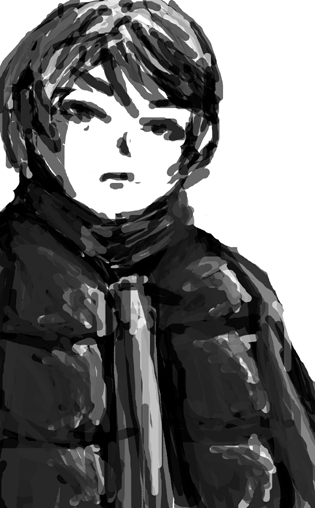
Mildly Ornery Girl in Snow

Lately it seems most of my drawings designed to help me relax have involved girls in winter coats. I wonder if a certain Fred can relate.

Drawn with a mouse because why not.

Turn A = Science, Z Gundam = Liberal Arts, G Gundam = Athletics: Zoku Sayonara Zetsubou Sensei Episode 5

I normally don’t discuss just individual episodes here, but there’s enough content in this episode for about two or three posts, so I think this is totally warranted.

Wow.

Zetsubou Sensei is probably the finest SHAFT/Shinbo show to date on every level and episode 5 goes a long way in showing why exactly they’ve stepped up their game.

You want to know how to make a reference-based joke funny? Zetsubou Sensei shows you how to do it. The timing of each joke is superb. The references are explicit without being overt, and don’t dominate the joke itself. The references, be they the above screenshot, the above title of the post, or Goku and Vegeta sillhouettes fighting each other as Zetsubou Sensei refers to the harsh physical requirements of athletic events are used to support the humor rather than act as the entire joke itself (something certain otaku comedians, especially ones who refer to themselves as such, need to learn).

More importantly, Zetsubou Sensei doesn’t even rely on reference-based jokes the way, say, Pani Poni Dash does. The absurdity of a cultural athletic festival is topped by the even more absurd athletic culture festival. Prior notions of tsundere are twisted and shattered. This is anime! This is Zoku Sayonara Zetsubou Sensei! The land of wild fantasies and desires! (In the theme of Zetsubou Sensei, this is actually a reference that most of you will not get).

As always, the show is visually rich and a plain joy to watch with its strong use of color and composition, reinforced by delightfully comedic characters with strong personalities to keep it all grounded. I don’t care who your favorite Zetsubou Sensei girl is, this episode just presented all of them so well I’m sure you’re pleased.

I know I am.

I would eat her curry anytime.

The Passive Protagonist

I’ve learned that many, many people do not like passive protagonists. They are seen as weak-willed, indecisive, unpleasant to watch, and just plain too passive. There’s nothing I can do to stop people from feeling this way, but it makes me wonder why I, for example, like the passive protagonist whose life is changed by circumstances beyond his control.

The second most hated anime protagonist of all time is everyone’s favorite human male Evangelion pilot Ikari Shinji (thanks, Itou Makoto for taking the position of most hated). Shinji is a very passive protagonist who, while capable of taking action, only does so as a reaction to things happening around him. It’s not because he’s poorly written, or that he’s necessarily a surrogate for the viewer. Shinji is the way he is, and his passive nature is a direct result of the events in his life, as well as his inability to truly take action for himself.

I can’t fault Shinji for that. I can’t even fault him for never quite getting over it, just as I can’t really fault people for not liking Shinji’s character. But it makes me think of the sheer difference two lives can experience to the point that one person will connect to a character such as Shinji while the other will immediately reject him. And of course, one may turn into the other as we accumulate more experiences in our lives.

The Genshiken 2 DVDs continue to be de-fogged

Let’s just leave it at that.

Double-sided Devil: Watching Anime and Learning Japanese

I’ve studied Japanese for a few years. I studied in Japan for half a year. It’s been two years since I stopped studying Japanese in school, though I still try to keep up with things. My Japanese has more than a few holes in it, and I don’t get enough practice speaking these days.

And all this time, I have been an otaku.

The otaku in the Japanese classroom is considered by some to be one of the most unpleasant aspects of taking Japanese classes. I don’t really believe this to be true, because the real culprit isn’t being an otaku, it’s having no actual desire to learn the language. Even if it’s not something you plan to pursue well into fluency, throwing around baka and sugoi doesn’t benefit anyone.

That said, I believe anime CAN help you learn and improve your Japanese. Being an otaku does not put you at a disadvantage. It does not impede your education as long as you know what to watch out for.

Do not take the words spoken in anime as any indication of what is formal or even informal or friendly speech. A lot of anime does not try to accurately portray Japanese society, but rather tries to reflect upon it. There’s really no steadfast rule here. You basically have to learn how to filter out anything that is too unusual, or to learn it but to keep in mind that it’s unusual.

Learning vocabulary also falls into this category. You have to take what you learn and refine it. For example, memorizing special attacks and technique names alone won’t help you in any normal or academic situation, but I think they can give the aspiring Japanese-learning otaku and introduction to the difference between on and kun readings, as well as kanji compound formation.

The best way to put it perhaps, is to say that if you have the drive to learn the language, any usage of it no matter how odd can benefit you as long as you let it and know how to let it.

Oh, and I don’t think anything needs to be said about reading raw manga and learning from there.

Put the all-character splash image at the end of openings to bed

They appear to be some unusual obligation, and more often than not I feel like they make openings worse than they could have been if they had only ended the video prior to it. The number of shows that I could describe in this regard are probably more than I can count.

As an example of an opening which ends on a NOT-Splash Image and ends up being better for it, I present Rose of Versailles:

Back to the Basics

I learned a little about myself recently: The title of this blog is very appropriate.

I haven’t really talked much about Genshiken in a while, and it’s expected. The second series is over, the manga is long over. I’ve talked about it numerous times in this blog.

But then recently one morning, I was suddenly struck by the lighting called Ogiue.

The sheer presence of her character moves me to evaluate myself and try to improve, in a number of ways. Sometimes it doesn’t work out, but hey, this is fiction, and Ogiue, as realistic and complex she may be, is not real (as much as I might sometimes prefer otherwise). The events of her life are incorporated into the greater goal of a good story.

So Ogiue Maniax. I talk about Ogiue.

Because I CAN”T HELP IT.