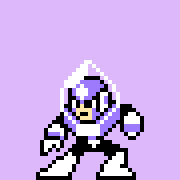
Obscure Robot Masters Makeover Part 1

Continuing with my Megaman fever as the result of the announcement of the 10th game in the main series, I’ve gone back to making NES boss sprites for the fun of it. You might recall that last year around the time Megaman 9 came out, I had created a sprite for a design from my childhood, Garbageman. This time around however, I’m working with “existing” Robot Masters.


Above you’ll see the three Robot Masters from the really awful DOS Megaman game for the PC and then my sprites based on them below. These bosses, from left to right, are Sonicman, Voltman, and Dynaman. The game was licensed by a company called “Hi-Tech Expressions” from Capcom in the 1990s and was released only in the US. The biggest challenge here was trying to get them to actually look in line with the bosses from the NES games while also keeping them faithful to their original designs as well as actually looking good.

And if you’re unfamiliar with how awful the DOS version is, a gameplay video can be sampled below.

My next round will be the bosses from the PC Megaman III game. Personally, I can’t wait to tackle “Sharkman.”

EDIT: Actually, one more thing.

2000-2009 Part 1: Looking Back


Ogiue Chika, Goddess of the 2000s

Introduction

We are on the cusp of a new decade, and with such a benchmark on the way it’s only natural for people to reflect on the past, to review what has happened to them and everything they care for. Anime and manga fans are no exception. After all, it’s normal for us to assign certain traits to specific periods of anime and manga, whether it’s nostalgically remembering the “time when anime was GOOD” (which depending on your mileage can be pretty much any period) or analyzing the trends and developments in anime from decades prior, and to really be compelled to fight for the medium we love. Anime and manga thrive on emotion and reflection, and we love it for that reason. With all that in mind, I asked myself a question.

“How will this decade be remembered in the eyes of future anime fans and scholars?”

After much thought, I decided on nine ideas in total which I feel are significantly representative of the 2000s.

The Dawn of Digital Animation and the Proliferation of CG

For about as long as there has been an animation “industry” to speak of, cartoons were done on cels, painted and layered by hand, resulting in a cost-intensive and laborious process. When graphic technology progressed far enough that it became possible to animate shows “digitally,” it’s no surprise that the Japanese Animation industry, known for its significantly lower production costs compared to western counterparts, would by the early 2000s embrace this change. As of today, about the only cel animation holdovers that still exist are Sazae-san and Ponyo. Going hand in hand with the switch to digital is the increasing usage of cg and 3D graphics in anime, again generally as a cost-saving measure. Though 3D graphics in anime have been around since the late 80s (see Char’s Counterattack for example), it was the 2000s where it became a common sight.


Athrun Zala from Gundam SEED (left) and Gundam SEED Destiny (right)

The unique properties of the digital format influenced every aspect of animation production and aesthetics. Looking at character design for one example, characters are made to be colored digitally now and their features are drawn in ways which facilitate digital animation. As such, the impact the switch to digital has had on anime cannot be underestimated.

Digital Anime is a little over 10 years old now, which is a lot of time and yet not very much at all, and this decade has seen it go through some serious growing pains. In particular, it’s gone under scrutiny as critics from every level of anime, from the highest industry intellectuals to the fans, have pointed out how much it isn’t cel animation. Personally speaking, the classic example of awkward digital animation for me is Gundam SEED, where characters in zero-gravity environments looked like cut-outs awkwardly motion-tweened against a background, something which improved with SEED Destiny. Over time, animators have become more adept at using these “digital shortcuts” more effectively, and now just as you have people championing the days of cels, you also have people who think that digital animation is inherently superior.

The real answer of course is that each has its own strengths and weaknesses, and that it’s best to understand that, but that’s another talk for another day.

Character Over Story

Though there are still plenty of series which try to tell stories and have greater themes, the overall trend over the past few decades has been an increasing focus on the characters in those stories and to view them on a very personal level. While Evangelion is often marked as one of the major points where character emphasis began to supercede story emphasis, it is after 2000 where story truly begins to fall by the wayside. Taken to the extreme, these shows focus everything on intimate character portrayals with little to no narrative progress, eschewing narrative entirely, effectively creating a time capsule where characters are defined more by their static qualities than their active ones. Putting aside slice of life shows such as Hidamari Sketch and Azumanga Daioh, even series such as Haibane Renmei and Eureka Seven which place great emphasis on the grand scope of the world tend more towards the personal. The Melancholy of Suzumiya Haruhi in particular is a show whose story and events are more backdrops to display the characters and their workings.


Suzumiya Haruhi and the SOS-Dan

Essentially, this decade of anime and manga has been very much about “getting to know the characters” and treating them as “real.” Sometimes you’re a voyeur, peering into their most private moments. Sometimes you’re a close friend who gets to see them as they really are. In every case, it’s as if the goal is to have an anime viewer see a character and say, “I know what you’re really like.”

Moe

I could discuss moe all day long, but that’s not as important here as the fact that it became such a publicized word in anime fandom around the world. Whatever moe “is” or “is not,” in this decade it was clear that fans wanted it and that companies were eager to sell it.

While the word had been used prior to 2000 (such as in the 1999 visual novel Comic Party), it was after 2000 that the concept exploded and transformed into the beast that everyone knows and loves (or loves to hate). Moe became a buzzword, a rallying cry, and a point of contention as people inside and outside of the industry, as well as fans new and old, debated the effects that the popularization and push of “moe” had on the industry, the art form, and the people. The best example of how far the idea has reached would probably be the fact that Pokemon of all things featured a cute, spunky female character named “Moe” who had a crush on Satoshi/Ash.


Moe‘s name is also a pun on her usage of Fire-type Pokemon

At this point, it seems that moe has reached the height of its popularity and will become a genre that can be utilized in part or in whole. I suspect it will still be revisited in the future, but never again will we have this “moe mania,” perceived or otherwise.

“Softened” Character Designs

Chalk it up to “kawaii” or “moe” or “digital animation” or “influence from visual novels” or anything else, but character designs became softer in the period of 2000-2009. What does “softer” mean? It means rounder facial features, it means smoother curves on characters, it means subtle changes to color palettes that give off a sense of warmth, even in shows where you might not consider that appropriate. That’s not to say of course that “soft” character designs never existed in prior decades, but it was never to the same degree, and it did not seep into nearly every level and genre of anime in existence as it has here. It’s not just the Dengeki Daioh shows which went through this transformation.

It would be very easy to show you a picture of some gruff, manly shounen anime from the 80s and then put it next to something more modern and have people go, “Wow! That’s so different!” but there would be too many variables there, such as the inherent styles of the artists. Instead, I’m going to use a more subtle example.

Suzuki Mikura, Mezzo Forte (left), Mezzo Danger Service Agency (right)

Mezzo Forte is from 1998. Mezzo Danger Service Agency is from 2003. Both character designs are by the same person, Umetsu Yasuomi (who also directed both shows), and both of them are supposed to be the same character as well. Now Umetsu was always known as a skilled animator and character designer whose style leaned a little more towards the realistic side of things. And yet, look at what a difference five years make! If someone like Umetsu felt the winds of change to this extent, I think you can see what happened to character designs in anime as a whole.

Otaku in Fiction

Like many things on this list, the idea of otaku appearing in anime and manga isn’t new or unique to this decade, but the 2000s were when the concept exploded. While you had a handful of works in the previous decade, most notably Gainax’s Otaku no Video, the period from 2000-2009 saw such a growth of stories centered around otaku that it’s difficult to keep track of it all. Genshiken, Welcome to the NHK!, Lucky Star, Fujoshi Kanojo, Otaku no Musume-san, Rabuyan, Mousou Shoujo Otakukei, Tonari no 801-chan, Akibakei Kanojo, and of course Densha Otoko are among the many works which have thrown anime and manga fans into the fictional spotlight. Densha Otoko requires special mention, as its supposedly true story was partly responsible for Akihabara receiving much more mainstream media attention than in the past.

Not only are there stories about otaku now, but the “otaku” and the “fujoshi” have themselves become archetypes used in anime and manga. Go back to previous decades and only rarely will you find an otaku character who’s called an “otaku character.” Rarer still will you find them as main characters. The establishment of the otaku and fujoshi as character types in the world of anime, manga, and beyond is arguably a bigger impact than simply having works centered around otaku. Sanzenin Nagi would most assuredly have found a difficult time existing prior to this decade.


Sanzenin Nagi from Hayate the Combat Butler, Otaku Heroine

The arrival of the “otaku hero” is itself indicative of the increasing desire to appeal towards otaku. Just like how many shounen heroes are designed to appeal to kids by being more like them, otaku heroes are created to market towards anime and manga fans, to make it easier for them to relate to the characters and world of the story. At least, that’s the intention. Actual results have varied.

Greater Reverence for the Past in Remakes

Every decade has its remakes of famous and beloved works from the past, but there was something different about the way the 2000s went about it. In order to show just exactly what that difference is, we’re going to take a trip back over 40 years and start at the beginning.

In the 1960s a black and white cartoon called Tetsujin 28 appeared on Japanese television. Taking place in that era (or in “2001” if you follow the Gigantor version), the show followed a boy detective named Kaneda Shoutarou and his remote-controlled giant robot “Tetsujin 28.” He would traipse about the world in his plaid suit and short shorts, righting wrongs and fighting crime, and the show was very popular among kids.

In 1980 someone decided to revive the franchise and Tetsujin 28 underwent “modernization.” Referred to either as New Tetsujin 28 or Emissary of the Sun Tetsujin 28, the new anime sported updated redesigns for both Shoutarou and his trusty metal companion, with Shoutarou ditching his semi-formal wear for an open button-down shirt over a striped t-shirt and Tetsujin 28 slimming down and gaining more “realistic” human proportions. The art was less like its predecessor and more like the other anime coming out at the time.

The series was remade again in 1992 under the title Super Electric Robo Tetsujin 28 FX. Taking place many years into the future, the main character this time around was the son of the Kaneda Shoutarou. Kaneda Masato looked completely like a 90s anime character, sporting wild spiked hair and trading in the old remote control for a remote control gun. The new Tetsujin 28 meanwhile was the biggest departure yet, with its massive armored frame, oversized shoulder pads, and angular features. One look at this show and its designs, and you would be able to determine its time frame almost instantly.

Then in 2004 another Tetsujin 28 was announced. Would the story this time be about Tetsujin 28 fighting terrorists in the 21st century? Would Shoutarou’s be changed into a bishounen? Just how would this Tetsujin 28 update itself? The answer, it turns out, is by revisiting post-war setting of the original anime and manga, putting Kaneda Shoutarou back in his suit and short shorts, and returning the titular robot to its round and cumbersome-looking original design. The main difference was, this time around they could tell an on-going story that wasn’t possible with the episodic nature of the first anime.


Tetsujin 28, 60s (top-left), 80s (top-right), 90s (lower-left), and 00s (lower-right)


Here we see the level of reverence that animated remakes in the 2000s have for their source material. As cool as Sugino Akio’s Black Jack from the OVAs looks, it’s more a Sugino design that it is an adaptation of the Tezuka version. Whether it’s the new Black Jack, the new Towards the Terra, or the new Glass Mask, these remakes over the past ten years have all derived their aesthetics from the originals and tried even in their updated redesigns to capture their visual essence, as opposed to re-envisioning the characters almost entirely to fit in with the current trends of animation. Re: Cutie Honey in particular is a prime example, when comparing its opening to the original’s. Even adaptation of 90s series such as Itazura na Kiss and Slayers Revolution went about trying to capture that 90s anime “feel.”

Overall, this decade has done a much better job at looking back then the decades previous, but that might just be because anime is old enough at this point for that to happen in a proper fashion.

The Kids’ Manga of Yesterday is the Adult Manga of Today

Tying directly into the remake reverence, nostalgia for anime and manga has become a greater factor in the industry than it ever has in the past, and it has everything to do with appealing to the adults of today who were once kids. As with the example of Tetsujin 28, the revivals of today differ from the revivals of yesteryear in that while the previous ones tried to update the series for the kids of that era, more current series tap directly into the adult market who have a longing for the anime and manga of their childhood. Whereas Kinnikuman and Hokuto no Ken ran in Shounen Jump (the current home of One Piece, Naruto, and Bleach), Kinnikuman II (1998) and Souten no Ken (2001) run in adult magazines high on nostalgia.


Hokuto no Ken’s Kenshiro (left), Souten no Ken’s Kasumi Kenshiro (right)

Nowhere is this more evident than in the way the super robot genre has been approached over the past ten years. Arguably starting with 1997’s Gaogaigar and its realization that adults are watching this kids’ show, super robots have tried to tap into the childhood of those 18 and up. One only has to look at Gurren-Lagann, Godannar!!, Koutetsushin Jeeg, New Getter Robo, Shin Mazinger, Aim for the Top 2 and others to see this trend. While not all of these shows go out of their way to alienate new viewers (and shows such as Gaiking: Legend of Daikumaryu try harder to focus on a younger audience), they are still homages to the themes and tropes of decades past, trying to attract yesterday’s fan today.


Accelerated Access to Anime

Looking at the way we watch anime and read manga now, with our streaming videos, official online comics, torrents, rapidshares, and just ease of access to the product, it can be easy to remember that there was a time when getting any anime at all was a diffcult feat, and any show we saw was many years old at that point. But let’s not step back too far, and just consider the fact that there was a time before stores had “anime” or “manga” sections where you could easily buy the latest volume of your favorite series (or not buy, as the case may be).

Speed of information. Speed of communication. Speed has defined this decade as a whole, let alone in the realm of anime and manga, but it’s in the easy access to large amounts of media that anime began to feel like a juggernaut. On the up-and-up, you could buy anime DVDs and manga in mainstream stores and chains, or watch anime about fighting with monsters on Saturday Morning cartoons, or catch Cartoon Network’s Toonami and Adult Swim. On the illegitimate side of things, people began to produce “digisubs,” obviating the need for VHS fansubs and tape-trading. IRC downloads gave way to Direct Connect, which was succeeded by the Bittorrent, which in turn was overtaken in popularity by a new website called YouTube, which ushered in an age of streaming video.


The ease with which we could find anime made the world feel a little smaller

At anime cons, industry representatives have talked about how Bittorrent, while significant, didn’t cut into their revenues nearly as much as streaming video had. Streaming anime was fast, easy to understand (no “What’s a Torrent?”), and of course it was free. That’s why so many companies are trying streaming video right now; they know that this is where people are turning and they want to get something out of it rather than trying to squash it entirely. Even the Japan side is getting more savvy about this, with Bandai Channel getting into the mix and the rise of Nico Nico Douga. Now we actually have shows which are accessible to international audiences at nearly the exact same minute as a broadcast in Japan. And ironically, some people have shown that it’s still not fast enough.

The Ups and Downs of Internationalization

Back in 2000 I saw the second Pokemon movie on opening day, as I had with the first movie. I distinctly remember it being the summer of 2000, seeing as how the English title for the movie was Pokemon 2000 and all. But as I sat in the theater with friends that morning, I looked at the entrances for a moment and then…they came. Children flooded the theater, seeping into every row and every seat that they could like a single Pikachu-loving blob. In a couple of minutes the theater was packed. This was Pokemon. This was where anime had gone.

Then years later I went to see the 5th movie, starring Latios and Latias in theaters. Once again it was opening day, but this time I was the only person in the theater. Looking back, this should have told me everything I needed to know about the life of anime and manga in this decade.


The Pokemon movies from 2000 and 2003

The anime and manga industries of today struggle as their peers and rivals fall victim to a mix of overzealousness, bad decisions, and a market that just isn’t there even though they wanted it to be. But whether there was ever any actual success, or whether it was built purely on kindle and gumdrops from the beginning, the fact that these companies were even around to be eliminated, the fact that someone could actually think an “Anime Network” would succeed, the fact that another person would think, “We have to make our cartoons more like that anime stuff,” the fact that Anime and Manga could even give the impression of “Making It Big” is amazing in itself.

Conclusion

Anime and manga in the period from 2000-2009 has undergone changes in almost every area imaginable, from the way it’s watched to the way it’s created, from storytelling styles and character aesthetics, to perceptions of the past and the future. Whether it’s for the better or worse, I think ultimately history will have a neutral opinion on this era as the good inevitably came with the bad.

While these changes have been quite major, they do not exist in a bubble separate from history, and if you look closely you’ll find strong connections going back to the earliest days of anime and manga that continuously resonate from past to present. And in a way, this decade was not so different from the ones previous to it in the sense that every decade has brought with it changes to how anime is perceived, received, and produced. What’s different this time though, is that everyone around the world can see them more clearly and talk about them with ease, as we are doing right now.

So that’s 2000-2009 and the look back. Get ready for Part 2, where I talk about where I think anime and manga will be going in the coming years.

Megaman = Onizuka, and a Look at Robot Master Sprites

That is to say, today Megaman is 22 years old. Happy Birthday!

Actually, had I known that his birthday was coming up, I probably would have saved my post about Megaman 10 for this occasion. Still, there’s plenty to talk about regarding Rock and the various mechanical adversaries he faces on a daily basis. One such topic is the art of sprites, and today I’m going to explain one of the interesting trends that occurred as the Megaman series progressed on the NES.


From left to right: Cutsman, Gutsman, Iceman, Bombman, Fireman, Elecman

If you look at the first Megaman game, the Robot Masters had the same basic physical frame as Megaman himself, Gutsman excepted. Over time however, the Robot Master sprites as a whole became larger and more detailed. No doubt this is to some extent due to the improvement of the technology within the NES cartridges, but there was a greater discovery that happened over the course of the series, one artistic in nature.


From left to right: Metalman, Airman, Bubbleman, Quickman, Crashman, Flashman, Heatman, Woodman

What makes larger characters like Airman and Woodman look less chunky than Gutsman? Take a look at their limbs, particularly in the legs. You’ll notice that they’re all colored black, at least before the knees and elbows. Some time in the production of Megaman 2, Inafune and the others working on the game must have discovered that by giving the Robot Master sprites black limbs, it would allow for Robot Masters with larger bodies to have arms and legs that did not look either overly thick or too spindly. It’s also what gives Quickman the ability to bend his knees better for cool poses. By the time Megaman 3 rolled around, every Robot Master had black limbs, and was designed to be larger than Megaman.


From left to right: Needleman, Magnetman, Geminiman, Hardman, Topman, Snakeman, Sparkman, Shadowman

The reason black has such a slimming effect on the limbs (outside of real world settings, I mean) is that the outline of the sprite is already black, and so when a different color is used our eyes tend to focus on that color and use the black as an outline, but when the limbs themselves are entirely black we view the entire leg, outline and all, as a solid block. There are still cases where a Robot Master might have non-black limbs, or cases where the arms aren’t black but the legs are, but you’ll notice in almost every case that it’s from a desire to make one set of limbs look “bigger” than the other.

Let’s use a more recent example, Plugman from Megaman 9, who has black legs and gray arms. I’ve altered his sprite twice, once to show him with black limbs only, and once to show his limbs as gray.

Plugman and Variations

You’ll notice that when I made his legs gray, it altered the perceived angle that his legs are bent at as well as making the outline around those legs more awkward looking, and also that when his arms are black your mind regards them as just a little bit thinner. It’s kind of subtle, but at the same time when it comes to something like an 8-bit sprite, one pixel can mean a lot, as in this case where it comprises about 25% of the width of a single thigh.

So there you have it. To another 22 years of Mega goodness, to another 22 years of smart and effective sprite work.

MMM… Megaman 10

Megaman 10. That’s 10 Megamen. Actually, more like 50 or so, but hearing news that last year’s retro revisit of the classic franchise is getting a sequel brought joy and happiness to this anime blogger. There’s a lot of positivity and negativity floating around because of the announcement, and I want to just talk a little about it, go through some of the things that pop up in my head when I read these conversations.

The Megaman series is very special to me. If I had to pick a favorite classic NES series, the Blue Bomber’s exploits would be it. I even wrote an entire post about it  where I talked about the way its graphics affected me.

Two of the most frequent criticisms I saw leveled towards Megaman 9 were that its mode of play and concept of difficulty was a relic of older times that should have stayed buried and that it was a cheap cash grab that fell back on a tried-and-true formula with little innovation and a gimmick to tug at older player’s feelings of nostalgia. While there’s no way to play Megaman 10 at this point, it’s a fairly safe bet that the former complaint will resurface, while the latter’s already being tossed about.

Is there any merit to these criticisms? Well sure, Megaman‘s idea of difficulty falls under the banner of “NES-difficult,” an unofficial term which describes the days where games could be brutal and unforgiving and would often require you to play many times over before you started to get the hang of it. Megaman was particularly cruel. Whereas a game like Super Mario Bros. would place an item somewhere in order to give you some respite, Megaman had a somewhat frequent tendency to deceive, placing items as bait to lure you into inescapable death traps. That’s how Dr. Wily rolled, and whether you could handle that or not was key to whether or not you enjoyed those games.

As for the whole cash-grab thing, I can totally believe that, but that doesn’t diminish the amount of effort that was put into 9 and that I assume will be put into 10. It’s also easy to attack the use of 8-bit sprites as a “gimmick,” but when you actually sit down with a Megaman game you realize just how significant the graphics are towards the gameplay. Yes, what I’m saying is that in this case graphics matter, just not the advancement of graphics. And this is coming from someone who played the hell out of Megaman 8 on his Sega Saturn. I loved how bright and lush that game was, I loved how hitting the bosses with their weaknesses would cause unique effects and animations. I even tolerated the JUMP JUMP SLIDE SLIDE rocketboard sections. But when I went back to the NES Megaman games and Megaman 9, I could really feel the difference that those simple (yet still very good-looking) 8-bit graphics made. They were graphics that assisted the gameplay immensely. Same goes for the music. Try as they might, I’ve never heard a remix of an NES Megaman song that I liked more than the original, and that includes live bands like “The Advantage.” They’re songs that work best as video game music.

Megaman 9 was a look back at things that the series did right. While constantly moving forward in the name of progress is great and all, sometimes a look backwards can be just as important, as it can teach you what to keep and what to discard. Many people called it the best Megaman since 2 and I’m inclined to agree.

So yeah, I’m looking forward to Megaman 10. I hope they make Protoman more unique, rather than just him being the “challenge” character, and I’m eager to see who the third playable character will be. Maybe it’ll be Roll, hot off her victory over Gold Lightan. Or maybe it’ll be Bass making his first non-cameo 8-bit appearance. Better yet, let’s get some multiplayer up in here. If New Super Mario Bros. Wii can do it, why not?

Bikes and More Bikes

I was looking at my old photos from my time in Japan in 2005 when I came across this one. Looking back, it’s probably the best photo I took, and so I’ve included it here.

I’m normally a terrible photographer so the fact that this one came out well at all is mere coincidence.

Miyamoto Shigeru Agrees with Me

I previously made a post positing that one of the big changes that occurred in video game graphics around the NES era was that character’s began to have faces. Their eyes and mouths (or approximations thereof) made the characters more relatable.

While I thought it made perfect sense, I realize that aside from my visual analysis there wasn’t a whole lot of record and evidence to back it up. But then recently while reading the New Super Mario Bros. Wii interview, the creator of Mario himself Miyamoto Shigeru said something which helped support my theory immensely.

Iwata
Mario’s trademarks are his moustache, his hat and his overalls. Why did you decide to give him this look? I have no doubt you’ve spoken about this many times before, but I’d like to take this opportunity to ask you to tell us about it one more time.

Miyamoto
Certainly. The original Mario was a 16 X 16 pixilated image. At that time, when games made overseas used human characters, they were always rendered with life-like proportions.
Iwata
It felt as if the developers weren’t happy unless they’d drawn a figure that was eight-heads tall.

Miyamoto
Or sometimes it would be six-heads tall. But actually, the number of pixels we were able to use was so limited that, if we did that, we’d only have had a couple of pixels for the face.

Iwata
With two pixels, you wouldn’t even have been able to draw eyes. You’d basically have ended up with a matchstick figure. In early video games from overseas, that kind of figure often featured.

Miyamoto
And as they just didn’t resemble human figures, I was absolutely convinced that they’d been designed by people who couldn’t draw!

Iwata
(laughs)

Miyamoto
I thought it was most likely that it was the programmer who was drawing these figures. But I thought: “I know how to draw!” I mean, I’m not saying I can draw as well as an artist, but I was confident that I was better at drawing than a programmer. That’s why I started by saying: “Right, let’s draw something that actually looks like a person’s face!” So I drew the eyes, the nose, the mouth and…
Miyamoto goes on to talk about how in creating the face, it left him with very few pixels to actually design a body, and that Mario’s look was essentially dictated by function (Mario has a mustache so that they didn’t have to draw a mouth). What’s important in Miyamoto’s words is that he saw how most of the characters in games abroad were attempts to replicate a “realistic” human figure, and he still made an effort to give his character Mario some semblance of a personality by giving him facial features, even if those features were the result of limitations.
Certainly it wasn’t impossible or uncommon for games prior to Donkey Kong to have personality of their own, and Miyamoto certainly wasn’t the first to give facial features to his characters (Pac-Man being the most obvious example), it does show the kind of thinking that would go on to implicitly influence generations of gamers.

Haven’t Done This in a While

“Why Do Attempts to Look Manga-Style Tend to Go Wrong?”

I’ve never been able to pinpoint the exact causes for why drawing “manga” style typically doesn’t look quite right, but there’s some things I’ve noticed that I think point towards why this tends to be the case.

The artists did not grow up in the culture. I had a Japanese teacher who one day as part of a vocabulary exercise brought into class a drawing she made of a “handsome guy.” Now, my teacher was not an artist, but the picture she drew was clearly that of a manga-style character and nothing seemed out of place. It was just, when drawing a cartoon character who’s supposed to look stereotypically handsome, this is how it turns out. While I don’t think not growing up in Japan or Japanese precludes an artist from developing that style, I think you can see how growing up in different environments with different artistic influences can change how even a normal person draws or sees drawings, let alone a professional.

But what then are those stylistic differences? Why is it that a manga artist who draws super realistically can still feel naturally like manga? Why is it that even a lot of the non-Japanese artists who get the basic visuals right (i.e. understanding that it’s not just big eyes and small mouths) still tend to produce works that jar you out of the illusion?

The first big one is the different philosophies in paneling. Traditionally in manga, the flow of panels is very important to the story, with emphasis on the concept of “flow.” That’s not really an official term or anything, but it’s one I like to use. Manga are typically designed to have the readers’ eyes be guided smoothly through the page, from one panel to the next, with everything in the panel, art and word bubbles and all, facilitating this flow. While American comics for example also take care to utilize word bubbles in strategic areas to help move the reader along, traditionally the American comic has been about having self-contained panels, each of which encapsulates everything going on at the time, a perfectly stilled moment. I’m reminded of when Grant Morrison in an interview after Final Crisis said, “We talk about events all the time. Well, why can’t every panel be an event?” In a way, he’s not far off from the tradition of Western-style comics, whether it’s indie, superheroes, or newspaper gag strips. It’s also what I think is the real difference between “compressed” and “decompressed” storytelling.

Basically, think of manga as a river, and American comics as a series of ponds. While of course there’s more to comics than just America and Japan, I’m simplifying for the sake of what little claims to brevity I have left. And while there are exceptions on both sides, take note how a manga with not as much “flow” such as Space Adventure Cobra or Nausicaa do well in the west, particularly Europe where highly illustrative backgrounds tend to be emphasized, or how an American comic with a strong sense of visual “flow” in Little Nemo could be seen fondly in Japan (at least I believe it is, if someone can correct me, please do so).

And then there’s other smaller things. Scott McCloud in Understanding Comics for example talks about how back when romance stories in American comics were more common, they still tended to compose scenes as if all of the characters were figures placed in a room. Contrast this with shoujo manga, which tends to emphasize the emotional over the physical; it’s not as important that you know where characters are standing.

But that only applies to manga, right? What about all those cartoons that try, but don’t quite get it. Your Teen Titans and Totally Spies and what-not. There, I’m not as certain about it, but I think it just has to do with what’s considered common in Japanese Animation to the point of it being ingrained into the system. I think the most prominent example of this might be animating on the 3’s, which means changing the image on every third frame instead of every second one as is common with American cartoons. This was originally one of many necessary money-saving techniques for anime on limited budgets as far back as Astro Boy, and what ended up happening was that stuff like animating on 3’s and using lots of stills and closeups, stuff which had its origins in having scarily low budgets, began to be embraced and improved upon and mastered until it in essence became the style anime is known for. What’s important here is the way in which factors such as these influenced the sense of timing that anime tends to have, and if you don’t understand that sense of timing then it becomes difficult to replicate it. Anime has a unique sense of timing.

To summarize, what makes manga seem like manga and what makes anime seem like anime goes deeper than how the characters or backgrounds look, all the way to how the story is told through the visuals. Another important thing to remember is that this is less about quality, or why one is “better” or “worse” than the other, and more about why things are the way they are from the worst comics to the best ones. If you were to compare X-Men: Misfits, an American comic trying to be manga, and that Japanese X-Men manga I posted about a while back, a Japanese comic trying to be American, you’d see that neither one is able to fully escape their origins. Whether these are the most significant factors, I don’t know, but that’s what I’ve seen.


I’ve never been able to pinpoint the exact causes for why drawing “manga” style typically doesn’t look quite right, but there’s some things I’ve noticed that I think point towards why this tends to be the case.

The artists did not grow up in the culture. I had a Japanese teacher who one day as part of a vocabulary exercise brought into class a drawing she made of a “handsome guy.” Now, my teacher was not an artist, but the picture she drew was clearly that of a manga-style character and nothing seemed out of place. It was just, when drawing a cartoon character who’s supposed to look stereotypically handsome, this is how it turns out. While I don’t think not growing up in Japan or Japanese precludes an artist from developing that style, I think you can see how growing up in different environments with different artistic influences can change how even a normal person draws or sees drawings, let alone a professional.

But what then are those stylistic differences? Why is it that a manga artist who draws super realistically can still feel naturally like manga? Why is it that even a lot of the non-Japanese artists who get the basic visuals right (i.e. understanding that it’s not just big eyes and small mouths) still tend to produce works that jar you out of the illusion?

The first big one is the different philosophies in paneling. Traditionally in manga, the flow of panels is very important to the story, with emphasis on the concept of “flow.” That’s not really an official term or anything, but it’s one I like to use. Manga are typically designed to have the readers’ eyes be guided smoothly through the page, from one panel to the next, with everything in the panel, art and word bubbles and all, facilitating this flow. While American comics for example also take care to utilize word bubbles in strategic areas to help move the reader along, traditionally the American comic has been about having self-contained panels, each of which encapsulates everything going on at the time, a perfectly stilled moment. I’m reminded of when Grant Morrison in an interview after Final Crisis said, “We talk about events all the time. Well, why can’t every panel be an event?” In a way, he’s not far off from the tradition of Western-style comics, whether it’s indie, superheroes, or newspaper gag strips. It’s also what I think is the real difference between “compressed” and “decompressed” storytelling.

Basically, think of manga as a river, and American comics as a series of ponds. While of course there’s more to comics than just America and Japan, I’m simplifying for the sake of what little claims to brevity I have left. And while there are exceptions on both sides, take note how a manga with not as much “flow” such as Space Adventure Cobra or Nausicaa do well in the west, particularly Europe where highly illustrative backgrounds tend to be emphasized, or how an American comic with a strong sense of visual “flow” in Little Nemo could be seen fondly in Japan (at least I believe it is, if someone can correct me, please do so).

And then there’s other smaller things. Scott McCloud in Understanding Comics for example talks about how back when romance stories in American comics were more common, they still tended to compose scenes as if all of the characters were figures placed in a room. Contrast this with shoujo manga, which tends to emphasize the emotional over the physical; it’s not as important that you know where characters are standing.

But that only applies to manga, right? What about all those cartoons that try, but don’t quite get it. Your Teen Titans and Totally Spies and what-not. There, I’m not as certain about it, but I think it just has to do with what’s considered common in Japanese Animation to the point of it being ingrained into the system. I think the most prominent example of this might be animating on the 3’s, which means changing the image on every third frame instead of every second one as is common with American cartoons. This was originally one of many necessary money-saving techniques for anime on limited budgets as far back as Astro Boy, and what ended up happening was that stuff like animating on 3’s and using lots of stills and closeups, stuff which had its origins in having scarily low budgets, began to be embraced and improved upon and mastered until it in essence became the style anime is known for. What’s important here is the way in which factors such as these influenced the sense of timing that anime tends to have, and if you don’t understand that sense of timing then it becomes difficult to replicate it. Anime has a unique sense of timing.

To summarize, what makes manga seem like manga and what makes anime seem like anime goes deeper than how the characters or backgrounds look, all the way to how the story is told through the visuals. Another important thing to remember is that this is less about quality, or why one is “better” or “worse” than the other, and more about why things are the way they are from the worst comics to the best ones. If you were to compare X-Men: Misfits, an American comic trying to be manga, and that Japanese X-Men manga I posted, a Japanese comic trying to be American, you’d see that neither one is able to fully escape their origins. Whether these are the most significant factors, I don’t know, but that’s what I’ve seen.

Umino Chika Spikes Water at Production IG, Kimi ni Todoke the Result

I strongly suspect that Honey and Clover creator Umino Chika, while on her way to deliver character designs for Eden of the East, decided to “spice up” the lives of the members of Production IG. How else can I explain how good Kimi ni Todoke has been?

Not to take anything away from the original creator of Kimi ni Todoke, Shiina Karuho, seeing as it’s her strong story and nice character designs that they’re working with, and certainly Production IG has always been known for its high standards of animation quality, but KnT is a beast unlike any other unleashed by the Igg (that’s how the cool people pronounce it, you know). Rather than using their expertise to make a more fleshed out and realistic-looking show, as one might expect from the studio that brought us Ghost in the Shell: SAC, what Production IG has managed to achieve is a show that truly looks shoujo in a way most anime have not, including perfectly good works such as Cardcaptor Sakura and Itazura na Kiss.

There’s a very strong understanding by the staff on this show as to when to utilize the more visually two-dimensional and emotional elements and when to incorporate a three-dimensional sense of spacing among the characters, and it, and the result is that it achieves that pastel and wispy shoujo manga feel while still making sense as an animation. In a way it reminds me of 70s-style shoujo, only with less emphasis on the melodramatic, and more technical skill on the part of the animators.

And even if you don’t care about all of that stuff I just said, note that Kimi ni Todoke is still very good, and does a good job of murdering cliches with an 80 lb. battle axe, which I will assure you is the perfect metaphor for this show. Good shoujo, from Igg to you.

Relating to NES Sprites

Whenever I say there’s something special about video game graphics during the NES/Master System era, some will believe that it’s simply due to nostalgia, while others will agree with me, but won’t be able to explain why. Sometimes those who agree with me will even chalk it up to nostalgia themselves. I however believe that there are concrete reasons as to why the level of graphics that the 8-bit systems achieved for home consoles holds such significance, and I’d like to discuss one of them here. I’m going to be using mainly NES graphics and not Master System ones, because 1) the NES was more popular and 2) the Master System actually had better graphics overall, and we want to look at the less-good.


From left to right: Berzerk, Robot from Berzerk, Circus


From left to right: Mario, Megaman, Karnov

What is the significant feature that the characters below all have in common that the characters above do not, aside from obvious graphical quality improvements?

Answer: They have faces.

This makes it easier to identify with them as characters, and gives them a sense of personality. In the NES era, the graphics were strong enough on the popular consoles to portray characters’ faces and to give them facial expressions, even if it’s the same expression all the time. This is important because we as humans tend to see ourselves in our surroundings. Scott McCloud talks about this a good deal in Understanding Comics, but it really is something fundamental. Two dots and and a line becomes a face. A semi-circle shape can be a smile or a frown depending on which way it’s facing. It allows players to identify with the characters.

While this does not take into account those games which feature primarily vehicles or objects inanimate objects, my focus is not so much on them, as I believe they have a somewhat similar appeal, only focused on their fantastical realism rather than their human quality.

Even those characters who practically had no eyes, noses, or mouths still benefited from the 8-bit graphical quality, as it allowed the games to clearly delineate an area of the body as the head.


From left to right: Simon Belmont, Bill Rizer, Ryu Hayabusa

This was especially useful in portraying characters with more human proportions as opposed to the big-headed cartoonish sprites from before, as it allowed the characters to seem realistic on the NES while again still giving them some sense of personality.

That is not to say that faces on sprites were a wholly unique experience to the 8-bit era. The NES and the Master System were not the first consoles to regularly portray characters with faces, with that honor probably going to the Colecovision in 1982. However, the difference here is a matter of timing, as 1983 was also the year of the North American Video Game Crash, and so in the minds of most people, graphics went from Atari to Nintendo, and if you look at the graphics of that era, they more often than not could barely differentiate a head from a neck, with one notable exception being Pitfall for the Atari 2600. Hey, it’s not all art and discovery.

The 8-Bit NES era was when graphics were good enough so that almost anyone who made a game for the console could give a sprite a face (and in essence, a personality), and thanks to good timing also was when video games were again popular enough to be a common feature in households. Graphics were certainly not the only factor in endearing the NES (and to a lesser extent the Master System) to young gamers, but as humans are visual creatures, graphics played a significant role in implanting the memories of these games into their minds.