Eureka Seven is one of my favorite anime ever, Eureka is one of my favorite characters ever in a show full of incredible characters, and I consider the pacing of the show to be among the best I’ve ever seen. It’s a tough act to live up to, and so with the new Eureka Seven AO currently running in Japan, I wanted to at least give it more than one episode before I started talking about it. Not that I thought that the first episode was bad and needed a second one to “give it a chance,” but my experience with the original told me that this may very well be a show which continually ramps up and whose threads (plot, thematic, or otherwise) are only barely visible in the beginning.
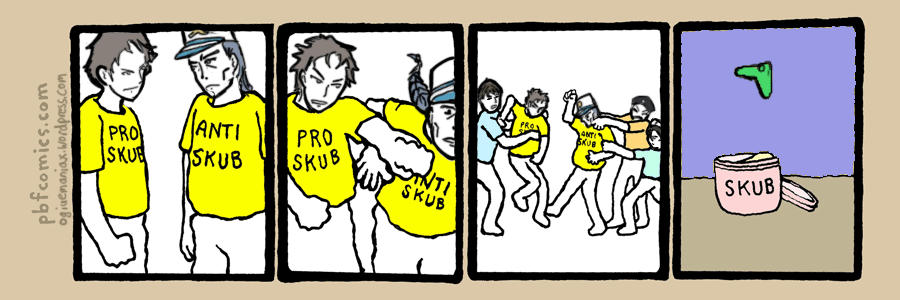
To cut straight to the chase, the main character Ao is clearly implied to be Eureka and Renton’s son. As a result, I feel like Ao inevitably draws comparisons to Renton, but also that the show obviously wants you to do so. The first episode of the original Eureka Seven was all about how Renton wanted to escape his boring, do-nothing town and join the fabulous rebels of Gekkostate, whereas Ao has to deal with the constant materialization of skub coral and the destruction it causes. On top of that, both have parents whose legacies at first seem larger than them, with Renton’s father Adrock being regarded as the greatest hero who ever lived and Ao having to cope with the fact that even mentioning his mother and her turquoise hair on the island garners animosity. The difference between the overbearingly positive reputation that Renton had to deal with and the overwhelmingly negative one that Ao must live with draws an additional interesting parallel, but I feel like it does so while making Ao seem like his own character.
It also doesn’t hurt that Ao’s relationship with his friend Naru is distinctly different from Eureka and Renton’s. It seems to be built on this strong friendship which goes beyond the immediate conventions of the island where they live, and I actually have it in my mind to judge anything related to Eureka Seven based primarily on how it handles its main romance. The reason is that when Eureka Seven was originally airing, during the breaks there would be commercials for the Eureka Seven: New Wave PS2 game where the slogan for the game was “Another Boy Meets Girl.” This of course implies that Renton and Eureka were themselves a “boy meets girl” story, and the fact that their romance was so unbelievably strong supporter that concept. In that respect, and many others, I continue to look forward to Eureka Seven AO. No guarantees it won’t wipe out (see what I did there), but I feel like it’s definitely off to a strong start.
What is a one-dimensional character? What is a well-developed character? And how is it that two people viewing the same exact anime can reach entirely different judgments on whether or not its characters feel “real” or not? Those are the questions that have most recently been on my mind.
It makes me ponder the differences in the way people perceive the world and the people around them, as well as how those perceptions are then translated into the world of fiction. What do some people prioritize in their concept and understanding of a “three-dimensional personality” that runs so counter to the opinions and values of others?
Personally speaking, I find characters to be particularly well-developed in personality when I can sense that there is something more to them than what they are saying. It’s not like I want characters who are saying one thing and thinking another, however. It’s more about showing or at least hinting at a thought process behind those words. Genshiken, Eureka Seven, and Toradora! for example are particularly good at this, in that you can see the transmission from personal desire to choice of words getting filtered through the characters’ own personalities and values. But then I know there are plenty of people out there who dislike these series while accusing the shows of the very opposite of why I praise them. So again, what causes this conflict?
Many times when a character is seen as “artificially deep,” the accusation leveled at them is that they are simply there to fulfill a checklist. This isn’t necessarily wrong or unwarranted, and even I’ve used the “checklist” criticism before and have no real regrets doing so, but the question then becomes, how did these checklists form and who is responsible for them? To what extent are those negative checklists generated by one’s own standards of realism and authenticity?
What is more important for a well-developed character, that they start off with an almost palpable personality that reveals a heart and mind in them, or that they grow their hearts and minds over the long term?
What is more important, what you let the audience see, or what you let the audience infer for themselves? If you keep on revealing more and more angles, is the purpose to imply a sphere, or simply a many-sided polygon?
And how much of it is tapping into the familiar vs the unfamiliar?
It’s food for thought I haven’t really digested myself yet.
Otakon 2010 fires its first major volley with “Home Made Kazoku” as their Sunday musical guest.
Realistically speaking, this is pretty much the kind of musical guest I want at conventions more often. While I know that they’re not a J-ROCK BAND and thus won’t have quite as much clout among those who go to anime conventions mainly for the concerts, Home Made Kazoku’s a legitimate act that’s actually done music for popular anime. I mean, you couldn’t exactly call Naruto or Bleach small-fry cartoons (aside from literally being for children), and they also did “Shounen Heart,” the love-it-or-hate-it second opening of Eureka Seven.
I still consider it a crime that JAM Project got only a fraction of the audience of other musical guests at Otakon 2008, especially when they had Kageyama “Chala Head Chala” Hironobu, a guy whose songs almost every person at an anime con knows at least one of. While I get the appeal of the J-Rock band, I wouldn’t mind them nearly as much if more of them had actually sung something related to anime, or if they weren’t being sold mainly on image. Hell, a COVER of an anime song would be acceptable.
So, Home Made Kazoku. I can’t wait to see everyone at the concert try (and fail) to sing along to the rap portions.
2009 has been a crazy year for anime, with ups and downs and all-arounds, but amidst a weakened global economy and an industry going through some serious growing (or shrinking) pains, I find there is still plenty to be thankful about.
I am thankful for…
Great shows being licensed or made available streaming so that when I say Glass Mask is a FANTASTIC SHOW, you can now go and watch it. And Monster is on TV!
Some stellar guests at anime conventions. Between Ishiguro, Tomino, and a whole bunch of others, this has been a highly informative and unforgettable year of conventions. Thanks to Ishiguro and Tomino as well, for telling me all about Nagahama Tadao.
An explosion of new blogs. As the years pass, they just keep coming and coming. Keep it up, the only way to improve your writing is to keep writing.
An industry which is still trying, despite what others might claim. There may be some “safe” shows out there, but we’re also continuing to see the mediums that are anime and manga being challenged and made better as a result.
An Eureka Seven Movie. Sure, it might not be quite what I’d like from an E7 movie, and it didn’t capture what made the TV series great, but I am still grateful that such a thing could be made 3 years after the original finished.
Genshiken 2 out on DVD! Get it as soon as possible. Ogiue is waiting.
The friends I’ve made and the people I’ve met through the fandom. Truly you have made this an unforgettable year.
Others and I will be attending the Union Square showing of the one-night-only US theatrical premiere of Psalms of Planets Eureka Seven: Good night, sleep tight, young lovers, which is sure to be a rip-roaring good time and a great way to spend an evening. I’ve actually already seen the movie, but I wouldn’t pass the chance up to see it in a theater. The theater showing will be dub only, but it isn’t that much of a problem, and I’m interested in seeing how the dub crew tackles this movie.
If you want to read my review of the the E7 movie, it’s right here.
I also managed to win a copy of volume 1 of the Eureka Seven light novel adaptation, so there’s a good chance I’ll be reviewing that some time in the future. Who knows when though; I still have a Gundam 00 Second Season Review to write!
EDIT: I previously labeled this movie as “Pocket Full of Rainbows” only to realize that the title is actually a reference to the Elvis Presley song “Pocketful of Rainbows.” As such, I’ve changed the title and the associated category accordingly.
When the Eureka Seven movie was announced, speculation began as it always does. BONES said they would be retelling the story of Renton and Eureka, and using some of the existing footage from the TV series in the movie. Fans wondered if this meant the movies would be a retelling of the TV series with content edited to make it flow better as a movie, not unlike the First Gundam movies. Preview images and trailers started being released showing Renton and Eureka together as small children, something that never happened in any previous Eureka Seven media. Now that Psalms of Planets Eureka Seven – Pocketful of Rainbows (or as it’s apparently called in English, Psalms of Planets Eureka Seven – good night, sleep tight, young lovers –) is out, we know that the plans for this movie were much more ambitious than most anyone expected.
Once again, Eureka Seven focuses on the boy named Renton and the girl named Eureka, only this time any hint of the previous series beyond a superficial level are thrown out the window. As mentioned before, now Renton and Eureka are childhood friends who are separated and then reunited amidst a war with an inhuman enemy called the Image. Connecting them is a small fairy named Nirvash, whose words only Renton can understand. Front and center in Pocketful of Rainbows are the concepts of mythologies and dreams, as the movie explores the effects their existences have upon the world and what they mean for human beings.
This is a new world with a new history, and familiar faces are anything but. If you’re approaching this movie without ever having seen any of Eureka Seven in its other incarnations, rest assured that they have little to no bearing on the events of the movie. If you’ve ever seen the Vision of Escaflowne TV series and the Escaflowne movie, the level of difference in Pocketful of Rainbows is even more pronounced. In fact, spoiling the events of one will actually NOT spoil the other!
For those of you who are fans already, let me tell you just one little thing that will make you realize how different this movie is compared to the source material: In the world of Eureka Seven: Pocketful of Rainbows, there are no such things as Coralians.
This movie uses existing footage better than any anime I have ever seen. This is not simply reusing stock footage to show flashbacks or for the animators to go, “We already animated this once, why should we do it again?” Just like how the characters may look the same but their insides have changed dramatically, the TV series footage is given new life. Even though the same animation is being used on a number of occasions, the context of each scene is so different from when it was originally used in the TV series that the meaning of these animations change entirely. You almost can’t tell that it wasn’t originally made for the movie. This also has to do with the fact that this animation was already impressive in the first place, and the scenes newly animated for the movie are just as good if not better.
Being a movie, Pocketful of Rainbows does not have the luxury of developing the relationship between Renton and Eureka as thoroughly as the original TV series, but it still manages to get a sufficient amount of characterization into them and others. Even though you aren’t given all of the information, the way the characters act around each other will make few of the revelations about character relationships seem jarring or negatively unexpected. BONES knew that this was a 2-hour endeavor instead of a 50-episode series and worked accordingly. It really shows, as I do not feel that this movie was rushed unnecessarily.
Overall, this was a fun and thought-provoking movie as an Eureka Seven fan. Expect future posts about it as I explore some of the concepts presented in Pocketful of Rainbows, as the movie has gives you a lot to mill over.
For those of you want to see the movie for real inside of an actual theater, you should know that Bandai Entertainment has plans to do exactly that, albeit dubbed. Tickets go on sale August 21st for a September 29th showing in select theaters across the United States.
Before I start talking about the Eureka Seven manga adaptation, I’d like to explain what Eureka Seven is as a franchise. Eureka Seven was designed by Studio BONES and Bandai to be a sort of multimedia franchise that reaches out and expands beyond the normal frame of any single anime or manga series. You have the flagship anime, video games which retell the story of the anime, video games which act as prequels to the anime (which I’ve never played, but if I do get my hands on them some day I may review them too), a manga that is a prequel to the prequel video games, as well as a recent movie which is an alternate setting using the same characters. The Eureka Seven manga I’m about to review is somewhat similar to the movie in that it takes the characters and settings of the anime and adds a few twists to them here and there, but unlike the movie it sticks a little more closely to the plot of the TV series.
Unlike a lot of anime or manga, the Eureka Seven manga was not really made to be an “adaptation” of some source material that already exists in public entertainment, despite me using the word adaptation numerous times. Instead, the manga and anime were released almost simultaneously, so one does not rely on the other to be an initial source. Instead, the “source” for both of them is the director, Sato Dai. The result then is that as a manga, Eureka Seven is something quite unique, both relative to other manga in general, as well as to the anime TV series.
Premise-wise, the manga is pretty much the same as the anime. You have an impetuous youth named Renton Thurston, an enigmatic girl named Eureka, an anti-government group called Gekkostate, and there’s sky surfing and trappar and all sorts of familiar sights. Many of the plot points between the anime and manga are similar, too. However, many plot points are also quite different, and these changes to the story also change the basic feel of Eureka Seven.
The Eureka Seven manga is a little more action-based, a little more violent than the TV series. There’s not superfluous amounts of blood flying about, but people get hurt in the manga pretty badly. In other words, it reads less like the crescendo that is the anime and more like a sforzando. Now, if you’re like me and only knew the word crescendo (gradual buildup), and had to look for another musical term to continue the analogy, sforzando basically means “sudden changes.” The manga comes at you fast and hard, and at times it can leave you asking, “Wait, when did that happen?” Not that it’s necessarily a bad thing, of course.
There’s also more fanservice in the manga, such as panty flashes. And by panty flashes, I mean a character literally lifting Eureka’s skirt in Renton’s presence in order to get a rise out of him, both emotional and physical. Anemone in particular is given some choice sitations, as well as an ever-so-slightly different personality, where her cheerful side and her not-so-cheerful side are just a bit more extreme on either end.
I personally feel that the manga is not nearly as good as the anime, lacking much of the subtlety and grandeur of the anime, but that doesn’t mean I think the manga is bad or mediocre. I know some people prefer the manga because it doesn’t dawdle as much, and it really does get to the point more often, although it tends to be at the expense of building up the characters more. Still, I think it’s worth reading whether you’re an Eureka Seven fan or not. In fact, you don’t even need to have seen the anime in order to enjoy the manga, and it’s even possible you might enjoy the manga more if you don’t have the anime for a comparison.
The creators of the Eureka Seven manga, Kataoka Jinsei and Kondou Kazuma, are currently working on their own original manga called Deadman Wonderland. Check it out if you want to see them working in a setting that isn’t tied to a greater franchise beast.
With the Eureka Seven movie out, I figured it was high time for me to start talking more about Eureka Seven. I already reviewed Gravity boys & Lifting girl, but now I’ll be reviewing the original for this post, and then working my way towards the new movie.
Psalms of Planets Eureka Seven is an anime I hold very near and dear to my heart. I’ve watched it in almost every way possible: On Japanese TV, using downloaded raws, using downloaded fansubs, on DVD, and dubbed on American TV. It is not the first anime I watched, far from it in fact, but it has impacted my fandom and my life tremendously in positive ways. When asked to present a series of high quality with excellent characters, art, story, and pacing, Eureka Seven is the one I mention.
Eureka Seven centers around the concept of sky surfing, or being able to ride your board through the air, carried on mysterious green waves called Trapar. Sky surfing, known as lifting, is a popular sport in the world of Eureka Seven and influences culture tremendously, much in the same way skateboarding or surfing can attract people. Lifting is so well-known that they’ve become a common feature on giant military robots (called KLFs) to help them fight more freely in the sky. Perhaps the most famous lifter is a man named Holland, whose skills on a lif-board and in a KLF are all but unmatched and is also the leader of a band of anti-government rebels called Gekkostate.
With all that said, Eureka Seven is mainly the story of two people. The first character is Renton Thurston, a 14 year old boy and amateur lifter who idolizes Holland and is the son of a man regarded as the greatest hero the world has ever known. Renton dreams of escaping his dreary town and the shadow cast by his father, a dream which he is granted when he meets the second character and namesake of the series, a beautiful and mysterious girl named Eureka. Eureka has a personality you could almost call cold and distanced if not for the hints of humanity that reveal themselves occasionally. Enamored by Eureka’s calm beauty, Renton decides to follow her, only to find out that she is part of Gekkostate, the same rebel group led by Holland, and is given an invitation to join.
In the beginning, it’s fairly episodic, with the events of each episode pretty much resolving themselves by the end, but always dropping hints that there is more to the series than one might expect. The initial hook, as it were, is that you get to see the adventures of a stylish gang of rebels fighting against their world and its injustices while also having some fun. You also get to see the partnership between Renton and Eureka develop slowly but surely. If the series stayed like this forever I would have been happy with it, happy to keep watching, but fortunately for all of us the creators decided to do more. From here, the story continually ramps up, becoming stronger and grander until you are swept up by the raw emotion in the story. I know many people disagree with me, but I truly feel that Eureka Seven is one of the best-paced series ever. It is 50 episodes long and really knows how to use that number, with only a few hiccups along the way. Other than that, though, if you like a show which builds up gradually and never falters, Eureka Seven is it.
The characters in Eureka Seven are fantastic on pretty much every level. Design-wise, they’re all very unique and stylish, no doubt due to the contributions of character designer Yoshida Ken’ichi, a man who is possibly my favorite character designer ever. What really pushes Eureka Seven though is the incredible amount of character development. Very few characters in the show are the same person they were in the beginning and at the end. Renton struggles with growing up, Eureka has to deal with her strong and unfamiliar emotions, and Holland must come to terms with the contradictions in his real personality and the one he presents to the world.
Then you have other rich and well-developed characters. Talho Yuuki, girlfriend of Holland, is the ship’s pilot for Gekkostate. Having known Holland for a long time, she is able to reach past his facade and talk to the real him in a way no others can. On the government side is a man named Dominic Soleil, a young and intelligent communications officer who is also the caretaker of an unstable pilot named Anemone. Dominic is the main window into the government side of the story, and his presence does a good job of humanizing it, though there are others who add to the portrayal.
I can pretty much keep talking about the characters. It is they who really push the series and get it to stick in the minds of fans. However, there are other reasons for its artistic success, such as the aesthetic presentation that is on par with the characters. The animation ranges from decent to gorgeous, and the music is varied and strong, from the background music to the main themes. In fact, music is connected deeply with Eureka Seven, with musical references throughout. For example, you should know that Renton’s father is named Adrock Thurston.
The only flaw that Eureka Seven has isn’t really a flaw at all. You may be feeling it yourself as I expound praises on Eureka Seven. What I’m referring to is something called “overhype.” Eureka Seven fans have the hindsight of being able to see the entire series as a whole and knowing just how far it goes, so they, myself included, approach telling others about it by explaining how great it becomes. They have the entire image in their heads and their hearts. However, what happens is that this hypes the show up so much that when some new viewers watch the initial episodes, they don’t see the grandiose and life-changing anime known as Eureka Seven. The show is still good at the start, but it takes time to build up, and because of this overhype they ask, “Why isn’t it as good as people said?” You can see a similar thing happening with Gurren-Lagann or Legend of the Galactic Heroes. This is why I’ve tried to write this review in a way which explains the growth that happens in the series, but I know that even I fall victim to overhyping it.
That is Psalms of Planets Eureka Seven, a series which is, as the title of this review puts it, too good for its own good.
It’s the exciting new series that has the animation critics calling it even better than Voltron and Macron-1…combined!
The Omega Skies centers around a boy destined for greatness. This boy, Renton Thurston, is a fan of the latest craze on the planet, SKY SURFING! Sky surfing is so popular that not only do people do it, but robots as well! However, what he couldn’t predict was that his love of Sky Surfing would lead him to meet a mysterious girl named Eureka!
Not only that, but she’s friends with the most out-there rebel and Sky Surfing pro, Holland!
Joining Holland and Eureka on their custom-made radical airship, the “Gecko,” Renton’s life is transformed as he too realizes he has the potential for greatness, especially when the alien menace, the Coraelians arrive! Action-packed fights explode everywhere the Sky Surfers go!
But just when you think the story’s over, there’s more! Don’t look below this line if you don’t want to ruin the big events in The Omega Skies!




 OGIUE MANIAX