Not the X-Games: Anime Expo 2012

Anime Expo 2012 was my first Anime Expo and my first west coast convention. While I’m not one of those really thorough con veterans, I still found some interesting differences between it and the conventions I’ve been to before, both when compared to the bigger cons as well as the smaller ones. Located in Los Angeles, it uses its position to its fullest.

Industry

In a change of pace of sorts, I  somewhat foolishly attended fewer industry panels than I normally would at a convention. I say somewhat only because of the fact that, for so many of them, they largely amount to announcements (which appear within a minute on Twitter) and they have Q&A sessions which lack teeth. Sometimes you can get a good one, and I try hard to ask good questions when I can, but the more “official” it is, the less chance you’ll get a decent answer. The foolish part is the fact that I was accustomed to Otakon, where one must generally choose between autographs and panels, an only later found out that AX works on a system of giving people “skip the line” tickets for attending guest panels. Lesson learned for (hopefully) next time.

Despite those limitations, AX2012 was by far my most autograph-heavy convention experience I’ve ever had, which is a reflection of one of Anime Expo’s greatest strengths: the sheer amount of guests, particularly Japanese ones. I managed to get stuff signed by the staff from Madhouse, Animetal USA, Kajiura Yuki + FictionJunction, a limited autographed image from manga artist Toume Kei (who wasn’t attending but offered the images as part of a gallery), and probably the biggest one for me: an OVA of Legend of the Galactic Heroes signed by Horikawa Ryo, voice of Reinhard von Lohengramm. I happened to take a fantastic picture of him.

I did manage to go to a few panels as well. I went to the Animetal USA Q&A just to see that bit of spectacle (it was calmer than I had expected), and attended the panel for GoFA, or Gallery of Fantastic Art. GoFA can be described as an organization dedicated to taking anime and manga and giving it a sense of realism by creating products and opening galleries based on those works. The panelists showed off actual products such as glasses and watches based on the designs of anime and manga creators, and mentioned that artists such as Hoshino Lily (Mawaru Penguindrum character designer) and Fukumoto Nobuyuki (Kaiji, Akagi manga creator) have or will have gallery exhibitions in Japan. Apparently they’ve been a part of AX for a long time now, but this was their first time running a panel, a privilege they received because they’re actually producing a stop motion animation based on the artwork of Toume Kei (Sing Yesterday for Me). We got to see a very short preview, about which not much can be said because it lasted less than two minutes.

Another panel of interest was a manga workshop run by an actual manga artist whose name I sadly did not catch (though Peepo Choo’s Felipe Smith was helping to translate). I was unable to stay for the entire thing, but what I saw focused a good deal on anatomy, working from the idea that a solid foundation in realism is needed in order to deviate from it. While I don’t entirely agree with that assessment, I think it is nevertheless an excellent skill to foster and definitely a legitimate way to begin to create art and comics. I do wish that manga workshop panels and the like could move more towards paneling and page layout, but I get the feeling that character design is much more immediate has much more impact for the vast majority of people.

Concerts

I went to all three of the concerts—Animetal USA, FictionJunction, and LiSA—in some capacity, though could only stay for a small portion of the FictionJunction concert due to some scheduling conflicts (more on that later). Animetal USA had by far the smallest crowd, but an enthusiastic one nonetheless, and it was great to hear their take on classic anime songs from shows like Gatchaman, Mazinger Z, and Saint Seiya. I’ll admit, I’m not a fan of heavy metal (though that’s not to say I don’t enjoy it), but I’m glad I went. Later at their signing, the most impressive thing was that there was a real Animetal USA cosplayer, a girl dressed as guitarist “Speed-King” (aka Chris Impellitteri). What little I heard of FictionJunction was definitely excellent. I definitely wish I could’ve seen it all.

The LiSA concert is one of the highlights of AX2012 for me, because I went in only knowing her as the singer of the Fate/Zero opening but not particularly interested, and came out of it as a fan. Not only were all of her songs really good, but her practically-headbanging enthusiasm just filled the concert venue. Impressively, she managed to do the emceeing for her own concert almost entirely in English. I’m not sure how much of it was from actual fluency and how much was practiced and scripted, but she pulled it off regardless. She gave us the benefit of singing the opening to a new summer anime (that wasn’t even out yet), Sword Art Online, and the concert actually made me want to check it out despite only having a passing interest in it prior.

Non-Industry Panels

If AX’s main strength is its industry presence, its main weakness is a lack of interesting fan panels. While fan panels can always vary in quality, they tend to follow along the same basic goals of bringing fans together in order to share in a topic or to convey new ways of seeing the things we love, hat’s not to say that the fan panels at AX weren’t or couldn’t be interesting, but that the sheer amount of “official” panels somewhat limited the overall presence of fan panels. On top of that, many were workshops or something similar, but personally speaking I generally don’t go to conventions for workshops.

I attended the Bloggers and Podcasters Town Hall, not knowing quite what to expect, especially given the use of the term “Town Hall,” but it ended up actually being fairly accurate. Moderated by the Benjamin “Benu” Lopez of the long-running Anime Genesis podcast, the audience (including myself) discussed various topics, including the move to include blogging into a podcast and vice versa, as well as ways to break up the factionalism and cliques which often appear around groups of bloggers/podcasters. It was a fruitful discussion, and I got to meet a number of people I’d only read/heard previously, though I do kind of wish that we didn’t just talk about reaching out but also ways to refine and improve our existing work. As I said at the panel, I do believe that content is king.

Given that I’ve been a part of academia for a while now, I went with the purpose of attending as many of the academic panels as I could. At times, this caused conflict as I had to sacrifice seeing a certain guest in order to see what other researchers were working on, but I think it was well worth it. Even though other events clearly overshadowed the attendance of the academic track, there was something distinctly different about having it as part of a general convention instead of simply being a stand-alone academic conference. Mainly, I felt like presenters had prepared for a mix of academic and non-academic audiences, and it made the presentations a little more fun than what would normally happen.

The highlights of the academic track were the keynote address, where Professor Jeffrey Dym of UC Sacramento discussed his “History of Manga” class, and the “We Make Manga” panel run by Northrop Davis of the University of South Carolina. In both cases, the speakers really knew what they were talking about, and described the challenges they faced in creating their classes, how they designed their curricula, and what sources they used as the foundations for their classes. For Dym’s panel, the things that stood out to me the most were his lament that Ishinomori Shoutarou did not have more work out in English despite his legendary status and the fact that he hesitated on including sports manga in his class because of how little of the really groundbreaking series (Star of the Giants for instance) exist in English. For Davis’s panel, it was definitely the fact that he mentioned his class as being designed to somewhat mimic the editor system used by manga publishers in Japan, especially given the degree to which endeavors such as Tokyopop’s old OEL material lacked in that very area.

I think the attendance could have been stronger if the academic panels hadn’t been added so late. The large color guide didn’t even have those panels, and it was clear that despite the giant screens showing the updated schedules that many attendees ignored it. When I presented at my own panel (which ended up overlapping with the FictionJunction concert due to a 40 minute delay, thus eliminating my chance of doing both), it was to a rather sparsely populated room, which I honestly think could have been made more lively if only people knew about it (and if the concert didn’t start and end when it did). Overall, I think I did an all right job (I did a visual analysis of the manga 7 Billion Needles), I just wish more of you could’ve attended it!

Cosplay

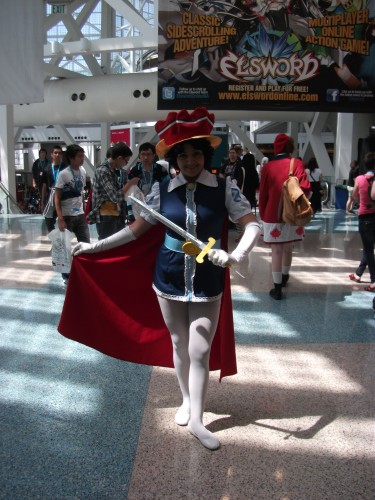
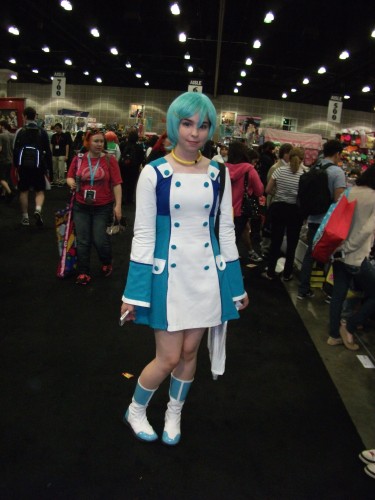
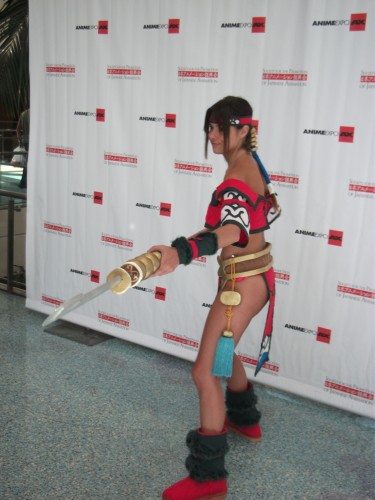
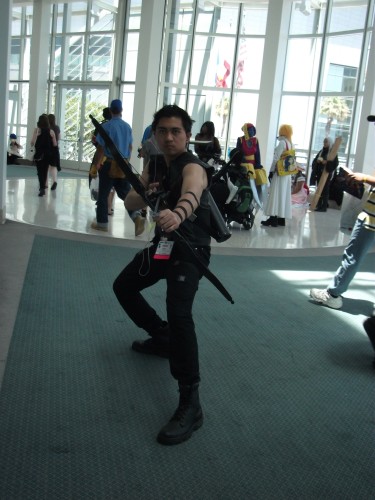
I think I’ll say it: AX2012 was possibly the best convention I’ve ever attended in terms of cosplay. Not only were many of the costumes excellent, but I don’t think I’ve ever seen so much variety. Popular cosplay topics such as Homestuck and Hetalia!, while still very present, didn’t even come close to dominating the visual landscape of the con, and cosplays I had resigned myself to possibly never seeing appeared in numbers. Whereas previously I had seen zero Dragon Kid cosplays from Tiger & Bunny, this time I saw five.

I remember being the only person to clap for Dragon Kid at Otakon 2011’s Sunrise panel, so this was a pleasant change.

In addition, I thought I’d never see a Precure cosplay at an American con, but I was gladly proven wrong. Have you watched Heartcatch yet? It’s really good.

Anyway, I’ll let the rest of the cosplay speak for itself, though keep in mind that this certainly isn’t an accurate representation of all of the cosplay at AX2012, merely what I photographed.

Final Thoughts

So there went my first Anime Expo. If I had to do it over again, I probably would’ve found a better medium between panels and autographs, and I would’ve definitely tried to see more faces. Also, the Kinokuniya in LA is definitely better than the one in NYC.

Dutch-Japanese Foods Part 1: Japanmarkt 2012

The city of Leiden has an annual outdoor market called the “Japanmarkt” (Japan Market), where people and booths gather along one of the canals of the city in order to celebrate all things Japanese. I actually went last year but forgot to bring my camera, so I made sure this year not to forget and to also actually report on the danged thing because it’s pretty cool overall.

Held this year on May 25th, Japanmarkt is not terribly different from any of the Japan-themed festivals I’ve attended back in the US, but what is very clear is that the festival reflects to some degree the unique history the Netherlands has with Japan. Back when foreigners were for the most part not allowed in Japan, it was the Dutch merchants who were the rare exception. Moreover, the first Japanologist, Philipp Franz Balthasar von Siebold, was a German living in Leiden, and his old house is now a Japanese museum on the same street as Japanmarkt. And of course, there are a good amount of Dutch anime fans mixed in there, creating this convergence of Japan-loving generations that’s different from an anime convention. That said, there were actually anime con booths there as well.

Food was a popular item, and for my part I tried two things in particular. The first was a curry (for charity!). The second was something that could only have come out of a Dutch-based celebration of Japanese culture.

If you don’t know takoyaki, they’re essentially fried chewy balls of batter stuffed with bits of octopus and covered in savory sauces, a kind of convenient comfort food (and quite delicious if I do say so myself). There was a takoyaki stand at Japanmarkt, but it had a twist, mixing the concept of takoyaki with that of “poffertjes,” tiny pancake-like snacks typically served with powdered sugar.

These “takoyaki poffertjes” were something I felt I could never get elsewhere, their uniqueness compelling me to try them out. I can’t complain.

At one of the tables which was selling manga, I overheard a girl helping her friend out by finding volumes of My Girlfriend is a Geek (Fujoshi Kanojo). I don’t often see people interested in those otaku/fujoshi romance manga, especially ones giving lists to their friends to hunt down those books wherever possible, so that put a bit of a smile on my face.

My Hopes for “Tropes vs. Women in Video Games”

There was a big to-do recently when Anita Sarkeesian over at Feminist Frequency received a barrage of nasty comments over her Kickstarter to fund a project to analyze common tropes concerning female characters in video games. A lot of the commentary was as you might (unfortunately) expect, citing her supposed jealousy of better looking women, her “hypocrisy” over wearing makeup, as well as threatening her with rape. Even if most of this turns out to just be purposeful button-pressing in order to get a rise out of her, it’s still pretty sad that it came down to this.

I do not think people should have to agree with her just “because” she’s feminist, but at the same time I do wish people would come up with better arguments against her ideas and her points than simply things like “sexualization happens to men too” (the nature of the sexualization is nowhere near the same).

Tropes vs. Women in Video Games is already more than well-funded as of this post, but having watched her previous videos in the Tropes vs. Women series, I still want to say something about my hopes and worries about the project.

While Sarkeesian makes overall good points in her videos pertaining to the types of tropes which can reinforce images of women as passive beings in service to more fully developed men, I find that her videos tend to take something of a sledgehammer approach to addressing problems. Tackling big problems with big answers is a valid method, and it does result in points which are more readily and sharply conveyed, but there is a loss of nuance in discussing specific tropes she addresses as a result, possibly due to the brevity required in making short videos.

The consequences of this loss of subtlety is that the presentation of the tropes themselves seem to center around the idea of the trope itself being sexist more than its overuse (though both are considered culprits). For the Women in Refrigerators trope, the idea of a side or major supporting character dying in order to drive the hero to action is a recurring theme throughout fiction, be it with men or women, and the use of a girl as the “sacrifice” is not so much the problem as it is the degree to which it happens in superhero comic books, a genre which is all about power and inspiration.

Similarly, in her discussion of the Manic Pixie Dream Girl, she criticizes the character type for being something of a vague supernova of inspiration for the leading male character, lacking in qualities to make her fully realistic. To that I have to ask, since when does more realistic automatically equal a better character? While I certainly see the advantages and have argued for the strength of such characterization before, there is something to be said for characters who are their concepts distilled to an extreme. Furthermore, it risks leaving no room for the trope to be turned into something which can be positive for women without having to completely subvert it.

When it comes to Tropes vs. Women in Video Games, my hope is that Sarkeesian will not come at the female characters of video games with a “one strike” policy. While there are plenty of girls to be rescued and recurring roles for girls that can be explored and criticized extensively, I hope that she does not view individual characteristics isolated from each other, but rather sees the characters as a whole. In the end, any judgment she makes is hers, and characters can and will end up being considered problematically sexist (because let’s not kid ourselves, video games do have them), but if a character has positive traits in addition to negative or even harmful ones, they should be acknowledged in order to show where games have managed to make smaller progressive steps in addition to bigger ones.

Thinkin’ Thoughts

Getting anime and manga merchnadise in the Netherlands is actually not that difficult I’ve learned, particularly when you live closer to the bigger cities. Though a lot of material is in Dutch, because a lot of people here know how to read in English already a lot of it is also imported from the US. I could be in worse situations.

That said, I’d be lying if I said I didn’t miss New York City and the amazing amount of access I can get with just a short train ride. When I think about how to spend a summer day in New York for me, it involves going to Kinokuniya first, followed by Bookoff (or vice versa), and then moving on to eat at Go Go Curry. They’re all around the same area so it also makes for an enjoyable walk. The sheer weight of my bookbag as it’s stuffed with manga is also a strangely pleasant and familiar feeling, and even reminds me of my high school days. It’s even more fun to relax on the train ride back, preferably with friends, just sharing everything we got while simultaneously peeling off layers of Bookoff price tags (those things tend to accumulate as the same book gets resold over and over).

Perhaps the New York routine is special mainly because it’s where home is. Probably if I gave myself more time here (and actually went to Amstelveen), I could build up a similar routine, but for now I’m content to wait for the moments I go back.

Definitions of Lolicon

If you’re into anime and aware of the concept of lolicon, then you probably have an idea of what the word means and the kinds of characters associated with it. Lolicon, after all, means the eroticization of very young characters, particularly female ones, right? It turns out to not be so simple, and I don’t mean in terms of “she looks 10 but is actually 500.”

I’ve been re-reading Sharon Kinsella’s Adult Manga lately (which is one of the best academic texts on manga and the manga industry), and in one chapter she writes about lolicon and doujinshi creators, as well as their relationships to professional manga In it, she gives the definition of “lolicon manga” as manga which “usually features a young girlish heroine with large eyes and a childish but voluptuous figure, neatly clad in a revealing outfit or set of armour.” It’s still pretty consistent with the current general conception of lolicon, but the “voluptuous” trait might seem a little strange.

Kinsella points out Gunsmith Cats as a lolicon title, but unlike the idea that it’s lolicon because of Minnie-May Hopkins and her child-like figure (see above), the example given is of the older-looking Rally Vincent.

Furthermore, she discusses the lolicon-esque qualities of Ah! My Goddess, but like Gunsmith Cats she isn’t just talking about the younger Skuld but also Belldandy and Urd, who, Urd especially, seem to go almost entirely against the current conception of lolicon used by people. Other titles from Monthly Afternoon (home of Genshiken!) mentioned as lolicon which seem to defy that definition further are Seraphic Feather and Assembler 0X.

Ah! My Goddess

This could be considered merely a rather broad definition of “lolicon,” but there are three things keep me from drawing that conclusion. First, according to Kinsella the influence of lolicon-style on the manga industry is somewhat acknowledged by professionals. Second, the character designs of Azuma Hideo, the “father of lolicon,” are very much in that blurry territory of the “child-like but voluptuous.” Third, is a conversation I’ve had with ex-manga editor and current Vertical Inc. editor and frontman, Ed Chavez.

According to Ed, one of the most significant lolicon characters ever is Lum from Urusei Yatsura, a character known for her sexy figure, and he also considers the origin of lolicon to actually be Maetel from Galaxy Express 999, a character notable for her mature and motherly qualities. I remember finding his categorization a little out of the ordinary, but when taking Kinsella’s words into account as well, it starts to make sense. It is that intersection of youthful but in certain ways adult, where for example the body is more developed but the face remains youthful, though neither is necessarily at any extreme.

Lum (left), Maetel (right)

Given this idea of lolicon, one of the most fascinating lines of thought to come out of this can be summarized with the following: if we go by this older definition of lolicon, even many of the fans who consider themselves vehemently against lolicon, who try to avoid it like the plague, would be categorized as lolicon fans themselves. Again, characters like Rally Vincent and Belldandy have been presented among fans for years and years now as the positive counterpoint to their respective series’ younger-looking characters, but they too now fall under the same umbrella.

Taking that into further consideration, the question becomes: given the anime of the last 20 years or so, what female characters wouldn’t be considered lolicon? It seems to encompass a large majority, where even characters defined by their mature, sexual bodies like Miura Azusa from THE iDOLM@STER and Fukiyose Seiri from A Certain Magical Index are grouped in, not to mention characters like Lina Inverse from Slayers.


Miura Azusa (left), Fukiyose Seiri (right)

I am not using this as a platform to invalidate people’s opinions, or to accuse anyone of being hypocrites. The term lolicon seems to have transformed over time, and the current generally accepted definition of it isn’t somehow less valid than its origins discussed above, though it may make for some inconsistencies in communicating, and at the end of the day Minnie May is still there. Rather, I think it shows a clear example of how words can change over time, that the boundaries by which we categorize things may not simply be about what traits are and aren’t present, but how those traits interact with each other (though that subtlety makes it susceptible to being more narrowly defined), and furthermore, how those traits are then perceived by those viewing.

In the end, Kinsella provides a quote from a senior editor of Monthly Afternoon:

The form of the manga is the same, but the themes have been changed to make them easier to read and understand for lots of people. Aah! My Godesss is a good example. It looks like otaku manga, but the content is different, the story has been changed so it can be read by a wider audience.

Could it be that, by taking the styles originally associated with lolicon, and putting them into contexts more relatable to a broader audience, this lolicon aesthetic no longer exists in that form? Where once the term referred to a broader range created by the interaction of certain traits, by having that larger readership claim one end of that spectrum, does the lolicon genre as we currently know it come into the forefront?

Blaaaazin’: Anime 2012

This past weekend was my second time attending the unambiguously named “Anime Con” over in Almelo, the Netherlands, only unlike last year I managed to go for more than one day. Truth be told, I had originally planned on skipping out this year for various reasons, but when I saw the guest list it seemed like a must. Not only was anime and manga scholar with a particular fondness for Tezuka Helen McCarthy attending, but there was Initial D opening/ending band m.o.v.e. as well. Another prominent guest was Dutch comics artist Martin Lodewijk, but I was not able to see him because he was only able to attend on Friday (which I skipped out on).

Located near the German border, the train ride to Almelo for me altogether took about two and a half hours, something I felt I should have remembered from the last time I did it, but somehow seemed strangely new. I was unable to procure a hotel at or near the venue, but taking the train back and forth ended up costing less money (and even less than a similar trip by Amtrak back in the US), and it gave me a lot of time back and forth to read manga and even to draw, which I hadn’t done in a long time. So, even aside from the actual convention itself, fun was had. Also quite fortunate was that the weather in Almelo was excellent, and if I hadn’t had to pass through wind and rain to get there I would’ve thought it to have been a waste to wear a jacket.

Before I get into the con itself, I do want to note that there are some interesting parts of the event which didn’t change too much from last year like the game room and the maid cafe, so I’ll refer you again to last year’s report.

Panels

Now I am the type of con-goer who loves to attend panels, and it was very clear to me that Anime Con this year had made a concerted effort to insert more panels into its programming. There were humorous panels, quiz shows, and a number of informative ones, including a Vocaloid panel. Not being terribly interested in Vocaloid myself normally, I walked in on it half an hour after it had begun in order to be around for the next panel, only to realize that in my ignorance I had missed out on what may have been the best Vocaloid panel ever.

Normally, Vocaloid panels seem to be more celebrations of Hatsune Miku and friends, but this panel was actually run by motsu, the rapper from m.o.v.e. Known for such sage wisdom as “I got no impression/ This town made by the imitation/ Wanting your sensation/ In this silly simulation/ I wanna rage my dream,” from the little I caught of it, the whole hour was a little bit of history about Vocaloid and a lot about how it works as a music-making program and its limitations, like how Vocaloids are bad at that double-consonant often found in Japanese, the “kk” in Tekkaman for instance. The band has somewhat close ties to the program, as not only was his fellow bandmate yuri was made into the celebrity Vocaloid “Lily,” but the guy as an active musician uses the program himself, even posting on Nico Nico Douga under the name “Nicormy.”

We learned that motsu likes to use the Gackt-based Vocaloid “Gackpoid,” and that there was originally some trouble with Vocaloid Lily because of yuri’s relatively deeper voice and how the program is better-suited for high-pitched tones a la Hatsune Miku. He also gave some tips for working around the program’s limits, like using the hi-hat (the cymbal?) from a drum machine in order to simulate a “ssst” sound, another weakpoint for Vocaloids, or using a “bend down” to improve the sound of Vocaloid rapping. Even though I don’t know music and had to look up some of these terms after, I really regret not being in there earlier.

Right after the Vocaloid panel was Helen McCarthy’s talk on “kawaii” and its origins, tracing it back more generally to a biological human tendency to want to protect doe-eyed creatures be they babies or kittens, as well as more directly how the styles we associate with Japanese cuteness were the result of an intermingling between Japanese and Western cultures. For instance, Helen pointed towards Betty Boop as an influence on kawaii, a mix of cute and sexy and facial proportions which resemble a traditional idea of attractveness in Japan, and talked about the French artist Peynet, whose romantic drawings of Parisian life still persist today.

Of particular note for me was her brief discussion of the artist Macoto Takahashi, whose “Makoto Eyes” (see above) would clearly become an influence on 60s and 70s shoujo manga. In fact, I had to ask Helen about the clear lineage into shoujo, and what might have caused a decline in those types of sparkling eyes, to which she replied that it likely has to do with how the painstaking detail of Makoto Eyes, which can take hours to draw precisely, conflicts with the hectic work schedule of a manga artist.

The last panel I attended was “The Future of Comics is Manga.” Held on the last day of the convention, it drew what I felt was a surprisingly large crowd based on my experience with American conventions, and I have to wonder if there are actually proportionately more anime con attendees interested in industry and creator discussions compared in Dutch conventions. On the panel were Helen McCarthy, Japanese manga and video game pixel artist curently living in the Netherlands Aoki Noriko, writer for the Dutch anime magazine Aniway Rik Spanjers, and Dutch comics writer Sytse Algera. The discussion went to various places, from how it’s faulty to say that comics never appealed to adults around the world and that it’s more an issue of the comics industry not being able to hold onto those readers to the comparatively low salary that most manga artists make, which has to be tempered by an actual passion and enthusiasm for creating comics.

Somewhat unfortunately, the Q&A session turned into primarily a discussion of piracy and copyright, from downloads to doujinshi to everything in between. While I felt that it was in certain ways a fruitful discussion, and everyone agreed that creators cooperating with fans had definite benefits, it also pushed aside all other potential questions. Moreover, a lot of the discussion had to do with artists feeling that they’re being slighted by downloads, and I feel that when you have a panel comprised of mostly artists and creators it skews the discussion in a certain direction, just as a panel of mostly editors might, or a panel of mostly fanfiction writers. All in all, though, it was quite informative.

The Concert

While I’m aware of the fact that m.o.v.e. has performed at at least one anime convention in the US, given my current living situation and the sheer size of the United States it was actually easier for me to go to Anime 2012 to see them than if I were still back in the US and they had visited another state.

Last year I had attended a portion of the Aural Vampire concert, but had to leave early. This year I decided to stay for the full thing, which almost didn’t happen because the concert started 45 minutes late. In spite of not getting home until 1am as a result, it was still really great, with m.o.v.e. playing up the crowd and throwing in their Initial D songs alongside some of their non-anime-related work.

I am no regular concert attendee, so I can’t say if this is anything truly special or not, but I was pretty amazed that the singer yuri actually sounds better live than she does in official recordings. I don’t have the proper musical vocabulary to describe what I mean, but she actually comes off as more powerful on-stage than in music videos. motsu meanwhile rapped up a storm, and in some ways it’s even more special to hear live than yuri’s strong vocals.

There were also some technical difficulties with the microphones during the concert, but m.o.v.e. handled it very well with the help of a supportive crowd. When mics would stop working, the two would share one, and at one point the DJ Remo-con (who also deserves respect) passed over his personal headset to motsu so he could continue.

As might be expected, motsu actually has excellent English (he was even occasionally switching to English in the vocaloid panel prior), and was definitely not working from a script when talking to the audience. My favorite moment was probably when motsu asked if we wanted “A CAT FIGHT” or “ANOTHER KIND OF FIGHT.” Remo-con responded with a cat paw gesture. At another point, motsu also asked what kind of beat we want, giving “flamin'” as one option. Naturally, there was only one choice.

Artist’s Alley

Unlike many of the Dutch cons I’ve attended the artist’s alley this time around was somewhat separate from the dealer’s room. I’ve spoken about this many times before, but I’m still interested in the fact that most of the artists in the alley seem to prioritize making full books, either by themselves or in collaboration with others, as opposed to buttons and other trinkets (though those were still around). I have to wonder if it has anything to do with the Netherlands’ own strong tradition when it comes to publishing (it was known for having very good freedom of publishing centuries back), though that connection may be too tenuous.

An interesting element of this convention’s artist’s alley was that there was this peculiar collectible card game available, where you actually buy cards based on the amount of things you buy in the artist’s alley, which you could use to create an actual deck. I didn’t buy too much from the alley, so I couldn’t experience the game firsthand, but it was apparently the idea of the people running the Manga Kissa (manga cafe) at this convention and many others, and who actually currently have a permanent location in Utrecht.

I also got a chance to talk Aoki Noriko, the Dutch-resident Japanese artist, who is also apparently a huge fan of Saint Seiya given her personal portfolio. As we talked, she mentioned some of the difficulty going from traditional media to digital, which is a topic I’m always interested in. In the end, I bought the comic above and left with a thank you, though looking back I regret not asking her more about her work in video games, as she did sprite graphics in the 8-bit and 16-bit era.

Speaking of art, ever since Nishicon 2011 I’ve been really enjoying the idea of a drawing room at conventions, a place which provides free paper and drawing tools so that people can go nuts. Like at Nishicon, the room was run by “Mangaschool,” the group which also ran various drawing tutorials and workshops throughout the convention. I feel like sometimes the best thing to do to get away from the hustle of a con while still being a part of it is to just sit down and draw, to let the mind wander through the hand. Also robots are cool.

I don’t have a proper scanner on me at the moment so while I’d like to share the drawings I made at the convention, I’m going to save it for a separate post in about a month. Look forward to it!

Storyboards

Also on display at the convention were various anime design work and storyboard pages from a wide variety of shows. I’ve included some below for your enjoyment:


Sakura contemplates revenge

Cosplay


Sadly she was not singing the Panty & Stocking opening

Overall

While I may not be the best judge of the long-term progress of “Anime Con,” I noticed many improvements compared to last year, especially in terms of varying the kinds of things that are available to do. Theaterhotel Almelo may only be able to hold 3000 people, but I certainly felt their energy as fans.

Language, Insults, Slurs

In online communication, whether it’s on a forum or in a video game, it isn’t uncommon to see some strong insults (racist, sexist, etc.) being thrown about, and the ubiquity of such language has created a lot of debate on the subject among fans and others concerned. What I see from those arguing, however, is a tendency to take a rather extreme stance in one direction or the other, which ends up avoiding much of the nuance of such a complicated topic which goes well beyond video games and technology and into the deep recesses of human history. I’m no expert on the matter myself, and I’m bound to have my own oversights, but I wanted to lay out my own thoughts, as well as my own personal philosophy on the matter.

One of the stereotypes of being on the internet is that, in order to successfully participate, one must have or develop a thick skin. Behind the safety of a computer screen and at least a few hundred miles, it’s easy to say what you want, when you want. People will take anything they can to put you down, whether it’s because they want to seem tough, or they want to psych you out, or because they actually feel that way, and race, gender, and sexuality factor into that equation as well. However, while it’s true that listening to what every single random person has to say about you online and taking it to heart is a bad idea and that having an impermeable hide can help deflect the insults away, there’s still the problem of the very fact that words such as “n****r,” “f****t,” and “slut,” are considered viable as insults.

How often do you see someone try to put down another person by calling them white, heterosexual, or masculine? We take these values to be in may ways a societal default on practically a subconscious level. When you call someone a n****r online to try and get under their skin, even if you don’t really mean it seriously, even if they’re not actually black, you’re implying that being black is in itself a terrible thing. It’s one thing to trash talk to get a mental edge, and it’s another to even unknowingly reinforce the idea that some people are perpetually inferior on some inaccessible level simply because of the color of their skin or whom they find attractive.

That said, I am very much against censoring or removing slurs from the English language.

While I do not believe that words are necessarily innocent in and of themselves, as they may have elaborate backgrounds rooted in hatred and intolerance, I am a firm believer in freedom of expression, whether that’s artistic or verbal or any other form, and that includes the nastier side of how we speak. If the writer of a story wants to convey hatred through strong language, then that option should be available to them, just as the option to deride them for doing so is available to everyone who chooses to read (or not read) their work. If people feel the desire to express themselves using that language, then I do not think it’s right to deny them their own feeling. To simply say that we need to erase these words is like layering bricks over a massive sinkhole.

The problem with “f****t” isn’t that it originally meant “twig” or whatever and that we polluted its meaning, but rather that we allowed ourselves to believe that homosexuality is a quality worth insulting in the first place. This is also why I think people using words like n****r and f****t in a positive fashion, or at least trying to do so, is not necessarily reinforcing the negativity associated with these words, but that is a topic I will leave for another time.

One thing I am well aware of is the way such language can be so commonplace that those who are exposed to it frequently while growing up can wind up having it as a part of their subconscious mind and not realize the potential strength of these words. Using them becomes habit, as simple as saying “good morning.” I’ll admit it myself: when I was younger, I would use the word “gay” to mean “awful,” as in “You got a 50 on a test? That’s so gay!” If you had stopped me and asked whether or not I actually thought homosexual were inherently worse as human beings or that I actually hated them, I would’ve said of course not, but still, “gay” was in my vocabulary as an adjective to describe mundane areas of life. Eventually, I stopped using the word in that fashion altogether, but it didn’t come from me declaring that “from this day forward, I will no longer use the word ‘gay’ in a way which implies negativity!” It simply happened gradually and almost unconsciously, and if I had to attribute it to anything, it would be to meeting and becoming friends with people who are gay, the act of which likely educated me into thinking of them not as some distant idea or label, but as fellow human beings. Just as easy as it was to start using the word “gay” in that particular meaning, it became just as easy to stop after the fact.

In contrast, when I was even younger, I made the active decision to stop cursing, and while I’ve gotten somewhat more lax since, I still try to avoid such words as much as possible. I never mind if others use them and use them often, but I have knowingly limited my own regular vocabulary because I think it serves me better, and I will still use them when I’m quoting another person who’s used a word like “fuck,” or if I’m discussing it as a topic and feel that ideas get too obfuscated through the use of euphemisms.

The fact that I’ve consciously removed some insults from my language and unconsciously removed others can seem rather contradictory I realize, because it might seem as if I’m saying that people should consciously remove certain words from their vocabulary while also claiming that it happens naturally and we should just let nature take its course. The difference here, however, is that I am not claiming a solution wherein everyone eliminates offensive language from their vocabulary or society deems it fit to consider the use of those words a crime in and of themselves. Nor am I claiming that people should use only the words that I use. Rather, I think the key to addressing the use of slurs, whether the user did not consider the weight of those words, is simply education, and not on a didactic level.

If we can show people about how words can and do have power, or encourage people to realize that those they see as “others” are not some nebulous concept but as a group of individual human beings, then we can give them the power to shape their own language usage from an informed position, instead of an ignorant one. This way, when someone unconsciously uses a word that encourages intolerance, they can be shown the potential problems of doing so without forcing upon them a false paradigm of “right and wrong,” or trying to instill shame into them. Thus, if they stop using a word, it isn’t because the word never existed or that it has some vaguely defined negativity, but because they felt that, on some level, whether conscious or unconscious, that it isn’t how they would like to express themselves. Vocabulary is avoided but it isn’t removed.

Preparing for Anime Con NL 2012

I’m going to be heading to the Dutch con known simply as  “Anime Con” next weekend (May 18-20). Located in the city of Almelo near the German border, I attended for the first time last year, though this time I’ll be attending for more than one day.

Of particular interest at this convention is their musical guest, m.o.v.e., known for their Initial D themes, manga scholar Helen McCarthy, and the famous (actually I believe most famous) Dutch comics artist, Martin Lodewijk.

If you’re in the area but haven’t decided to attend yet, do note that the hotel rooms are all booked, but that you can still get a discount if you register by the 17th.

Aniblog Tourney II Quick Guide

If you’re coming from the Aniblog Tourney, welcome. I’ll make this short and sweet.

This blog’s been running for a while now and has what could be considered a rather daunting archive, so I’ve picked out some of my better posts. I encourage you to take a look. Don’t forget to check out the blog that’s going up against me as well, and remember that voting is open to both new and long-time readers of Ogiue Maniax.

Round 5 Opponent: Metanorn (June 25th)

Round 4 Opponent: Sekijitsu (June 20th)

Round 3 Opponents: Atarashii Prelude, Bokutachi no Blog, Loli Salad (June 6th)

Round 2 Opponent: Shonen Beam (May 4th)

Round 1 Opponent: BYE

Long Posts

Explaining Decompression in Comics

The Divide of Time, Space, and Imagination: A Look At the Concept of Nostalgic Merchandise

Seeing the Darkness of Madoka Magica

Short Posts

Understanding the “Emotionless” Anime Girl

Drossel, the Best Figma

More Powerful than Aizen and Freeza Put Together

Dumb Posts

Another Legend is Born

Testing Out Comipo!

What is Kuronuma Sawako’s Favorite American Football Team?

Reviews

You’re Magical: Ojamajo Doremi

Moe Anime Girl Gets Pregnant, Has Baby – Jigopuri Volume 1

Brilliance of Life, Billions of Stars: Rintaro’s Galaxy Express 999

Genshiken

Why I Like Ogiue, Part 2

Battle, Fever: Genshiken II, Chapter 64 (SPOILER WARNING)

The Difference in Variety in the New Genshiken

Maybe I Don’t Read Enough Manga

Given the fact that I dedicate an entire blog to anime and manga, it might be strange for me to think that one of my problems is that I don’t read enough manga. Many burned-out bloggers cite the activity of blogging itself ends up taking a chunk out of their actual enjoyment time with the stuff they love, but that’s not really what I’m feeling here. My posting rate is consistent but light enough for me that, while I do sometimes feel the pressure of thinking of something to say, I don’t treat it as a chore.

Part of it may have to do with the fact that, although I can read Japanese, I do have my limitations and one of them is speed. I just can’t read fast enough. That’s only a part of it, though. Instead, I have this strange sense that I don’t quite have a proper pulse on manga as it currently is, and by extension manga as it has been. When I’m reading a bunch of manga in the same genre or for the same demographic, I get this strange sensation that I’m continuously boxing myself in too much, that I need to keep expanding my horizons. And so I do, I keep reading more, I keep trying new things out, but it’s like I can’t try them fast enough. I want to feel everything manga has to offer, to understand it as well as I possibly can, but somehow it’s just not enough, like I’m losing my connection to it.

What I’m experiencing may be somewhat the opposite of burn-out, though not in the way that you feel when you initially dive head first into a new obsession, where you have to consume every little bit that you can possibly find, good or bad. Rather, it’s this unusual melancholy where instead of feeling like way too much, it feels like not enough.