Superhero Comics and Being Sexy on an Individual Basis

Introduction

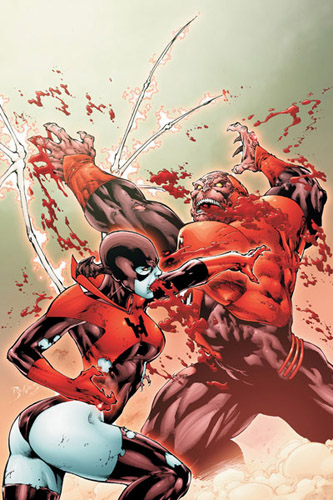
When it comes to the controversial approach to sexuality in superhero comics, probably nothing is more exemplary than the oft-seen exaggerated pose where a female character twists her torso such that both her butt and her breasts are facing at the reader directly. Known as the “brokeback,” the pose is frequently the target of criticism as an example of sexualization gone wrong. Generally, the criticisms concern the fact that, as action-based stories, the pose is a completely impossible and extremely impractical thing to do in fighting. The idea is that, by showing them as such, comics communicate the idea that when it comes to female characters the T&A is more important than their identities as heroes or characters in general.

The point at which I might diverge from other opinions is that I believe strongly in freedom of artistic expression and think that such works have a right to be drawn and a right to be enjoyed by readers on a sexual level. While I think that the disparity in idealization between genders can definitely be too much, something has to be said for the fact that the visual arts in general can make the impossible happen in the first place. If people are literally physically incapable of contorting themselves into the “brokeback” pose, then mediums such as comics are the only places where it is possible at all.

I also think people have the right to admire a character while simultaneously desiring her or the pose that she’s taking. Again, the fact that forms of fiction such as comics make it more than possible for the portrayal of a female character to be an effective fighter while doing the least physically sensible thing possible is not an inherent negative, as long as we’re being honest about the fact that it is indeed done for sex appeal. No matter how much we’re able to point out that those contorted positions would shatter someone’s spine, or that other poses come straight out of pornography, they successfully generate sexual attraction. Individual tastes may vary, but they’re also called “porn poses” because they work, and at the end of the day pornography drawn or otherwise does not automatically turn people into misogynists.

But while the act of making or consuming such products causes no harm in and of itself, when the brokeback pose becomes the default method for portraying sexual attractiveness, it creates two major problems in particular. First, while anyone has the right to enjoy any type and degree of sexualization, if the goal is to try and attract a larger female readership, then no one should be surprised when such portrayals lessen their desire to pick up superhero comics. Second, and what will be the primary concern in this article, is that by having that style of sexualization be so ubiquitous, it creates a singular image of how a female (character) is supposed to look when they’re being “sexy.”

Sex as Character

Over the month of February, comics news and editorial site Comics Alliance published a series of articles on sex in comics. One of the articles discussed Adam Warren’s Empowered, where writer David Brothers argues that, even though Empowered is more sexually explicit and has more overt fanservice than regular superhero comics, it still approaches the topic of sex in a much healthier and more mature fashion.

Although a majority of commenters have voiced their understanding of David’s points and explanations, there are a few dissenting responses which I found interesting for what they imply. The recurring criticism, which not only appears in David’s article on Empowered but also many of the other posts, basically calls out the writers for having a double standard, praising the portrayal of sex in indie comics, while lambasting the presence of sexuality in superhero comics, in something of a high art, ivory tower, porn vs. erotica-type argument. Another criticism leveled at Empowered in particular, is that its crass displays of actual sexual content and juvenile-sounding dialogue make it worse than the other superhero comics to which David compares it.

I think David actually addresses this well in the article itself when he describes the primarily sexual relationship in Empowered, that of the main heroine, Emp, and her ex-henchman boyfriend, Thugboy:

Empowered‘s eponymous heroine is a superhero with issues. Her costume is too skintight and ineffectually fragile, and neither her teammates nor her nemeses respect her. She gets tied up way too often for her liking.

They both get different things out of the relationship, aside from just sex. Thugboy clearly loves Emp, and expresses that in a way that’s both a little paternal and a lot touching. He gets her issues with her body and career, and when she doubts herself, he’s there to point out how wonderful she is. He supports her, and the reverse is true, too.

More important than that, though, is the fact that she’s comfortable expressing her insecurities to him.

The thing to take away from their relationship is that when Emp has sex, it’s not simply a display of sex but rather shows the specific scenario of “sex with Emp.” It takes all of the various bits and pieces of her characterization and doesn’t forget them even during moments of titillation. The trouble with how sexuality is frequently visualized in superhero comics then, assuming the goal is to show female characters in a sexual manner in the first place, is that this level of specificity doesn’t exist in most portrayals. Rather than a female character making a sexy pose, it becomes a female character conforming to a sexy pose template, no matter her personality, history, or quirks. When combined with the way that superhero comics can grow and reinforce bad ideas, we end up in the current situation where this approach to sexuality generates an entrenched position that causes people to staunchly defend it as if it is simply the way that comics communicate “sexy,” as if there is little alternative.

The issue of posing isn’t confined to just “bad” artists, as the above example from Jim Lee demonstrates. Taken from his famed X-Men run in the 90s, the image is well-drawn and the women are idealized without necessarily going off the deep end, but aside from Jubilee (front) all of them are taking the same sexy stance. Psylocke (left), Rogue (center), and Dazzler (right) all have very different backgrounds and personalities, so it seems strange that they would all be in the same pose. This goes double when you compare them with all of the male characters, each of whom showcase their individuality in the way they’re standing or sitting, or Jubilee once more, whose “attitude” comes across in her slouched position.

Again, there’s nothing wrong with showing attractive girls in exaggeratedly attractive poses in and of itself, nor is there any fault in enjoying them, but superhero comics are in the business of creating unique, iconic characters. This is why they have different origin stories, different costumes, and different powers. The goal is to be able to see how a particular character stands out from the rest, and if sexuality is involved, then comics can benefit from making sure that the erotic is also made to fit the characters.

Alternatives from Anime and Manga

I’m going to steer away from superhero comics and take a look at anime and manga, a territory I’m much more familiar with, and one which I find provides some strong examples of works where the sexuality of their characters is both emphasized and individualized. This is not to say that anime and manga are devoid of sexism, or that any of the examples shown below are perfect in their portrayal of women. Instead, I want to show how these works go out of their way to portray their characters’ sexuality in ways which also reflects their unique characteristics, and to point out how the issue with pushing just one type of sexuality can be an issue even when the goal is to portray characters in a sexual fashion.


Senjougahara Hitagi (above) and Kanbaru Suruga (below) from Studio SHAFT’s Bakemonogatari/Nisemonogatari

The first title is Bakemonogatari (and its sequel Nisemonogatari), which features a number of attractive and highly-sexualized female characters. The characters depicted above are both the same age and both attracted to the main character. However, Senjougahara’s seductive body language is fed by her sardonic personality, whereas the athletic Kanbaru, a self-admitted pervert and an exhibitionist, shows a more forward and aggressive approach. What isn’t as clear from these screenshots is that the show banks on their sex appeal being highly individualized down to the very way that conversations happen.

Left to right: Ran, Madoka, and Muginami, from Rinne no Lagrange by Studio XEBEC/Production IG

Next is the recent Rinne no Lagrange. The three main characters depicted above are all clearly meant to be attractive, but in addition to having varying styles of dress which set them apart at the same time that they emphasize their figures, the three girls also literally sit differently. Just having them relaxing on chairs in unique manners suggests the differences (as well as differences in physical appeal) between them, and I might even go so far as to say that a person could get a rough idea of their personalities based on this image alone.

What of the brokeback itself, then? Is the pose forced to contain only one connotation, such that it cannot become a characterization factor? I believe the answer is that any way of posing a character, even the brokeback, does not automatically void its own potential to be a factor in showing a character and their particulars. The easy answer here is that if some seductress character wanted to stand that way to entice men sexually (and I’m assuming heterosexuality here mainly because that is the site of this debate), then it would make sense, but it doesn’t require that the character herself to be hypersexual, provided that it does not take over her overall portrayal or the view of sexuality in the comic itself.

Akashi Kaoru (right), heroine of Zettai Karen Children by Shiina Takashi

In these pages from Zettai Karen Children, we have its main heroine Akashi Kaoru standing in a way that emphasizes both her chest and her rear. It’s in the context of “stretching for a run,” which lends some practicality to it, but as I said in the introduction, I find arguing from a point of realism as if to say that once you undermine the physics of the pose, you break its spell to be a flawed one, somewhat like arguing that Superman shouldn’t fly with one arm out because that would just create unnecessary wind resistance. Instead, the reasons I see Kaoru’s pose as being be different on some level compared to the typical broke back are that first, the twist of the torso isn’t quite as exaggerated, and second, it is shown to be just one pose among many within these two pages, let alone the rest of the book. Her stance is neither the primary display of athleticism nor the primary display of Kaoru herself, and on top of that she contrasts with the other girls shown.

To re-emphasize, my goal with these examples isn’t to assert some kind of general superiority of manga over American comics, but to say that the problem with having the brokeback and what it represents be the default for comics in general is problematic for more reasons than simply “sexism.” Comics and other media don’t necessarily have to go so far as to possess the highest quality of characterization, nor do they have to be the most tasteful or thought-out. Rather, if the goal is to create unique characters, then that uniqueness shouldn’t be subsumed by some generic template, sexual or otherwise.

Conclusion

The topic of poses and how they emphasize female sexuality in certain ways almost inevitably leads from the action of the body to the body itself. That is, the idea of “defaults” and “templates” can also encompass specific body types, and even a cursory glance at superhero comics shows that certain proportions on women are far more prominent than others. To address the issues of “body” and “body image” would make for an entire essay (or several) in and of itself, so I won’t touch on it except to acknowledge it, and to state that, like the brokeback for poses, the “big-breasted porn star” look isn’t inherently valueless, but it can be abused. Instead, the real problem lies not in the porn poses or the porn star bodies in and of themselves, but in their sheer ubiquity, as the singular image of sexuality that they create winds up narrowing the overall perception of beauty and idealization in comics. However, by broadening the approach to sexualization and showing that different forms of “erotic” exist, it is possible for even female characters with extremely similar bodies to show a greater degree of variety as characters, and can help to expand the number of ways a woman’s sexuality can be portrayed.

Meal, On-hand-to Eat: Strike Witches Rations

I like food, and I like shameless advertising involving food, but it’s often hard for the two to make sense. Sure, there was the Saki Tacos promo, but rarely do the components of edible promotion actually line up so well, instead usually involving some logos or stickers slapped onto the wrapping of a biscuit. Luckily, we now have Strike Witches rations, so that you can simulate the feel of being a teenage girl with propellers strapped to your feet fighting a war.

Japanese blog “Kyou no Gogo kara Honki Dasu” has a photo review of the product, which appears to come with “biscuit bars” and some kind of jelly to go with it. According to the reviewer, the biscuits are absurdly sweet, though I don’t know by what criteria he’s judging it (American candy tends to be sweeter than Japanese desserts for instance).

I’ll be honest, unlike Saki I don’t really know much about Strike Witches. I’ve only seen two episodes, but even so, I still feel compelled to buy this product, if only because it really exists.

Real Life Isn’t Graded

A while ago, I was linked by a blog which laments the state of anime fandom as a kind of “frivolous space” in which those without confidence try to shelter themselves, those with confidence try to assert a paper-thin authority in the form of blogging, and that in general geekdom is tending away from originality and towards imitation. Going into detail, it links to one of my old posts, in which I talk about a time when I was having difficulty engaging in a conversation because the people I was speaking to seemed to be without interests, and states that I am an example of the problem with geeks, who define people by their interest first and their actual selves second. Seeing as I am being pointed out as an example of what’s wrong with “nerds,” I feel I should respond to this “manifesto” and to take it as sincere (even if it might not be entirely so), not simply to act as a counter-argument but to clarify some of my own views on the ideas proposed by the post in question.

First, I’d like to address the accusation directed at me in particular, where the blogger points out that people should not be defined by their interests and that geeks should not think that having a hobby is priority one. For one thing, I agree. I think that it is a trap a lot of nerds fall into, thinking that their friendships and relationships should be predicated on common hobbies and tastes. However, that does not mean that it is an illegitimate way to begin to know someone, and the original point of my post was not to say that people who did not come prepared to talk about their interests were somehow lesser as individuals. Rather, as Starcraft commentator Day[9] once said, I like hearing people talk about things they’re passionate about.

It’s not about a specific hobby or activity or some kind of material substance, but that I find the best conversations to be ones where people are expressing something they love so much that you can see it in their faces. The “interests” in that sense are just a conduit to seeing the manifestation of joy and drive and desire, and it is how I personally connect with people best. While in hindsight I am aware that I could’ve approached that original conversation better in the first place, if wanting to hear people be passionate about something is a problem, then I am glad to be problematic. Perhaps I need to improve my own conversational abilities further, but I never claimed to be perfect.

Second, I’d like to respond to the title, “Real Life Isn’t Graded On a Curve.” And once again, I agree. Real life isn’t graded on a curve. That’s because real life isn’t graded at all unless you want it to be. Barring extreme situations like poverty leading to malnutrition, there is no rubric that the whole of mankind can reference for an exchange rate between money, health, passion, friends, family, whatever. But if you want to rank your life to see if you’ve hit a passing mark, then that “world” opens up to you, for better or worse. That’s not to say that people shouldn’t try to improve their lives or that they should be content to just coast along in life, but accomplishments are self-defined.

So when the post accuses artists on Deviantart of using art as an excuse for social interaction rather than a desire to perfect their craft, I have to simply ask, what is wrong with that? Yes, Deviantart has a sizable population of people who draw but may not have the training, talent, or desire to learn that will allow them to improve upon their mistakes and grow increasingly adept at making art. However, art, whether you believe in divisions of high and low and whether or not you believe it should have some higher purpose, is not so narrow and simple as to not have room for both those looking to perfect their craft and those who are using it as a conduit for social interaction and many other types of people as well. For some, it is an ends, for others, a means to an end, and it is short-sighted to believe that the only type of artist that should exist is one who seeks only perfection, or seeks only originality.

This applies more broadly to fandom (and people) in general. Occasionally I find myself wishing that anime and manga fans would engage their hobby more actively, with a greater desire to learn and to grow, and in that I can find some common ground with a person who wishes to see only the best of fandom and the best in fandom. However, I think it is a big mistake to disregard the ability for an online space to make people feel comfortable as some kind of “hugbox.” Competition is fantastic, but it is not the end-all be-all, and there is no absolute need to inject competition into a space where people do not need to be graded for performance.

The “Real Fan”

Though I don’t talk about it often here, I enjoy watching Starcraft, be it Brood War or the current Starcraft 2. Currently, competitive Starcraft 2 is enjoying something of a boom, with tournaments and teams popping up all over the world, from Korea to Ukraine to Las Vegas. This past weekend, one organization tried their hand at a new tournament broadcast format: pay per view.

Typically, Starcraft 2 tournaments are free to view online in some capacity, with additional content available at a cost, such as higher quality video, additional video streams, or recorded match videos you can watch after the live event is over. Major League Gaming, known as having the most exciting Starcraft 2 tournaments in North America, decided that they would have a supplemental event called the “MLG Winter Arena” and that it would require $20 to view live. This barrier to entry in turn caused a large amount of discussion, whether or not $20 was simply too much, business models for eSports organizations, etc. I personally did not pay to watch MLG Winter Arena, especially given that there was a second big tournament going on at the time.

One comment I saw cropping up repeatedly had to do with being a “real fan.” The idea was that if Starcraft 2 tournaments were so important to you, why wouldn’t you prioritize them? For those who can’t afford it at all, there’s no choice, but for those who can, isn’t the product worth its value (tons of big names, very good production values, promises of extremely intense competition). I had the money, but I didn’t use it. For me, as much as I love spectating, Starcraft is not my primary passion or hobby, and if given a choice between spending money on something anime/manga-related and spending money on SC2, I’ll typically lean towards the Japanese comics.

That’s not to say I’m not willing to spend money on Starcraft at all. I felt that the convenience of being able to watch matches any time instead of adhering myself to the Korean time zone was reason enough for me to subscribe to GOMTV’s Global Starcraft 2 League. But I didn’t get the premium package, I got the light one. All of those nice perks offered for the extra money weren’t worth it for me, and I’m glad they gave me the choice. That’s one thing that GOMTV correctly recognized that seemed to get lost in this flurry of discussion: Starcraft fandom (or any fandom in general) does not exist in a binary setting where it’s either one or the other. People can like something, but there may be a limit to how much they like it, especially if money is involved.

Manga and Women in Refrigerators

Introduction

If you were to ask an avid and informed fan of superhero comics about controversies surrounding the portrayal of women in the cape-and-mask genre, you might get answers having to do with the male gaze, or the number of female protagonists, or perhaps even whether or not comics need to do more to attract female readers. In every case though, the focus can potentially lead to the phenomenon known as “Women in Refrigerators.”

Coined in 1999 by comics writer Gail Simone (probably most famous for her work on Birds of Prey, a series starring a team of female superheroes), “Women in Refrigerators” refers to a tendency for female characters in superhero comics to be either killed, abused, raped, or depowered in what seems to frequently be a move to anger or inspire a male superhero into action, or to intensify the hatred between the hero and his nemesis. Named after the Green Lantern character Kyle Rayner depicted above (who not only literally finds one of his girlfriends in a fridge but has also lost a number of significant others in his career), WiR has been an on-going discussion among comic fans for the past 12 years. In spite of the age and scope of the topic though, the conversation has not really penetrated the realm of anime and manga.

Given arguments over things like moe and lolicon and how Japanese society treats women, what of “Women in Refrigerators in Manga?” Furthermore, whether they’re informed or ignorant, with the number of people who have spoken or written about WiR in the superhero comics community, what would happen if they all focused their attention more towards manga?

Casca from Berserk, a strong female character horribly traumatized by brutal rape

When initially thinking about the topic, a number of questions came to mind. Would they look at manga and find it to be more sexist than superhero comics? Is the lack of a similar phrase or concept in manga a potential problem for it and any movements towards improving manga? However, I soon realized that WiR and its surrounding discourse are very much shaped by the superhero genre itself; evidence of this includes the whole idea of being “depowered,” something which holds a lot more weight in a setting where super powers are the x-factor in the story.

Of course, comparing one genre to the entirety of manga makes things quite unfair, but even when you narrow it down to, say, shounen fighting and action series, or even a single magazine such as Shounen Jump, the setup of superhero comics has particularly unique consequences.

Conceptual Paradox in the Superhero Genre

The basic superhero (of which Superman is probably the most well-known example) is someone who is somehow stronger, faster, and overall better than the average human, and this allows them to right wrongs. Where the regular authorities falter, the superhero-as-vigilante can come in and thrash the bad guys and make the world a better place. These settings rely on an environment fairly close to our own, one grounded in a similar default reality so that we can compare the ideal of the superhero to the everyday, but it also makes for a world that can start to unravel if the concept is pushed too far.

Adding a superhero to an otherwise normal world can transform it entirely, and when you begin to really question the effects a particular superhero can have on his environment,  you wind up with questions like “If Mr. Fantastic is so smart, why hasn’t he found a cure for cancer?” While there are comics which do explore in detail the influence superheroes can have on society (Watchmen, for instance), and the Mr. Fantastic question isn’t some magic contradiction that destroys the superhero genre, it does point to the idea that a typical superhero story has to set its boundaries if it doesn’t want such questions jumping out at its readers.

The idea of boundaries isn’t limited to superheroes, as just about any story which adds something “superhuman” while wishing to maintain a semblance of normalcy has to draw the line somewhere. The tricky thing with superhero comics, however, is that the manner in which they have developed over the years encourages readers to find those limits through the prominent usage of a shared universe. When a comic is just about Batman, you can see how he fights crime and strikes fear into the seedy underbelly of Gotham City. When you cross him over with Superman though, suddenly Batman is put in contrast with a near-omnipotent alien who can outclass him fifty different ways. The reason to join them together is not to just make Batman look bad but rather to afford both heroes sufficient respect, so it requires Batman to have something extra to make up for it.

Where once he could just be a clever and ingenious individual, Batman is now the smartest man on Earth, armed with the most complex contingency plans ever conceived by man, all to make him Superman’s equal. In manga terms, this would be the equivalent of putting Monkey D. Luffy and Son Goku in the same universe and having to find a way for Luffy to be as powerful and influential as the Dragon Ball protagonist, like saying that Luffy’s rubber body makes him more resistant to ki blasts or something. As Marvel and DC actively promote their shared universes, this type of comparison becomes almost inevitable, and when you’re comparing, then the superhero universe comes under at least a certain degree of scrutiny.

If you then add the on-going saga aspect that is “continuity” to that mix, then the world of the hero can be scrutinized not just in terms of space, but also time. Superhero comics encourage a long-term view of its characters, where the events build on top of each other to create a loose history. And given the longevity that some of these characters possess, an action 30 years ago can continue to be associated with that character. In a comic from 1981, Avengers character Hank Pym hit his wife Janet , and it became a recurring topic all the way up until she died a few years ago. If they were to just ignore it and have the two characters act like nothing had ever happened, then it would have been perhaps silently condoning spousal abuse. However, because they kept it, it wound up defining the characters in certain respects. Although one can argue that this enriched their characters, it also meant that once it was done, neither of them could return to what they were prior to it. And while things are re-written or counteracted on a somewhat regular basis in superhero comics, this shared universe setup means that just one bad decision by one creator can potentially define a character to the point that no amount of reboots or retcons can undo its influence.

One Woman, One Refrigerator, One Universe

Let’s go back to manga for a little bit and pick a title that most definitely has female characters that are WiR candidates: Fist of the North Star. Now I love this series and consider it among my all-time favorites, but its female characters range from essentially cheerleaders to useless. Going in the style of the original Women in Refrigerators post, I’m going to list them with a list of ways they’ve been “fridged.”

Yuria (above) abused, forced to become Shin’s lover, kills herself (not really), contracts a fatal illness from long-term radiation exposure

Mamiya turned into a sex slave, her lover Rei dies, stops fighting entirely

Lin almost forced to have Kaioh’s baby, brainwashed into falling in love with another man

And so on and so forth.

Women are kind of a non-factor in Fist of the North Star no matter what they say about love and no matter how many women nobly sacrifice themselves. But at the same time, the fact that Fist of the North Star ran in Shounen Jump doesn’t mean that its portrayal of women exists in the same environment as One Piece or Toriko or City Hunter. Misogyny can exist, and it can even exist in multiple titles from the same publisher in the same magazine to the extent that you could call the whole thing sexist, but there is less of a risk of the comics congealing into an entrenched, constantly self-reinforcing “super misogyny.”

With superhero comics and their long continuity and shared universes, it can be incredibly easy to permanently “poison the well.” In this environment, a single instance of a WiR does not stand alone in its own conceptual space, but ends up existing in a greater universe, and then stays there in the timeline potentially forever. While this is not inherently a bad thing, it means that more innocent and simplistic stories and concepts have a harder time maintaining that innocence. If someone said The Cat in the Hat and Schindler’s List occupied the same continuity, it would be very hard for Dr. Seuss’s characters to be quite the same when the idea of genocide hangs over them.

This can even apply to the degree to which women are sexualized in comics. Somewhat like how “Hollywood Ugly” requires you to believe that the attractive celebrity in baggy clothes and glasses is meant to be homely, if you take a title where the aesthetic portrayal of women is geared primarily towards the sexual gratification of men and put it in the same world as a comic where the attractiveness of women is depicted in a more neutral fashion, then there is bound to be a conceptual clash, especially if the two were to cross over directly. Either the overt “butt and breasts out” poses would have to be acknowledged directly with respect to how a woman would normally pose herself (accounting of course for stylistic flourish), or the more neutral design would have to be subsumed by the overtly erotic aesthetic. If respect is supposedly afforded to both portrayals, then there winds up being a compromise, much like Superman and Batman’s situation, that generates at least a certain degree of schizophrenia.

It can also be easy to poison the well of a shared universe because once that idea takes root in one corner of the world, it becomes easier for it to spread to other parts as well, and I think this is what ends up really shaping Women in Refrigerators in terms of the superhero genre. While I may be assuming things too much, I think it’s far easier to corrupt an innocent idea than it is to make a corrupted idea turn innocent, and so every time another woman gets killed or raped or depowered, it means less and less of a chance for that whole thing to be turned around entirely, which means the rate at which the universe becomes “darker” winds up being far faster than the rate at which it becomes “lighter,” unless deliberate steps are taken to work against it.

Given everything I’ve said about the danger of a shared universe, does this mean that any sort of shared universe will lead to similar problems? Not necessarily, but I think that regardless of which direction that universe goes, compromise is almost inevitable. When Neon Genesis Evangelion with its emphasis on psychological turmoil enters the crossover environment of the Super Robot Wars games, its story and characters end up less traumatized overall. When Lupin III meets Detective Conan, his role is more of a lovable scamp than a hardened thief. Even taking darker series and making them lighter to fit in another work is a form of compromise. However, neither of those bother to maintain their continuities for prolonged periods. Moreover, while a shared universe does not guarantee Women in Refrigerators, the way that superhero comics have turned out means that it is constantly poised to do so, and as far as I can tell, the discussion surrounding WiR is very much about a concerted effort to turn things around, to deal with what may very well be a case of inertia.

Towards Methods for Manga?

A quote from Gail Simone in 1999 clarifies one of the original purposes of Women in Refrigerators:

My simple point has always been: if you demolish most of the characters girls like, then girls won’t read comics. That’s it!

This is not as much of a problem for manga, even titles and magazines designed for boys, as many publishers in Japan have learned ways to court a female audience. Some titles in Shounen Jump are especially known for their sizable female readerships: Saint Seiya, Katekyou Hitman REBORN!, and The Prince of Tennis, to name a few. Granted, most of these titles have primarily male casts and so the portrayal of female characters is not the primary draw, but that is also getting into another more complex issue of gender-based character identification. I’ll leave this as something of an aside for the sake of not going too off-course, but will say that this might mean that it doesn’t take outstanding portrayals of women to attract a female audience, but at the very least ones that won’t make them feel uncomfortable to be women.

As it is, the “Women in Refrigerators” discourse is especially suited for the superhero genre. Its concerns and the manner in which it can quickly spread to other stories are at least partly predicated on the structure set out by decades of development. If WiR is to be applied to manga, or even a certain genre or magazine/publisher, then it likely needs to be modified to fit a very different history, both in terms of manga itself and the Japanese culture surrounding it. Personally, I’m not entirely sure what changes need to be made. It’s probably an endeavor that is too big for one post, but I can throw out some possible directions.

I think the killing, rape, and abuse aspects probably translate adequately as is, but to go back to the “depowered” aspect of WiR as something very particular to superheroes, perhaps it would be a good idea to find something that is not quite so specific. If we’re dealing with a genre like shounen action, your Dragon Ball‘s and Naruto‘s and such, then maybe it’s not so much a matter of depowering as it is being quickly outclassed or made irrelevant. A lot of characters in these works often get some kind of improvement to their abilities, but that is made obsolete by the fact that every other hero gets stronger at a quicker rate. While this is not exclusive to female characters, it may be something worth tracking among female characters to see how they’re made to be functionally useless.

If we’re looking more at sexually-charged (but not necessarily pornographic) titles, maybe it would be wise to keep an eye out for degradation or humiliation. For example, how often are characters made to do something or wear an outfit that not only embarrasses them, but sexualizes them in the process? What of humiliation as a sexual tool, even when it’s meant to be light-hearted prodding and not something more extreme like torture?

Maybe it would also be a good idea to take a look at one popular title and to note where the female characters are mistreated solely to advance the male characters’ stories. After that is done, the next step would be to look at works that may have come about as the result of its popularity, whether it was because there was a clear influence, there was a blatant attempt at riding the wave, it was the next title readers flocked to, or even if there was some kind of editorial mandate to feature more of those stories. Do some of those WiR-esque ideas and portrayals still exist? Are they getting weaker or stronger? This may be a way to track things across one magazine or one genre without having the shared universe of superhero comics.

Of course, this is all assumes that WiR is not an issue when the female readership has been established and sustained sufficiently, but what about the possibility that the phenomenon not only exists in shoujo and josei, but that such events might occur in greater numbers compared to manga geared towards male readers?

What I’ve provided in the ideas above would not comprise a complete framework, but then again neither did the original list of Women in Refrigerators. There is a distinct possibility that with each genre of manga, even if you were to narrow it to titles somehow similar to superhero comics, that it would require its own adjustments be they subtle or broad. It may even be the case that in the end, we find out that WiR cannot be applied to manga no matter how many modifications are made, but I think it would still be a worthwhile endeavor to figure that out in the first place. I’m sure we’d learn something along the way.

The Potentially Positive Influence of Public Relationships in the Starcraft 2 Pro Scene

The release of Starcraft 2 last year has caused something of a boom in competitive video gaming, referred to in the community as “ESPORTS.” More and more, professional gamers around the world are becoming stars, and along the way the fact (or impression) that they’re “nerds” is celebrated; to be a nerd is to be smart and talented and even handsome. Made prominent is the idea that nerds can be attractive to the opposite sex, that these (mostly male) keyboard athletes have an appeal attached to their passion and drive for victory.  This is not a new concept, as is evident in the gigantic Korean Brood War scene and the fact that based on the screams of the audience you might assume that it’s John Lennon playing from that soundproof booth. However, a major difference is that while Brood War shows its players as owners of large female fanbases, competitive Starcraft 2 is showcasing couples far more prominently, both inside and outside of Korea.

Whereas Brood War pros will avoid answering the question of significant others (or will mention girls they once dated), Starcraft 2 pros seem much more willing to admit that they are seeing someone. Moreover, Starcraft 2‘s has what can be described as “power couples,” well-publicized relationships where both individuals are a part of the scene. Evil Geniuses captain Geoff “iNcontroL” Robinson and Miss Oregon 2011 Anna Prosser, Startale captain Kim “RainBOw” Sung Je and his fellow teammate Kim “aphrodite” Ga Young, player/caster Trevor “TorcH” Housten and WCG Ultimate Gamer Rachel “SeltzerPlease” Quirico, Terran Emperor Lim “SlayerSBoxeR” Yo Hwan and actress Kim “Jessica” Ga Yeon, all are major examples of the public relationships that populate the Starcraft 2 community.

Part of this may simply have to do with the higher average age of Starcraft 2 pros vs. their Brood War counterparts. Where 20 might be considered an aged veteran in Brood War, some of the most talented and well-known Starcraft 2 players are approaching or even past their 30s, and with that comes possibly a sense of maturity and stability. It is also well-known that dating is frowned upon for Brood War pros for fear that it might distract them too much from the game, and no such taboo exists for Starcraft 2. While there are prominent married figures in Brood War such as Choi “iloveoov” Yun Sung, BoxeR’s former teammate and one of the most dominant players of all time, and Kim “January” Ga Eul, manager of the team Samsung KHAN, neither of them were active players when their significant others were made public. The “sex appeal” of the young Brood War player seems to be more along the lines of a K-Pop star whose relationship status is intentionally ambiguous to draw in more fans.

The reason that I am pointing all of this out is not to foster gossip about who’s dating who or to draw attention away from the games themselves, but to posit the idea that perhaps that seeing these relationships can potentially promote a different kind of lifestyle image for the nerds of the world. Rather than being a hit with the ladies, the professional nerd can be a hit with the woman of his life. You, yes you, can find a woman who will not only condone your geek lifestyle but will understand and actively support it. More than just an aspiration, the power couples of Starcraft 2 provide concrete examples that this is an attainable goal.  What is also clear, especially from the examples given above, is that these couples are not together solely because of an individual’s skill when it comes to their game of choice, but because of their character. In this way, progamers may act as role models in more ways than one.

Thoughts On the Pervasiveness of 4chanspeak

Since its inception, 4chan has generated a peculiar set of vocabulary. The term “weeaboo,” now synonymous with “japanophile” and “wapanese,” was born out of a word filter designed to mitigate usage of the term “wapanese.” Often times extreme and intentionally insulting, 4chan is also known for appending the suffix “-fag” to almost every word possible, to the point that its origin as a homosexual slur almost becomes a generalized slur. How else would you explain the usage of the term “straightfag” to denote someone who is annoyingly heterosexual?

Though it is convenient and perhaps comforting to think of terms such as “weeaboo” and “moralfag” as isolated elements of the 4chan userbase, 4chan-isms have permeated the internet to the extent that people who have never even loaded a 4chan page are using these phrases. I saw one such thread on a reddit video games thread, where after throwing around a bunch of classic 4chan terms, proceeded to ask what /v/ is  (the video games board on 4chan).

Personally, when it comes to my writing and even my online chatting, I prefer to keep the usage of 4chan-isms to a minimum, because I feel that they 1) have too much baggage that requires unpacking and 2) are overly broad when I tend to prefer a bit of precision in my sentences. I also prefer that other people do the same, though I don’t mind seeing it pop up every so often, especially for flavor. On the other hand, overuse of 4chan-isms to the extent that thoughts are conveyed using almost nothing but them can not only be difficult to read but causes my mind to kind of gloss over what they have to say.

However, given the sheer amount of 4chanspeak users out there, I find it increasingly difficult to write off what people have to say solely because of their excessive 4chan-sisms.  After all, if it has become so ubiquitous, if there is an entire generation of internet users who think this to be the normal way to speak online, then it is more than likely that very smart and insightful individuals who communicate primarily through such terms exist. While I can criticize them for using terms which probably have better alternatives, I cannot deny the possibility that smart things can be said in a “inarticulate” fashion. Not only that, but if someone feels most comfortable describing their feelings using 4chanspeak, who am I to judge? If someone says, “I got NTR’d and might become a suicidefag,” and actually means it, then maybe I have to just understand that sentence as being their way of expressing a hurtful situation and to take that seriously.

Burning Out On Quality

A while back I wrote a post about mitigating burn-out when it comes to consuming anime and manga, advice that had the caveat of me never having actually burned out, which means that I’m either very qualified to talk about it or not qualified at all. Recently though, I was in a situation where I had trouble watching anime, and I feel like I learned a lot from it.

I’ve been watching a lot of science fiction-themed anime, series full of ideas about how the future can/will/should be, not necessarily heady stuff but enough to make a person think a fair amount. However, even though I like everything I’m watching, one day I just suddenly had this strong desire to not continue, like my brain and eyes were telling me that they would refuse to process that information meaningfully if I tried to watch more. I wasn’t sure what to make of it, until I could hear my own thoughts more clearly.

I need to watch something ultra dumb.

And so I did, not knowing how long it would be until I could restore my capacity to watch so much science fiction. In the end, it only took a day away from those shows for me to feel the urge to keep watching, but it taught me a valuable lesson that seems so obvious in hindsight: You can have too much of a good thing.

Often the picture of anime burn-out seems to be that someone who just watched too many bad shows and can no longer handle the bottom-feeding tropes which populate low-tier anime, but I think that a more fundamental aspect of such burn-out is just monotony. Much like eating the same food day in and day out with no variety, even the most delicious of meals can lose their flavor, especially if you’re not naturally predisposed to liking them. Also like food, the level of variation needed to keep things interesting varies from person to person. With anime, I find there are shows that I can become quite fond of with little effort, shows that I can watch just about any time, but for other shows, I find I need to put a bit of myself into the show. As a result, sometimes I find myself unwilling to watch another episode because I can sense that my mind is “exhausted” and will not give me an accurate impression, and just pushing and hoping to power through that mental blockade can end up doing more harm than good.

And so, I have much gratitude for ultra dumb shows. Sometimes they’re just what I need.

Ogiue Maniax on the Veef Show

I recorded a podcast over at the Veef Show just this past weekend with Andrew of Collection DX fame, and it is up for your listening pleasure.

We talk about a number of topics, but it mainly focuses on things like space travel, the state of anime, and philosophizing about that most sacred of subjects, mecha anime. For reference, my Code Geass post that we mention is this one.

Apologies for the background noise on my end. If you’re curious, that’s the sound of Leidens Ontzet.

So in summary, this:

Plus this:

A Response to Geordie Tait, from an Otaku

In a recent article on Star City Games, Tait wrote an article to his future daughter explaining to her the prevalence of misogyny in the gamer community. He cites the recent buzz over Gizmodo intern Alyssa Bereznak and her own article detailing a failed date with Magic: The Gathering world champion Jon Finkel. In contrast to the cries of “shallow” and “whore,” Tait steps back to examine not just the disturbing ubiquity of such comments, but the combinations of elements that would result in such an environment, and points out that Bereznak’s main problem was that she should have known her tone in her article would have set off the primarily male geek community of Gizmodo.

Tait continues his article, talking about the self-delusion that is the “Nice Guy,” and even his own past where he himself was once one of the pack, decrying women for not looking past the gruff, hairy, overweight exterior of Magic players. There is a good deal of nuance in the article and I think it’s worth your time to read. That said, I have a minor problem with something Tait says.

Oh, Japan. Nearly every female character we encountered was designed by men, for men. Ridiculously proportioned, child-like in voice and temperament, they were calculated to attract the subway-groping attentions of the otaku.

My problem with the above statement has nothing to do with his accusation that female JRPG characters are infantile and designed for men. Despite my closesness to anime, manga, and Japanese video games, I simply haven’t played enough Japanese RPGs over the years to give a fair assessment of the overall picture. The source of my disagreement instead comes from his use of the phrase “subway-groping attentions of the otaku.”

At first when I read it, it seemed like Tait was trying to say that all otaku are the perverts on the train who victimize women by touching them on the train. “But,” you might say, “He doesn’t mean that all otaku are molesters, he’s just referring to the ones who are.”  That is still problematic however, as that qualifier treats “groper” as a subsection of “otaku,” when in reality the “otaku groper” is more the cross-section of a venn diagram. To imply that the primary reason that such things happen on Japanese mass transit is because they’re really into anime, manga, and video games with excessively cute girls is an unfair judgment.

Yes, there are plenty of examples of female characters who are explicitly sexualized in Japanese entertainment idea. Yes, there are characters who are designed to pander to an otaku market. Yes, you can go on the internet and find a whole world of fanart expressing the desire to see these characters as fetishized sex objects. And yes, this can be off-putting for women who see only examples of the “male gaze” where they would prefer personal identification, but all of the above elements do not say that otaku are going out there and waiting to violate women. It’s not a matter of whether or not such otaku are a minority. It’s not even about pointing out the number of female otaku or the amount of works in the “otaku mediums” like anime and manga that have managed to reach and strengthen women over the decades. After all, if a problem exists, it still exists, even in small numbers. But while Tait’s unkind descriptions of nerds are not limited to the otaku, they do not carry anywhere near the same (perhaps unintended) vitriol.

“Caucasian malcontent.”

“Warm, hairy male privilege.”

“Nice Guy™ Gamer.”

Only for the otaku does he define that category of nerd as not just sexually deviant, which is still fairly harmless if insulting, or simply as passive-aggressive misogynists, which is the Nice Guy in spades, but as purveyors of sexual violence. To have that stigma propagated by someone who should very well know better because he just spent an entire article reflecting intelligently on some of the problems among nerds and gamers is really a shame.

An important thing to note: While this is a flaw in Tait’s article, it does not invalidate the rest of the letter. I certainly did not just kick the corner of a house of cards, as his overall points and even many of his examples are still valid, including the realization that there was a good deal of discomfort showing those Japanese games to his girlfriend/now-wife. I think it just goes to show that developing understanding is a continuous path, and this is another area where Tait can continue to grow, just as we all should.