Somerset Somersault: AnimeNEXT 2009

This past weekend I attended AnimeNEXT in New Jersey. While held this year in Somerset at the Garden State Exhibit Center and conjoined Somerset Doubletree Hotel, in years prior the convention was held at the Meadowlands Arena in Secaucus. However, seeing as this was my first ever AnimeNEXT this did not have much of an effect on me beyond the fact that I was basically required to stay at a hotel, an experience which turned it from a commuter convention to a hotel convention, and perhaps turned out better because of it.

AnimeNEXT is a fairly small con whose guest list is comprised mostly of locals. There are no big name Japanese guests at AnimeNEXT but the convention doesn’t really pretend to be an Anime Expo or an Otakon. It’s in this environment that I was able to do my first two official con panels ever (I was a last-minute panelist on the Comic Market panel at Otakon 2006), and I managed to learn a lot despite attending relatively few panels myself. At a convention like this, fan-run panels really are the order of the day so that was the majority of my activity at AnimeNEXT.

Friday, June 12

Friday I arrived in Somerset accompanied by kransom from welcome datacomp and the Reverse Thieves. After finding out that my site was apparenty called “Ugiue Maniax” I went to the panels. Getting there too late to see the mecha panel or others that might have been of interest to me, I ended up going to the “Anime Through the Generations” panel, curious as to who would be giving such a panel with such a name. It turned out to be a group of girls who were fairly young but also fairly diverse in their approach to the fandom, and with the help of Rob Fenelon and other (seriously) old school fans it turned into an interesting discussion about how otaku relate to each other across age gaps.

Next was a panel about Anime Pirates, whose name was fairly confusing because I was unsure of whether or not it was a panel about Pirates in Anime or about Anime Piracy. It turned out to be the former…sort of. Apparently Gurren-Lagann totally counts as pirate anime because it makes Captain Harlock references.

Probably the highlight panel of Friday was Anime Princesses, or as the full title goes, “Anime Princesses Rule, Disney Princesses Drool,” run by the aforementioned Old Guard Anime Fans, which talked about female royalty in recent anime and how their portrayals as figures essential to the governance of their respective kingdoms contrasts heavily with the traditional portrayal of the damsel-in-distress Disney Princess. I noticed a lot of girls leaving once they realized that the panel was essentially about politics in anime rather than talking about princesses per se, but for those who stayed it was an informative hour. My only complaint with the panel really was that too much time was spent on too few princesses and there was a glut of video clips. Points that could have been illustrated with one or two videos were expanded to four or five.  Still, a fun panel.

At this point I’d like to talk about the game rooms set up for AnimeNEXT and how pleasant it turned out to be. They had six separate rooms dedicated to different genres with the most popular ones getting their own rooms out of consideration for said popularity. Most importantly, they never really smelled too badly. It was a well-run game room overall.

Saturday, June 13

Saturday began with the panel run by the Reverse Thieves and I, titled “I Can’t Believe You Haven’t Seen This!” Though it was among the first panels of the day, running from 9am-10am, we still managed to get a fairly large crowd and for that I am thankful to you our panel attendees, whoever and wherever you are. It’s our hope that we could expand your selection of possible anime to watch and to go beyond what you know already, and people came away ready to look at the titles we recommended, among them being Kaiba, Rose of Versailles, and Kekkaishi. Again, thank you to everyone there.

Vertical Press also had their panel Saturday, led by Marketing Director Ed Chavez. In it, he tried to clear up misconceptions about Vertical Press, which is often touted as a provider of manga classics but should more accurately be seen as a provider of the widest range of material indicative of Japanese popular culture. Ranging from cook books to light novels to non-fiction memoirs and of course manga, no topic is taboo for Vertical Press. Having spoken to Ed on multiple occasions now, I have to recommend anyone who has an interest in manga or Japanese pop culture who has the opportunity to listen to Ed speak should take that opportunity. While a Marketing Director, he does not speak like a stereotypical spin doctor, and will fast convince you that Vertical Press is trying to sell you something worth your time. I know I felt that way at least.

The panel immediately following the Vertical Press one was a dub voice actor panel featuring Michele Knotz and Bill Rogers. The crowd was significantly larger than the Vertical Panel, which came as no surprise once it was revealed that both Knotz and Rogers are voice actors for Pokemon. Both are talented individuals, though the main reason I was there is because Knotz is the English voice actor for Ogiue. So naturally I had to ask Knotz for her opinion on Ogiue. Michele called Ogiue a “very interesting” character, and a type whom she had never played prior to landing the role of Ogiue. Recalling difficulty in achieving the right voice for Ogiue, Michele mentioned that the voice director told her to do a voice akin to “Wednesday Addams.” While I don’t think Ogiue is quite like Wednesday Addams (a more accurate description would be to imitate a girl imitating Wednesday Addams), it was interesting to see how she approached this most important and defining of roles in anime. Both of them also talked about how much they’re looking forward to Genshiken 2’s US release. There were other questions but as far as Ogiue-related topics were concerned this was it.

One of the panels that caught my eye on the programming schedule was “Restricted Rock Paper Scissors.” Anyone who’s seen Kaiji should be familiar with this concept, though interestingly only half of the people at the panel had even seen Kaiji. After a few hiccups and the panelists warning the half who didn’t see Kaiji to say away from the half who did, the game was afoot. I managed to be a finalist in both of the games I played, remembering that there’s no such thing as Honor in the ultimate gamble and to avoid the mental trap of “balance.” My prizes were candy and a tiny deck of Uno cards. Truly I was at the very least a Penultimate Survivor.

The highlight of Saturday by far was dinner, as I and other bloggers converged on the local Ruby Tuesday and chatted it up. Many of the bloggers were ones I met for the first time at AnimeNEXT and it’s always enjoyable to see new faces. Among them were the Reverse Thieves and kransom, my fellow Sunday panelists Omo, Super Rats, and Moy, as well as Anime Almanac’s Scott and Japanator’s Brad. I got the dry-rub Memphis ribs with mashed potatos and steamed broccoli, and followed it up with a decked-out baked potato.

After dinner I arrived just in time for the “Bad Anime, Bad!” panel, where we watched select clips from an old Toei animation called “Dracula: Sovereign of the Damned,” an entertaining movie which plays fast and loose with the story of Vlad Tepes and whose plot involves Dracula pretending to be Satan so he can trick Satan’s bride into marrying him. The movie managed to continually top itself in ways that few could imagine. It was also apparently based on a comic by Marv Wolfman, writer of the most famous Teen Titans run as well as many other comics.

Hisui from Reverse Thieves joined us halfway through Dracula, the other half having been spent at the “As the Otaku Grows” panel, which he informed us was a very misleading title as it turned out just to be a guy with a serious hard-on for 90s anime. He would declare that everything made before and after the 90s was worse by comparison, and would apparently give inane evidence to support his claims. I guess if we have so many people calling the 80s the greatest anime decade it’s inevitable we’d get one for the following decade. I look forward in 15 years when someone declares this decade of Zaizen Jotaro and Slap-Up Party Arad Senki to be the greatest period of anime ever.

Sunday, June 14

Due to rearrangements in the AnimeNEXT schedule, I essentially had my entire Sunday convention experience in the same room. Starting off with the History of Manga in the US panel, I learned a lot about not only manga translations in the US, but also the many attempts to either take existing manga properties and get American artists to draw comics based on them, or to draw a comic in a deliberately “manga-esque” style. It’s a side of the manga industry that isn’t really explored much and I learned a good deal, particularly in regards to how the companies constantly try to adapt to the shifting environment. My only regret was that I had to leave the panel a little early so I was unable to ask him about anything he knew in regards to Marvel’s Shogun Warriors comics. For those who don’t know, Shogun Warriors was a toy and comic line where popular Japanese super robots were brought to America with their stories entirely changed so they could fit in the same universe, somewhat similar to Super Robot Wars but not at all like Super Robot Wars.

US Manga History was followed up immediately by “Otaku Perceptions & Misconceptions,” and it turned out to be a panel by the same people who ran the Friday Anime Through the Generations panel. The conversation revolved around how not only others see otaku but also how otaku see themselves, and it eventually boiled down to how otaku could and should work to fight misconceptions, a topic I contributed to based on my own beliefs.

And then after that was the moment of truth, the “Anime Blogging Basics” panel. As expected from a 1:30pm panel on the last day of a con, barely anyone we did not know showed up, but again that was hardly a surprise. We talked mainly about the “Why” of anime blogging, which turned out to be quite interesting because of the level of variation between our blogs and our styles. Omo enjoys focusing on the fandom (he mentions that his feed contains over 400 anime blogs), Super Rats concerns himself primarily with anime figures and photographs of, Moy’s blog has gone through many variations until it settled into something more personal, and my own blog is defined by the description you see at the very top of Ogiue Maniax. Omo described my blog as the evolution of those old character shrines from 90s online fandom, a description I can’t quite disagree with. In the end, I think we managed to lay down some solid thoughts and opinions on blogging and perhaps helped the two or three guys we didn’t know to engage in their own blogging adventures.

With the con over, I and the others had lunch at Marita’s Cantina, which turned out to be a surprisingly good Mexican restaurant, and one that I would recommend if you are ever in New Brunswick. After eating to our content, we took the train back to New York.

Final Thoughts

AnimeNEXT as mentioned in the beginning is not a widely attended convention, but it still managed to attract a lot of dedicated anime fans. While I did not focus much on cosplay, I did notice a lot of dedicated cosplayers, and to those of you who dressed as Eureka Seven characters I salute you. I do not know if I will attend again based on circumstances beyond my control, but I would recommend it if you live in the area. It’s not the most exciting convention but it’s certainly not a nightmare. AnimeNEXT is the type of convention where being around good people and great friends can magnify your enjoyment of the con tremendously.

Oh, and if you’re taking the train to New Brunswick to get to the con, watch out for bums. Just a warning.

AnimeNEXT 2009 Tomorrow!

This is the last reminder to everyone that I and the entire staff of Ogiue Maniax (i.e. just me) will be at AnimeNEXT in New Jersey from June 12-14. It’ll be my first time at this convention, but I’m sure I’ll find ways to have lots of fun.

I will be on two panels at AnimeNEXT:

“I Can’t Believe You Haven’t Seen This!” with the Reverse Thieves on Saturday 9am-10am in Panel Room 2. This panel is all about shows we think more people should see as it’ll really broaden your horizons when it comes to this thing we call Japanese Animation.

“Anime Blogging Basics” with a gang of others on Sunday 2pm-3pm in Panel Room 1. See what various bloggers have to say about what makes blogging so great and just why the hell we do this in the first place.

The following are panels I will probably attend but this list is subject to be incorrect with the slightest breeze or whenever I feel really hungry.

Friday
-Anime Through the Generations, 5pm, Workshop 1

Saturday
-Vertical Books: Industry Panel, 1pm, Panel 2
-Power Hour with Michele Knots (Ogiue’s dub voice actor) & Bill Rogers! 2pm, Panel 2
-Restricted Rock, Paper, Scissors, 6pm, Panel 2

Sunday
-Otaku Perceptions & Misconceptions, 12pm, Panel 3

The Joys of Afternoon and Kuroda Iou

Recently I found out that Kuroda Iou, creator of Sexy Voice and Robo as well as one of my favorite manga artists, has a new series entitled Atarashii Asa (New Morning) in one of my favorite magazines, Monthly Afternoon. Afternoon was home to Genshiken, and is where Kio Shimoku’s current series about a teenage mom Jigopuri, as well as Mysterious Girlfriend X, are running. Suffice it to say, at this point I am almost, almost tempted to consistently buy Monthly Afternoon even though I understand how much the costs tend to add up after a while.

This got me thinking about why I like Kuroda’s artwork, as it’s a wild style unlike most other artists in the anime and manga industries. If you look at my previous Sexy Voice and Robo review, you can get a good idea of what his drawings entail. He’s detailed but not meticulously so, and his brush usage leans away from the “cleaner” style that is so popular with so many people. Often times his drawings and panels aren’t completely coherent, but I feel like these “mistakes” are part of what make his style so unique. I call them mistakes only in the sense that in the end he did not decide to redraw something so that the thickness of the lines made a little more sense or the proportions of a character’s fingers were more realistic, but ultimately it was a decision, and it’s these decisions of which I am fond.

I’ve mentioned before that his style is pretty much what I wish I had, and it really has to do with conveying a sense of energy that goes beyond “accuracy.” Accuracy has its place in that world, but it is not at the forefront, much to the dismay of people who scrutinize single frames from Naruto episodes. While I don’t think my own style will ever be JUST LIKE his, it’s good to know that he’s still in Japan producing works that hopefully will get brought over to America at some point.

Oh and I found out Jigopuri’s first volume should be out, but that’s it’s not listed on Kinokuniya’s website. Maybe it takes a while for new series to get over there.

The Silent Ogiue

Every so often I have to check that my fondness for Ogiue has not simply become a formality, that she is my obsession just because I say she is. It’s also the case where without new material, it can sometimes be difficult to maintain such a fandom unless one goes deep into, say, writing fanfiction, which I have no intentions of doing in regards to Ogiue.

And so I thought of the many reasons why I’m so into Ogiue, and I realized that there are a few things I’ve never talked about despite the fact that, well, I’ve talked so much about her. One in particular stood out, quite appropriately I might add, and that is the strength of Ogiue’s silence.

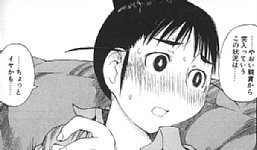
I’ve previously talked about how Ogiue’s words are always weighted with all of her inner conflict and that it came through very strongly especially when she tries to be succinct. This is taken to its logical extreme when Ogiue says nothing; she really, really exhibits her tension whenever she leaves her mouth closed. This effect is mostly achieved by her facial expressions, including the one we see so frequently coming from her, this kind of surly restraint.

It’s effective because you know she wants to say something, but is actively avoiding it. And even as she gets more comfortable with Genshiken and Sasahara, this never goes away completely.

Saki’s Comment and Ogiue’s Transformed Wardrobe

At the beginning of Volume 5 of Genshiken, Saki comments on Ogiue’s clothing, telling her that if she wore clothing that fit better Ogiue would look much cuter. While we know that at the end of the chapter Ogiue made one failed attempt to revise her wardrobe, what we can see in later chapters is that Ogiue did indeed take Saki’s advice to heart. It’s something not immediately noticeable, but her clothes do start to fit better and become a little more feminine (though still boyish most of the time), especially after she starts to date Sasahara. This ultimately culminates into the outfit that Ogiue wears to Sasahara’s graduation, one of the few times we ever see her in a skirt (the first time is at dinner celebrating with everyone on a doujinshi well-sold).

Some visuals:

My Response to Tamagomago’s “Otaku Girl Moe”

Yesterday I posted my translation of Japanese blogger Tamagomago‘s post about the moefication of the “Otaku Girl.” This is my own follow-up to it, and how I feel about the various themes and ideas put forth by Tamagomago.

While I think the threat of otaku confusing reality with fantasy is not that likely for the most part, I do see how “Otaku Girl Moe” is different from most other types of moe, with the possible exception of “Imouto Moe, ” though that mistake can be quickly dispeled by interacting with real little sisters. Otaku Girls actually exist in the real world and are in a sense closely related to Otaku Guys, so the line between fantasy and reality can blur quite a bit. It’s sort of like how most people probably wouldn’t realize that a model’s photo was airbrushed, or that the situations that occur in porn have very little chance of actually happening, but because we associate those things with “reality,” e.g. photos are realistic, we as people can be susceptible to their illusion.

Basically, while I don’t think there’s an immediate danger involving confusing the Otaku Girls in Anime with Otaku Girls in real life, there is a sort of precedent.

I of course also agree with the notion that as strong a character and as realistic as Ogiue is, she’s still just a character in a story. Though I can still hope…!

Another interesting point Tamagomago talks about is what I translated as the “exceedingly shaky” foundation upon which otaku build their preferences for women. I mentioned an earlier example of confusing fantasy with reality, but this one is particularly interesting as it’s almost an inverted example from the one above.

What we have is a situation where an otaku will take a realistic goal, i.e. finding a girl that can relate to them, and using their doubts and fears to transform it into an impossible dream. In other words, they’ve taken what is real and confused it for fantasy, something not talked about quite as often in these conversations about moe we have on this internet.

Of course, the part that generated the most conversation was where Tamagomago said that the act of calling someone moe is “violent” because it strips them of their individuality. Perhaps it was my translation not being completely clear, but the point that Tamagomago was trying to get across was that real people are not anime characters. It’s kind of an obvious thing to say, but within the context of moe you’re using a term associated with fiction and fictional characters and attaching it to real human beings with real depth and personalities. Let’s forget the word moe for a second, and instead imagine that I was talking about one of my female friends and I said, “Her character development is excellent!” It’s still a compliment, but it’s kind of bizarre to use that kind of language with an actual girl.

One more note, I don’t really think calling girls fujoshi is that bad, especially as it’s taken on this specific meaning of “yaoi fangirl.” Words in languages are malleable things as much as some would like to disgree, and the word “otaku” is a perfect example of this as its negative properties have fluctuated over the years. It’s like, I know that the word decimate originally meant “reduce by 10%.” Do I care? Not at all.

So in conclusion, I can’t wait for Hirano Kouta to knock down Tamagomago’s door for daring to say that there’s no such thing as Otaku Guy Moe.

It’s Okay to Propagate the Idea that “Otaku Girls” are Moe, But…: The Aggression and Difficulty Inherent in Moe

Translator’s Introduction: This is a translation of a post by Tamagomago aka Makaroni-san for his blog, Tamagomagogohan. It’s a post talking about his feelings in regards to the moe-fication of female otaku by their male counterparts. Because it’s written in a somewhat casual style, I’ve altered the language in small parts to be a little less stiff. The paragraph formatting is different from the original, as I’ve tried to make it more friendly for English readers. Also, Tamagomago has a tendency to put key phrases into quotes, a property I’ve kept, though admittedly something gets lost in the translation.

There’s also the occasional meme or internet humor used by Tamagomago, and whenever that happens I’ve tried to find an English equivalent. Translation notes are at the bottom of this post.

In any case, please enjoy Tamagomago’s essay.

‾‾‾‾‾‾‾‾‾‾‾‾‾‾‾‾‾‾‾‾‾‾‾‾‾‾‾‾‾‾‾‾‾‾‾‾‾‾‾‾‾‾‾‾‾‾‾‾‾‾‾‾‾‾‾‾‾‾‾‾

It’s Okay to Propagate the Idea that “Otaku Girls” are Moe, But…: The Aggression and Difficulty Inherent in Moe

I previously participated in the magazine Gendai Shikaku Bunka Kenkyuu 3 (The Study of Modern Visual Culture Volume 3) with an interesting project titled “This is the Kind of Otaku Girlfriend I Want!”

Let me introduce it briefly.

In short, it’s a feature which in order to promote the concept of “Otaku Girl Moe” says things like, “Girls who are otaku are cute, aren’t they?” For instance, something like this.


“A girlfriend who will make a manga out of my embarrassing fantasies.”

…Does not exist! That’s what I think, but I’ve got to admit that when a situation like that is turned into a drawing, the result is dangerously cute. While there are a variety of complications inherent, there is definitely a strong emotion involved when a guy thinks, “Wow, she’s willing to go this far just for me?!”

But there’s no such thing. At all.


A girlfriend delivering a fervent speech about Sega.

Now this is possible. In fact, I’d like to have conversations this nice.
This is what I would call a good girlfriend. There’s no such thing as a bad person who likes Sega.

These sorts of anything-goes fantasies are the kinds of feelings I’m utilizing when drawing the “Portrait of an Otaku Girlfriend.” It’s not an artistic design, but rather one completely steeped in the kind of subculture that surrounds Gendai Shikaku Bunka Kenkyuu, and I do feel it’s the right decision to make.

I consider it to be the right decision because its topic is difficult to really take “seriously” as it were. It would probably receive snickering comments along the lines of, “Whoa, I get it! It’s definitely a fantasy… but that’s okay, isn’t it?” That sort of thing.

That said, in truth I do like the “Otaku Girl” character.

I’m an otaku myself, and so I have no trouble speaking about this stuff, but that’s not what’s most important here. Instead, having someone who’s capable of completely immersing themselves in something, that is the real appeal of Otaku Girl characters.

Lucky Star‘s Konata, Kagami, and Hiyori. Doroko (Thundering High)’s Rin and Chouko. Rakkyou no Kawa (Shallot’s Skin)‘s Maki, Tsukiko, and Ms. Shiogama. Every character in Comic Party. And others still.

Seeing that Otaku Girl characters do actually exist, it then might be possible to have Otaku Girl characters that are “moe,” and can thus be looked upon with adoration. But with this “Otaku Girl Moe” concept you have a mountain of problems piled high up, acting as an obstacle. The “Otaku Girl Moe” genre is one where you just can’t quite get a proper foothold.

The reason is that there’s actually a kind of violent aspect connected with moe.

Hold on, I’m about to do some serious thinking.

From the Very Beginning, Some Went Down the Wrong Path

How female otaku became a topic of conversation is itself a conversation from long ago with no clear origin. However, one particularly important point at which the discourse changed was with the arrival of Genshiken.

With the introduction of Ohno and Ogiue, the topic of conversation became “Girls Who Like ‘BL.'”


The blunt and honest Ogiue is very cute.

The reason why we have someone like Ogiue, who has such a disagreeable and problematic personality, is of course to create in the story a character with whom the reader can easily relate and empathize. The core of Ogiue is that she’s a girl who with honesty and seriousness approaches life with everything she has.

Then there’s Ohno, who claims, “There’s no such thing as a girl who hates homos!”

Oh, of course it’s useless to actually accept them as real. THAT’S THE JOKE.

In one sense, I feel that the idea that “Female otaku go through life giving all they’ve got despite their suffering” has really picked up, and it’s something that’s being drawn quite often now as a result. Genshiken is a splendid work. But we must never forget that, in the end, we’re talking about “manga” here.

No matter how realistic it gets, it’s still a fantasy.

I don’t really think there’s many people who will tell me, “Hey that goes without saying,” but I want to point out that it does not, in fact. As proof, three years ago there was a misunderstanding by the media, and from then onwards a strange and unusual searchlight was placed on the “fujoshi.”

A character who really likes BL is fine when that character is in a 4-panel gag strip. However, when that becomes a sought-after quality in real life, well there’s a big problem. To start with, when actual girls are called fujoshi, I believe they are being done quite a disservice. When you get down to it, doesn’t it sound like a masochistic joke? Even if there were people who called themselves “disgusting otaku,” to be called a disgusting otaku by people I don’t know would elicit the same negative reaction from me.

Certainly, within the context of a manga, Girl Otaku are lovely. But to have written articles for the purpose of riding this wave, with statements such as “Right now, fujoshi are in!” and “How to get fujoshi to fall for you!” and then to have those statements be given in all seriousness, to actually see these things written for people, why it made me dizzy.

C’mon now, it’s just their hobby, you know? Just treat it as a hobby, and then leave it alone.

And then there’s the problem where female otaku in general are now being bunched in with those whom we would call “fujoshi,” and men’s magazines are marginalizing female otaku as a whole. That’s the worst part of it to me.

Then again, men’s magazines already give tips on how to hit on women. Considering the condescending nature of these magazines towards women, you really can’t expect much else.

For the sake of completely removing themselves from the path of sensibility, some have come to accept a great and terrible and very 2D idea: “Otaku girls sure are cute!” Well that’s obvious. But when it comes to actual girls, those same guys will just be all, “Hey, leave me alone, okay?”

It is never a good idea to confuse the two-dimensional world with reality. Ever.

If this strange fad had never caught on, if these guys and girls could simply realize the charm of being people who live for their hobbies and interests and then use it to attract others, that would have been just fine. However, it seems we’ve gone and removed ourselves from that path.

The Foundation of “Moe” is Violent

To see someone actually say, “This is so moe,” and actually mean it is quite mystifying. That’s because declaring something to be “moe” is an extremely violent act in the first place.

In cases where someone is moe for a two-dimensional tsundere character, it’s really just a matter of holding a commanding view of the character, or, perhaps, it’s a matter of cherry-picking what’s convenient. There are no alternatives. If that girl character suddenly strays from the supposedly correct path and gets closer to another guy, it’s often the case that some people will just abandon her. It’s not impossible at all. Because when it comes to “moe,” all you’re looking at is just one aspect of a girl. It’s not impossible, that is, because it isn’t “love.”

However, when it comes to two-dimensional characters, I think this is fine. Those who are capable of loving a character to the very end are wonderful and all, but there are those characters who can only be loved so much. That too is nature’s providence.

They are containers to hold and store the desires of aggressive humans.

But what happens when you take that idea and apply it to reality?

“This person is different from what I expected!”

“This person’s changed compared to what I thought they were!”

The only outcome then, is denial of the other.

These are individuals we’re dealing with here. You’re free to say, “I fell for you,” or, “I love you,” but don’t ever say to someone, “I’m moe for you.” It’s a violent act in which you try to deny them their individuality.*¹

The reason tsundere and maids have been so successful is that they are two-dimensional characters clearly separate from the real world. And sure, there are actually things like tsundere cafes based on these memes, but no one in reality would actually want or desire a tsundere. Even if you unexpectedly fall in love with someone who gives off a tsundere vibe, given enough time that fictional character-type image you created of her will go away.

But of course “female otaku” are not uncommon. Nevertheless, unlike “Shrine Maiden Moe,” “Nurse Moe,” and other similar types of moe, female otaku are to some degree in possession of a “guilty conscience,” a conscience which causes these girls to exclaim, “Leave us alone!” Particularly, those who like BL live their lives burdened with hardships, as they’re confronted with tons of people saying either, “Moe!” or “Give me a break!” in response to them.

“Female Otaku Moe” is a Fantasy

Based on what I’ve read and considered, the true identities of these two-dimensional “Otaku Girls who get the guys feeling moe,” so to speak, are “girls who act like guys.” Of course, I think the easiest example to understand is Lucky Star’s Konata. While she has some feminine qualities, her nature and her desire to collect are extremely similar to that of male otaku.

She immerses herself in her hobbies, and while she’s a little rough around the edges she gives it her all. Occasionally her eccentricities show. Rather, she doesn’t really bother to try and be more “feminine.”


Even if this girl was a boy, she wouldn’t feel uncomfortable at all.

‘s why she’s cute.

If we were to turn this around, it’s like otaku are saying, “A girl whose tastes are like mine, a girl who I can speak to honestly without pretense, isn’t that just a dream?” and so the manner in which they’ve developed their taste in girls is exceedingly, and I mean EXCEEDINGLY shaky.

If I were to rephrase the above paragraph, I would say that I think of it as a matter of wanting someone who understands you and enjoys being with you.

Whenever someone says, “Girl otaku characters are cute,” I want you to understand that by no means are they saying that they harbor an excessive amount of sexual desire for real actual female otaku, or that they want to sleep with those female otaku.

For the guys, this is considered “fantasy” and is viewed as a line that will not be crossed. Thought of in that manner, girls then are just a source for “memes.”

If that’s the case, this seems like a good time to talk just a little more about the moe that I myself haven’t been able to exclaim, the “Girls who are otaku are cute!” moe.

It would be strange of me to say, “Don’t moe them!” so I think it would be nice if we could find some kind of balance or harmony.

On one final note, people who with all earnestness engage in otaku activities are in a sense guys and girls filled with enthusiasm, which gives them a certain charm, no doubt. …Right?

———————————————————–

Addendum.

There have been a lot of otaku marriages recently. How nice…

But these aren’t people saying, “I married someone because they’re an otaku,” so much as, “I married an otaku I fell in love with,” and nothing beyond that. These are normal marriages, no more and no less.

Hmm. In comparing “Female Otaku Moe” to other types of moe, there’s too great a sense of reality with the former, and because of that it’s also become a rather harsh subject to approach. Nevertheless, if we accept the logic that “a girl who’s engrossed in something is cute,” it’s inevitable then that we would see girls who are “into” the “otaku culture” so close to us as being cute, and that the level of demand stemming from this preference would rise greatly. However, there’s pretty much no such thing as “Otaku Boy Moe.” At all.


Gendai Shikaku Bunka Kenkyuukai 3 (Sansai Mook Vol. 3)
(The Society for the Study of Modern Visual Culture 3)

Sansai Books


Rakkyou no Kawa—Moero! Morinomiya Koukou Manga Kenkyuubu (6) (Gum Comics)

(Shallot’s Skin!—Get Moe! Morinomiya High School Manga Club Volume 6)
By Abekawa Kineko
Wani Books


Kyoumeiseyo! Shiritsu Todoroki Koukou Toshoiinkai 3 (ID Comics and Zero-Sum Comics)
(Resound! The Thundering Private High School’s Book Committee! Volume 3)
By D. Kissan
Ichijinsha


Mousou Shoujo Otakukei (5) (Action Comics)

(Fujoshi Rumi Volume 5)
By Konjou Natsumi
Futabasha

If there’s any title that has a relative balance of the realistic and the cute, it would be Mousou Shoujo Otakukei. It doesn’t bother to hide its sharp edge and instead thrusts at you using bitter words like “disgusting.” It’s not just a series which remains closed to outsiders while shouting, “LONG LIVE OTAKU!” But as we all know, lively girls are adorable.

‾‾‾‾‾‾‾‾‾‾‾‾‾‾‾‾‾‾‾‾‾‾‾‾‾‾‾‾‾‾‾‾‾‾‾‾‾‾‾‾‾‾‾‾‾‾‾‾‾‾‾‾‾‾‾‾‾‾‾‾

*¹ Idols, maid cafe maids, and others involved in constructed roleplays excepted.

‾‾‾‾‾‾‾‾‾‾‾‾‾‾‾‾‾‾‾‾‾‾‾‾‾‾‾‾‾‾‾‾‾‾‾‾‾‾‾‾‾‾‾‾‾‾‾‾‾‾‾‾‾‾‾‾‾‾‾‾

Translator’s Notes:

Moe: This is a very difficult word to translate, not because the word can have multiple meanings but because the meaning can change drastically depending on who you’re talking to. It means something along the lines of “passion” or “infatuation,” particularly for fictional characters, and often for characters who are somehow weak or deeply flawed.

Otaku Girl, Girl Otaku, Female Otaku, etc.: Tamagomago uses a variety of phrases to say the same basic concept of an otaku who is a girl, and so I’ve tried to vary it accordingly, but it’s still not 1:1 because I didn’t want to use crazy phrases like “Otaku Lass.”

BL: Stands for Boys’ Love, refers to the genre of guy-on-guy action targeted primarily at female readers. I know most of you know this, but I’m being safe.

Fujoshi: A slang phrase used to refer to girls who are obsessed with Boys’ Love. A pun on the Japanese word for a lady, the kanji used with this Fujoshi (腐女子) literally means “rotten girl.” A frequent topic on this blog.

Disgusting Otaku: In Japanese, “キモオタ” and pronounced kimo ota, an abbreviation of kimoi otaku.

THAT’S THE JOKE: The actual phrase used here in the Japanese is “ネタをネタだと(略” which is an incomplete way of referring to someone who doesn’t realize a joke is a joke or that a meme is a meme. I used the popular quote from Simpsons character Rainier Wolfcastle’s movie, McBain: Let’s Get Silly.

Genshiken: A manga by Kio Shimoku about the lives of otaku in college. Published by Kodansha in Japan and Del Rey in the US and made into an anime by Palm Studio and Studio ARMS. If you aren’t familiar with Genshiken, I suggest you read it, seeing as this entire blog is devoted to one of its characters.

Gendai Shikaku Bunka Kenkyuu: Despite being similar to what “Genshiken” stands for, this is not the above-mentioned manga but rather an otaku-oriented magazine, or more specifically, a mook.

Mook: Magazine + Book. Used to refer to publications which focus on a single topic, thick but bound together like a magazine. The Gundam series tends to get a lot of mooks.

Lucky Star: A 4-panel manga by Yoshimizu Kagami about an unabashed otaku named Konata and her three friends in high school. Published by Kadokawa Shoten, it was turned into a very popular anime by Kyoto Animation.

Doroko: Short for Kyoumeiseyo! Shiritsu Todoroki Koukou Tosho Iinkai, a 4-koma high school comedy which occasionally switches to a more normal panel format, kind of like Azumanga Daioh.

Rakkyou no Kawa: Short for Rakkyou no Kawa-Moero! Morinomiya Koukou Manga Kenkyuubu. A manga about a “former” otaku in high school.

Comic Party: Originally an erotic game by Leaf/Aqua Plus about doujinshi artists, it has been converted into a variety of media.

Mousou Shoujo Otakukei: Released in America as Fujoshi Rumi. The manga is about a high school girl who loves BL and yaoi. Published by Futabasha in Japan and by Media Blasters in the US.

Ogiue’s Favorite Show from Spring 2009

I think it’s pretty clear to everyone who’s seen it that Ristorante Paradiso would be Ohno Kanako’s favorite anime of the new season. Going with that, I began to wonder what, then, would Ogiue’s most anticipated anime of Spring 2009 would be. Ultimately, I decided that it would have to be the new Fullmetal Alchemist series, known in English as Fullmetal Alchemist: Brotherhood (though I still enjoy calling it 鋼の錬金術師 Fullmetal Alchemist).

This might be too easy an exercise in hindsight. We already know that not only does Ogiue tend to prefer shounen series with lots of cute guys, but that she’s already a Fullmetal Alchemist fan. For those of you who don’t recall, in the manga Ohno slyly revealed that she was well aware of Ogiue’s burgeoning “Haregan (sic)” obsession (this was replaced by “Reass Mood” in the anime). On top of that, Ogiue is a fan of Roy x Ed, and was even originally planning on doing her first Comic Market erotic doujinshi of Fullmetal Alchemist.

I’m sure she’d have read the manga already, but that she’d still tune in for each episode in order to further fill her fujoshi reservoir, a reservoir for which there is no bottom. Well, not that kind of bottom.

Belated Happy Birthday to Ogiue

I am ashamed.

Just as I did last year, I failed to mention in time that last Saturday was the birthday for the great and wonderful Ogiue Chika, who if we go by the dates set in the Genshiken manga is already a productive(?) member of society.

If you recall, Ogiue at the end of Genshiken started to work as a manga artist for Monthly Afternoon. This was in 2005, and so by now she’s had about 4 years to make something of herself. I’d like to believe that in the world of Genshiken, she has worked hard with Sasahara at her side, a wonderful professional manga romance. Sasahara meanwhile is still probably working hard as an editor, possibly losing lots of sleep and wrangling manga artists to get their jobs finished on time. Such a splendid concept, being in a relationship with a person in your field who approaches it just a bit differently from you.

Let us give our goodwill to Ogiue in her future endeavors, and hope for happiness for her in the years to come.

Incredible America: Genshiken and the Accidentally Accurate Portrayal of Americans

In Volume 1 of Genshiken, Ohno’s character profile states that her favorite game is Samurai Spirits. “Well that makes perfect sense,” you might think, seeing as how Ohno lived in America for many years, and how that very game was released in the US under the name Samurai Sho-down, but a later comment in the Genshiken Official Book reveals something interesting. It turns out that Kio Shimoku had no idea whether or not Samurai Spirits was ever released in America, and most likely picked it for Ohno due to the game having multiple old/burly types such as Earthquake.

So what we have here is what seems to be a surprisingly decently researched aspect of the American video game/anime fandom from the 90s but instead is just a lucky coincidence. Of course, Ohno and her preferences aren’t the most “American” aspect of Genshiken. That title naturally belongs to her friends Angela and Sue. And when you look at Angela and Sue across their incarnations (anime, manga, drama cd), you get the feeling that Kio Shimoku and the staff of the anime ended up portraying American fangirls with surprising accuracy, but based on the Ohno-Samurai Spirits Revelation there is the very real possibility that this too was also one huge coincidence.

Much of the portrayal of Angela and Sue can boil down to “HAHA AMERICANS ARE SO MUCH MORE DIRECT THAN JAPANESE,” but there is a grain of truth to that, and I think the result is that this “fictional” portrayal is about as realistic as the portrayals of the actual Genshiken members. Sue may possess a knowledge of anime far beyond your typical female otaku, but keep in mind that her otakudom was fostered by a Japanese fujoshi, so it might not be surprising for her to reference, say, Saint Seiya. Sue’s got a fairly abrasive personality, a general lack of manners, and you often cannot tell if she’s being awkward or devilish. Her frequent and loud reciting of anime quotes in lieu of real Japanese is definitely a trait you can find in fangirls (though she eventually becomes comfortable enough with the language to actually start speaking it fluently, albeit with an accent).

Then there’s Angela, who loudly declares to Sasahara that she may in fact be bisexual, which Sasahara despite his limited English ability seems to get the jist of. It might be somewhat stereotypical to brand Angela as very open when it comes to sex and sexual relationships, i.e. very AMERICAN, but it’s not like this is unprecedented even if you ignore anime cons and the fact that they are places where sex occurs in less than small amounts. Not that I’m saying she’s a slut or anything, merely that she is possibly about as sexually experienced as Saki, maybe more. I can also totally see Angela attending an anime club in America and being the center of attention among male members, but maybe I’m reading too much into it. As an aside, I sometimes wish there would be a Genshiken AMERICA spinoff starring Angela and Sue and seeing the interactions between characters in that respect. Maybe this could be a fanfic or a fancomic, I don’t know.

Sue is either young-looking for her age or actually young (her age is never given, only loosely implied), and we already know that the anime fans are getting younger and younger, so this makes plenty of sense. Angela meanwhile has a dynamite figure which some might say isn’t terribly realistic for a nerd girl, but I speak from experience (no not that kind of experience) when I say that this is not an impossibility. There are geek girls who look that good. You might see them cosplaying.

Though I think what stands out to me most about Sue and Angela and their American-ness is a scene in the Drama CD “Road to Ikebukuro,” where together they recite the famous line that so many female anime fans in the US have tied to their very histories: “In the name of the moon, I’ll punish you!” Granted, it’s said in Japanese, but I know that plenty of Sailor Moon fans are familiar with the Japanese catch phrases. And Sailor Moon was popular in Japan too (Love Hina creator Akamatsu Ken mentions it as the inspiration for him getting into doujinshi), but that doesn’t take away from the fact that Sailor Moon is arguably one of the most significant shows in American fandom history.

And again, all of this could just be happy coincidence! Kio Shimoku could have simply said, “I have no idea what American anime fans are really like so I’ll just make them however.” Which is to say, Kio Shimoku is a frightening man.