The Destiny of Kicking Ass

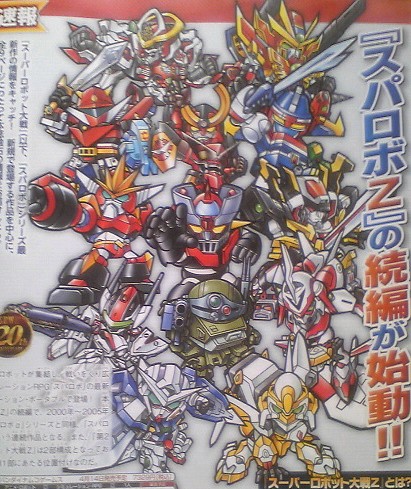
In very exciting news, Super Robot Wars Z 2 (Part 1) has been announced. Subtitled Break the World, the game has some surprising new entries into the world of SRW, from both recent and not-so-recent anime. Before I start elaborating on my thoughts concerning the lineup, I’m showing the complete series list uses for the game.

Italics means this anime has been in SRW before but was not in SRWZ.
Bold means this anime is brand new to the SRW franchise.

Muteki Choujin Zambot 3
Muteki Koujin Daitarn 3
Muteki Robo Trider G7
Space Emperor God Sigma
Space Warrior Baldios
Rokushin Gattai Godmars
Sentou Mecha Xabungle
Armored Trooper VOTOMS
Armored Trooper VOTOMS: The Last Red Shoulder
Armored Trooper VOTOMS: Red Shoulder Document – Roots of Treachery
Armored Trooper VOTOMS: Pailsen Files
Super Dimension Century Orguss
Mobile Suit Z Gundam
Mobile Suit Gundam: Char’s Counterattack
New Mobile Report Gundam W
After War Gundam X
Turn A Gundam
Mobile Suit Gundam SEED Destiny
Mobile Suit Gundam 00 1st Season
Choujuu Kishin Dancougar
Juusou Kikou Dancougar Nova
Shin (Change!!) Getter Robo: Armageddon
Shin Mazinger Shougeki! Z Saga
Earth Defense Corp. Dai-Guard
The Big O
Overman King Gainer
Choujuushin Gravion Zwei
Genesis of Aquarion
Code Geass: Lelouch of the Rebellion
Tengen Toppa Gurren-Lagann the Movie: Gurren Saga
Macross F
Macross F the Movie: The False Songstress
Psalms of Planets Eureka Seven: good night, sleep tight, young lovers

There’s a lot to talk about here, especially with shows like Code Geass, Gundam 00, and a major curveball in the form of Dai-Guard, but probably the two newest entrants which are the biggest deals are VOTOMS and Gurren-Lagann, though for somewhat different reasons.

VOTOMS hails from early 1980s and is considered among the “realest” of real robot anime. It has a grittiness to its robots and overall setting that is rarely seen in mecha, let alone anime in general, as can be seen from my reviews of the series (though I must apologize for never actually writing my final review). For years people thought it was a shoe-in for the SRW series, but when years and years went by and VOTOMS still wasn’t included, fans started coming up with excuses. Oh, maybe the robots would be too weak and bland, or Chirico would be too strong of a pilot, or it somehow wouldn’t fit in among the earth-shattering forces that populate the roster. But as if to lay those possibilities to rest, SRWZ2 puts it into the same game as Gurren-Lagann, one the biggest example of escalating power levels and over-the-top, universe-rending attacks in a robot anime ever (which is the “problem” with Gurren-Lagann), as if to say that while all of those possible reasons may have once been valid, they’re history. Sure this first part of SRWZ2 is going to avoid having to deal with the really crazy stuff, but it’s inevitably going to have to confront the big guns of Gurren-Lagann by the next game. And it’s the movie version on top of that!

I understand that the reason this lineup works is that the plot of the game is based heavily on Orguss, which involves going to different dimensions and universes, so they can even do things like have Shin Mazinger where they once had Mazinger, and the Eureka Seven movie to replace the TV series, but that’s all right. Plot was never exactly the strong suit of the SRW games, after all, as the latest anime proves.

So to conclude, various fanboyish notes:

-Can’t wait to see Zeus in action.
-Mazinger Z is going to get not one but two crazy powerful finishers. No need for the Kaiser here!
-I wonder if Zambot, Daitarn, and Trider are going to have a Final Muteki Special. Sun, Moon, and Phoenix?
-Re: Godmars – ポゥーン
-I wonder how much Dai-Guard will cost to replace if it blows up in battle?
-I’m looking forward to the VOTOMS BGM.
-I know I’m jumping the gun and putting expectations on the next game, but Amuro vs Ribbons? Hell yes.
-Setsuna F. Seiei gives the best (worst) pep talks.
-I think movie Eureka and Fyana from VOTOMS will get along swimmingly.
-I wonder if the geass will factor into gameplay in any way, shape, or form?
-Aquarion and Shin Getter better not accidentally deface the moon too much or they’re going to make Loran Cehack sad. They’ll also make Garrod upset but for a different reason.

Secret Santa: Patlabor: The Movie, Where Oshii Mamoru Says, “Trick or Treat!”

This review is a part of the Reverse Thieves’ Secret Santa Project for 2010.

Mobile Police Patlabor: The Movie is a film by Oshii Mamoru, director of Ghost in the Shell. Though it predates Oshii’s most famous film by a few years, there is no mistaking its pedigree.

In the world of Mobile Police Patlabor, mankind has embraced the use of giant robots to help with large-scale construction and manual work. Referred to as “Labors,” it wasn’t long until some people started using them for less altruistic purposes, creating a new problem in the form of Labor-related crimes. In response, the police begin deploying their own Patrol Labors, or “Patlabors” for short. One such force is the Tokyo Metropolitan Police Special Vehicle Section 2, Division 2, a group of misfit officers whose ranks include a tomboy who names all of her pets Alphonse (her Patlabor being the latest), an overly aggressive gun nut, and a seemingly dull and lazy division chief. Nevertheless, they do their best to serve and protect despite their spotty reputation.

Given this scenario, you’d probably expect some combination of cop show drama and ensemble comedy with a dash of mecha, and you’d be right, normally. But while most of the Patlabor franchise falls along those lines, Patlabor: The Movie is instead a cerebral mystery. A recent string of “berserk” Labors threatens the completion of an important project and the most likely suspect, programmer Hoba Eiichi, is already dead, confounding Shinohara Asuma, the Division 2 member who has taken it upon himself to investigate. All the while, the film explores the continuing onset of technology and the eternal struggle of new vs old, with numerous biblical references strewn throughout. Given the tone and content, Patlabor: The Movie is like a stepping stone towards Ghost in the Shell and the eventual direction Oshii’s oeuvre would take.

The film still has a lot of the requisite elements of Patlabor; it has those same goofy characters (all of whom act as they should), robot fight scenes, and a personal feel to the setting. In fact, you need not have watched any of the previous material to understand the movie or to get an idea of the personality quirks and relationships of the characters. However, those aspects of Patlabor are either more subdued or less frequent in the film, instead putting the spotlight on the mysterious culprit, “E. Hoba” (Jehovah), and his motives. In this respect, it reminds me of another movie, Sengoku Majin Goshogun: The Time Étranger, a sequel to a super robot anime featuring a decidedly different tone and absolutely no giant robots, only Patlabor: The Movie is somehow both more extreme and less in its deviation. Patlabor: The Movie really feels as if Oshii (who also directed the Patlabor OVAs) was trying to push the franchise beyond the limits of its basic premise and bend it to his own personal will. It actually works pretty well overall, maintaining suspense throughout and giving quite a bit to think about, but I’m not sure if Patlabor was the place to do it.

In short, imagine Oshii Mamoru trapped in a giant paper bag called Patlabor, trying to punch his way through until he ends up wearing the bag like a Halloween costume, and you have Mobile Police Patlabor: The Movie. He’s pretty dashing in that getup.

The Cross-Cultural Exchange of a Couple of G’s

In 1996, Russian-American animator Genndy Tartakovsky premiered Dexter’s Laboratory and pioneered the thick-lined,”flatter” animation style. This style can also be seen in Samurai Jack and Star Wars: Clone Wars, as well as in Powerpuff Girls, where Genndy was director.

Flash back a few month to 1995 and we get one of most the influential anime ever, Studio Gainax’s Neon Genesis Evangelion. Gainax, known for a variety of works from various genres, are especially fondly remembered for their giant robot fare, most notably Evangelion but also Aim for the Top! and Tengen Toppa Gurren-Lagann.

Now, in late 2010: Gainax’s latest anime is a tongue-in-cheek cartoon about a pair of misfits and heavily utilizes thick outlines and very flat character designs, while Genndy Tartakovsky’s newest show is an honest, non-parody attempt at a super robot-themed series. Both series’ debuts occurred less than three weeks apart from each other.

While the relationship between Japan and America’s cartoons and comics have been put in the spotlight recently with collaborations such as the joint Iron Man and Wolverine projects involving Marvel and Studio Madhouse, the fact that Genndy Tartakovsky’s Sym-Bionic Titan and Gainax’s Panty & Stocking with Garterbelt have come into existence so close to one another puts an even greater focus on the two nations’ cartoons. Here in one cross-section of time, we can see the active/passive exchange of ideas as these cultures’ animation styles appear to intertwine so tightly that they sling each other across the Pacific Ocean.

Neither show is so like the animated series of the others’ country that they come off as weak imitations. Sym-Bionic Titan takes fusing robots, a fight against a powerful invading force, and various other giant robot tropes, mixes them in with Genndy’s own character aesthetics, and places the story firmly within America and its own cultural norms. Meanwhile, Panty & Stocking utilizes the visual elements and humor of early “Cartoon Cartoons” (as Cartoon Network referred to them) while also injecting very anime-esque expressions and reactions from its characters, most notably in their faces, and also ramping up the humor to more “adult” levels. The two series and their hybrid styles reinforce both the idea that creativity is not limited by national borders and that individual cultures can still maintain some of their distinctiveness when it comes to artistic output.

This is not a bad thing.

As a final aside, the personal robot used by the character Lance in Sym-Bionic Titan reminds me of the titular robot from Galaxy Gale Baxinger.

I can’t be the only one, right?

Mitsuya Yuuji Throughout Combattler V: A “Lesson” in Voice Acting

At Otakon 2010, voice acting veteran Mitsuya Yuuji (or Yuji Mitsuya) was a goldmine of valuable information about the industry and the art of voice acting, using his own experience as a complete seiyuu rookie on Choudenji Robo Combattler V as an example During the panel, he mentioned that an interesting exercise is to compare a voice actor’s performance in the first episode to their performance in the final episode.

Taking that suggestion to heart and expanding on it a little further, I’ve compiled a clip of Mitsuya’s voice acting progression from the beginning to end of Combattler V‘s 54 episodes. Not every episode is shown here, but it still gives a good indication of how much effort he put into improving.

Early on, you can hear that he’s clearly an amateur and not entirely sure what to do with the role. He also sounds much deeper, having not yet hit upon the right voice for the main hero Hyouma. You can also hear him experimenting with all sorts of ways to say Combattler V’s name, stretching this syllable, shortening that one and so on. Towards the middle around when the story starts to really ramp up, he puts a lot more intensity into his performance. Then, in the second half you’ll notice that he’s starting to find a “standard” of sorts on how to shout, “Combattler….V!” until it pretty much solidifies, for better or worse.

Remember that this was Mitsuya’s debut role, and here you can really see his growth as a voice actor. It’s no wonder he’d go on to form his own voice acting school.

At his panel, Mitsuya placed great emphasis on the fact that a lot of male voice actors these days try too hard to maintain the “coolness” of their characters and don’t put their all into their performances, citing that this probably has to do with the fact that not nearly as many voice actors these days come from a theatre background (if any at all). It’s interesting then to think about how Mitsuya’s own theatrical experience still had to be molded to fit voice acting.

As a bonus, take a look at his performance in 2000’s Super Robot Wars Alpha, where he has to perform the same line as in the above video roughly 25 years later. Skip to 0:46 to hear it (or watch the whole video, it’s cool). Amazingly, his voice appears to have gone up with age.

Better Go Get Some 3G Coverage

V! V! V!

Puberty is a funny thing when you’re a fan.

In some instances, a female character can enter the mind of a young boy just by virtue of being the most prominent female in his favorite show, and then stay with him as he awakens sexually. Of course it doesn’t happen to every fan, and I’d be remiss to not include female fans who carry the torch for their male childhood crushes (or varying combinations between these two areas), but as a guy who likes girls I want to focus on that area. Feel free to chime in with your own thoughts given your own sexuality.

The first examples I can think of are Sayaka from Mazinger Z and Chizuru from Combattler V. While they are obviously not applicable to me seeing as I did not grow up with either show, in Japan and Italy and other parts of the world where these shows found popularity you have a lot of devoted male fans who will sexualize them and possibly draw fanart of them, to the extent that someone unfamiliar with these series might scratch their heads, or perhaps get the wrong impression of them when they see fanart of Chizuru in an outfit that’s quite a bit tighter than canon suggests. This is not a knock on either Sayaka or Chizuru. I can easily see guys liking them for legitimate reasons, and they’re even portrayed as attractive within the contexts of their shows (e.g. shower scenes), but I think there’s more to it than that.

An even better example might be video game characters. I’m not talking about your RPG characters who get loads of development, or games that have come out more recently and have the benefit of powerful graphics to improve character design and rendering, but those old, let’s say pre-90’s video games which barely had stories to go with them. While Samus Aran has had a lot of development over the years, guys were finding her hot since the NES era. Obviously her stripping to her skivvies in the ending sequence plays a role in this, but I think what pushes that over the edge is that you play as her for so long that you get attached to her. Again, familiarity.

Of course this doesn’t happen with every fan, but being a fan makes this more likely, I think. To preserve the memories of their favorite “stories” from childhood and bring those memories with them through to their teenage years and possibly their adult life, isn’t that the kind of thing a fan does?

And then my thoughts lead towards “moe.” Modern moe shows of course don’t have that advantage of familiarity, but when I think about it, liking a video game character because of the two or three things you know about them and liking a moe girl who is a collection of moe traits aren’t that far off. So I wonder if moe in the marketing sense of the word is trying to tap into that same nostalgia reservoir, only through more “efficient” means.

I’m not here to judge what characters you like for whatever reason, but to simply put down my thoughts on the way the fan mind works, particularly for when you start thinking girls (or guys) are awfully nice-looking.

On another note, I realize my past three post titles have all been song lyrics. Yeah I don’t know either.

Otakon 2010: I Don’t Believe It. That’s Unbelievable.

At this point, having gone to Otakon for the past four years, I feel it safe to call myself an Otakon veteran to some degree. In terms of what to expect, this year didn’t feel that different from all the previous times I went, but a lot of things have happened to me over the past year or so, makes me think I’ll reflect back on Otakon 2010 particularly fondly.

Ogiue Maniax’s Panelist Debut

Otakon 2010, from July 30th to August 1st, was the first time that I came to the convention as a panelist. And I had two to boot!  It may have been obvious from all the posts I made about panel preparations, but I really wanted to do a good job and I really wanted people to come to the panels, so up until I finished both of them, I had been very nervous.

The mahjong panel, titled “Riichi: Japanese Mahjong, Anime, and You” was a collaboration between me and Sub over at Subatomic Brainfreeze. With a 9:30am Friday timeslot when a good portion of the con hadn’t even been registered, and a fairly obscure topic like mahjong, we were both worried that our panel attendance would amount to our friends and acquaintances, and while we would have been glad to teach them about mahjong, our real goal was to reach those people who were only barely familiar with mahjong anime. Fortunately, the turnout was better than we had ever expected, and while I am to understand that our panel room was the smallest of the bunch, we still managed to pretty much fill the whole room, getting approximately 160 people to listen to us talk about an old Chinese tile game and the way it works in Japanese cartoons.

The Riichi panel itself also went far better than we expected. Knowing how much information there was to convey despite the fact that we had already decided to cut large amounts of information, we had practiced the panel on multiple occasions, barely finishing on time. But while our practice sessions felt kind of strange and awkward, the actual panel itself had an amazing energy to it. Both Sub and I were playing to our strengths, playing off of each other, and we managed to give all of the information we wanted to while also keeping the audience entertained. We even finished early and had a good amount of time for questions! From this experience, I have learned that Sub and I make a good paneling team and I look forward to the next opportunity we have to do a panel together.

By the way, for those of you who were at the mahjong panel but were unable to copy down the URL for the additional mahjong resources, here it is.

My second panel was also on Friday, but at the opposite end of the day at 11pm. Entitled “Portrait of a Fujoshi: The Psychology of Ogiue Chika,” this joint effort between myself and Viga the Otagal was in many ways a culmination of what I had been doing on this blog. Last year, Viga challenged me to do a panel all about Ogiue, and that’s how we ended up on stage.

I understoood well that even if a good portion of the convention was into yaoi and Hetalia and the like that they would not be interested in deep character analysis, so while the panel attendance wasn’t as high as it was for the mahjong panel, it was still quite impressive, and once again we managed to play off the energy of the audience and each other and give a good presentation, with me giving a more subdued approach. Also, once again, where practice netted us a panel that had about 10 minutes worth of Q&A, the actual thing gave us three times the amount. While I wish we had prepared more, I think we did a good job of expressing what makes Ogiue such a great character and why we connect so well to her (and why you should too!).

When I think about it, doing a panel on a single character is unusually rare at an anime con. You have panels about Evangelion, but never is it a panel specifically about Ayanami Rei. I hope we can start a trend at anime cons, as I think it’s a worthwhile way of running things.

I don’t know if any video recordings are available so I apologize for those of you who were unable to attend but wanted to see them. I also want to say thank you, thank you from the bottom of my heart, to all of you who attended my panels. I hope you enjoyed them.

Now having panels at both extremes of the day has its drawbacks, but it also had the great benefit of avoiding conflict with the majority of events, thus freeing up the rest of the con for me. As is the case with every year, my primary mode of entertainment at Otakon is the panels, both industry and fan. Fortunately or unfortunately however, I found that there was still too many entertaining things crammed into a single weekend and I still had to sacrifice one panel for another.

Industry Panels

In terms of guests, I was not looking forward particularly to any of them this year, but I’m glad I attended the Q&A’s that I did as all of them provided incredible insight into the industry, with Mitsuya Yuji’s panel perhaps being the most informative of all. Attending his Friday panel, the voice acting veteran told us how voice acting became a “profession” rather than a side job for dramatic actors and how voice acting should come from the entire body and not just the voice. He also talked about how in the old days, if you flubbed a line, rewinding the film reel and readjusting everything was a huge pain, so mistakes were a big deal.

Throughout the panel, Mitsuya showed us what it was to truly be a voice actor, from passionate yells (he delivered a passionate “CHOUDENJI SPIIIIIIN” on more than one occasion) to voice changes to even the change in jobs given to you as you age and can no longer be the handsome male lead. Also, seeing as his debut voice acting role was as Hyouma, the main character of Combattler V, I asked him the question I had asked of Macross director Ishiguro and Gundam creator Tomino: What were your experiences with legendary anime director Nagahama Tadao?

Mitsuya gave us the impression that Nagahama was an incredibly passionate man. Gentle and understanding, he took his role as director very seriously and pushed Mitsuya to improve his performance. Mitsuya had originally tried out for both the lead Hyouma and the rival Garuda, and Nagahama made him redo his Garuda takes ten times. When asked if this was typical of a mere audition, everyone said that this was highly unusual. Mitsuya would later find out that all of this, from the audition to the strict voice sessions, were all signs of the fact that Nagahama had seen the amazing potential Mitsuya had and wished to nurture it into something greater.

Maruyama Masao was back again this year. The head producer over at Studio Madhouse, in my opinion the best anime studio there is, Maruyama is a staple of Otakon, but despite the fact that he comes pretty much every year, I look forward to it every time. This year we finally learned that Redline, the series he had been working on for six years which he also mentioned at numerous past Otakons, is finally getting a theatrical release in October, though its director also passed away before it could debut. Redline is  high-intensity anime, resembling the most elaborate portrayal of F-Zero ever, and Maruyama claims it will be the last truly hand-drawn anime ever.

Otakon was also the American debut of Welcome to THE SPACE SHOW, a feature-length film from the animation team which brought us Read or Die and Kamichu. As such, the creators were also there at Otakon, and managed to have an informative Q&A session. I gave a question targeting mainly Ishihama, the character designer, asking if he felt there is a trend in anime films to move towards simpler character designs which lend themselves towards looser and more whimsical animation. Ishihama responded that he believed there is indeed such a trend, but that there is also a counter-trend present, where more detailed, less fluid animations are also becoming popular.

As for Welcome to THE SPACE SHOW itself, the movie is quite fun but is too unfocused. The story of kids who travel into outer space in a way reminiscent of Galaxy Express 999, the film had opened up many good directions the story could have gone but ended not taking very many of them and losing a good deal of its potential. The film also dragged on after a while in a way where even the expertly animated sequences and wonderful set of aliens felt less exciting overall. At the Q&A session, we learned that this was the team’s first feature-length work, and in hindsight it really showed.

The only American industry panel I ended up attending was the Vertical Inc. panel with Ed Chavez and Peepo Choo author Felipe Smith. Ed, responsible for all of those Vertical Vednesdays I keep talking about on the blog, is about the most personable marketing guy in manga. While giving hints at interesting new titles coming in the future (including another Tezuka title), he also showed that he has some strong opinions on manga, stating that Vertical would not license Yokohama Kaidashi Kikou because “I don’t like it.”

Fan Panels

I had a lot of fun with the fan panels I attended, which mainly focused on exploring elements of anime and manga but I also attended some fun ones too. In the “elements” category there were three panels:  “You Don’t Like Moe and Here’s Why,” “The Changing Faces of Anime,” and “The Life and Times of Akiyuki Shinbo.” In the “fun” category, there was Anime World Order‘s “10 11 Anime You’ve Never Heard of But Must See,” the “Mecha Fan Panel,” and Megaman in Anime and Manga.”

The moe panel focused on the concept as a phenomenon and the meanings it gains as it has become a part of the industry itelf. It took a while to get off the ground but eventually found its footing, and the best advice I can give to the panelists is that more can be done to bridge the gap between what they are talking about and what the audience understands.

The Changing Faces of Anime panel, run by Evan Minto of Ani-Gamers, was a literal look at faces in anime, discussing changes in character designs over the years. It was a good panel which generated even better discussion, and it’s a difficult topic to tackle in only an hour.

The Shinbo panel, presented by wildarmsheero, showed that he had clearly done his research on the eccentric director and took a look at all the stylistic elements Shinbo loves to employ in his works. It ran a big long, forcing the Q&A session to be cut.

The “Must-See Anime” panel was very entertaining, though it was focused less on recommending good shows to anime fans and more about showing amazingly obscure anime that were difficult to obtain and had a lot of excitement value (but could still be good shows). I know that I’m going to track down Natsuki Crisis and other titles. Also, while obviously the clips themselves say a lot, it also doesn’t always convey some of the more overarching positives of a title, so more talking might be a good idea.

The Mecha Fan and Megaman panels meanwhile were fairly similar, giving the history of mecha and Megaman in Japanese graphic fiction. I won an old issue of Nintendo Power at the Megaman panel, and enjoyed the liveliness of the mecha panel, but I think that both could benefit greatly from delving even more into their topics. The Megaman panel also suffered from everyone reading from their scripts too much. It was very obvious that everyone at the panel was an expert in the field of Megamen, and I think removing the script would have made it more personable. On the other hand, it also showed the best Rockman.exe opening, so it’s all good.

Entertainment

While neither was truly the start or the end of the convention, I find that the opening ceremony and the Home Made Kazoku concert act as nice bookends to the con proper, mainly because of the positive impression Home Made Kazoku made on the audience at the former, which led to great anticipation about their performance for the latter. A hip hop-oriented Japanese group, their music and live performance was really infectious, and I think that music-wise it was a great success for Otakon this year, especially when I found out that the shamisen-playing Yoshida brothers managed to fill the concert area so tightly as to nearly be a fire hazard.

Speaking of fire hazards, the talk of the town was clearly the fire alarm Saturday Afternoon which forced all of the nearly 30,000 attendees to evacuate the Baltimore Convention Center. Given the general immaturity of the con crowd (including whoever actually pulled the fire alarm), I was pleasantly surprised to see people doing the right thing in the even of the fire: leave in a calm and orderly manner. Even the most rambunctious anime teen knows not to mess with this sort of thing, which brings a smile to my face.

Food and Friends

But going to a con isn’t just about the anime or the guests, it’s about meeting people and having a great time doing so. The con begins on Friday, but the con experience truly begins the Thursday before, from the point the bus arrives, and only really ends when we get back home. This year’s Otakon featured the return of glorious Brazilian Buffet, being amazed at the evergreen awfulness of G-Saviour while watching it in the hotel room, large gatherings with people relaxing and joking about, and amazingly deep discussions about everything anime and manga.

As I rode the bus home with my travel companions, we discussed for about four hours straight the very nature of enjoying anime and manga, as well as their qualities as creative forms of expression, and it made me realize just how much better conventions are when you add the human element to it.

I love it, and love makes Otakon better, I can guarantee you that.

Easily Misconstrued Title: Taekwon V Invades Japan

On August 7th, Robot Taekwon V makes its Japanese theatrical debut.

A Korean animated film from the 1970s about a super robot utilizing the power of Taekwondo, Taekwon V was thought to be “lost” for many years, in the sense that no good copy of the film could be found. This all changed in 2007 when an excellent-quality print was discovered.

Though Korean in origin, Taekwon V is clearly based off of the Japanese Mazinger Z, a similarity that its creator Kim Cheong-gi acknowledges, stating that he wanted to create a Korean hero for Korean children and simply assuming that this was the way robots were supposed to look.

While the bad blood extends well past animation and into the irredeemable treatment the people of Korea faced at the hands of the Japanese occupation before and during World War II, in this narrow scope the issue has always been the idea that “Korea just copies Japanese animation.” My previous post about this topic generated quite a bit of controversy and discussion, so take a look if you feel so inclined. By the way, I still maintain my stance, even if the movie features animation ripped straight of Bambi.

This is why it’s all the more amazing that Taekwon V is actually getting shown in Japan, even if it’s at only a single theater. No doubt it’s going to generate more racial slurs on the internet, but in a way I feel like it’s a big step forward. Also, I don’t think anyone can really blame a 30+ year old cartoon from an era with an almost non-existent animation industry for having taken some shortcuts. Well actually, you can, but I think looking at it in terms of copying/not copying is only seeing one side of a much more complex shape. There’s plain old “making stuff people enjoy regardless of how it’s made,” also plain old “making profit,” and other aspects as well.

By the way, the movie will be in Korean with Japanese subtitles, so sorry English speakers living in Japan who might be able to actually see it.

The trailer for all of you cool cats:

As well as an incendiary video from a while back:

Random Robot Doodles

Believe in the Evangelion 2.22: You Can (Not) Advance that Believes in You

I watched Evangelion 2.22: You Can (Not) Advance over the weekend and I have a whole smattering of thoughts to put down on the subject. It’ll be part-review, part-editorial, and it will contain a ton of spoilers, so watch out.

Evangelion 2.22: You Can (Not) Advance is the second of four movies whose purpose is to retell the story of Studio Gainax’s Neon Genesis Evangelion, one of the most influential works ever in anime history. Fueled by hindsight and merchandise profits, Rebuild brings it all back while taking into account changes that have occurred in the world and in anime since the original series ended back in the 90s.

The basic premise of Evangelion is that a cataclysm in the early 21st century has left most of the world unpopulated. Ikari Shinji, a quiet, passive teenager, is tasked  with defeating otherworldly monsters known as “Angels” through the use of unusually organic-looking robots called “Evangelions.” However, his nature and personality make him perhaps the least qualified person in the world to be engaging in battle, let alone defending the Earth. He is supported by the organization NERV, which houses the Evangelions as well as his fellow pilots, the mysterious, stoic Ayanami Rei and the aggressive and competitive Sohryu Asuka Langley.

The idea seems fairly simple, but Evangelion would eventually become a whirling dervish of emotional trauma and introspection that sucks you into the characters’ thoughts and fears, and that characteristic of the series is by far its main strength, and according to some, also its main weakness.

Shinji especially is a pile of neuroses and doubts, which can make him an aggravating main character but also establishes him as quite a bit of an “anti-protagonist.” In watching the first Rebuild of Evangelion movie I found myself unable to engage Shinji, as they tried to build him up to have just an ounce more confidence and determination, but failed to spend enough time on his inner thoughts. His change of heart at the end of the movie comes so suddenly that it rings false to some extent as a result. Luckily, You Can (Not) Advance solves this problem with grace and artistry, which is to say, I liked this second movie. Now on to why.

While the movie opens with a fight between brand new character Makinami Mari Illustrious and an equally brand new Angel, I feel like the movie truly “begins” with the scene immediately after. Here, Shinji and his father Gendou, who is also the head of NERV, are at the grave of Shinji’s mother. Prior to the first movie, father and son had not seen each other in years, and so their relationship is justifiably awkward. Walls have been erected towards each other. However, here at the grave of Ikari Yui, both show that the walls are not absolute, that they are willing to express their feelings towards each other, if only briefly.

While Evangelion has always been about humans relating to one another, this idea of taking just that one tiny step towards trying to connect with others is what really sets apart the Rebuild of Evangelion from the original TV series. The characters aren’t significantly different from who they were in previous incarnations, but by attempting to reach out to others they encourage others to do the same as well, which keeps everyone from retreating into the comforting shell of personal insecurity. Ayanami Rei is seemingly without personality in the first film, and could have very well remained that way, but Shinji is able to reach out to her. In turn, in this film when Asuka (now sporting the surname “Shikinami”) confronts Rei and accuses her of being a “doll,” Rei is able to reply that she is not, but more importantly tries to help Asuka, who she sees as being much more human than herself and thus able to foster relationships outside of their “work.”

I really became aware of this element when Rei invites Shinji and Gendou to dinner to try and have them grow closer (or perhaps less distant). Amidst all of the talk of Angels and Human Instrumentality, I began to care a little more about this dinner, as I felt it skirted closer to the heart of the movie than anything else. The film follows a minor variation of the motto for success from another Gainax work, Gurren-Lagann, “Believe in me who believes in you.” Everyone is portrayed as a thinking and feeling being, even the Angels, who are not one-trick ponies but instead contain backup plans which are augmented by contingencies, hinting at the idea that they have brains underneath those monstrous facades.

The dinner ends up being canceled, as a disaster leads to Asuka and her new experimental Evangelion being possessed by an Angel. Shinji is sent out to fight the compromised EVA, but cannot act out of fear of hurting Asuka. Despite Shinji’s protests however, Gendou is able to override his controls, causing Shinji’s unit to go on auto-pilot and crush the Angel, with Asuka still inside. Shinji is justifiably upset at the whole ordeal, but what he curses most is that he ended up doing nothing. When Shinji is faced with a similar situation again, this time with Rei being the one at risk, Shinji is determined to not repeat the same mistake. Even if something terrible happens as a result, it’s better than having stayed on the sidelines.

The final scene of the movie mirrors one of the most famous scenes in Evangelion, that of Shinji falling unconscious and the EVA rampaging out of control, ultimately leading to it consuming the Angel in an orgy of violence and “evolving.” In this instance however, Shinji does not fall by the wayside and instead is fully in control. His desire to do something and make a difference where he once could not causes the EVA to transcend into a god-like state, visually captured by the movement and posture of the EVA. Neither hunched like normal, nor craven like when berserk, this divine manifestation stands with shoulders apart and head raised, as if to say that it has transcended into another level of existence. Its movements are steady and deliberate, with a clearly conscious mind behind them. In the end, Shinji is able to succeed because he has grown as a person with the help of those around them, who were themselves made better by knowing Shinji.

Whether or not I like this more than the original TV series is still up in the air, but seeing as there is so much to this film, so much to discuss and address, I am quite surprised that so much of the discussion going on about You Can (Not) Advance tends to be rather lacking. Instead of exploring the characters in-depth or talking about themes and story, the conversation revolves around talking about whether or not Asuka is tsundere, the levels of fanservice in the film, and how much merchandise the whole thing generates, as if to say that the movies do not contain any merit beyond being cash grabs. Why is that? I understand that Evangelion, being the classic it is, has been discussed to high heaven by anime fans the world over, but I don’t think any of us are too cool for school that we cannot bring about that fervor again.

Actually, a better way to put it would be to say that people seemingly do not allow the discussion to move beyond the idea that Rebuild of Evangelion is tapping into that pool of devoted fans. It is doing that of course, but no one ever said that they cannot still put heart and effort into the whole project.

So let’s talk!

(And if you’ve talked already, kudos to you.)