Have a Mega Chain Combo Halloween

Analyzing the Hokuto Zankai Ken

I was thinking about one of Kenshiro’s most famous moves, the Hokuto Zankai Ken, i.e. The One Where He Sticks his Fingers in Your Head and a Counter Appears And You Die When it Gets to Zero, and the scene in which he used it on Souther to no effect. Souther’s secret is that his heart is on the right side of his body so all of his pressure points are reversed, and this is why he is, under normal circumstances, immune to Hokuto Shinken. But if that’s the case, that must mean one of a few things.

1) The two pressure points Kenshiro hits are not the same ones on each side.

2) Kenshiro IS pressing the same left and right points on the side of the head, but uses a different amount of pressure on each side.

3) The human head’s pressure points aren’t symmetrical.

4) Souther simply can’t be affected by Hokuto Zankai Ken even if Kenshiro knows his secret.

Yes, I thought too much about this

This is a Hokuto no Ken Joke

1.

2.

Girls, are you having trouble coming up with a Halloween costume?

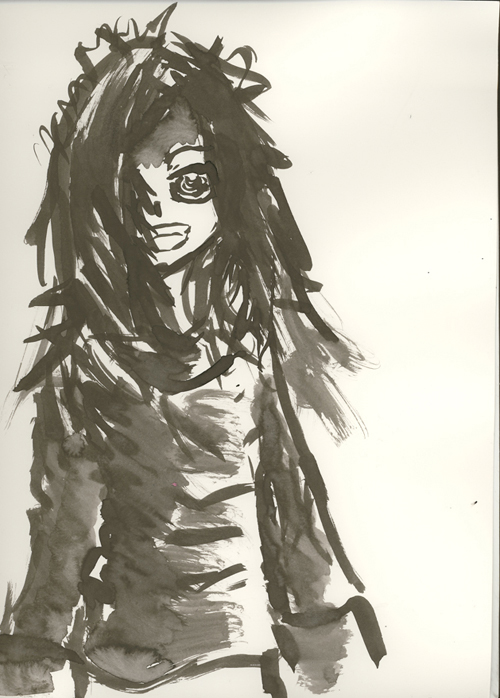
Might I recommend the “Ogiue” costume.

Ogiue wears plenty of outfits throughout the series, so clothing-wise there shouldn’t be too much trouble. You can go with the classic hoodie from her first appearance, but make sure to wrap your arm in bandages to go with it. Alternately you can go for Ogiue incognito at Comic Festival. Wearing men-sized shirts is also Ogiue-appropriate. And there’s always the Renko cosplay option.

The hair of course is the difficult part and seeing as my hair is not long I can’t give any real tips. Perhaps you could construct a fude out of a spare large paint brush, or create some sort of fude clip to add to your existing hair. If this is too much trouble, don’t forget that Ogiue has other hairstyles, such as the high school hairstyle (perfect in conjunction with incognito Ogi), the junior high style, or even the heavy side bangs from volume 9.

And to top it off, secretly carry some yaoi.

Spandex of Future Past Dreams

I wouldn’t really call myself a sentai or tokusatsu fan. Of course I grew up with the Power Rangers on TV, though I didn’t keep up with it too well, and even remember denying even watching it (and Sailor Moon). I’m enough of a nerd that I will say “3 3 5” in the middle of a conversation, and I watched episodes of Magiranger when I lived in Japan, but I do not self-identify as a sentai fan. So it’s with that history and mindset that I started watching videos of Super Sentai crossovers.

Having little nostalgia for Super Sentai, I find the almost familiar effect these crossovers had on me to be amazing. It doesn’t matter if I didn’t grow up eagerly awaiting the latest crossover every year. The acting and presentation tell me that it doesn’t matter, and that something can feel nostalgic without actually being so.

I think the main reason why Super Sentai and other such shows manage to garner their fanbases among even adults has nothing to do with people being unable to grow up, or that they’re using it to live in the past however temporarily. The actors in Super Sentai, be they the actors behind the masks or with the masks off, always show respect for their roles. Respect and talent. Can’t forget that second part, as no matter how much you respect it your Japanese 101 video with you speaking broken Japanese while dressed like a samurai won’t ever amount to much. But respect for the role is more important than talent, just by a little.

Being convinced that the characters take whatever it is they do seriously is a recurring theme in anime and manga, and it’s something I’ve found difficult to use as a reason to convince others to watch a show. While fighting anime such as Hokuto no Ken are the most common grounds for this sort of thing, you’ll even see it in shows like Maria-sama ga Miteru.

So I hold much respect for Super Sentai, for being what it is. They’re kids’ shows, but that’s no reason not to try. Try to watch it, try to make it, try again.

BIIIIIIIIIIIIG OOOOOOOOOOOOONE

I Would Like to See Artistic Use of Dithering

Dither is, according to Wikipedia, “a technique used in computer graphics to create the illusion of color depth in images with a limited color palette.” In terms of otakudom, it’s a visual technique used in many early to mid-90s h-games when the maximum number of colors was 256, and is basically a way to make an image more detailed with limited resources. If you play the Phoenix Wright games, you might notice some of the backgrounds have significant dithering, at least the ones that were adapted from GBA titles. You’ll also see it if you enlarge any gif.

These days, with 16-bit, 32-bit, and “true” colors available, dithering has fallen by the way-side. Games as far back as To Heart and Kanon didn’t use dithering, and really there’s no practical reason to keep it up. People who want to get off on these games would undoubtedly prefer better colors, and those who play for the story and characters, it doesn’t make much difference. But where practicality falters, artistry thrives.

We’ve seen a “return to form” in anime and other media with varying degrees of quality. Megaman 9 showed the world what it meant to look 8-bit because your gameplay was suited to it. Bihada Ichizoku shows the world what it’s like when you make a show just to throw in super 70s shoujo designs.

So I want to see dithering used not as a substitute for better things, like a pirate attaching a pegleg, but as an intentional part of design, like a pirate carving his pegleg into an intricate horse shape.

Personal History of Drawing

Something I put together because a friend did it a while back.

1995

2001

2002

2003

2004

2005

2006

2007

2008

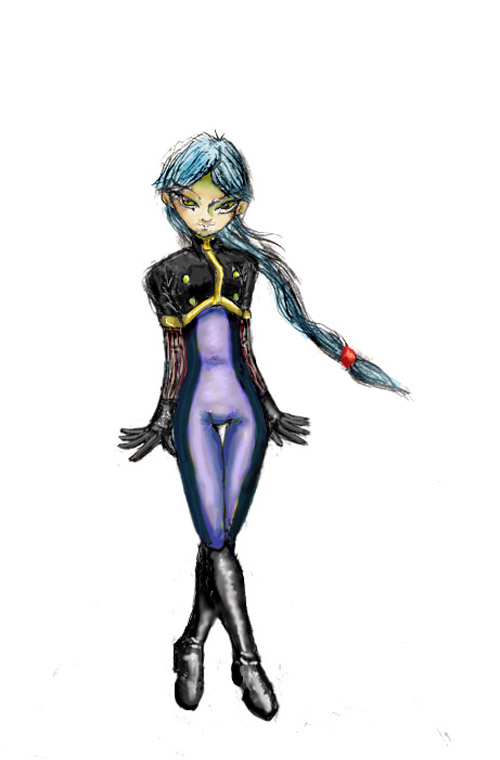
The Moe Heroine and the Yamato Nadeshiko

A “Yamato Nadeshiko” is defined as the traditional ideal Japanese woman. These qualities include being loyal to their husband, putting family first, modesty, and being skilled in domestic matters. Belldandy from Ah! My Goddess is a prominent example in anime and manga of a Yamato Nadeshiko, and the fact that Ah! My Goddess has continued to run for many years indicates that this type of character is relatively popular today.

Of course, the spotlight in recent years has been on moe characters, and while some character traits reinforce the idea of the Yamato Nadeshiko, others defy them. Key’s heroine of heroines Tsukimiya Ayu has loyalty as one of her important traits, but is also a clumsy tomboy whose cooking ability is on par with Homer Simpson pouring cereal. Tsundere characters such as Hiiragi Kagami are strong, capable, and put family and friends first, but are independent-minded and are anything but submissive. Aisaka Taiga from Toradora! meanwhile is a clumsy tsundere.

I don’t think the intentional increase of moe traits in characters is, at the very least on a basic level, “progressive feminism,” but I think it’s worth taking a look at how these characters relate to a concept with a long history in the society from which their fictional media are produced. In American fiction, particularly television and movies, there are certain stereotypes for female characters, particularly when it comes to romantic interests. The Girl Next Door can be considered a reaction to the Bombshell (or vice versa). Any time there’s a shy girl who turns out to be highly sexual, it’s actually just a simplified form of “what you see isn’t always what you get.” Though they are now recurring, even stereotypical concepts in fiction, their basis is in the trends of what most people want in their entertainment, at least as it pertains to female characters.

Granted, otaku are not “most people” in Japan or any other country in which they (or should I say we) reside. And when non-typical people look at something typical, I think there’s often a desire for something “different,” though perhaps not drastically so. But the line between “different enough” and “too different” is a very personal thing, and I think it’s the area in which disagreements regarding the validity of moe characters arises.

Bag + Coat

Joke of a Day

“Kana Middle Sister”