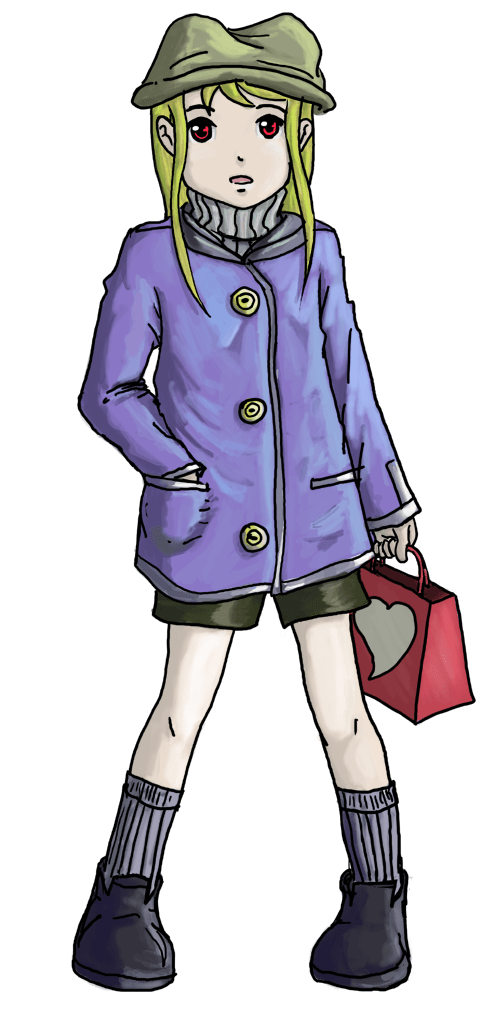
Ogiue the Moldbreaker

My fondness for Daidouji Tomoyo predates my obsession with Ogiue by a number of years. At one point, pre-Ogiue, I was talking with someone online, who mentioned that in his opinion Hotaru from Sailor Moon is a “better” Tomoyo. I held nothing against him despite his being completely wrong, but remembering this brief conversation got me to thinking about how many characters I would call variations of Ogiue’s character-type. Ogi-esque, if you will. After much deliberation, it dawned on me that no such other characters exist. Other fujoshi characters bear little resemblance to Ogiue, and are typically much more cheerful. It’s easy to call Ogiue a tsundere, but her tsundere is like nothing else. It’s not even a stronger type of tsundere, like with Kugimiya characters, but it’s a unique flavor full of body and depth that leaves you satisfied.

I think it has to do with Ogiue being a very balanced, well-rounded character. She has this mix of passion and repression that comes out in everything she does. Her simple one-word responses speak volumes as to the kind of person she actually is, particularly because throughout the story she tries her best to hide her true self. And certainly there are characters who often don’t say what they actually think or feel, but this attribute occurs much more frequently on far more aggressive characters.

Or maybe I’m just incredibly biased. Which I am. But I’m still right.

A Source Not Worth Citing

According to MSNBC’s recent article on anime and otaku culture, not only is anime NOT KIDS’ STUFF, but apparently lolicon is short for “lolita + comics.” Oh, and Gurren-Lagann and Urotsukidoji can be mentioned in the same breath with ease.

The writer makes some valid points, such as the division between 2d and 3d among a portion of the otaky population, but It does no one any favors when a mainstream news service such as MSNBC posts an article full of logical leaps so astounding they’d have taken the gold at Beijing. Students of all ages eager to write their school essays on anime, or even relatively inexperienced academics trying to examine fandom from a broader scale might actually take this article seriously. And if anime-related academia on any scale is ever going to improve, we need to not have yet another “BAM! POW! COMICS AREN’T JUST FOR KIDS ANYMORE”-type article, no matter how dressed up it is with hipper, modern references like Gurren-Lagann or Akihabara.

My Friend the Nattou

Following a Sunday where I delighted myself with a traditional Irish breakfast (blood pudding is delicious), I spent Labor Day with friends at the New Jersey Japanese-based Mall known as Mitsuwa. The last time I was there was over a year ago, and I looked to relive some of that experience, particularly when it came to my dining experience. I knew before I even went that I had to get the Nattou Set, otherwise known as a traditional Japanese breakfast. And just as the idea of a pudding made of blood turns some off, so does the sticky stringy fermented soybean dish known as nattou.

I am well aware of the fact that nattou is easily purchasable in New York City, but I tend to not buy it these days as a courtesy to others. I owe a lot to nattou, as it was the key food in keeping me healthy and keeping my wallet fat while I studied in Japan. It is perhaps as important to my time in Japan as my bicycle and Ogiue (Ogiue riding a bike while eating nattou?) The traditional nattou-based breakfast is a combination of rice, nattou, and raw egg. Each bite was a combination of satisfaction, strong-yet-pleasant flavor, and nostalgia.

It is delicious, if you’re me. A friend of mine who accompanied me to Mitsuwa knew of my affinity for nattou, and so he decided to try it for the first time. One whiff and he decided to hand it over to me. I was happy to oblige.

As an aside, I thought of purchasing some manga or something while I was there, and I had my eye on a volume of the original Japanese Kino’s Journey light novel. I then realized that, having seen the anime, I already knew much of the story and decided to hold off on it, at least for now. Oh, but Volume 7 of La Sommeliere is out. I’m only up to volume 3, so I can’t jump the gun just yet. Sadly I couldn’t find Patrick Macias’ “Otaku in USA,” though I’m sure Kinokuniya or something has it. No worries there.

The Right Way to Do “VS” Arguments

Who would win in a fight, Kenshiro or Golgo 13?

Lina Inverse or KOS-MOS?

Toilet Paper or a Snickers Bar?

I love this sort of argument generally, but it’s generally considered in very poor taste by large parts of fandoms, tired of seeing them. It is considered a useless endeavor, be it in the “unstoppable force vs immovable object” sense, or just being futile and biased based on favoritism by the people arguing. , but there is a wrong way to do it, as stated, and there is a right way to do it, which begins with realizing its uselessness is not a problem at all.

At the end of the first Phoenix Wright game, and this is the point where those of you who haven’t played should turn back in case you don’t want to get spoiled, the message given is that in a court of law the prosecution and defense aren’t working against each other but with each other to arrive at the truth. This is what you should be doing with VS arguments, except that there’s clearly no actual truth. You may want to reach for it, but the goal is not to grind the other person underneath your forum avatar’s heel. The real goal instead is to build upon each other’s arguments and logic and to challenge each other’s opinions in order to promote critical thinking, even if it’s all in jest.

There’s never really a loser in VS arguments, and that’s the fun of it. Work on opposite sides, but work together, just as Phoenix and Edgeworth* do.

*Substitute their Japanese names if you so feel inclined.

Enjadening

At some point, it seem likes most anime reviewers begin to lose passion for their work, provided they had any in the first place. Though we may say something along the lines of, “Why do it in the first place if you no longer like it,” they say that one of the reasons they lose that passion is because they are constantly forced to wade through shows they dislike. They cannot choose the anime they review, and so with every disappointing show they become more and more bitter towards anime. That ocean that once seemed so wide turns out to be polluted.

At least, that’s what I think might be happening.

Aside from a few exceptions, I haven’t really tried to talk about anime on here that don’t really interest me. I mean, it’s difficult to talk about things you find boring, right? And anime reviewers have to do it, be it hell or high school romantic comedy.

In that case, what if I did start reviewing things outside of my interests?

I don’t know if I’ll actually do this. While I have a strong love of anime and manga, to put it to the test like this may be asking too much of me. If I go in, I may come out a different person. I’d like to think there’s interesting lessons to be learned in any anime, good, bad, or decidedly mediocre, but how many will it take before I break, if I do at all?

Most likely, if I do decide to begin this self-experiment, I won’t say specifically which reviews are part of it. That would be up to the readers to determine.

One of the few gripes I have with Genshiken

In the earlier volumes of Genshiken, there would always be writings by the various members of Genshiken pertaining to particular topics, and always under a psuedonym. They were always a fun window into each character, and early on it was interesting figuring who exactly was who.

Ogiue never had a chance to write.

By the time Ogiue comes around, even Ohno at first is contributing here and there, but in the later volumes it turns into Madarame and Sasahara discussing things like Kujibiki Unbalance preliminary character sketches.

Maybe it’s because Ogiue is more a story-oriented writer, or even that because we the readers are so privvy to her innermost thoughts that it becomes somewhat unnecessary, but the writings were never really “innermost thoughts,” much like how this blog isn’t in the strictest sense.

I mean, I can’t be the only one who’d like to know which Kujibiki Unbalance fighting game character Ogiue prefers, right?

The Most Difficult Question

“What anime/manga would you recommend?”

At some point this went from being a fairly simple question to being an incredibly complex one that leaves me puzzled for long periods of time. As I absorbed more and more shows and comics into my being, as I began to expose myself to more and more types of fans and non-fans, the number of variables just kept increasing.

How long has this person been watching anime, if at all? What titles do I think are good? Out of those, which do I think the person asking me would like? What non-anime genres is he or she already into? How open is he or she to new genres? Different visual styles? How familiar is the person with digital downloads, bittorent, etc?

I know in a previous post that I recommended Slayers, but that is more of a generalist approach. The difficulty arises when I try to tailor my response to that individual. Everyone is unique, and I can’t rely on my own taste to sell a show to another.

An equally difficult question is “Which shows do you like?”

How familiar is this person with anime? If I say a title, will they understand what it is? How open are they to explanation?

And it’s not like I’ll lie or anything. I just prefer to pick an answer that will most accurately describe what I like in anime as efficiently as possible to the person in particular who’s askng.

Or I can just say “Rose of Versailles” and see what happens.

The Empty Storefront: The Rickety Path Towards Purchasing Anime

A boy passes by a storefront window, when something catches his eye. He desperately wants it, but knows his parents won’t just buy it for him, and his birthday is many months away. But the boy has a plan, a plan he has thought up entirely on his own. He will save money little by little however he can. He will make small sacrifices. He does not need candy EVERY week. Little by little he accumulates bits of change until finally his effort is rewarded and he can confidently walk into that store, put the money on the counter, and walk out at least a little happier.

…Except that the store is all sold out and the chances of them getting more are now slim to none.

Purchasing Anime DVDs these days feels like a race against time. There might be a series you really want to own, but you are unable purchase it as soon as it hits store shelves, be they real or virtual. And yet, if you don’t purchase it now, it might be on your hands that this DVD did not sell well. Worse yet, if the 1st DVD doesn’t sell well, or the 2nd or the 3rd, there’s a chance the rest of a series may never see the light of day.

I don’t fault the anime companies in particular for removing titles or lowering circulation rates. They are businesses, after all. At the same time, I feel like it almost penalizes those fans of anime who do not have immediately disposable income. It puts the pressure on fans to support ther series they love, but they must do so in a limited time window.

It’s a problem.

Untameable

The Japanese word for tomboy is “otenba (お転婆).” I learned that it’s based on the dutch word “ontembaar,” which means untameable.

And then stuff happened: More Real Shoopon?

Before I realized it, it seems her pose is similar to a certain previous drawing.