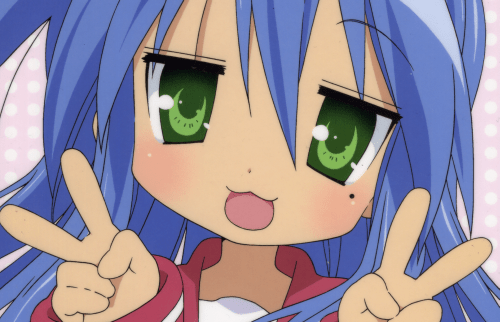
The True Appeal of Izumi Konata

Konata is a surprisingly good character. There’s something very endearing about her and for a long time (since I finished watching Lucky Star), I wasn’t quite sure what it was, but now I know.

I’ve heard from numerous people that they think Konata’s popularity is because she has the same tastes as and acts like a male otaku. That’s not necessarily off the mark, but it’s a little too simplistic. The actual appeal of Konata is not simply that she’s an otaku, but that she’s an otaku who’s not afraid to show that side of herself in public.

I think there’s a fear within everyone (but particularly relevant to dorks) that if they reveal too much of themselves that people will think less of them. They will either believe they cannot make any friends, or that their friends will stop being so friendly. Konata stands in the face of all that. Where most of dvd-and-figure-buying comrades falter, Konata is able to confidently declare to her “commoner” friends that yes, she loves Haruhi, yes, she goes to Comic Market, and yes, she is indeed an otaku.

Combined with some of Konata’s more poignant scenes, such as the Hirano Aya concert or some of her conversations with her dad, Konata shows that she’s not just an impossible ideal for otaku, but that it’s possible to both feel weak and strong at the same time.

Konata, one might say, is the opposite of Ogiue. However, unlike, say, Kohsaka from Genshiken, Konata doesn’t appear to be too perfect. Sure, she’s athletic, sure she’s friendly and outspoken, but in the end she is still genuine to her own interests, still has her own doubts and insecurities, and really isn’t that much different from the otaku from which she is derived.

The dance of moe

I believe that the appeal of moe is derived from the viewer and not the product. The basis of moe is in a person’s own feelings of doubt, insecurity, and empathy. Not necessarily that they are full of doubt and insecurity, but rather that they are very aware of its power.

Moe does not always address these feelings head on, but it frequently refers to them in its characters. Even the strongest characters are somehow weak, and weakness is okay for not only the characters, but also the viewers, is the message I believe moe gives.

I don’t think moe is the complete removal of reality and the real world because even the most simplistic of moe addresses the inner feelings of people, and emotions are a world that to any person are more real than the world surrounding them.

Kenshiro: He who is the most “Gar”

The SaiGAR Tournament 2008 is starting up, and I’m here to argue the case of Kenshiro.

Kenshiro is the latest master of an 1800 year old martial art called “Hokuto Shinken,” or Divine Fist of the North Star. It is the most deadly and powerful martial art known to man, and it involves mastery of the body’s various pressure points to cause a variety of effects. It is a martial art so powerful that traditionally only one master is allowed at a time, while the other students are forbidden from ever using it again, either by choice or by force.

As for Hokuto Shinken itself, here are some of the things it can do.

-By hitting one set of pressure points, he can cause a person’s head to explode after the count of 3. During this time he tells his victim to think about all the terrible sins they have committed in their lives.
-He can make a person walk backwards forever.
-He can force you to point a gun at yourself.
-He can make your arm tell the truth.
-In fact he can make any part of your body explode.
-Part of Hokuto Shinken is learning from other martial arts, so if you’re a master as well, he’s probably going to pick something up from you and use it just as effectively
-He can cure blindness caused by psychological trauma

That last one isn’t very violent now is it? Ah, but that’s where the true character of Kenshiro lies.

He is the inheritor of an almost two-thousand year old assassin-based martial art, but it is not solely because of his capacity as an assassin that makes him deserving of the title of Hokuto Shinken Master, it is also because of his compassion.

Kenshiro lives in the era after 199X, a cataclysmic year where the world was destroyed by nuclear war. In the aftermath of this nuclear war, the planet has become a place where the strong oppress the weak, where violent gangs rape and pillage families and towns.

It is the end of the century.

And Kenshiro is its savior.

Kenshiro aids the downtrodden, gives hope to the innocent, and is able to sense the true intent of any individual. He is accompanied by two young children in his travels, children who represent the hope of the future. Even when faced by strong opponents, he can tell when they are truly evil and when they are simply misunderstood. Fighting a pair of twins, he is unable to continue fighting them as he can see the sadness within their faces. Indeed, these brothers fight against their will because a man has kidnapped their beloved younger brother. Kenshiro not only has ultimate strength, but ultimate empathy.

But if you are evil? If your intent truly is malicious?

Why, you’re already dead.

Traditional Tsundere

A traditional tsundere is a character who at first is cold towards the protagonist but eventually develops strong feelings for him. The appeal in this, I think, is that the protagonist may not succeed at first, but that he has the potential to win the girl over if only she would find out about his true self.

A guy who is rejected by a girl, but over a long period of time is able to gain her love and affection…

urkel and laura

Hmm.

It needs to exist

A Kenshiro dakimakura.

One side will have him getting ready to do Hyakuretsuken, and the other side will be TENHA NO KAMAE.

“You are already asleep.”

If Moe is to Survive, Compromises Must be Made

Moe is associated with lolicon largely because Moe is about weakness, and little helpless girls are about the easiest way of conveying moe.  We’ve seen this trend before in American comics, only it was about gruff manliness and it was called 90s EXTREEEEEEME.  What better way to show that someone is a real man’s man than giving him 8 guns and arms the size of a buick with veins everywhere?  What better way to show a girl has her weak side than by making her weak physically AND emotionally?

When you take a girl and make her defining traits just her weak points, that becomes her whole character.  It is easy, yes, but I would dare call it lazy.  Why bother actually creating character flaws when you can just make someone pure and perfect and helpless?   As with 90s extreme, I feel moe, as it continues to exaggerate certain specific features, as more try to take advantage of it with half-hearted attempts, will receive a backlash.  Some might welcome the backlash, that’s okay.  But for those of you who do like moe, you’re going to have to accept that certain changes have to take place.   Rather than the moe character, we must have the character with moe traits.

We already have these characters among us.  They are the ones who we CAN see as competent, but as with all humans they are not perfect.  They have emotional problems, doubts, and fears.  I believe people like moe in the first place because it allows us to relate to a character on a very emotional level, that our feelings are understood by others, and manifested in characters.  I believe it is a common fear among otaku and dorks in general that those in normal society are “perfect” and never have to deal with the same issues that they themselves face constantly.  Moe characters if they are too extreme are too far-removed from reality, and thus lose their significant impact.  If instead a moe anime uses more “normal” characters, but show that they have the same issues that otaku face, then we have more than just a marketing tool, we have something that can motivate otaku to move forward, to come to a greater understanding of others.

Why I Like Ogiue, Part 1

I think perhaps it is time I talk more specifically about Ogiue. I mean, I’ve talked about Ogiue in the past before (in case you haven’t noticed), but now is the time to begin discussing the topic of WHY I like Ogiue. I’m referring to this as Part 1 because it’s inevitable that I’ll have more posts on this topic. For Part 1, I am going to focus on my emotional response to Ogiue’s character.

I have always described Ogiue to people as possessing True Moe. Now, I know moe is hard to define, as is truth, but Ogiue is a character I care for deeply because I feel a connection to her plight, her interests, and her progress from self-hating fujoshi to fujoshi girlfriend. She speaks to anyone who has ever been concerned that their otaku nature excludes them from any sort of conceivable romantic relationship, and that includes me. We all have doubts as human beings, but Ogiue’s doubts are very similar to my doubts and to see her overcome them eventually, it’s inspiring, it’s life-affirming, and really, if it were possible, I would give her a hug whenever she needed one. She is someone to whom I can relate, but she is someone else entirely. She’s also a fictional character, but even though she’s not real, her concerns are realistic, and they affect me in such a way that she’s always somewhere either in the front or the back of my mind.

Ogiue is in my opinion the most beautiful and attractive character ever, and the reason why her presence hits me so hard with respect to sex appeal is that, while a lot of her physical and personality traits are things I’ve always liked, such as tomboyishness and having the hottest eyes ever, Ogiue also possesses many traits which I never realized I liked until I read Genshiken. Her harshness, her softness, the way she wraps her doubt in a facade of hate, her problems taking criticism, her tendency to let her imagination run away with her her spurts of creative energy, and yes, even her body type all make her incredibly attractive, but it’s not because of those traits that Ogiue is beautiful.

No, those traits are beautiful because Ogiue possesses them.

You Too Can Be Straight for Oscar

I’d like to design an eroge based on 70s-era shoujo manga and anime, the kind with impossibly sparkly eyes and whispy bodies and extreme melodrama.  The sad(?) fact is, that computers simply were not advanced enough in the 70s to pull this off, so we must make up for lost time

The plot would be of that time period, and rather than the stereotypes we get today with the loli, the tsundere, the loli tsundere, and all that, it would incorporate common character types of 70s shoujo as well.

And the sex would involve rose petals flying everywhere and symbolic lightning.

“Slice of Life” they say

This post is inspired by my recently having watched more of Kino’s Journey after a long delay of not-watching Kino’s Journey. Warning: Rambling ahead

I’ve realized how unusual it is that when I think of the term “Slice of Life,” my mind goes immediately to anime. It’s a genre I enjoy immensely, from Azuma Kiyohiko’s works to Haibane Renmei and beyond. You could even consider Genshiken to be “slice of life,” and much of Ogiue’s appeal comes from the small moments in her life. But then, why is it that “slice of life” is so associated with anime, instead of, for example, shows with live actors?

I’ve spoken to friends before about what it is that makes an anime feel like an anime, what differentiates it from other mediums, what makes us come back for more. I think in certain cases, it has to do with this sort of slice of life pacing that’s just not seen as often elsewhere. Of course, I’m not saying that all anime is slice of life, or that there are no slice of life shows outside of anime, but merely that there is a recurring trend that a good amount of people who like anime like it because of shows such as Haibane Renmei. Even if this genre of anime and manga doesn’t occur as often as I think it does, I don’t think anyone would fault me when I say that when it occurs, it leaves a big impression on its fans, perhaps more than even the most soulful of epic tales.

Slice of Life, what does it mean? It means, basically, a story where “normal” life occurs, with less focus on dramatic events and more on the day to day occurrences to which we can relate. I’ve spoken a bit about moe before, and I don’t want to turn this into a moe essay, but I can’t help but feel that there is a corollation between the two. When watching a slice of life show, one desires to live the life of the characters, what tends to be a slow-paced life where the characters involve simply enjoy each passing day. In moe, the appeal is in the “weakness” of characters, the raw, emotional side which is different from stopping and smelling the roses, but also invokes a feeling of realism. If slice of life is “I want to live how they live,” then I think moe is “I feel how she feels.” And of course, the two can co-exist and are often together.

I wonder, then, if animation, as shown through the aesthetics we associate with anime, lends itself to the slice of life genre, much like how moe is associated with anime and manga. Characters tend to be pure and beautiful (though not necessarily attractive). They exist as (seemingly) simple characters leading (relatively) simple lives, no matter what the circumstances. They generally consist of flat colors with minimal shading and black outlines. Due to budget constraints, animation tends to not be very fluid, so still images and animation shortcuts are used, which may lead to slower-paced shows (though that is sometimes called “filler”).  All this may lead to why “Slice of Life” as a genre has attracted so many people to anime.

Or maybe I should just talk to Scrubs fans more often.

Crossing Gender-oriented Genres and Fan Reaction

I’ve been thinking about those works which cross the line between various genres of anime, particularly those which bridge the gap between “male-oriented” and “female-oriented” labels. Series like Saint Seiya and Cardcaptor Sakura manage to capture an audience beyond their main targets, while others such as Gundam Wing and Mahou Shoujo Lyrical Nanoha not only bridge the gap, they cross over and begin to set fire to the ropes.

I know I have some issues with Nanoha, and while I think it’s a fine series overall, it never completely shakes that feeling that yes, this is totally intended for guys like me who love Cardcaptor Sakura (though not in that way personally), and it is kind of creepy for doing so. I know Gundam Wing is often considered far more of a black sheep than G Gundam among male fans of the Gundam franchise, for the way it perhaps overly de-emphasizes aspects often associated with Gundam, never mind that the original series garnered more than a few female fans of Red Comet Char Aznable and his zany (dead) friend, Garma Zabi. It’s just interesting to see this negative reaction in both myself and others pertaining to certain series and our expectations of what a show should entail.

I wonder if it’d be possible for genres to swap almost completely.