Created Equals

Warning: Spoilers for Aquarion EVOL in this post
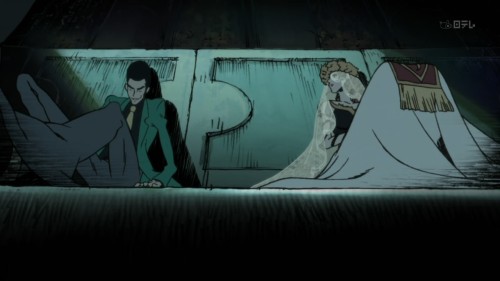
Amidst fears that a television series starring the matron saint of anime femme fatales would be mired in an inescapable well of sexism, Lupin III: The Woman Named Mine Fujiko manages to assuage those worries through extremely sharp characterization. Say what you will about nudity or Fujiko as an object of sexual desire, but the show makes it clear that they all have the skills and the smarts to succeed in their mutual world of thievery. Even if trust is at a premium (as is often said), there is no shortage of respect between Fujiko, Lupin, and the rest, and with mutual respect comes a sense of equality.

I’m not about to decry anime and manga as being polluted with unequal male-female relationships, as I can think of many examples to counter that idea, enough so that they don’t collectively turn into “the exception that proves the rule,” but this very idea of representing gender-egalitarianism has me thinking about what goes into portraying such relationships. For example, if a boyfriend and girlfriend each alternate being “dominant,” then is that “equal” or is it merely just multiple instances of inequality? Does breaking things down for comparison defeat the idea of equality between a guy and a girl by putting too much emphasis on haves and have-nots, or is ignoring it a bigger mistake?

As far as recent anime goes, the other show besides Lupin: Fujiko which has me really considering the concept of equality among opposite sexes is Aquarion EVOL, particularly that of Yunoha and Jin, the (literally?) star-crossed lovers who seem to have taken Pixiv by storm. Yunoha is an extremely quiet girl whose very shyness translates into her power (invisibility), and when she meets Jin (an enemy spy whose power is to keep others away), the two form a bond which gradually grows stronger.

Between Yunoha’s diminutive size in multiple respects (in a series full of toned and busty girls, her proportions are significantly more subdued) and her personality, Yunoha can seem to carry a potential problem that is similar, yet in a certain sense opposite to that of Fujiko in the sense that she can come across as the girliest girl, harmless and pleasant and easy to dote upon. Yet, despite the awkwardness of some of her interactions with Jin which can come across as her being dominated (notably the part where he tries to kidnap her out of love so that she can be the mother of his children and save his woman-less population from dying out), I don’t get that sense from their relationship.

While Yunoha can seem weak, and even her willpower and inner strength aren’t particularly impressive, Jin in many ways seems even weaker despite the basic idea that he’s an extremely skilled pilot and a deadly fighter. There’s something to his personality, perhaps a combination of naivete and extremely subtle yet numerous emotional scars, which make even his “domination” seem weak. In that sense, I find their relationship to be a very equal one, but in the sense that the two seem to grow to understand each other, a resonance between similar, yet complementary individuals.

One of the big ideas I keep running into when it comes to portraying a character well with respect to their gender is “the right to be a weak character.” By that, I mean how weakness (mental, physical, emotional, etc.) is generally thought of as a trait which makes one character “lower” than another, and which implies that their appeal is in their “lower” status, but at the same time that weakness can resonate on a more “equal” level with those who perhaps find themselves similarly weak. I think this is probably part of what makes arguments over moe so volatile, but let’s leave that for another time.

(Please don’t argue over moe.)

Meal, On-hand-to Eat: Strike Witches Rations

I like food, and I like shameless advertising involving food, but it’s often hard for the two to make sense. Sure, there was the Saki Tacos promo, but rarely do the components of edible promotion actually line up so well, instead usually involving some logos or stickers slapped onto the wrapping of a biscuit. Luckily, we now have Strike Witches rations, so that you can simulate the feel of being a teenage girl with propellers strapped to your feet fighting a war.

Japanese blog “Kyou no Gogo kara Honki Dasu” has a photo review of the product, which appears to come with “biscuit bars” and some kind of jelly to go with it. According to the reviewer, the biscuits are absurdly sweet, though I don’t know by what criteria he’s judging it (American candy tends to be sweeter than Japanese desserts for instance).

I’ll be honest, unlike Saki I don’t really know much about Strike Witches. I’ve only seen two episodes, but even so, I still feel compelled to buy this product, if only because it really exists.

The Fujoshi Files 36: Hina

Name: Hina (ひな)
Alias: N/A
Relationship Status: Single
Origin: Tonari no 801-chan

Information:
Hina is a junior high school student and younger sister of 801-chan. Relatively inexperienced as an otaku, let alone a fujoshi, Hina often makes rookie mistakes such as shortsightedness when it comes to the history of things. She has even gone so far as to believe that Aslan from The Chronicles of Narnia had his name based on Athrun Zala from Gundam SEED. For this reason, Hina can often get on her older sister’s nerves.

More generally, Hina is at the perfect age to suffer from Chuunibyou, the delusional illness that comes from being a junior high student otaku and thinking that a number of things are fantastically cool and deep. Like her sister, she is fond of the Prince of Tennis, but has differing tastes otherwise.

Fujoshi Level:
Although one might suspect that her older sister’s influence is responsible for Hina becoming a fujoshi, this is not the case. Hina was able to reach that mindset entirely on her own, even while 801-chan was trying to hide that aspect of her own life.

Walk that Aisle with Style and Profile: Genshiken II, Chapter 72

In this month’s Genshiken II, Madarame and Hato have an awkward but heartfelt man-to-man talk and Ogiue springs possibly the worst question could ask a room of otaku.

The chapter opens up right where we left off with Madarame and Hato, with Hato asking to come inside Madarame’s apartment so that they can have a talk. Hato’s main goal is to apologize, as he believes his actions have led to Madarame not coming to the clubroom anymore. Situated right on his desk however is a copy of the game Kohsaka’s company was selling at ComiFest, inevitably drawing the discussion towards it. As they discuss its rather unique contents (though all the characters you romance are actually otoko no ko, you can also get them pregnant and marry them), they also begin touching upon the doubts and dilemmas that are currently bothering them. In the end, Madarame’s nonchalant attitude towards Hato being unable to draw anything but BL (his advice is essentially, “do what you want”) actually helps Hato resolve to work on the planned manga with Ogiue for the school festival.

At the club, both Ogiue and Hato independently decide to do something different and decidedly not BL, going with Sue’s proposed plan of Ogiue on script, Hato on art, with no crossover. Ogiue, looking to do a high school shoujo love story, asks the members of Genshiken if they have any stories of romance in their own high school experiences to share (also making the best face ever in the process). The chapter ends with a collection of dumbfounded stares, which shows that when it comes to teenage romance, no one in there can call themselves experienced.

During Madarame and Hato’s conversation, Madarame wonders aloud if it might be time for him to stop being so attached to his old college life. Hato thinks that he’s the cause for Madarame wanting to leave the club for good, but I think it’s clear that he’s probably one of the less significant factors, if really one at all. Madarame’s lingering feelings for Saki bleed through during their discussion of Kohsaka’s game, and it’s evident from his tone that the decision to move on is more tied to a rather more complex set of feelings. On the one hand, moving on means letting go of Kasukabe and deciding that it’s over. On the other hand, it can also mean that it’s time to “grow up” and stop being the otaku he was during college. Too many strong emotions are bundled together to not make this anything less than a growing concern for Madarame.

The fact that Madarame played a game centered around otoko no ko is both surprising and not. We already knew that his tastes could be pretty off-the-wall, and in terms of what’s out there, girl-boys aren’t anything special by comparison. However, this does further emphasize the idea that what one finds attractive in actual people may not be what they enjoy in their fictional characters, like with Madarame and Saki.

What is bizarre though is the whole thing about one of the characters being based on Kohsaka. Madarame mentions in the chapter that, not only is the character also named Kohsaka Makoto (with different kanji), not only does he look like Kohsaka, but his dialogue also closely resembles Kohsaka’s way of speaking. Now imagine you’re playing a visual novel, and you know for a fact that the character in front of you is based on a person you’ve known for years. It’s actually a step beyond finding out a friend of yours does porn now, and it’s one of the stranger kinds of familiarity that I can imagine.

Hato in this chapter is also revealing more about himself, particularly that his fantasies aren’t necessarily restricted to “just” BL. It may be about 95% of what’s going on there, but he begins to entertain the thought of Kasukabe turning to Madarame, though it ends up being aborted part-way through because of something that the old members of Genshiken determined back at the last graduation party in Volume 9: Saki isn’t moe, or more specifically, Saki’s personality and demeanor are such that it’s hard to turn her into a character type (“chara”) without significant changes. As Hato starts to try and think of something, he immediately remembers his first meeting with her, where she instantly saw through his disguise and called him a crossdresser.

Kasukabe’s too sharp, too real, which again emphasizes the contrast between Madarame as otaku and Madarame as a man of unrequited love. Have I ever said that Genshiken‘s really good at characters? Like fifty times? Okay, just so you know.

Going over to the Ogiue side of the chapter (which still involves Hato anyway, so I guess we could more call this a Hato chapter?), let’s talk about that face. Perhaps more than anything else I’ve seen, this expression is a sign that Ogiue’s changed deep inside, because I could not possibly imagine her making that face even up to the point where Hato, Yoshitake, and Yajima join the club. Even with her current problems, it just seems like a great weight has not only been lifted off her shoulders, but it’s also been tossed far away and mined for ore.

It’s also good to see that Ogiue and Hato have resolved to work together for the school festival, and that in doing so they’ve also resolved to work through their respective mental blocks. The fact that they’ve decided to go with a high school shoujo story is an interesting challenge, not only because it means new and unfamiliar territory, but because they’re otaku trying to write what is (probably) going to be a typical teenage romance. This is obviously where Ogiue’s last question in the chapter is coming from; as someone whose only pre-college romance ended in the worst trauma of her life, she can’t use her own experiences to fuel the story.

I think this chapter leaves with us wondering just who among the people in the club actually dated in high school? While Yoshitake might be the most obvious one given her personality, I’m basing my prediction on those last two panels of the clubroom.

Of all the people in there, only one is not shown to be reacting incredulously to Ogiue’s question.

That’s right. I get the feeling that we’re going to find out about the romantic life of Susanna Hopkins.

Whoo!

The Fujoshi Files 30: Kifujin-senpai

Name: Kifujin-senpai (貴腐人先輩)
Alias: Chief (チーフ)
Relationship Status: Single
Origin: Tonari no 801-chan

Information:
Kifujin-senpai is a woman well into her career. Working at 801-chan’s company as her boss, Kifujin-senpai subtly revealed to 801-chan her true form as fujoshi. Though often asked by her parents to settle down, Kifujin-senpai remains single and devoted to her fujoshi lifestyle. She has even once said that the only things needed in life are homos and cats.

Of 801-chan’s acquaintances, Kifujin-senpai is actually the most hardcore fujoshi she knows. This is quite a feat given 801-chan’s friends and acquaintances. Where others might limit their imagination to overall gestures, Kifujin-senpai takes into account every gritty facet with extreme detail. And where plenty of others can manifest their fujoshi sides in the form of furry little critters, Kifujin’s alternate form borders on the Lovecraftian, a many-eyed purple beast that can grow without end with countless numbers of flailing arms, surrounded by a dark, ominous aura.

Fujoshi Level:
In addition to every other detail listed above, Kifujin-senpai is recognized as being so powerful a fujoshi that 801-chan for all of her delusions and obsessions is actually frightened of becoming an otaku on par with Kifujin-senpai. She is one of the ultimate forms of fujoshi that others dare not touch.

The Fujoshi Files 29: Odango-chan

Name: Odango-chan (お団子ちゃん)
Alias: J-chan (Jちゃん)
Relationship Status: Single
Origin: Tonari no 801-chan

Information:
Odango-chan is a friend of 801-chan’s along with BL-chan and a regular attendee of their “fujoshi meetups.” Not much is known specifically about her taste in anime and manga or her personal life, except that she appears to not be quite as far down the rabbit hole as her fujoshi compatriots.

Like her friends, she can produce an alternate form representative of her true love for BL. Unlike the others however, that form has undergone more changes over time, most notably the symbol on her forehead, which resides in its current form as a “J,” but has previously even been blank.

Fujoshi Level:
Little is known about Odango-chan’s exact fujoshi level, except that she has definitely been in the game for a long period of time.

The Expanding/Contracting Anime Fanbase

Floating out there in the general discourse are what seem to be two contradictory ideas of anime fans.

1) Anime is appealing increasingly to a smaller and more niche crowd of otaku, often through devices such as loads of fanservice or active use of moe. As such, the fanbase is becoming more and more a select group of adult men who grow older and smaller in number over time.

2) Anime fans are getting younger and younger, that anime is attracting a primarily female audience. Moreover, a lot of these young fans are not able to retain their fandom as they grow older. They hit a certain age and anime stops being their obsession.

So somehow you have a fandom that is both shrinking and growing larger, while the median age rises but also lowers or remains the same, and this is all being done with the same collective pool of works we call “anime.” On the surface, something doesn’t quite add up. The more I think about it though, the more I find this isn’t necessarily an irreconcilable contradiction. I mostly have impressions and hunches from observing anime and its fans, but I can think of some possibilities as to how these two concepts can co-exist.

It might be that some fans are longing for another period of anime, a self-defined golden age where anime was at its best.  If it’s not simply a matter of nostalgia or specific tastes though, then it could be that these fans are not finding what they want in either side, the young and general, or the old and niche where they might have once been able to easily. So the anime fanbase may not necessarily be shrinking overall, but the demographic ratios may be shifting in a way that’s troubling to some. This one does not necessarily have any flaws, but it seems more to be a mix-up of personal desire for general trends.

Another possibility is that the effects of anime’s move towards extremes in its fanbase cannot be felt immediately and that it will take some number of years to really see the fallout. Perhaps it would be the age at which the current otaku base starts to literally die off, much like some of the criticism surrounding the current state of American superhero comics. This one doesn’t quite feel right through, and I can’t put my finger on why.

Similarly, while the younger fanbase is increasing, they are finding their access to anime through inexpensive means, be it through outright piracy or simply watching things streaming. “The surest” way at the moment to make reliable profit is to hit the collection/merchandise-obsessed otaku, hence all of the light novel adaptations. The amount of money being generated by anime is not what it used to be and may never be at that level ever again, even if there are new fans.

Overall, I’m not really sure. These are incomplete thoughts and I don’t think I’m going to be reaching a solid conclusion any time soon. I’d like to hear other people’s thoughts.


Kiddy Grade, Kiddy Girl-and, Memories of the Future

Recently, I was compelled to watch the Kiddy Grade opening, followed by the opening to its sequel, Kiddy Girl-and. For those of you who have never seen either show, I can best sum up the series as being a “girls with guns, maybe” show in a futuristic science fictional setting, and probably one of the shows that sticks out in people’s minds when you say “Studio Gonzo.”

Actually, the shows can probably best be summed up by watching the openings, which I invite you to do. Don’t worry about it, I’ll wait.

The original was fairly popular back in 2002, and seven years later out came its sequel, which I heard was not that well-received even by the typical diehard Japanese anime fan. Regardless of success or lack thereof however, when I watch those openings back to back, I can feel the flow of seven years of anime history, more than I can with other comparable methods. I can watch all of the Cutie Honey and Gegege no Kitarou openings and perceive the changes that have occurred over decades, but I can’t feel quite as much as with Kiddy Grade. I think the reason this difference exists in me is because this past decade was the time when I as an anime fan (and many others) could watch new shows within days or week of Japan, a dream at best for most people prior to the advent of the internet. I was there, man. It was intense (no it wasn’t).

But I don’t think it’s just the fact that I lived in this period that gives me the sensation of time flowing. It’s a definite factor, no doubt about it, but I think there’s also something different about the qualities of each opening, not just the fact that they feature different characters with different personalities, but also the way they introduce their content. Thus, though I’ve seen both shows either in part or in whole, I’m going to be thinking about them purely from what their openings have to stay about them (though I will be using their names for convenience’s sake).

The Kiddy Grade opening aims to give a sense of intrigue while introducing its main characters as two mysterious and attractive ladies. Eclair, the brown-haired one, is leggy and busty and is portrayed as the “muscle.” The “brains,” Lumiere, is decidedly younger in appearance, and seems to be taken from the same quiet, blue-haired mold as Evangelion‘s Ayanami Rei and Nadesico‘s Hoshino Ruri, though with significantly more smiling. Every scene has them contrasted with each other in some ways, whether it’s Eclair shooting a gun vs. Lumiere throwing a wine bottle, Eclair standing on one side with her lipstick whip with Lumiere and her “data trails” on the other, or the “kiss” scene, again, to create intrigue, sexual or otherwise.

The Kiddy Girl-and opening on the other hand is anything but mysterious in its presentation. It seems to want to convey an everyday sense of fun, and the two main girls are decidedly sillier in the intro compared to Eclair and Lumiere. They also are less different from one another compared to their Kiddy Grade counterparts, with Ascoeur (the pink-haired one) and Q-Feuille (the purple-haired one) having closer body types, though it’s clear that the former is bubblier than the latter. Rather than being presented as enigmas, Ascoeur and Q-Feuille are up-close. Personal, even.

Of course I can’t ignore the music itself either. Music isn’t my specialty, but I can tell you that Kiddy Girl-and‘s song is clearly sung by the voice actors of the heroines, whereas Kiddy Grade‘s with its mellow tones is not, and both songs lend themselves to the descriptions I gave. While having the seiyuu sing the opening was nothing new in anime even before 2002 (Slayers, Sakura Wars, to name a couple), I’d say that they’re supposed to be singing as the characters in the Kiddy Girl-and opening.

So then what are the big changes that this transition between openings represents? Well I don’t know if I’d call them “big” per se, but I feel that the Kiddy Grade opening exemplifies what was typical of its time, and the same goes for the Kiddy Girl-and opening. The much more “futuristic” vibe of the Kiddy Grade opening leads to the future-as-typical feel of its sequel’s intro, in a sense representing an increase in slice-of-life/”the everyday,” as well as a move away showing narrative-type elements as a prominent reason to watch. I wouldn’t go as far to say that this is an example of Azuma Hiroki-esque breakdown of the anime “Grand Narrative” though, as that’s a lot more complicated than just “less plot in anime.” Of course, there’s also the feeling that “moe” has changed as well, as I think that all four girls are supposed to be “moe” to certain extents, and seeing how their “moe” is conveyed in those openings is probably more indicative of that seven-year gap than anything else.

Neither of the shows are particularly amazing or special, and are probably best described as “the median” or “mediocre” anime, depending on how kind you want to be. However, that’s exactly why I think their contrast shows the path anime has taken so well, because while it’s great to see how the really pioneering, experimental, and enormously popular works operate, looking at the middle of the road gives a good idea of how anime as a whole moves.

The Fujoshi Files 20: 801-chan

Name: 801-chan (801ちゃん)
Alias: Kitaooji Nasubi (北大路茄子)
Relationship Status: Married
Origin: Tonari no 801-chan

Information:
801-chan (pronounced “Yaoi-chan”) is a company employee in her 20s and an otaku with two great joys in life. The first is her boyfriend-turned-husband, Tibet, a fellow otaku she affectionately calls “Chibe-kun,” whom she first met online. The second would be viewing her hobby through the lens of moe and BL, though she has her own complex internal logic about it. She has many favorites, including Dearka from Gundam SEED, but is notably fond of the Prince of Tennis musical, which she has gone to see on more than one occasion. She also draws.

When 801-chan is particularly roused by yaoi, a green furry creature emerges out of her back, representing her passion for it. Fortunately for her, she has many friends who share her fondness for the subject (and also have hidden yaoi forms), notably her good friend BL-chan and an older co-worker named Kifujin-senpai. This also includes her younger sister, Hina-chan, though 801-chan sometimes finds her exasperating.

Fujoshi Level:
That 801-chan possesses an alternate form dedicated to yaoi already shows that she is quite a strong fujoshi, but compounding this is the fact that her appearances as the green monster might just outnumber her appearances as a regular woman. She is also capable of applying BL to unexpected things, such as the all-girl j-pop band, AKB48. Moreover, not only is she one of the representative fujoshi characters in anime and manga, but 801-chan is actually originally based on the author’s significant other. Her twitter can be found here.

Ichika’s Rosy Life: An Infinite Stratos Fanfiction

It was noon at the Infinite Stratos Academy in Japan. There in the cafeteria sat Orimura Ichika, your typical guy who also pilots an advanced robot suit. In fact, it wasn’t the suit that made him special, it was that he was the only man in school, a special and rare case of a possessor of the Y-chromosome being able to pilot an IS. At least, he was, before his new roommate Charles Dunoa arrived from France.

So as Ichika sat there eating his sandwich, a bunch of girls came up to him. They were curious about Charles, particularly because he was quite handsome, and they used this opportunity to not only try to get more information on the Frenchman but also as an excuse to get closer to Ichika.

One of them sat right next to Ichika and said, “I’d like to visit the two of you in your room.”

“I guess that’s all right,” replied Ichika.

“Can I…invite my friends?”

“Sure! We’ll go wild.”

The girls’ faces all turned red and they shouted various exclamations and variants of “Kyaaaaa!” But just as it began to escalate, in  came four of the most talented girls in the school, Houki, Cecilia, Lingyin, and Sarah. Houki brandished her Japanese sword at the blushing girl. Cecilia reprimanded them. Lingyin began to activate her IS. Sarah pushed her short pink hair aside and told the girls that she prefers older men.

Ichika tried to calm the girls down. He figured the best thing to do would be to get up and leave the cafeteria, but while standing up his hand slipped and he fell face first into all of the girls’ chests.

I will leave the grim and violent details to your imagination.

Ichika eventually managed to escape, and saw a mysterious figure with sharp eyes and turquoise hair. Another guy, it seemed. He beckoned Ichika to come over and handed him a note.

Ichika whispered to himself. “This changes everything.”