Static vs Active: Another Moe Discussion Part 2

Yesterday, I made a post about how the “issue” of moe basically came down to whether or not it was personally offensive to someone. I didn’t go into what “is” or “is not” moe, as what was important there was not to get people to agree to any one definition but to point out the fundamentals of why moe can make for such heated debates and arguments. Today though, I want to talk about one of the possible reasons why discussions regarding moe can often seem like the two sides are arguing two entirely different topics. Keep in mind that my goal is not to show one side being right and another wrong, but to help you better understand why it is you, I, or anyone has developed their respective opinions on the topic of moe.

In the past, I’ve defined moe as a strong empathy for a character’s weaknesses, but knew that not everyone would necessarily agree with my interpretation. The more I studied my own definition and others’ however, the more I realized that there was some mix-up as to what different people considered the most important element in defining moe. From there, I thought up two general categories: static moe and active moe.

Static moe is where a character’s design and basic attributes are moe. The character’s voice, personality, unique physical traits, etc. all contribute to static moe. The idea is not to pull a character completely out of their context, but to see them in a stilled moment and gain moe from that.

Active moe is achieved through a character’s actions or what happens to them in the context of an animation. It is in the way they change or interact with their world that creates moe. In a way, this moe lacks concrete evidence, and is built into how the character grows on the viewer.

If we look at Tsukimiya Ayu from Kanon, her love of Taiyaki, tomboyish personality, lack of cooking skills, and penchant for saying “Uguu~” are all elements of static moe. Ayu’s interactions with Yuuichi, the way the two characters grow closer as friends, and the manner in which we learn about her true identity are what comprise Ayu’s active moe. To generalize, static moe is the stationary character, while active moe is the character in motion.

Now, what contributes most to your perception of moe? Whether you like moe or not, do you view moe as primarily static, where the most vital aspect of it is the design of the character, or do you view it as primarily active, with the greatest emphasis on the path the character takes?

Using myself as an example, when I examined the characters I found to be the most moe (Ogiue, Eureka, Hinata, etc.), I realized that my views on moe were shaped mostly by my own emphasis on what they had done as characters. In other words, I was moved strongly by their active moe. Again though, it’s not as if moe as active will make you like it, or thinking of moe as static will make you dislike it, but I think that the view of moe people have shaped in their mind relative to this dichotomy strongly influences their opinion as a whole, whether they realize it or not.

That’s Part 2 of Another Moe Discussion. Is there going to be a Part 3? A likely possibility, as I do have something in mind.

Two Questions: Another Moe Discussion Part 1

Hi kids, it’s time to talk about moe again.

There’s two things I want to address here, the first is what is up with the strong feelings towards/against moe. The second topic I’m going to address tomorrow, so hold onto your hats!

We as anime fans on the internet can argue about moe all we want, whether it’s hurting or helping the industry or anime as an art form, whether it’s a boon or a detriment to storytelling, but when you strip away all of the noble back-and-forth posturing and gesturing, it basically comes down to two “yes” or “no” questions.

Does moe creep you out?

If so, are you okay with that?

And this is based on however you yourself interpret moe to be. Of course I’m generalizing, and there can be other reasons to dislike it, but from what I’ve seen this is the origin of the most vehement opposition to it is from the people who just cannot handle the idea that anyone proper of mind would like moe of all things, and its most ardent supporters are the ones who take offense to the idea that they are somehow developmentally insufficient.

Now it’s okay to be creeped out by moe, as that’s totally your prerogative. I may like moe myself, but it’s not like there hasn’t ever been an instance where I was creeped out by a piece of fiction and I was not okay with that. Specifically, I’m talking about that awful Thundercats comic from a few years back where they had Wily Kit and Wily Kat as bondage slaves to Mumm-Ra. Sure, they were adults in the comic but what the hell. That really weird sexualization of two comic side characters from a children’s cartoon bothered the hell out of me, especially because this was not some guy’s fanart but an actual official comic that was supposed to be like canon to the Thundercats story. In many ways I think it’s similar to the reaction that a lot of its opponents have against moe, replacing Thundercats with anime as a whole.

As to what influences perception of moe, that’s for the next post.

Please Hunt Me, Onii-chan: The Willingly Poached Anime


Cardcaptor Sakura

Cardcaptor Sakura is a magical girl series released in 1996 (manga) and 1998 (anime) which remains very popular among otaku. Following the life of a young girl who discovers magic powers and must use those new-found abilities to collect magical cards which have been dispersed throughout her city, Cardcaptor Sakura’s main draw is the natural charm its characters possess, particularly the heroine Kinomoto Sakura. Sakura exudes a sense of authenticity in her character that makes older male fans feel for her, and sometimes even develop sexual feelings for her.

While it’s never clear as to whether or not Cardcaptor Sakura was intended to be received by the fans in this manner (even though Sakura creators CLAMP were fans themselves before becoming professionals), there exists little of that ambiguity with a similar show, Magical Girl Lyrical Nanoha. Essentially following the same basic premise as Cardcaptor Sakura, Nanoha features a young girl who receives magical powers and has to go collect items, but the key difference between the two series is that while Cardcaptor Sakura was targeted towards primarily young girls, Nanoha was aimed squarely at those older male otaku who were very fond of Kinomoto Sakura and the world in which she lived. The late-night time slot, the merchandising (posters in the otaku-oriented Megami Magazine, Nanoha-themed hug pillows), all of it points to a show made for otaku. Why then, do the people who make and promote Nanoha go through all the trouble of giving the series this magical girl facade and having it designed to look on the surface as if it were designed for the enjoyment of young girls when it clearly is not? The answer is, because that’s what the fans want.


Magical Girl Lyrical Nanoha

“Textual poaching” is a term which refers to the act of engaging a work of media, be it text, television, radio, etc., and taking from it not so much what the author intended, but what is pleasurable or enjoyable to the reader/viewer instead of the work as a whole. Coined by Michael de Certeau in 1984, the term was utilized by Henry Jenkins in his study of Star Trek fans, particularly in the way that fans approached their own creative endeavors pertaining to their chosen fandom. The classic example of this is the notion that Kirk and Spock are romantically interested in one another, based on their close friendship and lines which are interpreted as “hints” towards their “true” relationship.

More recently, Jenkins has talked about how the one-sided conversation between creator and consumer has broken down, and how easy it is now for people to talk to a creator, albeit in the indirect form of shouting into the internet. While Jenkins does not focus particularly on Japanese animation, this is essentially the environment modern anime finds itself in, and in this setting you will find that a number of shows, like Nanoha, are designed to be poached.

At the zoo, chimpanzees are not fed by simply placing the food in front of them. Instead, what the zookeepers do is hide the food in the chimpanzees’ cage so that the chimps may find it themselves, and in doing so are creating a facsimile of the wild setting where chimps would forage for food. Even though the zoo is obviously not the jungle, this artificial foraging is what the chimpanzees prefer to simply having the food given to them. In essence, this is the situation surrounding the otaku and the otaku-conscious creator. The otaku, the fan, gains enjoyment from being able to draw from these works a secondary interpretation of events and characters within, and so the creator responds by making a story which on the surface seems very similar to an “innocent” series, but in actuality is constructed from the ground up as a work meant to simulate the foraging otaku engage in to find aspects of a work they can extrapolate as fans. Another example of this is Prince of Tennis and other similar series which, while running in Shounen Jump, are designed in part to attract the female readers who, similar to the Kirk/Spock fans, saw the “close friendship” theme common in shounen manga as “CLOSE FRIENDSHIP.”


Prince of Tennis

The joy derived from not approaching a work as intended makes sense when you realize that many fans are familiar with the notion of liking things to an extent others may not. Fans, after all, are not the majority. As such, they are experienced with liking things which are not intended for them, to the point that the act of pursuing series not intended for them may become the focus of their activity as fans. Creators understand this desire, and so have responded in kind by making series which are designed to be used in that manner, like a small man-made pond where pre-caught fish are thrown in to make things easier. The relationship between creator and fan/otaku is thus predicated on this willful suspension of disbelief. The otaku are willing to pretend that this series made for otaku is not made for otaku. The creator, in turn, continues to intentionally hide bits of “sustenance” in the fans’ cage, a cage which the fans have willfully constructed themselves and can leave at any time should they choose to do so.

Celebrating the C-Class of the C-Class: Black Dynamite and Animexploitation

Last night, I had the fortune of seeing the Blaxploitation Homage/Parody Black Dynamite, and it was fantastic. Despite not being familiar with blaxploitation films. The closest I’ve ever gotten to watching anything like that was The Last Dragon, which I’m kind of sure doesn’t even count. Anyway, fun was had by all, and for a good review you should read the one over at Subatomic Brainfreeze. And if you have the opportunity to go see it, go see it. Because you have the opportunity.

When I got home, Sub linked me to an interview with Scott Sanders and Michael Jai White, co-creators of Black Dynamite (with White playing the movie’s titular character), and something there caught my interest. In it, they said that their goal was not to make Black Dynamite representative of the apogee of blaxploitation cinema, but the films that were made when studios realized they had a successful formula on their hands, and sought to milk that cash cow for all it was worth. They wanted to celebrate the films which went through a checklist of items,  from the rich white guy by the pool side, to the hot bitches, to the liberal application of kung fu, all wrapped in a packaging of shoddy cinematography and excessively expository dialogue. They wanted to celebrate the successful, yet mediocre blaxploitation films in all their film school-reject glory.

It’s an unusual idea I think, in any sort of media, to look fondly upon those works which were just kind of okay at best and weren’t terribly deep, but which sold and made names for themselves. Even in anime discussion, we usually celebrate the so-bad-it’s-good works while shunning the mediocre. And with anime the way it is now, people accuse it of running through checklists, utilizing excessively expository dialogue, and exploiting anime fans to make ultra-formulaic shows. Which they might be, but that doesn’t mean we can’t have fun with it.

From the bit of reading on blaxploitation I’ve done since yesterday (which obviously makes me an expert, right?), the genre came about when US movie studios, suffering the lowest revenues in about 20-30 years, realized that the African Americans were spending a large amount of money in the theaters and so decided to specifically target them by making movies for black people about black people. Much like Super Hero Comics fans and figure-buying moe fans, they became the target audience for relevant genres of entertainment media, for better or worse, because they had the money. Creativity aside, companies would like nothing more than for your dollars to go into their pockets so that they can keep making new works and continue to profit.

That’s the way things go, and much like how Black Dynamite really celebrates the genre of film it’s parodying, warts and all, I have to wonder how fans and creators in the future will regard the anime that comes out now. Maybe in ten to twenty years, we’ll be seeing throwbacks to those old shows of 2009. Not remakes, and not references to the ones that made you think, but the ones that told you, John Animefan, that there’s some kung fu and titties and nekomimi nurse maids in this show so why shouldn’t you watch it?

Momoiro Kakarichou and the Anime-niacs

I recently have had the fortune of watching Animaniacs dubbed into Japanese. It was a fun experience to say the least, seeing Yakko, Wakko, Dot go about their antics in another language entirely, but one part of Animaniacs stood out to me in Japanese: Pinky and the Brain.

Upon initially watching Pinky and the Brain in Japanese, nothing seems amiss. That is, until you notice an odd aspect of Pinky’s speech: his tendency to put the non-word “Naafu” into his sentences. In English, this is obviously Pinky’s famous catch phrase “Narf,” but in Japanese it ends up being more akin to Ayu’s “Uguu” or Stealth Momo’s “~ssu.”

Then you start to think. Pinky’s primary traits are being dumb, naive, and prone to clumsiness, but his secondary traits are being honest, kind, and strangely wise in a roundabout sort of way. You see Pinky, for all of his goodness and his desire to support the Brain in world-conquering endeavors, essentially to stick together forever, and you realize: in a different setting, with his distinctive catchphrases and wide-eyed innocence, that Pinky could have been a moe character.

I’ll let it sink in for a moment, and also remind you that Laura Winslow is a tsundere.

Taisho Matthew Musume: A Biblical Look at Moe

In thinking about my Taisho Yakyuu Musume-related post from yesterday, I was reminded of one of the difficulties some people have with understanding how varied the appeal of moe can be while still being considered moe. Sometimes people ask, “Why would you want to see helpless girls? Do you like them that way?” And the answer to that is, they’re not helpless, they’re just at a disadvantage, and that has its own appeal from the perspective of a consumer of fiction.

I’m going to present here a quote from the Bible which I think is appropriate given the subject. Better known perhaps as the Parable of the Talents, Matthew 25:14-30 (New International Version) reads:

14“Again, it will be like a man going on a journey, who called his servants and entrusted his property to them. 15To one he gave five talents[a] of money, to another two talents, and to another one talent, each according to his ability. Then he went on his journey. 16The man who had received the five talents went at once and put his money to work and gained five more. 17So also, the one with the two talents gained two more. 18But the man who had received the one talent went off, dug a hole in the ground and hid his master’s money. 19“After a long time the master of those servants returned and settled accounts with them. 20The man who had received the five talents brought the other five. ‘Master,’ he said, ‘you entrusted me with five talents. See, I have gained five more.’

21“His master replied, ‘Well done, good and faithful servant! You have been faithful with a few things; I will put you in charge of many things. Come and share your master’s happiness!’

22“The man with the two talents also came. ‘Master,’ he said, ‘you entrusted me with two talents; see, I have gained two more.’

23“His master replied, ‘Well done, good and faithful servant! You have been faithful with a few things; I will put you in charge of many things. Come and share your master’s happiness!’

24“Then the man who had received the one talent came. ‘Master,’ he said, ‘I knew that you are a hard man, harvesting where you have not sown and gathering where you have not scattered seed. 25So I was afraid and went out and hid your talent in the ground. See, here is what belongs to you.’

26“His master replied, ‘You wicked, lazy servant! So you knew that I harvest where I have not sown and gather where I have not scattered seed? 27Well then, you should have put my money on deposit with the bankers, so that when I returned I would have received it back with interest.

28” ‘Take the talent from him and give it to the one who has the ten talents. 29For everyone who has will be given more, and he will have an abundance. Whoever does not have, even what he has will be taken from him. 30And throw that worthless servant outside, into the darkness, where there will be weeping and gnashing of teeth.’

Religious connotations aside, this parable highlights the appeal of watching, say, the girls of Taisho Yakyuu Musume strive to beat a boy’s baseball team instead of aiming for a loftier goal: the desire to watch characters try their best to succeed with the abilities they have. You can even see that not all of the girls are the absolute best at the positions they’re given. Sure, some of the girls are already athletic, but many have to train, some harder than others, and ultimately no one expects them to easily surpass the ones with more training and talent, but we look approvingly upon the progress they’ve already made.

While the parable does not map completely to the case of the Baseball Girls, the gist is that the servant fearing that he was not good enough chose instead to bury his head in the sand and hope for the best. What the master wanted to see from the servant was for him to value what he has, even if it wasn’t as much as the servant with ten talents, and do something with it. What I and others want to see is characters who may not be the most skilled or even capable of simple tasks trying hard to accomplish what they can.

In a more secular vernacular, the proper term would probably be, “Work with what you’ve got.” This is why we enjoy watching moe girls try to cook even though they’re terrible at it. This is why we enjoy watching them learn to play baseball without any indication of skill. We’re not hoping for them to fail, we just want to cheer them on and congratulate them for not running to the backyard and burying their one talent.

Don’t compare the moe girls to those more capable than they, but rather look kindly upon what they manage to accomplish taking into account the amount of “talent” they were given.

For examples of character equivalents of the man with five talents, see: Akagi Shigeru, Kenshiro.

Noe is Moe. No, Not That One.

Sometimes I watch an anime, and I get amazed at just how well that anime portrays a certain simple act. Years ago I was quite impressed by the level of skill and animation used to depict crying in Alien 9, years before Kyoto Animation would make it a trademark of sorts with their Key adaptations.

Such a moment hit me again the other day, when I was watching Episode 8 of Taisho Yakyuu Musume. Here, we see team strategist Kawashima Noe giving one of the best blush moments I’ve seen in a long time, and it’s not like these baseball girls are any strangers to blushing; why the main character herself has eternally rosy cheeks. This one was different, however. It was this moment where Noe suddenly realized the position she was in and her face reacted accordingly. Not shown are the before and after moments, which serve to make this little scene even better.

It was, to put it mildly, so moe I could die.

In the meantime, Taisho Yakyuu Musume continues to please, as it continues its trend of combining 1920’s feminism in Japan with cute girls and catchy theme songs. If you’re worried about the show pandering too much, it really doesn’t.

Otakon 2009: When Guests Are the Real Deal

Otakon 2009 was punctuated by a number of personal differences and changes in my life, not least of which were a new method of travel, as well as a variety of new travel buddies. It was also my first year at Otakon as a member of the Press (thanks to the existence of this blog), and while I can’t say that it was as rockin’ as last year’s Otakon, I can tell you that it was a fine experience where I never felt like there was too little to do.

My trip began Thursday afternoon, where while on the bus to Baltimore and then on the city bus to Downtown Baltimore we argued about moe in all of its forms, seeking to wrestle the elusive beast to the ground with mixed results. Baltimore that day was a breezy 93 degrees Fahrenheit, the kind of weather perfect for strolling through the city carrying luggage. Dropping off our belongings at the hotel, we went off to dinner at the Cheesecake Factory and met up with esteemed guests such as Patz, Ed Sizemore, and Clarissa from Anime World Order. A variety of fine topics were discussed, such as the joys of showing little kids the Real Power Rangers and the deliciousness of beef (conclusion: it is very delicious).

Upon returning to the convention center to get our badges, we realized that there was a line still snaked around the building that normally would not be based on past experience. I luckily had my badge waiting for me at Press Ops, but many were not so lucky. It was yet another sign that this year’s Otakon was Different. The lines would continue throughout the weekend.


The Pre-Registration Line for Otakon 2009

I also had dinner with people on Friday and to a lesser extent on Saturday, meeting the rest of the AWO crew, Erin from Ninja Consultant and others who I can’t quite remember because the table was quite long. If you’re willing to sit down and relax, the downtown Baltimore area is good for food, and if you’re able to travel further out there are also some excellent restaurants. If you want fast food, that’s also available, and if you want to save money on food I recommend Grape Nuts and Parmalat. Grape Nuts is a dense cereal in a small box and is very filling and nourishing. It has the Ogiue Maniax seal of approval.

Food aside, there were so many events each day that they’ve started to blur in my head, and instead of discussing what happened chronologically I’m going to talk about things more categorically.

Industry and Otakon-related panels I attended were the Funimation panel and the Opening Ceremony panel. Funimation, as you might know already, announced some big-deal shows, namely Casshern Sins (which I reviewed here), Eden of the East (one of the best shows of last season), and the “Dragon Box” master edition remastering of Dragon Ball Z just like the one the Japanese have.

The opening ceremony also marked the second year that Madhouse animated a special opening for Otakon, akin to the Daicon IV opening of legend. This year’s animation incorporated the entire Otakon staff and had numerous references both eastern and western. If you wanted to see the Enterprise duke it out with the Yamato, this was your chance. Unfortunately, we were given the news that the director of the Otakon 2009 Opening Animation, Endou Takuji, had died the week prior, and our condolences go out to a man who reached out to American fandom so readily. Endou was also the director of Record of Lodoss War, a show which many fans in America consider vital to their beginnings as otaku.

As you might guess from the title of this post, guests this year were remarkably good in their decision to not constantly dodge questions and defer to others, though it still happened occasionally when it had to.

Yamamoto Yutaka, aka Yamakan, dropped down answers to questions which clearly showed him putting in some genuine thought and not just defaulting to stock answers. One person asked him how he got to be a director, and his response was that he wanted to be an animator but then couldn’t draw so he had to pick something else that would let him work in anime without drawing talent. To follow up, I asked what he thought of Takahata Isao, director of Grave of the Fireflies, because Takahata is also a director who cannot draw. Yamamoto answered that Takahata is one of the two directors who inspired him to get into anime, and that he considers the Anne of Green Gables anime directed by Takahata to be pretty much THE finest example of an anime TV series and how to tell a story in that format. Sadly, he would not reveal the second despite prompting.

I also asked him about Tonari no 801-chan’s anime debut, and he said that the original author asked him personally to do it, and that he felt destined to do it. Other highlights from Yamakan include his belief that what’s most important in animation is having characters stay “in-character” (and anyone who’s seen Tsugumi in Kannagi can attest to him putting his money where his mouth is), his desire for fellow anime creators to be capable of being creative with each other so that they may grow and improve, and his belief that today’s anime creators lack strong enough personalities akin to Miyazaki, Tomino, and Anno. As you can tell, he was not a “normal” Japanese guest and I am grateful for that.

Oh, and as for his definition of moe: If you like it, it’s moe for you.


Frederik L. Schodt

Frederik L. Schodt (apparently pronounced “Shot”) meanwhile revealed very good knowledge of the scanlation scene and an understanding of its appeal, as well as being good at handling the audience at his Astro Boy panel. At his Q&A panel, I asked him about instances where either American culture values in Japanese comics made them unapproachable by an American audience and vice versa. For the manga example, he pointed out how works are still censored to an extent, and that some companies are forced to claim the girls in their media are 18+ when they clearly are not given the context of the story, and that most of the genres of manga in Japan never come to the US, such as mahjong manga. His answer for American comics that were deemed not appropriate for a Japanese audience was even more interesting.

Schodt had accompanied the great Wil Eisner of all people to Japan, as Eisner was interested in publishing his works there and and there was a Japanese publishing company which published non-Japanese artists. However, when shown the work of Eisner, the company said that he had to rework it to flow more like a Japanese comic and have it read right to left. Eisner, who was over 80 years old at the time, naturally did not want to entirely redo one of his comics which had sold successfully internationally for decades and so the deal was off. He also talked about how much he likes The Four Immigrants Manga by Japanese immigrant Henry Yoshitaka Kiyama, a comic from California in 1927 which is written in a sort of simultaneous Japanese and English (thus requiring knowledge of both to read properly), and is arguably the first existence of a comic book in America, as well as predating Tezuka’s debut by a number of years. After the panel, I got Schodt to autograph my copy of Dreamland Japan.

While I did not manage to score any one-on-one interviews, I did attend some very informative press conferences. There was a sudden press conference with Maruyama Masao (head of Madhouse), Ishiguro Noboru (director of Macross and Legend of the Galactic Heroes), Kikukawa Yukio (producer of Legend of the Galactic Heroes), and Matsubara Hidenori (character designer for the Ah! My Goddess anime), which started off with Ishiguro and Maruyama deciding to just sit in the audience and act like they were members of the press. At this point we had some fun interviewing the translator in the room, asking him throwaway questions such as, “Who are your translating influences?” and “What made you decide to become a translator?” When the press conference actually began, as it were, it turned out to be one of the most informative hours of my life. This press conference will most likely appear online in its entirety at some point so you don’t have to worry on that front, but there are a few highlights I’d like to mention.

From left to right: Kikukawa, Maruyama, translator, Ishiguro, Matsubara

One interesting set of answers was everyone’s response to the anime they would love to make if they could. Matsubara said he would love to adapt the Tezuka manga Dororo into an anime, and even has the support of Maruyama. Maruyama meanwhile said that there were so many he’d like to have made and that’s why he makes them. Ishiguro wants to make a story set in Tokyo in 1948 that he’s been wanting to make for 30 years and even has the entire story plotted in his head. Kikukawa’s dream anime is to adapt the Darkover series of science fiction novels by Marion Zimmer Bradley.

Another interesting answer was one to my own question, where I asked Ishiguro to talk about his experiences with the deceased Nagahama Tadao, creator of Combattler V, Voltes V, and Daimos, as well as one of the directors of Rose of Versailles. Nagahama, as it turns out, was actually in puppet theater of all things before he became an anime director. Also, when working as a director he would act out every part, male and female, in the script to give a better idea to his staff as to how the story should go. Finally, because he had no talent for drawing, whenever he wanted to make corrections to a key animation (and he inspected every single one), he would write a detailed description on the back as to what needed changing. Nagahama is not terribly popular in the US even among old school fans so this was an amazing bit of information to find out. I personally cannot wait to ask Tomino this question at New York Anime Festival.

While the other press conference I attended with MELL was not nearly as informative, what I found was that MELL opened up to us much more than I would expect from a musical guest. We found out that, despite the heavy use of English in her songs she was never good at it in school, she had her first band at around the age of 15 or 16 where she sang for a college band, and that she mistook a guy for a girl due to his elaborate cosplay of a Victorian era character.

MELL was also one of the concerts I attended at Otakon, the other being the Tamura Naomi concert, and both were beyond my expectations. I am no music expert and my music vocabulary is entirely lacking, but I will say that MELL and her band knew very much how to perform and keep the audience in the mood. She sang songs from Black Lagoon and Rideback, and showed off why she’s well regarded among fans.

Sunday’s concert with Tamura Naomi showed how incredibly powerful her voice can be, as she demonstrated that the notes she hits in those opening themes she sings are notes she can hit in a live performance. Highlights of the concert include her own rendition of the Jackson 5’s I’ll Be There, and her Rayearth songs, namely Yuzurenai Negai (1st series opening), with which she ended her concert.
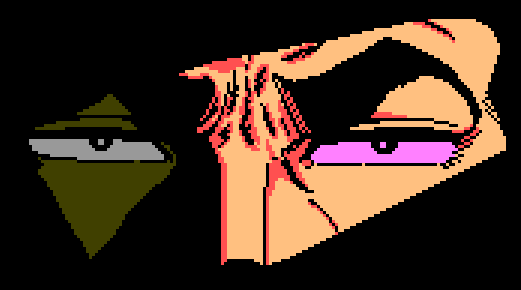
I also held my own concert on Sunday where I sang the theme song to the Golgo 13 NES games. In case you didn’t know, the song actually has lyrics!

My dealer’s room experience was also a most pleasant one as I managed to get everything I was looking for, specifically Ogiue-related…merchandise… as well as the recently released Revoltech Souther from Hokuto no Ken, or, as he’s known on the box, “Thouzer.”

On the fandom side of things, while I did not pay much attention to cosplay I was glad to see a good variety of costumes. While you had your endless Sora from Kingdom Hearts and the general love for Naruto and Bleach you usually expect, I also got some pleasant surprises, such as a cosplay of Kitarou and Nekomusume from Gegege no Kitarou.

Something I did not approve of was the near-total lack of Tainaka Ritsu when it came to K-On! cosplay. I like Mio too and all, but the ratio of Mio to Ritsu was unacceptable. I’m just saying.

The fan panels I attended were all well-run and had people who at least to some extent knew what they were talking about. The Neo-Shounen panel run by Daryl Surat succeeded in its goal of showing how Shounen as a concept changed over the years, mainly in its desire to appeal to both male and female readers, and the Lost in Translation panel was a good beginner’s panel for those interested in seeing some of the difficulties of translating from Japanese to English. The Mecha Appreciation Panel had knowledgeable panelists, but the format was a little haphazard and could have used some focus. If you ran this panel, I was the one who said “King J-Der” for coolest Gaogaigar robot.

I also went to the Anime Recruitment panel by the Reverse Thieves, which provided very good advice for how to get people into anime without scaring them off, offering tips such as, “If your first attempt fails, don’t press the issue. Instead, give them time to cool off, like three weeks or however long it takes.” I’ve spoken before on how difficult I find recommending anime to be, so I will take this advice to heart.

I had a personally vested interest in attending the Otaku TV and Genshiken panels, both run by Viga the Otagal, and was curious as to how these panels would go. Overall, they did a good job of showing the audience what these shows are all about, though I think Viga was a little too spoiler-friendly and it could scare off people who would want to see these series otherwise. Still, I was very glad to see such significant attendance for Genshiken-related panels. After the Genshiken panel, someone in the audience actually greeted me as a reader of Ogiue Maniax and asked to take my picture. Whoever you are, that made my day and I thank you.

Viga said in her Genshiken panel that she believes “The Psychology of Ogiue” would provide enough material for an entire panel, and I am inclined to agree. Keep on the lookout for that.

Overall, I have no serious complaints about Otakon this year, as I feel that the events I would have complained about I simply did not attend, such as the apparently misleading title of the “Sailor Moon’s Influence on Hentai” panel. The fact that Daryl Surat’s Anime’s Craziest Deaths got shut down because no one actually knew what Apocalypse Zero was disappointing, but I’m sure both sides will know how to better handle it next year. As a member of the Otakon press, I also would have felt better if I was told in advance that I would not be getting any interviews, rather than being left dangling. However, because this year’s Otakon was so packed with activities and intriguing and intelligent guests, I can say that this was one of my finest convention experiences, and everyone I traveled to Otakon and back with agreed wholeheartedly.

Haruhi vs Lucky Star vs K-On!

No I am not pitting each cast of girls against each other to see who would win in a fight, but rather I want to talk about the ways in which these three shows differ beyond a superficial level. You’ll sometimes hear people say that Kyoto Animation’s about is all the same, and I will agree with them as far as saying that they know their audience, i.e. otaku, but when you actually watch these shows you will most likely get a different vibe from each one.

I won’t be discussing the Key adaptations because that’s another beast entirely.

With Haruhi, you’ll notice an air of mystery that permeates the show due to the supernatural aspects of it. Sometimes it’s more obvious, but other times simple actions can imply greater things, and it gives a certain sense of intrigue to the series. It’s still all about a bunch of high school kids hanging out and doing dumb things, but even the dumb things are given a sort of significance as a result of the setting. You can always feel that Haruhi is moving somewhere (right to what the light novels have already spoken about!).

Lucky Star is not just otaku pandering, it is active otaku pandering, and that’s also what makes the show enjoyable. More than either of the other two shows, Lucky Star asks if you’re an otaku, then asks one more time just to make sure, and then high fives you because you watch a lot of anime. In fact, Lucky Star probably does this more than any other show, but don’t think that all the humor is in-jokes with no setup; all I’m saying is that the show rewards otaku.

K-On! meanwhile does away with the pretenses of the other two and is simply about what it advertises: cute girls playing instruments and not being too obsessive about it. There are no undercurrents, no subtle themes at work here. At the same time, I wouldn’t call K-On a shallow anime, as the humor derives from the characters’ personalities very heavily, possibly more than Haruhi or Lucky Star.

All three shows feature groups of girls having fun, but the effects they have on the viewers will vary tremendously due to the inherent differences in each show. If you hate one show you might not necessarily hate the others, and if you do like all theree, there’s a good chance you’ll be liking them for different reasons.

Hating Who You Used to Be

I have a few questions to ask of you the reader, and I would much appreciate it if you responded in the comment section below. If you want to remain somewhat anonymous, feel free to not put down your usual username, etc.

1. How much do you feel you’ve changed since you’ve become an anime and manga fan?

2. Do you resent who you used to be, and if so, how much?

3. Do you feel that the changes to your person, as well as your resentment (or lack thereof) significantly impact what anime or manga you watch? Alternately, have you stopped watching anime and reading manga as a result?

To start off, I’ll answer my own questions.

1. The main difference between who I am now and who I was when I first started getting into anime is that I am a much more confident person. I don’t radiate confidence, but I’m now much more apt to speak my mind. However, I don’t feel I’m significantly different from who I used to be, other than I’ve been exposed to more ways of thinking and education over the years.

2. I do not really resent my younger self, even though I feel like a much-improved version. While there are some things about myself which I regret, I can see how those things shaped me to be the person I am today.

3. One thing I’ve grown less tolerant of are mecha shows which try to get by almost entirely on their mecha designs, as I feel you can’t carry a show alone with that. However, when I see a character who is similar to how I was when I was younger, I do not hate that character any more than I hate myself.

Now, it’s your turn.