205 Days Left Until Earth’s Destruction: Space Battleship Yamato Episodes 9-14

“Why it was just different lighting all along!”

Another 6 episodes of Space Battleship Yamato and man, those slow episodes from early on seem like a thing of the past. The biggest step forward by far though is the introduction of Lord Desslar. I mean, he was introduced before in around episode 3 or 4, but at that point he was just Some Guy, and it’s not until episode 11 that I began to see why Desslar is so beloved, and why many consider him to be such a tremendously good villain. His plans to destroy the Yamato amount to more than just “totally shoot it until it blows up.” He has multiple contingencies and works to create situations where you’re damned if you do, damned if you don’t. Also, watching him open up a trap door underneath an uncouth soldier with no respect for the enemy and saying, “We don’t need such barbaric thinking in the Gamilus Empire” defines his character so very well. Highly intelligent and ruthless, but with a sense of honor befitting his title as ruler of Gamilus.

Desslar is just smooth.

But this isn’t the Desslar fan club. This is a Yamato review. And there’s plenty of characters to talk about. Kodai and Okita in particular get some powerful development. The revelation of Okita’s (space) radiation sickness and the quiet loneliness of his existence begins to show the real depth of the Yamato captain. Knowing that Kodai used to hate fighting shows how much the death of his family at the hands of Gamilus has driven him to take revenge. Just seeing every character say good bye to their families before leaving the Solar System, and all of them feeling that the 5 minutes allotted to each person was simply not enough time, that episode was probably the one that affected me the most so far.

Keep at it Yamato. You are deserving your reputation.

PS: Why is Yuki the only girl on board. They did not think this through very well, aside from the possibility that they need to keep the women at home to give birth and raise children for the sake of humanity’s future.

I Love Nostle Orunch: Baccano!

Baccano! takes place in early 1930s New York City and follows various Italian mafias in this era. This isn’t your run-of-the-mill story about gangs with tommy guns, though, as Baccano! adds an element of the supernatural to its setting and characters. The catch is, the series blurs the line between the two so that supernatural and natural abilities don’t seem that far off from each other. Being a hero or a monster is determined by the individual, and even then some characters can be considered both.

Baccano! has a large cast of characters, and they are incredible. And wonderful. Wondercredible. The story has no true main character, or should I say that every character is like a main character. You have Firo Prochainezo, a young baby-faced guy with a penchant for fisticuffs and a good heart. You have Ladd Russo, the sociopath whose only joy is to kill anyone who thinks that they’re completely safe. Then there’s Jacuzzi Splot, a man Kenshiro would be proud of, who manages to do the manliest things possible while crying like a girl. And not last (I told you that this cast was large), and certainly not least, are Isaac Dian and Miria Harvent, two skilled, yet bumbling honorable thieves who like to dress up for their various crimes and use the most distorted logic possible and happen to end up doing good as a result. They’re probably my favorites but it’s not like any of the other characters are far behind.

Wondercredible, indeed. And there’s so many more I haven’t even talked about.

Baccano! tells its story out of chronological order, so the events in each episode jump back and forth between 1930, 1931, and 1932. And you know what? I don’t care. I have no great desire to watch the series in “proper” chronological order, I have no motivation to see just exactly how all the dots connect. Baccano! is that engaging and entertaining that I did not feel like I was missing anything by having the story jump around so much. Events are grouped thematically, and it works very, very well.

So in summary, Baccano! hits it out of the park.

Gachiiiin!

2005’s Forgotten Anime: Glass Mask

Glass Mask, based on a long, long-running manga series, is one of my favorite anime from 2005 and 2006, and that’s no easy task with Eureka Seven in that running. It’s the tale of a plain girl named Kitajima Maya who is discovered to have an incrediblly innate ability for acting. At first, Maya is seemingly oblivious to everything except acting. She can recite a 3-hour play perfectly after having only watched it once. She can bring an uncanny realism to any role she plays, being naturally adept at pantomime. However, her greatest talent is her ability to fully take on any character, to literally become the role that she’s playing. Under the guidance of renowned former actress Tsukikage Chigusa, Maya engages in a friendly yet fierce rivalry with the prodigy Himekawa Ayumi while being watched over by the mysterious “Man of the Purple Roses. It’s old-fashioned shoujo at its finest, and I would implore everyone to watch it, except for one problem.

The subtitles never got past episode 5 or so, and this is a roughly 50 episode series.

I can only imagine that all of the acting terms and the settings of the plays in Glass Mask present a daunting task for any translator, as it requires not just knowledge of Japanese but also some French, Russian, and other languages. I’m certainly not confident enough in my translation abilities to start tackling other languages beyond Japanese, but if anyone is willing to heed the call, you will have done the anime community a good favor.

If you really want to see what Glass Mask is about, though, you can also check out the manga, which is available in all the places you expect (besides an actual bookstore). Watch out, it’s been around since the 70s and still has not finished.

By the way, my favorite scene in the show is during a play where Maya is playing the role of a queen. Another girl, jealous of Maya, tries to sabotage Maya by stepping on her dress as she walks outside so that Maya will trip. Maya is normally a very clumsy girl so this isn’t an unreasonable plan, but Maya senses the tug of her dress immediately, stops, and tells the girl to get off of her dress.

Standing there wasn’t Kitajima Maya, but the queen.

True Understanding of the Unity of Everything that Exists: Zoku Sayonara Zetsubou Sensei

In a previous post about Sayonara Zetsubou Sensei, I explained that I considered the characters to be basically concentrated versions of existing character types, not unlike boiling a stew until all that’s left is a thick muck.  It’s a crazy wonderful show.

After two episodes, I have to say that Zoku Sayonara Zetsubou Sensei is basically boiling down the entire first series until it becomes a thick gravy of pure entertainment.  Plot, characters, humor, and metahumor all exist as a singularity from which none can gain a true separate identity from the others.

It’s like injecting anime right into your eyes.

354 Days Left Until Earth’s Destruction: Space Battleship Yamato 1-8

I have finally begun watching one of the most enduring classics of anime, Space Battleship Yamato, localized in the US as Star Blazers. It is the epic tale of an old World War II battleship which has been revived as a space-faring vessel.  Its purpose: to traverse 148,000 light years to the planet Iscandar in order to obtain a device which can save the Earth from a radioactive death, and it has a little over a year to obtain the device and make it back to Earth.  Meanwhile, the dreaded Gamilus Empire, the ones responsible for turning the Earth into a wasteland in the first place, are doing everything they can to stop the Yamato.

Space Battleship Yamato, like all of Matsumoto Leiji’s works, feels like it comes straight out of the 1970s, and, well, it did. The show displays a sheer sense of wonder and imagination as to what awaits humanity.  Combined with the harsh setting of desperately trying to save a dying Earth, an Earth ravaged by war and destruction, and it begins to invoke the teachings of famed astronomer Carl Sagan, who warned that if humans do not go past the sentient “adolescence” of technology that we are all doomed to die.

Yamato is the first anime to build a true fanbase, and it is very, very easy to see why this show captivated so many people in Japan and the rest of the world. It’s a race against time, with the weight of humanity itself on the shoulders of the crew of the Yamato.  Nothing can be considered filler because there is no way to reset everything back to a status quo. No matter how many repairs are made, the 366-day countdown to Earth’s demise draws closer to zero.  The show has a large cast of likable characters, from the wise captain Okita to the beautiful Yuki, from the smarmy robot Analyzer to the daring Kodai, it is remarkably easy to slip into the world of Yamato as a sort of wish-fulfillment scenario, where the viewer is also a part of the quest to Iscandar.

One humorous aspect of the show is the way it overuses the word “space” as a descriptor. The Yamato travels in space knots.  It’ll be five hundred space seconds before they reach the next point. Oh no, space tanks!  Space space space space space. I’ll chalk it up to being from the 70s.  In this respect, it’s not much different from, say, Star Trek or Star Wars.  Another thing is the amount of fanservice Yuki provides.  Nothing wrong with fanservice, I just find it odd that no one ever told me about it.  It might just be that it all got removed from Star Blazers, so no one ever even knew about the Yuki panty shots.

I’m definitely going to keep watching.  For the historian and anime fan in me, Yamato is vitally important, but those pale in comparison to the way it appeals to the basic humanity in me and the desire to go forth into the universe with a noble cause at heart.

Aum Shinrikyo the Animation

DUN DUN DUUUNNNN DADADADUNDUNDUNNNN…

In the future, man discovers the Shinrikyou Drive, bringing limitless prosperity.

CRUSH THEM, GIANT SHOKO!

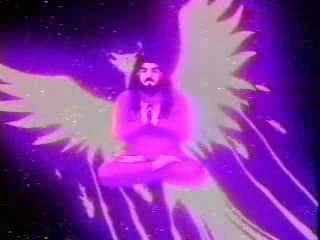
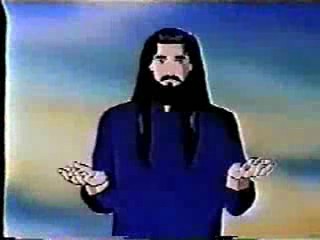
Yes, this is a review of an Aum Shinrikyou anime. The Aum Shinrikyou, currently known as Aleph, was the religious cult/organization responsible for the nerve gas attacks in the Tokyo Subway in 1995. During their heyday in the 80s and 90s, Aum, well aware of fiction’s power over men and women, produced their own anime and manga to try and persuade people to join. Fred Schodt’s book, Dreamland Japan, has a section concerning the manga side of things. So here we have this delightful 15 minute piece, entitled Chouetsu Sekai, or Transcendental World.


This is just the name and title of Aum founder, Asahara Shoukou, but I don’t really want to translate it so I can maintain the illusion that it’s an attack in Hokuto no Ken. Pretend it says “Hokuto Ujou Haganken.”

This anime starts off like so many anime with an opening theme. Except it’s clearly sung by someone with no real singing ability or even ability to modify his voice in post-production so he can pretend to sound good. The song is about how all great and wonderful Aum and Asahara are, and I would give details but I didn’t want to expend too much effort watching it.

The main focus of this anime is, of course, Asahara Shoukou, and his benevolent nature and awesome power. Asahara’s primary abilities appear to be levitation, astral projection, levitating while doing astral projection, and having soft anime eyes so he can seem like an upstanding guy. Naturally, his voice actor mumbles a whole lot and you can’t really tell what he’s saying.

Two other important characters are two Aum members who are dating each other. By far the defining moment of this 15 minute extravaganza is when Asahara astral projects himself into an Aum class and notices that the two of them are sitting together with two others and making sure no one knows about their relationship. Later, the girl receives a phone call directly from Asahara and gasps as soon as he says, “You’re seeing that guy aren’t you.” But he says it’s fine and people are made up of their experiences.

Then he goes astral projecting through office buildings.

I can’t quite describe how uniquely terrible this all is. Or maybe I can. Imagine a man with no limbs trying to convince you of the greatness of arm wrestling matches where the prize is getting kicked in the balls by Kenyan marathon runners.

So yes, wonderful. Exactly.

It’s over 400: Pokemon Diamond & Pearl: Dialga vs Palkia vs Darkrai

So the 10th Pokemon movie is about

VS

VS

This is the first Pokemon movie for the Diamond and Pearl series, which brings the total number of known Pokemon to almost 500.

Dialga is called the “Time-ruling Pokemon” and Palkia the “Space-ruling Pokemon.”  Normally they’re never supposed to meet, so when they encounter each other in a dimensional rift, they naturally end up fighting one other.  Their powers are so tremendous that it affects our dimension as well, though in such a way that is unfathomable to humans.  Darkrai is another powerful Pokemon who lives in the city Satoshi and friends travel to, and its defining trait is that it induces nightmares in any being it meets.  The people blame Darkrai for their problems, but it turns out Darkrai is actually trying to save the city, and thanks to everyone, the city is saved from being forever disintegrated by space and time destroying one another.  In the end, the most important lesson is understanding one another.

It’s everything you’d expect out of a Pokemon movie.  I’ve seen every single one prior to it, and I’d rank it somewhere in the same placing as the 9th movie, Pokemon Ranger and the Prince of the Sea Manaphy.  I still consider the first movie to be the best one, though I know I can’t exactly fairly judge this movie because I’m not quite into Pokemon the way I was back when I first saw Mewtwo Strikes Back.  Still, I feel like Dialga vs Palkia vs Darkria did not have quite as much substance as Mewtwo Strikes Back, or even something like Lord of the “Unknown” Tower.  Still, I have no doubts any kid who is a Pokemon fan would enjoy this movie, and more often than not, it is quite well-animated.

It also features Lickilicky (Japanese name Beroberuto), one of my favorite Pokemon of the new generation, so it wins points for that.

I am late: Densha Otoko

So after having passively avoided much of Densha Otoko’s tv drama for the longest time (I was even IN Japan while it was airing and still hardly saw any of it), I finally sat down and plowed through the main Densha Otoko story (I have yet to touch the special episodes).

Densha Otoko is based off of the allegedly true story of an otaku on the 2channel messageboard who manages to save a girl from a drunk on the train (hence the title “Train Man”), and afterwards begins to ask the messageboard for advice on how to woo the girl, who he refers to as “Hermes.”  Eventually, thanks to the genuine and heartfelt advice he receives from his fellow posters, he is able to win the girl over and start dating her.  The TV drama uses this same basic idea, but dramatizes it further (of course), giving faces and personalities to the various anonymous voices, and showing much more of the Densha Otoko’s life.

The drama is very, very cheesy, but I could feel tears welling up in my eyes at certain points while watching.  It can be a very moving show, and it taps into people’s common desire to not be alone.   It also shows that relationships can transcend common societal barriers.  Hermes is a beautiful woman from upper class society, while Densha Otoko is an awkward otaku who is barely a salaryman, and yet they manage to find each other and fall in love.  Everyone but Densha himself is anonymous on the thread to which Densha posts, but together they realize that they have all become true friends with Densha and each other, united by the desire to see someone so earnest and honest fulfill his dream.

The Densha Otoko phenomenon actually caused a brief period where girls tried to get otaku boyfriends, having become enamored with the idea of the hopeless dork with a heart of gold.  After having watched Densha Otoko, I can see why this would be the case.   The sad fact is that a lot of otaku you meet are actually just selfish people with horrible personalities, just like any other group in society, but I can ignore it for now.  At its core, it’s not about the improbability of an otaku finding love, but about looking to the person inside.

Armored Trooper Votoms: Part 1

This is a review of episodes 1-13 (or was that 14?) of Armored Trooper Votoms.

Armored Trooper Votoms is the story of a soldier gone AWOL named Chirico Cuvie. Chirico is the pilot of an “Armored Trooper,” essentially a giant robot used for military purposes, but without any of the flash or style of a Gundam or a Valkyrie. Having found himself an unwitting accomplice in a conspiracy to attack a friendly space station, Chirico is betrayed by his fellow soldiers, but not before discovering their most important secret: A mysterious, expressionless woman inside a capsule and the target of capture by his former allies. Barely escaping with his own life, Chirico runs into a higher-up in the military, a man named Rocchina, who believes Chirico’s accidental treason to be anything but. Chirico is tortured mercilessly, but manages to escape and ends up in a city of scoundrels and gangs not unlike the entire planet in Hokuto no Ken. That city is named Uoodo.

In Uoodo, Chirico manages to make some friends, though none of them are by any means innocent, given the nature of Uoodo. Chirico must deal with a corrupt police force while still running from the military who believes him to know more than he actually does. As Chirico tries to survive, he begins to learn the secrets of the mysterious woman he met at the space station, referred to as the “Prototype,” and the viewer is shown that the conspiracy that got Chirico running for his life in the first place runs much deeper than anybody ever suspected.

Armored Trooper Votoms, as I mentioned, has giant robots, and not fancy ones at that. The result is that, while the action is not exactly completely realistic, it has a very gritty feel to it. An Armored Trooper is not made of super alloys, it does not have any fancy weapons or serious technological edge. It is basically a tank with legs. In fact, Chirico frequently switches Armored Troopers because the previous one got wrecked beyond repair in battle, though he prefers a specific type called the Scope Dog. In one battle, his Scope Dog was taken down by heavy fire from people on foot and in cars and helicopters. They are far from invincible, and this is the basis of the combat in the show.

As for the plot, this is what is meant whenever someone says that you have to give a Sunrise mecha series chance to set up, that they generally have a 13-episode test. This entire first part, aptly entitled the “Uoodo” arc, is ALL setup for what’s to come. I can feel it, I think anyone watching can feel it, the whole point of this first part is to set up the characters and the basic setting, and to establish what is “normal” for the show so that the show can then be turned on its head. These first 13 episodes for the most part feel fairly episodic. They sometimes revolve around Chirico’s friends trying to strike it rich, or Chirico escaping from danger, or a combination of the two, but along the way hints are dropped and characterization is expanded. My only complaint is that the show has a very Tomino-esque way of introducing relationships, which is to say unrealistic and rushed in order to make a plot point. Other than that, the show is on its way to success.

I have been set up. Now it’s time for the show to begin knocking me down.

PS: One amusing aspect of Votoms I should mention is the next episode previews, which are usually serious expositions of what will happen to Chirico. Best of all is that they all end on some extremely dramatic and cryptic message of what’s to come. The one that stands out in my mind is “NEXT TIME, CHIRICO DRINKS HIS COFFEE BLACK, AND IT IS BITTER INDEED.” It kind of makes the show hard to take seriously sometimes, but that’s okay.

Sayonara Zetsubou Sensei: Zetsubou of Socks are Really Itchy

So with season 2 having just begun airing in Japan, it’s about as good a time as any to review Sayonara Zetsubou Sensei.

Simply put, this is a good series.

Sayonara Zetsubou Sensei is the story of a harshly pessimistic and cynical teacher, the titular “Mr. Despair,” Itoshiki Nozomu, and his student, Fuura Kafuka, who can put a genuine positive spin on anything. Their interactions with each other, the other students in the school, and their environment at large are approached in multiple layers of dangerously effective meta-humor, like getting a heart attack from Azuma Kazuma’s ultimate croissant.

Akiyuki Shinbo, the director of SZS, has a very distinct directing style which is evident in pretty much everything he does. You will find in Zetsubou Sensei a keen awareness of the anime as an anime, as an image projected from a television screen (or some other type of monitor). This applies not only to the strong use of flat colors as well as the placement of objects within each scene, but also to the characters and personalities. The characters could easily be thought of as gimmicks: Optimist, pessimist, anal-retentive, cell phone, fujoshi, hikikomori, on and on and on. I, however, believe it is better to think of them as character traits in their purest forms. Watching a character in Zetsubou Sensei is like chewing the coffee beans right in your mouth.

For me, the example that stands out most is the anal-retentive Kitsu Chiri’s perfectly symmetrical hair. It is a representative of her desire for symmetry in everything, and when shown on screen close-up, Kitsu’s hair becomes negative space and the split turns into a vivid shape on a flat plane. The split hair is quite literally symbolic.

Sayonara Zetsubou Sensei is a show I feel I can appreciate on a very artistic level, but it also satisfies my simple desire to watch an entertaining show. I look forward to Season 2.

By the way, if I had to choose: Kafuka, Kitsu, and Fujiyoshi in that order.