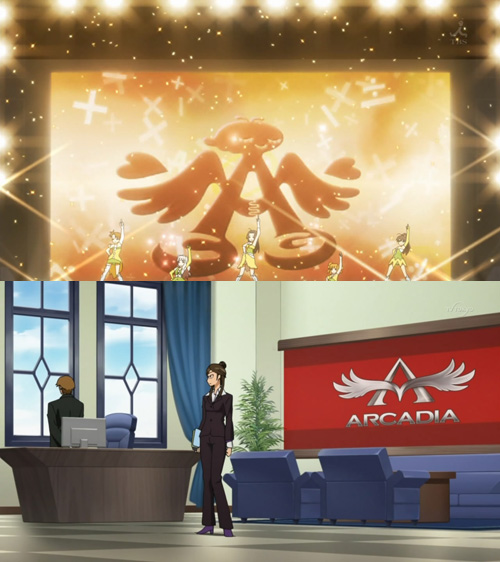
The Future of iDOLM@STER is Gyrozetter

I have a theory: Chousoku Henkei Gyrozetter actually takes place in the same world as The iDOLM@STER many years into the future. I’m going to lay out my ideas for how this transition comes about while also providing ironclad proof of their shared universe.

1) Inaba Rinne is a Futami Descendant

It’s not clear which of the Futami twins Rinne is descended from, but most likely it’s Mami. It’s not clear just how many generations into the future Rinne is removed from Ami and Mami, but Futami genetics are undeniably strong.

The resemblance is uncanny.

2) The Success of 765 Pro and the Start of the AI Car Boom

Thanks to a combination of talent, spirit, and camaraderie, 765 Productions becomes wildly successful. At first, they do only promotions for car companies, but thanks to rich girl Minase Iori’s connections and the advancement of technology 765 Pro manages to start their own automobile line. They name the car company offshoot “Arcadia,” modifying their logo along the way.


Assistants to the CEO continue to dress in black suits in honor of Akizuki Ritsuko.

3) Shijou Takane is Responsible for the Rosettagraphy

At first glance, the Rosettagraphy makes no sense. A mysterious stone tablet that tells humanity how to build advanced cars that turn into robots? It sounds like nonsense, until you remember that Takane is equally engimatic, and that she is capable of speaking in many tongues. As we can clearly tell now, it’s because she holds the secrets of not only technological growth but also of prophecy. If she had revealed it to humanity too soon, who knows what would’ve happened?

Takane was a Messenger in Many Ways.

4) Gyrozetter AIs are Actually Based on 765 Idols

How else would you explain this?

I rest my case.

My Conversation with a Singapore Mahjong Expert

Because of mahjong anime, I gained an interest in Japanese mahjong. And because I played so much Japanese mahjong and continued to consume anime and manga based on it, I began to wonder what it would be like if there was a series based on having to play all of the different styles of mahjong which exist around the world. This has led me to do some research and even attempts to play other styles of mahjong, and in fact the first post I made on this blog about other styles of mahjong was about Singapore-style. At the time, the only way I could play it was a single player java program, so no matter what my speculations about strategy and gameplay were the result of a very limited experience.

Since then, I’ve been able to find a website which allows me to play some form of Singapore mahjong against human opponents, and through it I’ve been able to put to the test some of my musings on Singapore mahjong from that post. Looking back, the post turns out to have been decently accurate, but I am of course still very much a beginner at it, so I wanted to find someone with more perspective and experience. That’s how I came across Singapore Sparrows, site dedicated to mahjong in Singapore (primarily the MCR—more on that another time—and Singapore styles), and through it managed to have an interesting and enlightening conversation concerning the similarities and differences between Japanese and Singapore mahjong.

I recommend reading the entire post as well as my follow-up comment, but to summarize I asked the blog owner Edwin a series of questions about strategy in Singapore mahjong, especially because the Singapore style has far fewer hands than Japanese and therefore the hands felt comparatively less fluid. Edwin brought up the fact that not only does Singapore mahjong have things called bonus tiles which can net you points just for drawing them, but it has more bonus tiles than probably any other style of mahjong, and so in his opinion the bonus tiles function in a capacity similar to cheap hands in Japanese-style such as tanyao and iipeikou.

Thinking about the function of bonus tiles, I speculated that rather than fulfilling the role of those smaller value hands, they were more akin to calling riichi: ways to empower worthless hands and give them some teeth and a chance to win. The big difference is that with bonus tiles they are the catalyst to deviate your hand into something simpler, whereas calling riichi always exists as an optional goal, beginning vs. end, but both carry risks unique to each version of the game.

Now, when considering how this would impact a narrative about a game of Singapore mahjong, the flower tiles really are wild cards, and I could see some maverick of a hero taking a risk to get just the right bonus tiles he or she needs, a foolish move normally, but one that the hero recognizes is the only path to victory. Along with all of that animal tile imagery of cats eating mice and chickens eating bugs, panels could be filled with really elaborate nature imagery.

Another fascinating point brought by Edwin was the way in which pinfu (or ping hu) hands in Singapore mahjong really influence the way the game is played. If you play riichi mahjong you may think pinfu hands are important because of how quick and probable they are, but their potency is nothing compared to Singapore pinfu. Not only can it be played open, but it has a special stipulation which makes it either a weak, simple 1 han (tai in Singapore-style lingo) or a monstrous and deadly 4 han hand, controlled by the presence or absence of bonus tiles (no bonus tiles means 4 han). As such, many players will aim for “ping hu,” but because it’s so clearly a good option no matter what, players of Singapore mahjong are also especially wary of its dualistic lamb/lion status. If you have no bonus tiles and a couple of open straights in your hand, people will get mighty suspicious and the player to your left will try to figure out ways to avoid dealing out tiles you need for your straights. It’s a dimension of strategy that is in many ways different from Japanese-style mahjong, and it’s the sort of thing that encourages me to try more styles.

And of course, the variable strength of Singapore pinfu is also a perfect place for some dramatic storytelling. Can’t you imagine a Washizu-esque villain playing his masterful 4 tai ping hu, ready to destroy his opponent, when suddenly he draws a flower bonus tile and all of his beautiful machinations slip through his fingers like sand? Can’t you imagine his agony as the hero willingly deals into the significantly downgraded hand, giving poor Singaporean Washizu a rather pyrrhic victory?

Fun times. Fun, fun times. Incidentally, thanks to mahjong comrade Dave I learned that Mahjong Hime allows you to play both Singapore and Taiwanese styles. Most likely, my next post regarding the hypothetical International Mahjong Manga will be about Taiwanese mahjong.

Psycho-Pass, the Forbidden Word, My Thoughts

People have been making kind of a big deal about how the director of the new anime Psycho-Pass, Motohiro Katsuyuki, has mentioned banning usage of the word “moe” among the staff, in order to counter current trends in anime. I’ve seen some people take this as a psuedo-rallying point, a sort of “BOOYAH! In your face, MOE!” attitude. I’ve seen reactions taking it as an attack on moe, a “Why are you so unenlightened?” response. For me, when I first read about it, I laughed, not because I’m for moe or against it, but I immediately thought of how ambiguous a word like moe could be and how it can potentially impact the creative process by being so ambiguous.

Other than the information we already have, I don’t have any insight into the production of Psycho-Pass so everything from here is purely hypothetical and speculative.

When you think about actually having the word moe be a part of discussions when creating an anime, you inevitably have to deal with “moe” as a conscious effort, and I can imagine it impacting the direction of a work. This is not an inherently bad thing, but I feel that just by banning the word you might end up having to explain things more concretely, or at least in a way that doesn’t use such specialized language. In some ways, I can see how “make it more moe” as a way of describing how something should be can be about as helpful as asking someone to “make it 20% cooler,” as the My Little Pony saying goes.

To say a word is banned doesn’t meant that elements won’t slip back in. Let’s replace “moe” with “hardcore.” Imagine if the interview said, “We banned the word ‘hardcore’ from our staff meetings.” While you might not have direct references to pro wrestling or other similar material, there’s a fair chance some kind of physicality or extreme imagery might make it back in. I don’t know if it’ll really happen with Psycho-Pass, but moe does not need a specific directive for it to appear. Even without the intent behind it, it can still happen.

Roger Klotz Dubbing

There’s been a tendency in English anime dubs of children’s shows that I’ve noticed for a while now, which is this tendency to imbue characters with ATTITUDE where previously there was none, or at the very least not such an overt presence as such. Basically, what dubs do is turn Doug Funnie, nice average guy with some decent qualities, into a Roger Klotz, a snarkier sort who’s quick to deliver verbal jabs.

After I watched the first episode of toy commercial-as-anime Monsuno in Japanese, I got this feeling that the English dub (which actually premiered months before the Japanese version) would give to characters the voices their character stereotypes expected of them. Sure enough, the nerd was incredibly nasal, and the main character, who isn’t quite Doug Funnie but is the nice sort, is cracking wise at his friends, bits of sarcasm seeping through his dialogue.

A more interesting example comes from Yu-Gi-Oh!, not so much from Yugi himself but from Kaiba. Kaiba in the Japanese version is certainly no Doug Funnie. He’s ruthless and blunt and lives by his own agenda, but what happens is that his Roger Klotz dubbing just takes these qualities to the nth degree. Where he might say something in Japanese like, “Get out of my way. I have no time to waste on you,” in English it would become, “Get your worthless existence out of my way, you dweeb. I can’t have you breathing the same air as me or it might make me sick to my stomach.” Certainly it makes Kaiba memorable in an odd sort of way, but it also gives him an entirely different set of fangs.

Have you noticed this? Is my reference to Doug too old for people at this point? Do people still watch dubs?

The High School Setting

Sometimes anime and manga as a whole are criticized for having too many stories take place in high school or involve high school students, and indeed there are a lot of titles, both good and bad, which fall into that category. While explanations range from “that’s how old a lot of readers are,” “there is a certain ideal to high school, the moment before you become an adult,” and even “so they can sexualize teenagers,” I have to wonder if it has anything to do with high school as a point of commonality among Japanese people.

Most young people in Japan go to high school (if someone can argue otherwise, please do), but once they go beyond high school their lives start to branch out more. Some go to college, some enter the work force, some go to technical training schools, and so on. This is even a plot point in some manga which make the transition out of high school such as Initial D. What this means is that, as a writer, if your aim is to have a position in life that the majority of your readers can directly relate to, then that period becomes harder to manage because not everyone will have that roughly similar experience post-high school.

Obviously this doesn’t mean that people cannot relate to characters outside of their own experience, or that people will reject heroes in unfamiliar settings, but that you end up losing that simple and easy connection. Such a loss can be overcome and frequently is, but high school perhaps remains that time people can look back to and say “I lived in that.” They might not have the magic powers or have gone to the rich school where everyone eats diamonds, but there is the thematic shorthand nevertheless.

What If Manga Had No Japan

When people in the past have argued about the definition of manga and anime, the grounds of contention have had to do with this idea of manga as “by Japan, for Japan, made in Japan,” and which pieces, if any at all, are relevant in categorizing. While I have my own ideas in this regard, I want to set that aside and ask, how would we define manga if Japan ceased to exist?

A lot of these debates occur because people bring their own values and their own priorities to “manga-ness,” such as personal desire to draw manga, or a desire to have clear-cut difference to make it easier to discuss, but generally they assume that there is a Japan, that as a nation-state, as a land mass, as a culture, it will never disappear. I do not wish this upon Japan or the Japanese, but with 3/11 and the Tohoku Earthquake and the subsequent fear of radiation, there is the possibility however small, or at least the notion implanted into our (my) thoughts, that someday there will be a great diaspora or maybe the government will have no one left to govern, and that included in this movement out of Japan would be the people who work in anime and manga.

If the vast majority of people move to the same location, is that where “manga” is located? If the artists spread around the world, and have to decide whether to draw for the scattered Japanese audience or for the country they’re now living in (with its potentially vastly different culture), are they considered manga artists either way or is there now a significant difference? What if we then fast-forwarded 100 years and now those artists had children if they didn’t have any, had maybe integrated more thoroughly into their adopted homes, and now a new generation takes over for them? If young people who grew up with the made-for-new-country comics of the now-deceased artists are drawing for that same audience but influenced by those artists’ styles which clearly derive from their days in Japan making manga, are they now manga artists too?

As it stands, I must admit that these questions don’t really impact the health or condition of manga or its fandom, but I thought about it and how it might alter the notion of Japanese-ness in anime and manga, and I thought it interesting to present, even in this half-formed state.

The Meaning of “Vanilla”

About a year ago I wrote a post wondering about the “NTR” (essentially cuckolding) genre of porn in anime and manga, and in it I had a small aside in the introduction where I mentioned the English-speaking anti-NTR fanbase that has developed in response, people who will proudly and adamantly proclaim their love of “vanilla.” At the time, I referred to these vanilla fans and their fervor as if they were an extreme response to the popularity of NTR because the intense championing of very conventional depictions of sex seemed odd (though understandable). Upon thinking about this subject again recently, however, I realized that I had overlooked something, and that one of the reasons there seems to be this contingent of vanilla supporters is that the definition of “vanilla porn,” at least according to certain fans of anime and manga, is quite a bit broader than how people would normally define it.

In general usage, vanilla (used for sex or otherwise) implies something that is ordinary and simple, and if one is being negative, bland and boring. In depictions of sex, this generally means something along the lines of missionary position between a couple. But when you look at the categories used in English to describe specific works of erotic anime and manga, you’ll sometimes get tag combinations such as “BDSM HAREM INCEST VANILLA.” I’m not making a value judgment on those other categories by any means, but I think that everyone can agree that, typically, those things don’t go hand in hand with “vanilla.”

What this has me realizing is that the ardent support for “vanilla” may be an even more direct response to NTR than I had first thought, because it ends up being defined by fans as essentially “not-NTR,” though to be more accurate it would probably be “anything that is not gay, rape, or NTR.” Given this definition-by-negation, it would seem that the most vital aspect of “vanilla” is loyalty. In this conception of vanilla, the relationships can be polygamous, they can be extreme in one way or another, but if there is a sense of betrayal or if feelings are hurt through sex, then it falls to the other side.

If you liked this post, consider becoming a sponsor of Ogiue Maniax through Patreon. You can get rewards for higher pledges, including a chance to request topics for the blog.

My First Exposure to 70s Robots

I can still remember my first exposure to pre-Gundam giant robot anime. I had a VHS fansub which at the very end had a number of retro openings on it, a preview of what was to come from that fansub group. That’s where I was first introduced to Zambot 3, which I thought looked pretty cool, and where I first got a glimpse of the 80s’ Aura Battler Dunbine, whose catchy theme song sticks with me even today. At the same time, though, I remember distinctly thinking that Koutetsu Jeeg looked like the dumbest thing ever.  I still think Jeeg is an ugly robot with its pickle legs, but it was more the overall style, fashion, choice of song, everything, that made it seem so foreign to me as an anime fan. I loved robots then as I do now, but obviously I needed some education, and I’m glad that I now know better.

I think what really sticks out in my mind in that video was the second Mazinger Z opening, mainly because of the way that Mazinger Z itself was shaded. It didn’t have the standard shine+shade of later giant robot anime, and instead had these large areas of pencil (or something like it) blocked in. When you watch the opening, you can literally see the grit of the drawing materials right there on the limbs and stomach. I hated it then, thought it made the show look old and tacky, but looking back, the way it stuck in my mind is part of why I started being able to look well past the aesthetics of 90s anime I had become so accustomed to, and to eventually realize how much the time that we’re in influences the look of everything around us, including the entertainment we watch.

The Eggshell of Gundam Fandom

Ever since Mobile Fighter G Gundam, various anime in the franchise have been accused of not really being Gundam, or for betraying the idea of Gundam in some capacity. Whether that’s robots powered by martial arts, a preponderance of pretty boys, or the presence of a mustache and biplanes, it’s clear that, at least to some, there is a vague idea of what Gundam shouldn’t be, but what I find interesting is that over time these prejudices seem to fade or in some cases even become something of a minority. Where once in the English-speaking fandom G Gundam was seen as a freak accident at best, nowadays you’ll find plenty of people who actually will say that G Gundam is their favorite Gundam, or even that G Gundam is the only good Gundam.

I am not here to judge anyone’s tastes or preferences, but rather I would like to wonder aloud about how and why this happens. In the case ofGundam W and G Gundam, the answer partly lies in the way they were situated in the Toonami block of the early to mid 2000s and were able to build up a fanbase as a result, but I feel like that is just one instance of a more basic process at work.

Whenever opinions form about a current or upcoming Gundam, it seems to come primarily from those most invested and devoted to Gundam. This group consistently has Gundam-ness as a priority, and so the initial discussion is shaped by that established fandom and their values. What I’m thinking is that over time, a series has a greater chance of reaching more people, and eventually they’re found by people who won’t necessarily label themselves as Gundam fans, whose value sets are different. At that point, a series may reach an audience more receptive to its ideas or less prejudiced against it (though they may carry their own prejudices different from the ones of more hardcore Gundam fans).

Essentially, what I’m wondering about is whether or not Gundam series (and perhaps other franchises like Macross) undergo a process where they first start off surrounded by their immediate fandom created by the franchise, and then break through that established core, such that the discussion about these series starts to change, that it’s not simply “a matter of time” but also a matter of reaching people who might be more receptive to it. That might not mean that a series will be loved, but that there is a greater chance of it happening.

Sakuga and “Action”

When it comes to the animation itself in anime, I believe myself to be a person who can appreciate not only the well-executed but also the bold and daring, but compared to all of the sakuga fans out there who can name names and pride themselves on spotting particular animators I am but a rank amateur. Especially because ending credits of anime are in Japanese (and Japanese names can be a pain to read), it’s traditionally been difficult to find out these things, but thanks to YouTube videos, presentations, and websites such as Anipages, it’s become easier and easier to find this information out.

So now we have an accessible history of Japanese animators, with names ranging from the ultra-famous (Tezuka, Miyazaki) to ones well-regarded but not so much in the public eye (Kanada, Itano). When it comes to the way that “great animators” and “great animation” are discussed, however, there appears to be a bias—perhaps an unintentional one—towards action scenes. By action, I don’t mean just “movement,” but  displays of violence, explosions, mecha, and so on. Itano is known for his “Itano Circus,” that detailed missile barrage most associated with the Macross franchise, but if Gundam Sousei is any indication, Itano’s talents also extended to something as simple as the way a key falls. And yet, much of what I hear and read about sakuga emphasizes “action.”

The appeal of a good fight scene, be it between two humans or two robots or even two planes, is fairly obvious, I would think. It catches the eye immediately, and there’s a lot of movement to work with. What I’m wondering, though, is to what extent this focus on action has shaped the discourse of “great animation in anime,” and whether or not that may have changed over the past decade or so.

Anime looks different now than it did two or three decades ago, and in that time the amount of mecha in anime has also risen and fallen, while the detailed animation of cute girls has increased. Though I say this without any real evidence to back me up (so please prove me wrong if you can), I get the feeling that the fans who grew up to be animators in the anime industry took to heart that which they saw on TV, so a generation of animators who fell in love with Yamato and Gundam wound up in the anime of the 80s and 90s, pushing “mecha” and “action” forward. But at some point, the new generation became the old, and the one that has started to take its place has its interests elsewhere, be that cute girls or something else entirely.

I can only assume that there have always been animators in love with the girls they animate (so to speak), so this isn’t strictly a new vs. old, but perhaps that the ratio has changed to the extent that values about animating have changed as well. That, and maybe changes to the toy industry connected to all of this may play a role as well.

This is not my condemnation of animators who work for the sake of giving motion to cute girls (or boys), as when you think about it that’s no better or worse than animating for the sake of mecha violence, and as I stated, this is not my expertise. If this is merely a mistaken hunch, then I’ll be glad to learn more.