Chop Chop Chop, Judo Flip: Genshiken II, Chapter 86

Genshiken II, Chapter 86 looks to possibly be a turning point. We’ve had quite a few of those already though. Also, next month there might be more news about the upcoming anime! It’ll be a long 30 days or so.

Sue visits Hato’s place, using Janglish to ask if he likes Madarame. Hato denies, but is clearly hiding something. After a tussle pitting Hato’s judo training against Sue’s freestyle which ends in a win by submission for the American, Sue discovers Hato’s secret Mada x Hato (in drag) drawings. Hato, who is increasingly confused about his feelings for Madarame (he feels that at this rate he might actually start liking Madarame), decides to just stop crossdressing and go back to being “a normal otaku.” This clearly makes Yajima uncomfortable despite her previous objections to Hato’s crossdressing.

With this chapter, I think I finally understand one of the big overarcing themes of Genshiken II. Yes, there’s the generation gap and the otaku/fujoshi distinction, but even more fundamental to the manga is a concept I’d describe as “the complexities of personal perceptions.”

The foremost example is Hato. He is getting to the point where he likely feels something for Madarame. I want to point out, however, the fact that Hato had no problems showing his “Hato x Mada” art to Sue, declaring that it was just the realm of fiction, but for some reason he also felt it necessary to keep his “Mada x Hato” hidden. I think the distinction between the two pairings is extremely important because it indicates a denial of clear-cut narratives about sexuality in describing otaku.

“What’s fiction is fiction, and what’s real is real” is a clear and concise argument. So is “what you’re attracted to in fiction can influence your real life preferences (and vice versa).” The former argument is used by Hato, while the latter was suggested by Kaminaga. With Hato and his feeling towards Madarame, however, it might actually be the case that his yaoi delusions are separate from his real feelings, but he began developing feelings for Madarame anyway due to their growing friendship, and that this manifests as Hato x Mada vs. Mada x Hato. I wonder if this is the case just because Mada x Hato for some reason apparently has to involve Hato crossdressing, as if to say the idea does not “make sense” to him otherwise.

In anime and manga about (or including) fujoshi, often there is significant time spent explaining how important the orders of pairings are important. “It’s like saying ‘curry on rice.’ No one says ‘rice on curry!’ says a character from the 4-koma series Doroko. This is generally played for laughs while trying to introduce to the reader the “mysterious” mind of the fujoshi, to allow the reader to say, “Oh fujoshi, you’re so lovably wacky.” I think that with Genshiken, Kio is trying to discuss that mindset a little more seriously.

I predict Ogiue is going to start playing a bigger role in this, just because Hato looks like he’s trying to run away from his current situation at all costs. Ogiue is more than familiar with this situation, is aware of how much trying to deny oneself can generate a festering wound of self-loathing, and just how complicated the real/fiction distinction can get. I think, or perhaps I simply hope, that Ogiue will manage to be Hato’s mentor, like how Ohno was there for her. Also, Hato says he’s “going back” to being a normal otaku, but was he ever a normal otaku? He discovered yaoi in junior high, so it’s been with him for a long time, which makes me think that Hato is trying to simply act like how a “normal otaku” is supposed to without truly direct experience, somewhat like how Ogiue sometimes tried to approximate a “non-otaku.”

If the Hato example is a little too crazy, I think Yajima in this chapter also provides an interesting case of personal perception. Clearly the reason why Yajima blushes at the end is because she still associates male Hato with the time she accidentally saw him naked, in addition to just the fact that he’s a guy. She doesn’t react this way so much to Hato in her female guise, which means that the wig and dress is enough to “trick” Yajima psychologically so that the first thing she thinks about is Hato’s clean-shaven personal area. What Yajima thinks of Hato is of course its own puzzle having at its origin her own self-image and her lack of experience interacting with men.

I don’t know if Sue counts towards this as well, but I do find it interesting that Sue’s embarrassment over kissing Madarame has nothing to do with him and everything to do with the fact that Kasukabe saw her doing it. On some level, I feel like I can really understand that distinction. Somewhat like that famous scene in His and Her Circumstances when Miyazawa accidentally runs into Arima while out of her “perfect student” guise,” there are people you feel like you can be a fool around and people you don’t. I also continue to think that it’s kind of brave of Kio to give Sue a larger role, as semi-fluent foreigner is not the easiest thing to pull off without reverting to very basic stereotypes. Sue is many things, but “basic” isn’t one of them.

By the way, there’s something I find really impressive about Sue and Hato’s fight scene, particularly the panel where Hato drags her and sweeps the leg. It captures that one moment so incredibly well, while allowing it to transition into the next set of panels. It actually makes me want to see Kio draw an action series.

To end, I want to ask a simple question: Sue x Hato, what are your thoughts? If this were a more popular series, I’m sure that neck-licking thing would have people talking.

On JManga’s Closure, and the Movement of People and Technology

JManga, the digital manga service backed by a number of Japanese publishers, is shutting down. No more points may be purchased, and all titles will be taken down by May 30, 2013. Any remaining points on users’ accounts will be refunded to them in the form of Amazon Gift Cards.

JManga, unlike so many other official manga sites, was at least partly accessible in regions outside of the US, and it was for this reason that I initially supported it in spite of its initial convoluted pricing scheme. Eventually, they changed the pay format to something a little more enticing and easy to understand, but when a friend told me that he wished he could purchase a title that was already on JManga, it made me realize just how unknown the site was. I tried to do my part and encourage others to use JManga, but for one reason or another it apparently wasn’t enough. It’s a shame, because I think they really made some excellent strides in getting manga to a digital format, even if their reader left something to desire in terms of functionality and ease of use.

The news of JManga’s impending demise brought up conversations about piracy and users’ rights that is affecting industries well beyond manga at this point (the Sim City server problems being currently the most prominent), and one of the arguments being made is that it’s in the end the fault of scanlations. I have a problem with this. While I don’t doubt that scanlations impact sales, especially when it comes to the popular titles, the fact is that none of the manga on JManga were heavy hitters. Their famous titles were things that simply don’t sell too well, like volume 1 of Golgo 13. I believe their most successful manga was Soredemo Machi wa Mawatteiru (some of which I purchased and am kind of miffed that it’s going to vanish in a couple of months), which to put it lightly is not a Naruto or a Sailor Moon.

The lineup at JManga was extremely esoteric, and while this had a great amount of appeal for me personally, I’m also aware that the average manga fan, whether they read free manga online or not, is not going to chomp at the bit to go read about a Heian era fujoshi (another purchased title I will miss). Essentially, the titles on JManga were so out there that for the most part they were not the things people would look to scan and distribute, so the traditional argument of piracy doesn’t really apply here. Also, JManga was apparently shackled by the fact that publishers would not hand over their A-List titles. Tokyopop tried the flood of mediocrity approach as well, and that didn’t go so well in the end. While it is possible to say that fans should have subscribed anyway in order to give JManga the opportunity to go after the big titles, as Narutaki over at Reverse Thieves and the Speakeasy podcast pointed out, you can’t expect people to pay money in the hopes that they might someday get the titles that they want, especially if they’re from wildly different genres and demographics.

I could see it argued that manga scanlations created the environment which made publishers fear handing over their major titles, and by extension was the cause for JManga’s demise, but I think this would be overlooking the fact that media companies tend to be conservative about trying out new platforms until they absolutely must. HBO’s business model, for instance, is based on subscriptions to their premium cable service. This is fine and all, but it turns out that people who only want to watch online (legally, mind you) must also buy cable and HBO anyway. Media companies, if they can help it, will dig their feet into the ground to the point that they pretty much have to be dragged kicking and screaming to evolve alongside their potential customers’ habits. As a classic example, would the music industry have even bothered with digital distribution and the mp3 format if something like Napster hadn’t forced them to do so?

This is not me defending piracy as some kind of noble endeavor, but merely making the point that if scanlations did not exist and were not so ubiquitous, then I highly doubt that Japanese manga publishers would have simply decided to put manga online “just because.” In other words, to say that JManga would have been fine had readers of manga behaved all along is I think a flawed argument because there’s a good chance we wouldn’t even have sites like JManga or J-Comi. Valuing creative talent and creative output is still important, but defining that value according to current conventions and blindly accepting the current distribution methods (or lack thereof) is problematic itself. That’s not to say that one must rebel against the system in order to “save manga” or “stick it to the man,” but it would be beneficial to acknowledge where it is flawed, and to also not put blame squarely on the shoulders of readers, especially when the site was not giving them what they want.

Pavlov’s Anime Blogger

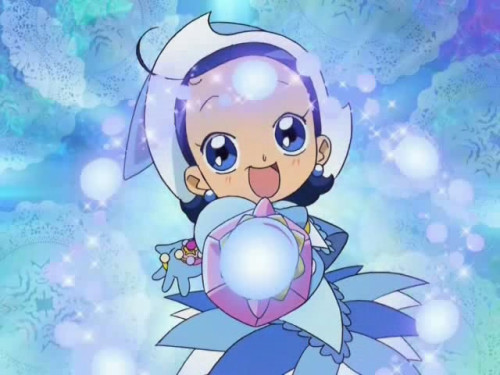
After more than a year of intentionally delaying it so as to not use up my supply of excellent magical girl anime, I’ve begun Mo~tto! Ojamajo Doremi, the third series in the Ojamajo Doremi franchise.

As I was watching one episode, there was the standard stock footage of one of the girls using magic, which starts off by showing a closeup of a music-playing magic wand. Before the show even revealed on-screen which girl was casting the magic, I thought, “Oh, it’s Aiko,” the tomboy character from Osaka. Moments later as Aiko appeared, I wondered to myself, how did I figure that out?

Upon re-watching, I realized that the signal to indicate Aiko was the music playing from her wand, which mimics a harmonica. Each of the characters in Doremi have an instrument associated with them, so in hindsight this is a rather obvious part of the show. As mentioned before, however, I hadn’t watched any Doremi in quite a long time, so it felt more like an unconscious response. I had watched enough of the show to absorb its elements into my psyche, and that “conditioning” showed up in this instance.

By the way, Doremi is a really fantastic show, and I wrote a review of the first series. If you’re wondering why there isn’t a review of the second series, it’s because pretty much everything I say about the first series more or less applies to it as well.

The Function of AKB48 Songs in AKB0048

The anime AKB0048 asks a simple question: “What if the J-pop AKB48 was in the future and its members fought with light sabers?” Essentially another marketing platform for an already extremely popular band, the anime uses a lot of existing AKB48’s songs, most of which are fluff pieces about falling in love or being young girls. The songs are part of their image and have factored into their popular and financial success, but within the context of AKB0048, I find that these same pop songs start to carry a different meaning.

AKB0048 takes place in a future where mankind has colonized space, and during which a movement to ban all entertainment and performance has grown increasingly strong. Successors to the “legendary AKB48,” the girls of AKB0048 fight in order to protect people’s rights to rock out, and in this setting the songs of AKB48 are near-ancient “relics” passed down through the generations. No longer acting as the supposedly genuine expression of young girls’ thought and feelings, the songs are “weaponized” within the context of a guerilla movement to restore entertainment in the universe. The songs act more like representative anthems of a better world, not so much in the actual lyrics, but in the way they promote the right to have lyrics so light and fluffy.

AKB48’s songs in AKB0048 act as symbols of change, revolution, and renewal. This is even more apparent when looking at the songs made for the anime. Compare the lyrics below:

First is “Heavy Rotation,” a popular preexisting AKB48 song used frequently in the anime:

I want you!
I need you!
I love you!
The blaring music
Playing in my head
Is on heavy rotation

The words “I love you” dance
Like popcorn
Popping
Just thinking
Of your face and voice
Makes me go crazy

I’m so lucky
To get to feel like this

(translation taken from Kiwi Musume)

Now compare it with “Dreams Will Be Reborn Again and Again,” the 1st ending theme for AKB0048:

The stars shining in the night sky
are billions of light-years away
Even if the deep despair
turns into endless darkness
The truth will be passed on
Who will be the one to accept
its message of light
that is entrusted to the flow of time?

People will be born
People will die
The flesh is mortal
What resurrects
from its ashes
is passion
that goes to the next generation

(translation taken from Words of Songs)

The lyrics writer for all of the AKB48 songs, as well as “Dreams Will Be Reborn Again and Again” is the famed AKB48 producer Akimoto Yasushi, so it’s not like AKB0048 is divorced from the creative forces which govern the actual band. Suffice it to say, however, the songs from the “future” seem cut from a different cloth than their predecessors, and this changes the meaning of “pop idol group,” at least for the anime.

It is difficult to regard the fictional group AKB0048 as simply girls who desire fan support within a specific section of the music industry. The girls begin to embody values beyond music, youth, and sexuality, such as social and political potential. Granted, this isn’t too surprising, seeing as the man directing AKB0048 is the creator of Macross. Kawamori Shouji has decades of experience in creating anime about pop idols changing the world, though I actually feel that the usage of pop music in AKB0048 surpasses Kawamori’s more established work because of the more thorough incorporation of the very idea of popular music into the anime’s narrative.

With the criticism and controversy surrounding AKB48 as a pop idol tour de force and all that it entails, the existence of AKB0048 is a curious thing. Is it in support of that system, does it go beyond, or does it sit somewhere in the middle? Is the “ideal” of AKB0048 different enough from the constructed space of AKB48 that it can be considered something more?

Jaoh Shingan: Genshiken II, Chapter 85

It’s back to basics in Genshiken II, Chapter 85 as  Sue, Yoshitake, and Yajima revive the old Genshiken tradition of spying on club members who think they’re alone. When it looks like Hato is getting unusually close to Madarame. Right when things seem to be getting to the point of no return, in comes Keiko, who quickly deduces that Madarame’s decision to quit his job comes from a desire to regress back to his old self now that he’s been rejected by Saki. When Keiko suggests that Madarame come to her Cabaret Club to “get dirty,” Sue interferes and inadvertently makes it known that they were being watched. An embarrassed Hato runs home, only to be met by Sue as the chapter ends.

The more I write these reviews, the more I worry that my constant references to the old chapters may be unfair to the new series. Perhaps if I engage the current Genshiken on its own terms, I’ll be able to do it justice. At the same time, I do actually feel that many of the ideas being explored in Genshiken II have their roots in the original manga, and that the new characters allow for a more complex elaboration.

Back when Ogiue’s own main storyline resolved, the message was one of acceptance. So what if others find your tastes weird? You’re who you are. While such a conclusion fit perfectly for Ogiue’ character, the question of whether the border between fantasy and reality is airtight or porous wasn’t answered to any great length. Not that it needed to be, but if we accept acceptance and remove moral and value judgments from the equation, how complex can that interaction be? This, I believe, is what is happening with Hato and his interactions with Madarame. Hato can go where Ogiue never could.

Hato is clearly emotionally confused in the current story, where everything he thought he knew about himself is being thrown into question. I don’t get a sense of a fear of homophobia from his situation, but that he is having trouble establishing the distinct barrier between his male self and female guise and that it means he doesn’t understand himself anymore. The breakdown hints at the power of imagination, of how we see and define ourselves, and invokes the idea that, while sexuality isn’t a learned behavior, that learning provides additional information for reflection.

Once again, if we go back to Ogiue, she once stated that the Sasahara of her yaoi fantasy is clearly different from his real self, but she also clearly enjoys and is even turned on by Sasahara when he role plays his imaginary “Strong Seme” self. For Hato, who not only includes a form of Madarame in his yaoi fantasies but is also becoming increasingly good friends with him, he almost provides a powerful thought experiment whose solution can’t be as simple as “he’s gay,” even if he turns out to be.

Something I find particularly interesting about Madarame’s portrayal in this chapter is the focus on his neck. The current Madarame looks different from when he was in college, and this is shown most overtly in his change in hairstyle, but when viewed up-close from behind, he still looks the same as he always had. Given that in this chapter he basically admits to wanting to regress, and the fact that Sue, Yoshitake, and Yajima did the old spying trick, I can’t see this callback as unintentional.

Keiko continues her role as a kind of substitute Saki in her own unique way. By that, I mean that where Saki has a natural pragmatism about her that Keiko lacks, Keiko seems to make up for it with sheer (mistake-filled) experience. I almost get the impression that her experience working at a cabaret club is actually increasing her perception skills far beyond what they already were, which even back when she was still attending college were still quite sharp (she’s the one who immediately noticed the sexual tension between Sasahara and Ogiue). I really can’t tell if Keiko is actually into Madarame or not, though the reveal that she’s been purposely mispronouncing his name as “Watanabe” the whole time says something. Even if Keiko is curious about Madarame, though, I can only see her interest being short term, even more than Angela’s.

As for the general idea of the “Madarame harem,” I think that it’s only a name. Take Sue, who both this chapter and last chapter was caught blushing in front of Madarame. The most obvious interpretation is a crush, but why did Sue stand back and watch when it looked like Hato was putting the moves on Madarame, but interfere when it looked like Keiko was about to do the same? For that matter, why did Sue interfere with Angela back when she was trying to get into Madarame’s pants? Given her appearance at Hato’s door at the end of the chapter, we’re probably going to find out more, but wish fulfillment fantasy with Madarame at the head this is not.

I am curious as to where Sue (who was super cute this chapter) is going. Is she going to get some real character development? She did start off as a kind of larger-than-life super fujoshi from another country, and to humanize her may either be an amazing decision or a terrible mistake. I have faith, though.

The last thing I want to point out is the significance of the Children’s Literature Society member we see in this chapter. In the past, that club was clearly on good terms with Genshiken given the whole spying thing, but I got the impression they were not exactly into anime and manga. The fact that this particular fujoshi chose to be part of the Children’s Literature Society in spite of the presence of not only Genshiken but also the Anime Society and the Manga Society (which has a large fujoshi contingent) has a connection with the recurring theme of  the generation gap between otaku that primarily manifests in the mainstreaming of the otaku and the rise of the fujoshi. The otaku are not limited to the clubs that are meant for them, which I think says a lot.

As for Ogiue ending the spying thing, it only makes sense given that she was already the victim of it in more ways than one.

If Only There Was an Angela Burton Spinoff

While I’m naturally excited about the new Genshiken anime that’s been announced recently, there’s one thing I wish could happen but most likely never will: a spinoff about Ohno’s American friend Angela Burton. I feel like it would be fun to see some of the quirks of American anime fandom accurately and painfully conveyed.

One big element of American fandom that for the most part doesn’t exist in Japan would be the convention scene, with its fan panels, industry Q&A, and AMV competitions, providing a unique venue and experience compared to the chapters about Genshiken‘s Comic Market analogue, Comic Festival, but also giving it a similar treatment concerning scale and impact. The huge otaku that she is, it would be no surprise to see Angela attending multiple conventions as a cosplayer, especially Anime Boston given that she’s from the area.

The Angela spinoff I’m picturing would have the same strong sense of characterization as Genshiken proper, giving the same sort of loving but at times harsh portrayal to the personalities that tend to crop up in college anime clubs in the US. I also see Angela herself making for an interesting main character, despite the fact that she has a fairly minor role in Genshiken because of her forward personality and her undeniable love of anime and manga.

One potentially serious topic could actually be the whole “fake geek girl” thing, as I can imagine Angela being subject to it fairly often. Angela is not only portrayed as extremely attractive to the point of being able to make guys nervous, but also as someone with relatively liberal views on relationships and sex (she doesn’t think one-night stands are that big of a deal) that might cause people who didn’t know her better to accuse her of not being “real.”

Incidentally, in reading Japanese comments about the new anime, it’s clear that the concept of the “fake geek girl” exists in Japan as well. There, it’s tied to the whole Densha Otoko boom and the “mainstreaming” of Akihabara, which at least a few commenters claim the Genshiken manga is reflecting.

The Day the Angel Fell…IN FLAAAAAMES

The 2012 Les Misérables movie was my first experience with the story in any format, and while watching it I had a thought that was probably the last one anyone would have: What if Gundam AGE were more like Les Misérables?

(Warning: Gundam AGE spoilers. Also for Les Miserables, but maybe that’s less of an issue because the book is quite old.)

flitoldyoung

I have a couple of reasons for comparing the two works. First, Gundam AGE, like Les Misérables, is a generational tale with a large cast of characters essentially centered around one strong-willed protagonist. Second, Flit Asuno, the hero of Gundam AGE, is extremely devoted to his quest to crush the enemy who has taken his family and his home, and over time it gets to the point that “eliminate the enemy” becomes a near-dogmatic mantra that he’s created for himself. His unerring path had me drawing parallels to Inspector Javert and his single-minded pursuit of Jean Valjean, while Javert’s personality that would have him rescue a man from robbers and then arrest the same man for not paying taxes further reinforces this comparison.

Gundam AGE suffers from not being able to properly bridge its generational shifts. The choice as to which characters remain and which ones leave (either by death or simply by never being on-screen again) feel rather arbitrary in that show, and so it loses the momentum that a work like Les Misérables manages to keep right until the end. So, if it were possible to revise Gundam AGE, I would make it more like Les Miserables but centered around Javert, with Flit of course being in that role of the straightforward devotee of justice, also reworking the enemy Vagans to be multiple characters playing the role of Jean Valjean-like antagonists, characters who challenge Flit’s black and white world view. However, I would also keep the element from the original Gundam AGE where Flit has a child and a grandchild who eventually rescue him from himself in his old age, so that his life doesn’t end as tragically as Javert’s. I’ve not read the book, but I know it is much more complex than the musical, and I could see a proper story existing somewhere between the two, depending on the audience desired, as well as other factors such as where exactly the broad strokes of the story should be focused.

Of course, there’s one last question to consider: would this version of Gundam AGE have singing? Maybe it wouldn’t be so bad.

The “Fake Geek” in “Fake Geek Girl”

The “Fake Geek Girl” is a topic that has been discussed extensively, mostly in terms of the sexism that arises from the designation and how it’s used. Certainly this criticism and discussion is warranted, but I think that understanding its connotative usages requires to some degree a removal of the “Girl” and a look at just the concept of the “Fake Geek” independent of gender. With that in mind, I’m going to lay out why I think the Fake Geek, or rather the concept of such, seems to engender bitter, defensive stances from those who would label themselves True, Legitimate, No Artificial Flavors Geeks (100% Authentic).

The idea of the Fake Geek (tied to the hipster) is someone who uses their feigned or marginal interest in a topic to gain some sort of advantage. That advantage may be an enhanced reputation or some form of cred, but generally the benefit is characterized as being able to increase one’s social circle, be it in the form of friends or otherwise. While I think that 1) any geek who has ever made good friends through their hobbies cherishes those friendships, and 2) we all to some extent have decided to check something out or keep up with something to a degree for social reasons, and thus I imagine the idea of friendships forged through nerd fires is not unappealing to people who are against “Fake Geeks,” what I believe to be the significant component in the creation of the “Fake Geek” as a symbol of disingenuous behavior has to do with the notion of “sacrifice.”

While geek friendship is more than possible, historically the label of geek came at a price, which is to say that it made friendship less possible with large groups of people instead of more. By being so engrossed in chosen, socially unapproved interests, geeks sacrificed their opportunities for social interactions and the friendships which would have been more likely to occur. When friendships were made through fandom or hobbies, it presumably required people who both (perhaps unconsciously) were aware of what they have given up. When you contrast this with the very idea that I talked about earlier, that the identify of the geek might be considered a clear and obvious way to make friends with others, that it no longer requires a “sacrifice” but may in fact be the opposite—something with socially inherent benefits—it comes across as a contradiction.

Imagine a guy who loves to eat eggs, but was told from the very beginning that eggs are high in cholesterol, bad for his health, and that anyone who ate them often would suffer. Wanting to remain healthy but also wishing to maintain his egg consumption, he adjusted every aspect of his diet, exercise, and daily habits to accommodate. Then, one day a report comes out that says the cholesterol in eggs are perfectly fine, and that everyone can benefit from eating eggs more often. Of course, the guy benefits from this information too, but he looks back and sees everything he gave up for the sake of his love of eggs, and then sees everyone around him now scrambling and poaching without a care in the world. The guy, understandably if also sadly, ends up accusing these newcomers of not being true egg connoisseurs.

Now, if you layer on the strange relationship geek culture has traditionally had with women, one which mixes reverence,  jealousy, and desire, I think you might start to see why the “Fake Geek Girl” is considered especially objectionable by those who decry their presence. A girl, with her “feminine charms,” is supposedly able to bridge the social gaps the old geek cannot, and on top of that is this notion that being a geek is a boon to social interaction instead of a disease, creating what is perceived as an “unfair advantage.” The Fake Geek Girl becomes a reminder of all the geek is not or could not have, and thus a bitter reaction is born from its conceptual existence.

The Japanophile Without Japan

Whenever we talk about the japanophile (or the wapanese or weeaboo or other terms), the rhetoric is that this person discovers anime (or something), starts to believe Japan is a superior country and culture to the one they currently live in, and if they stop believing, it’s because they realize that the ideal Japan of their imaginations does not match up with the truth. The assumption here is that because Japan is not simply the land of anime and Pocky, or ukiyo-e and sushi, that it trivializes the japanophile’s beliefs because there is this contradiction with reality. But what if we removed “Japan” from this process?

It makes logical sense for the japanophile to discover Japan, create a modified image of it in their head, and then desire it as a “superior” culture, but what of that potential for desire in the first place? Does Japan trigger this desire to be a part of a different culture, or is that sentiment already there to some degree, and that it takes Japan (or anywhere) to allow a person to focus those desires on a concrete example with a relationship to reality? As intelligent and visionary as human beings can be, there tend to be limitations as to how far we think or consider imaginary or hypothetical situations, and maybe this is just one version of that

If we remove “Japan,” then what we’re left with is a person who desires for a better culture and environment than the one they currently live in, where better means one more understanding, one which reinforces their beliefs and their wants. Whether that is out of some progressive vision or simply a venue to live out fantasies without consequence, I’m not stating any moral or intellectual prerogative to such feelings, but I almost find it to be a sort of utopian mindset.

Variety Limits

I’ve often been told that I cherish variety in my entertainment (particularly my anime) to an unusual degree,  and if there’s one anime I find myself getting into disagreements over more than anything else, it’s The Sky Crawlers (second might be Xam’d: Lost Memories).

Directed by Oshii Mamoru of Ghost in the Shell fame, I reviewed The Sky Crawlers favorably, noting that the way it’s able to effectively instill in the audience the same sense of mind-numbing monotony that the characters themselves experience is something quite impressive. Of course, that also makes it difficult to watch, something that can bore you beyond the point of no return, so the debates over the quality of The Sky Crawlers tends to come down to the following question: how entertaining should entertainment be?

The argument against The Sky Crawlers is that you can make a film which conveys that sense of monotony in its characters without having to drag the audience down with it, but my feeling has always been that this is just not the same effect. However, what I realize as well is that, as a person who highly values variety of content and concepts in my anime, it’s not so much that I think the approach taken by Oshii’s film is superior, that there is indeed something inherently more artistic about making the audience live that boredom, but rather that it is a valid approach to take in making a work of art (or entertainment). In other words, I would not want all of my anime to be like The Sky Crawlers, and I do not put it above other anime as I do not prize experimentation above all else: I simply like the fact that something like The Sky Crawlers exists.

Broadening the point of view to not just focus on something as esoteric as The Sky Crawlers, I have to wonder how much people are willing to welcome greater variety in anime provided they get enough of the types of anime they enjoy. We can talk about how there’s too much of X or Y genre of anime and how it might be stifling the kinds we enjoy, but what if that wasn’t the case, and the popular thing was the niche and vice versa? Is any imbalance problematic, or are “problematic” anime okay if they’re in small doses?